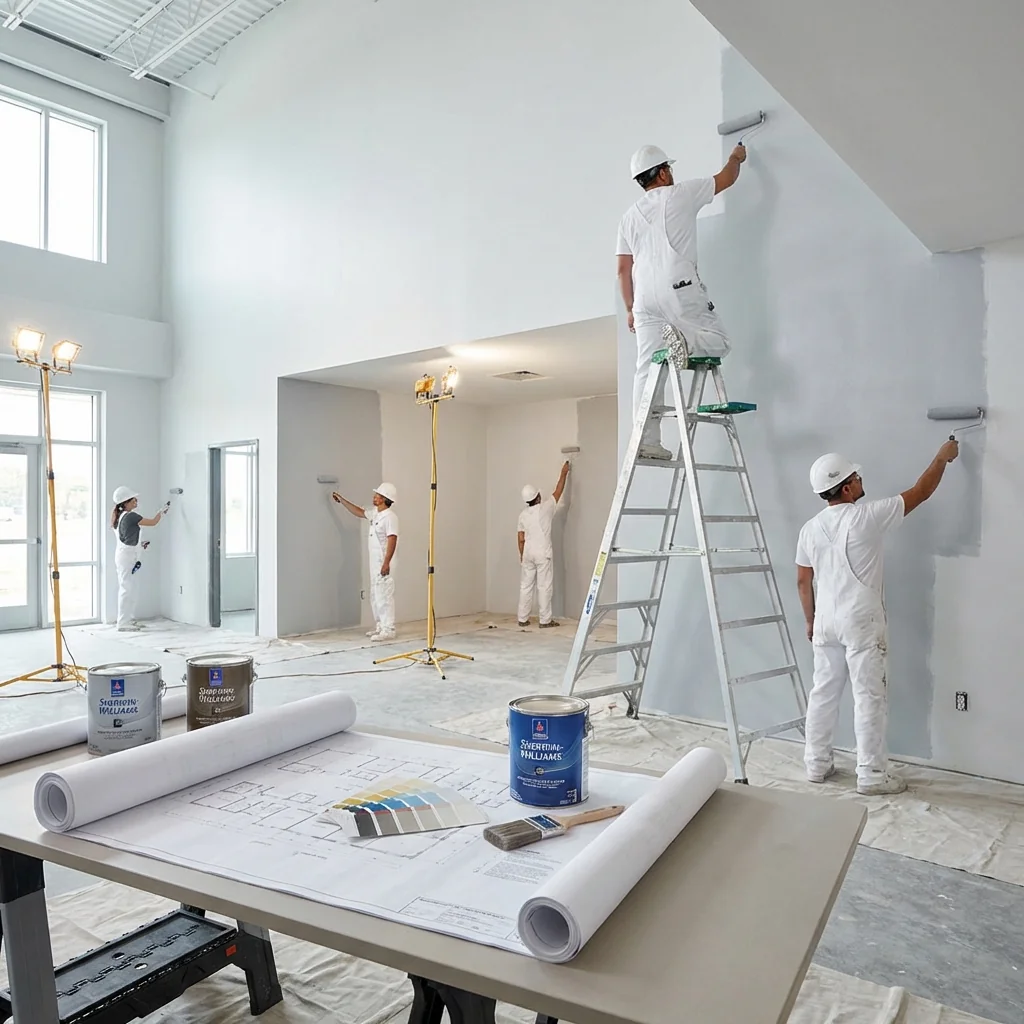
Painting Estimating Services
Interior, Exterior & Industrial Coating Takeoffs - CSI Division 09 90 - From Room Finish Schedule to Bid-Ready Estimate in 24-48 Hours
Painting Estimating Services for Painting Contractors, GCs & Industrial Coating Subs
Painting estimates look simple until you try to do one accurately. The square footage is straightforward - wall area less openings, ceiling area, door faces and frames. What kills painting bids is everything that comes after the area measurement: using the wrong coverage rate for the specified product on the actual substrate, not reading the finish schedule carefully enough to catch that the lobby specifies two-coat semi-gloss alkyd while the corridors take flat latex, pricing surface prep as a flat percentage instead of actually counting the patching, caulking, and priming required, and forgetting to price the lift rental for painting structural steel at 40 feet above the floor. The Virtual Estimation eliminates all of these errors by building every painting estimate directly from the room finish schedule and Division 09 specifications - not from square-foot rules of thumb.
We prepare complete paint takeoffs for painting contractors, wall covering contractors, industrial coating applicators, general contractors, and commercial developers across 🇺🇸 USA, 🇨🇦 Canada, 🇦🇺 Australia, and 🇬🇧 UK. We estimate all CSI Division 09 90 work: interior painting by room finish schedule with correct coverage rates for each product and substrate, exterior painting by surface type, specialty coatings (epoxy floor coatings, urethane wall coatings, intumescent fire-resistive coatings), industrial and protective coatings with SSPC surface preparation standards, wall covering (vinyl wallcovering Type I and Type II, fabric wall covering), and lead paint encapsulation and abatement on pre-1978 renovation projects.
We use PlanSwift for digital quantity takeoffs from PDF drawings, Bluebeam Revu for finish schedule review and drawing markup, and RSMeans Building Construction Cost Data - updated quarterly - for regional painting labor unit pricing. Paint material quantities are priced from current Sherwin-Williams, Benjamin Moore, and PPG contractor pricing for specified products, not from generic database assemblies. Our estimators are AACE International certified cost professionals and AIQS members.
Expert Painting Estimators for Precise Results
At The Virtual Estimation, we understand the critical role accurate cost estimation plays in painting and coating bids. Our team of expert painting estimators combines division-level specification knowledge, digital takeoff software, and current material pricing to produce estimates that hold up when you submit your bid.
Why Painting Contractors & GCs Choose The Virtual Estimation
- Room finish schedule driven estimates - every room priced from the specified finish type, sheen level, substrate, and number of coats in the Division 09 spec, not from a uniform SF rate applied across the entire project
- Correct paint coverage rates by product and substrate - smooth drywall, textured drywall, CMU block, concrete, wood, metal, and previously painted surfaces all have different actual coverage rates that affect gallon quantities and material cost by 20-40%
- Industrial and protective coating estimates with SSPC surface preparation standards priced - SP1, SP2, SP3, SP6, SP10, and SP5 all carry different labor hours and equipment costs, and surface prep is 40-60% of total labor cost on steel coating work
- Wall covering measured in square yards with correct waste factor by pattern type - straight match (10%), drop match (15-18%), random match (8-10%) - material order quantities that account for the actual waste at the specified pattern repeat
- Lead paint encapsulation and abatement compliance on pre-1978 renovation projects - EPA RRP Rule requirements, containment, HEPA filtration, regulated waste disposal, and clearance testing all included as separate line items
- AACE International certified estimators and AIQS members serving residential, commercial, industrial, institutional, and government painting contractors across USA, Canada, Australia, and UK
Whether you are working on a residential repaint, a commercial tenant improvement, or an industrial protective coating project, our estimators deliver reliable results that help you win more bids and stay within budget.
How Our Painting Estimating Process Works
Every painting estimate follows a four-step process built around the Division 09 finish schedule and specification - the same documents your painting sub will use to price and submit their bid.
Finish Schedule & Spec Review
We begin with the Division 09 finish schedule and specification sections - identifying every paint system, substrate, sheen level, number of coats, and special requirement (mold-resistant, antimicrobial, chemical-resistant, fire-resistive) for each room. For industrial coating work, we review coating system data sheets to identify the SSPC surface prep standard and DFT requirement per coat. Missing or conflicting finish schedule information is flagged before measurements begin.
Digital Surface Area Takeoff
Wall areas, ceiling areas, floor areas (for epoxy coatings), exterior surface areas, door faces and edges, millwork linear footage, and structural steel surface areas are measured digitally in PlanSwift from your PDF drawings. All openings are deducted. Surfaces are organized by finish system type so each group can be priced at the correct coverage rate for the specified product and substrate. Annotated marked-up drawings are included in every deliverable.
Material & Labor Pricing
Paint quantities are calculated from measured surface areas and actual coverage rates for the specified product on the specified substrate - not from a generic 400 SF/gallon assumption. Sherwin-Williams, Benjamin Moore, and PPG contractor pricing is used for specified products. Labor is priced from RSMeans regional data by application method (brush, roller, airless spray) and surface height. Surface prep is priced as a separate line item from the finish coat labor.
Delivery & Revision Support
You receive Excel and PDF deliverables within 24-48 hours organized by CSI Division 09 90 sub-section and room/zone type. The package includes surface area quantities, gallon quantities by product, labor hours by trade, surface prep breakdown, and equipment allowances. If addenda change finish schedules before bid day, we update the estimate at no additional charge.
Our Comprehensive Painting Estimating Services
We provide a complete range of painting estimating services tailored to meet your specific project needs:
Ready to Get Started?
Request a Free ConsultationRelated Estimating Services
Concrete Estimating
Detailed estimates for foundations, slabs, and structural concrete work.
Electrical Estimating
Comprehensive electrical takeoffs for all project types and sizes.
Plumbing Estimating
Accurate plumbing estimates including fixtures, piping, and labor.
Masonry Estimating
Precise masonry takeoffs for brick, block, and stone projects.
Lumber & Wood Framing
Complete lumber takeoffs for residential and commercial framing.
Roofing Estimating
Professional roofing estimates for all materials and project types.
How Paint Coverage Is Calculated
The most common reason painting bids go wrong is simple: the estimator used the theoretical coverage rate from the paint can label and called it done. Theoretical coverage is a lab measurement on a perfectly smooth, non-porous, properly prepared surface. Here is how we calculate actual paint coverage rate by surface type:
Smooth Drywall (Level 4 or 5 finish): Theoretical coverage for a quality interior latex flat is typically 400 SF per gallon. Actual coverage on Level 4 drywall by roller is approximately 350-375 SF per gallon. On Level 5 finish, actual coverage approaches 380-400 SF per gallon. Two coats = divide your net wall area by 350-375 SF to get gallons per coat, then multiply by two.
Orange Peel / Textured Drywall: Light orange peel texture reduces actual coverage to 300-340 SF per gallon. Heavy texture (knockdown, skip trowel, sand finish) further reduces it to 250-300 SF per gallon and sometimes requires three coats to achieve uniform hide. Pricing textured ceilings at the same coverage rate as smooth walls is one of the most reliable ways to underbid a project.
Concrete Masonry Units (CMU Block): Raw CMU is highly porous. The first coat of paint on unprimed CMU may cover only 75-125 SF per gallon. A block filler primer - applied first at 50-75 SF per gallon - fills the surface pores and allows subsequent finish coats to achieve normal coverage. Skip the block filler on a raw CMU project and your estimate will be short by 30-50% on first coat material alone.
Wood (Bare / Primed / Previously Painted): Bare wood absorbs a first coat heavily, particularly end grain - coverage on a first coat over bare wood can run 250-350 SF per gallon. Over a properly primed surface, finish coat coverage returns to 350-400 SF per gallon. Knots and resinous areas require stain-blocking primer (Zinsser BIN or equivalent) before priming - an item that appears in the specification but disappears from estimates that do not read specifications carefully.
Metal (Steel, Aluminum, Galvanized): Coverage on metal surfaces is about film build - dry film thickness in mils. A zinc-rich primer on steel may specify 3-5 dry mils which at 65% volume solids requires application at 185-200 SF per gallon wet. An intermediate epoxy coat at 4-6 dry mils from a 75% volume solids product requires 250-300 SF per gallon. Using coverage rates from an interior latex database for an industrial steel coating system will produce a material estimate that is wrong by a factor of two or more.
In every painting estimate we prepare, coverage rates are assigned surface-by-surface from the specified product data sheet - not from a generic database entry. This is how to calculate paint coverage rate correctly, and the result is a gallon count that reflects what you will actually use on the job.
Industrial & Protective Coating Estimating - SSPC Standards
Industrial and protective coating work - steel structures, water and wastewater tanks, bridges, marine structures, manufacturing facilities, and chemical processing plants - is the highest-margin segment of the painting market and the one where an inaccurate estimate causes the most damage. A missed SSPC surface prep standard or an incorrect coverage rate on a three-coat industrial system can turn a profitable job into a significant loss. The Virtual Estimation estimates industrial coating systems from the coating specification and product data sheets, not from a generic painting cost database.
SSPC-SP1 Solvent Cleaning: Removes oil, grease, dirt, and salts. Required before any other prep method. Estimated per SF at regional labor rates for solvent wipe-down with appropriate solvent (MEK, mineral spirits, or per coating manufacturer recommendation).
SSPC-SP2 Hand Tool Cleaning and SP3 Power Tool Cleaning: Removes loose mill scale, rust, and deteriorated old paint. Effective for spot repair and maintenance painting where blast cleaning is not practical. Labor is estimated per SF based on surface condition rating.
SSPC-SP6 Commercial Blast Cleaning: Removes all visible oil, grease, mill scale, and rust by abrasive blasting. At least 2/3 of any given SF of surface must be free of all visible residues. Required for most exterior steel structural coating systems. Surface prep cost (compressor, blast pot, abrasive media, containment) represents the majority of the labor cost.
SSPC-SP10 Near-White Blast Cleaning: At least 95% of any given SF must be free of all visible residues. Required for immersion service, secondary containment linings, and high-performance coating systems. Significantly higher labor cost than SP6.
SSPC-SP5 White Metal Blast: Most stringent - all visible rust, scale, paint, and contaminants removed. Required for potable water tanks, immersion systems, and nuclear applications. Highest labor and abrasive consumption of any blast standard.
Coating System Dry Film Thickness (DFT): Industrial coating systems are specified in dry film thickness in mils per coat. The formula: Theoretical coverage (SF/gal) = Volume Solids (%) x 1604 / DFT (mils required). A zinc-rich primer at 3.5 mils DFT from a product with 68% volume solids = 0.68 x 1604 / 3.5 = 311 SF per gallon. We apply this formula to every coat in the specified coating system using the actual product data sheet. Surface prep represents 40-60% of total labor cost on steel coating projects - the SSPC-SP6 SP10 industrial coating estimate must be priced accurately to protect your margin.
Lead Paint Estimation - EPA RRP Rule Compliance on Pre-1978 Renovation Projects
Any renovation, repair, and painting (RRP) work that disturbs painted surfaces in a pre-1978 residential building or a pre-1978 child-occupied facility triggers EPA RRP Rule requirements. Painting contractors who perform this work without addressing lead paint compliance face EPA fines that start at $37,500 per day per violation. Lead paint abatement estimating requires specific knowledge that most general painting estimating services do not have.
Lead Paint Testing: XRF (X-ray fluorescence) testing provides instant results by surface component. Paint chip sampling with laboratory analysis (EPA Method 7420 or 7421) is the alternative where XRF testing is inconclusive. Testing cost is estimated by the number of surfaces sampled and rooms requiring documentation. We include testing allowances for pre-1978 renovation projects where lead paint testing documentation has not been completed.
Encapsulation vs Abatement: If lead paint is present and in good condition, encapsulation with an EPA-recognized encapsulant product is a compliant alternative to full abatement. Encapsulant products such as Seal-Once Lead Encapsulant or Zinsser Perma-White are applied at manufacturer-specified coverage rates with documentation of surface condition before application. Abatement produces regulated lead paint waste that requires containment, HEPA vacuum collection, and disposal as hazardous waste - all of which carry significant cost that must be estimated separately.
Containment & Clearance Testing: Full containment (floor and window plastic sheeting, HEPA air filtration, worker PPE) is required for abatement work. Post-work clearance testing by a certified lead inspector is required before containment can be removed and the building reoccupied. We include containment setup and clearance testing allowances for all abatement scopes so your bid reflects the actual regulatory compliance cost.
Painting Estimating Service Pricing
| Project Type | Typical Range |
|---|---|
| Residential (Single Family Interior + Exterior) | $150 - $300 |
| Multi-Family / Apartment Complex (Per Building) | $300 - $700 |
| Commercial Interior (Tenant Improvement) | $300 - $700 |
| Mid-Size Commercial (10,000-50,000 SF) | $500 - $1,200 |
| Large Commercial / Institutional | $800 - $1,800 |
| Industrial & Protective Coatings | $600 - $2,000+ |
| Wall Covering (Vinyl / Fabric) | $200 - $600 |
| Lead Paint Assessment & Abatement Estimate | $300 - $800 |
First-time clients receive 30% off. Volume pricing available for painting contractors with ongoing monthly bid requirements. Fixed-fee quote provided upfront. Prices in USD; CAD, AUD, and GBP pricing available for international projects.
Painting Estimating FAQs
Get answers to common questions about our painting estimating services.
Still have questions about our building cost estimating services?
Contact Us Today