EV Charging Station Estimating: Cost Per Port in 2027
A commercial Level 2 charging port typically costs $3,500 to $15,000 installed, and a DC fast charging port typically costs $40,000 to $350,000 or more installed, according to Qmerit's November 2026 cost guide. Verdek's October 2026 price guide puts Level 2 at $3,000 to $15,000 per port installed, with most projects landing at $4,500 to $12,000, and DC fast charging at $80,000 to $250,000 or more per charger. The wide ranges are the point. The charger is often only half the bill, and the electrical work behind it, panel, service, transformer, trenching, conduit and load management, is where first estimates go wrong.
Who this is for: estimators, general contractors and property owners pricing commercial EV charging for workplaces, multifamily buildings, retail centers and fleet depots in the United States.
Price per port, not per charger alone and not as one lump sum. A dual-port pedestal serves two ports, and a $3,500 per port figure and a $15,000 per port figure can both be right for Level 2 if their scopes differ. Every figure below carries its scope line: hardware only, installed, or installed plus utility-side work. One more distinction: charger power is measured in kW, energy delivered is measured in kWh. A 50 kW charger does not deliver 50 kWh every hour, because charging tapers as the battery fills and the vehicle acceptance rate governs.
What a Commercial EV Charging Station Costs Per Port in 2027
The table below is the planning view. Every figure is attributed to its source and its scope. Do not average two sources into one settled number, and do not quote a per-port figure without saying what it includes.
| Charger type | Hardware only | Installed per port | Installed plus utility-side work |
|---|---|---|---|
| Level 2, 3.3 to 19.2 kW | $700 to $5,000 per port (Verdek) | $3,500 to $15,000 (Qmerit); most projects $4,500 to $12,000 (Verdek) | Top of the range and above with a service upgrade, transformer or long trench |
| DC fast, 50 to 100 kW | $35,000 to $140,000 per charger (Verdek) | $80,000 to $150,000 per charger (Verdek) | $40,000 to $350,000+ per port (Qmerit) |
| DC fast, 150 to 350 kW | $35,000 to $140,000 per charger (Verdek) | $150,000 to $250,000+ per charger (Verdek) | Top of the Qmerit range, with a new transformer and utility service |
The two sources disagree on the DC fast top end, $350,000 or more in Qmerit against $250,000 or more in Verdek, because power level and utility-side scope differ. A 50 kW charger at a site with existing three-phase power is a different project from a 350 kW hub that needs a new transformer and a utility service upgrade. Sources: Qmerit, Commercial EV Charging Station Cost in 2026, updated November 2026; Verdek, Commercial EV Charging Station Cost: 2026 Price Guide, updated October 27, 2026. These are 2026 sources, quoted as 2026 figures, not relabelled as 2027.
The Scope Line That Makes or Breaks Your Per-Port Number
On many projects, hardware is only about 20 to 40 percent of the total, with electrical and site work taking most of the rest, according to Verdek. A complete installed per-port figure covers charger hardware and dispensers, branch circuits, conduit and wire, panelboard work, trenching and surface repair, bollards and wheel stops, networking and payment setup, signage and striping, permits and inspection, and commissioning. Utility-side work, a transformer, a new service, or a utility make-ready contribution, sits outside the installed figure unless the quote says otherwise, and so do operating costs such as electricity, demand charges and software fees.
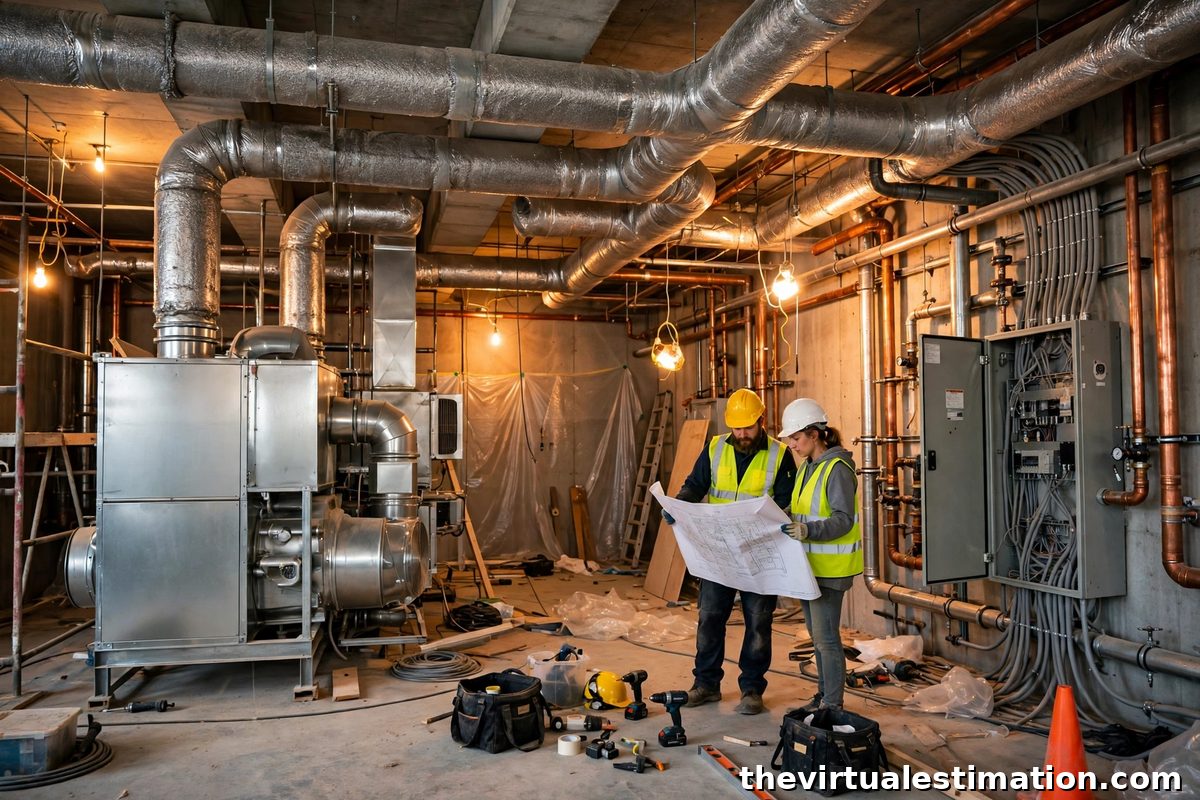
Price by system, in this order: charger hardware by power class; branch circuits, conduit and wire; panelboards and service work; transformer and utility-side work with lead time; trenching and concrete; protection, networking, signage and ADA spaces; permits and commissioning. The electrical estimating guide covers the panel, conduit and wire takeoff in detail, so this guide prices the EV scope that sits on top of it.
Level 2 Costs, Line by Line
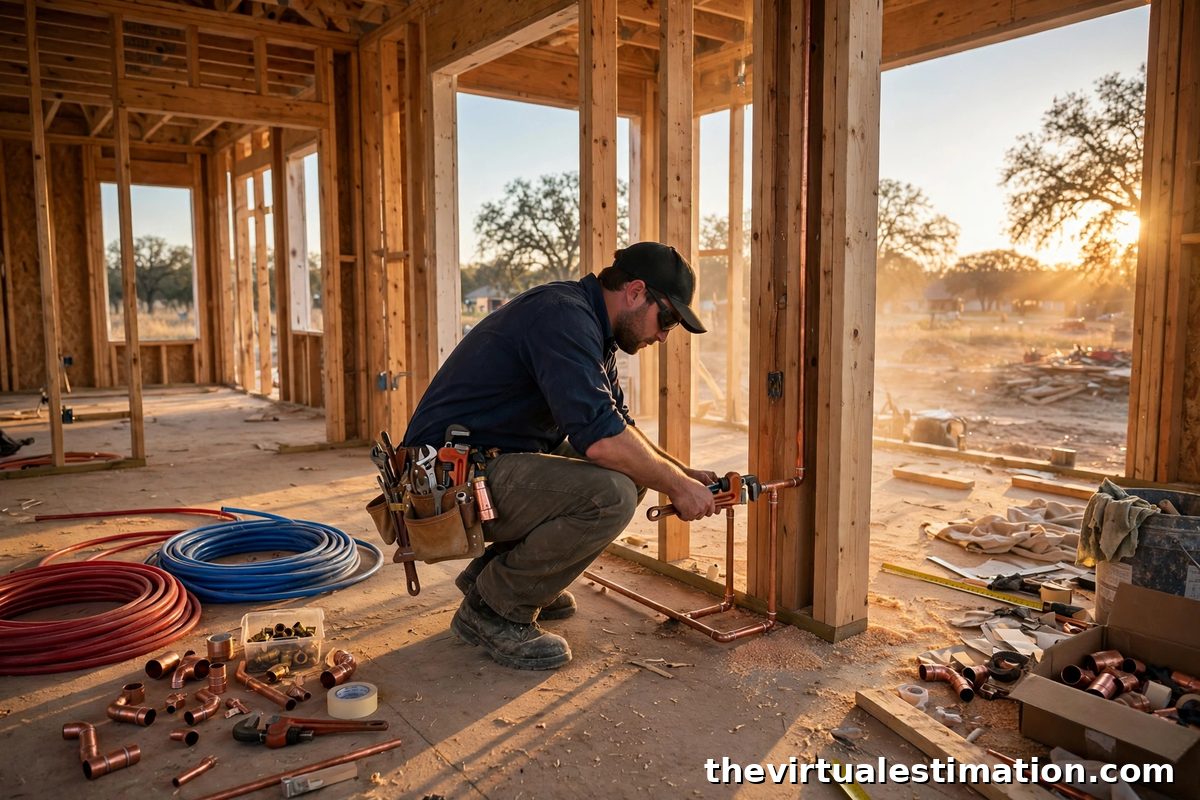
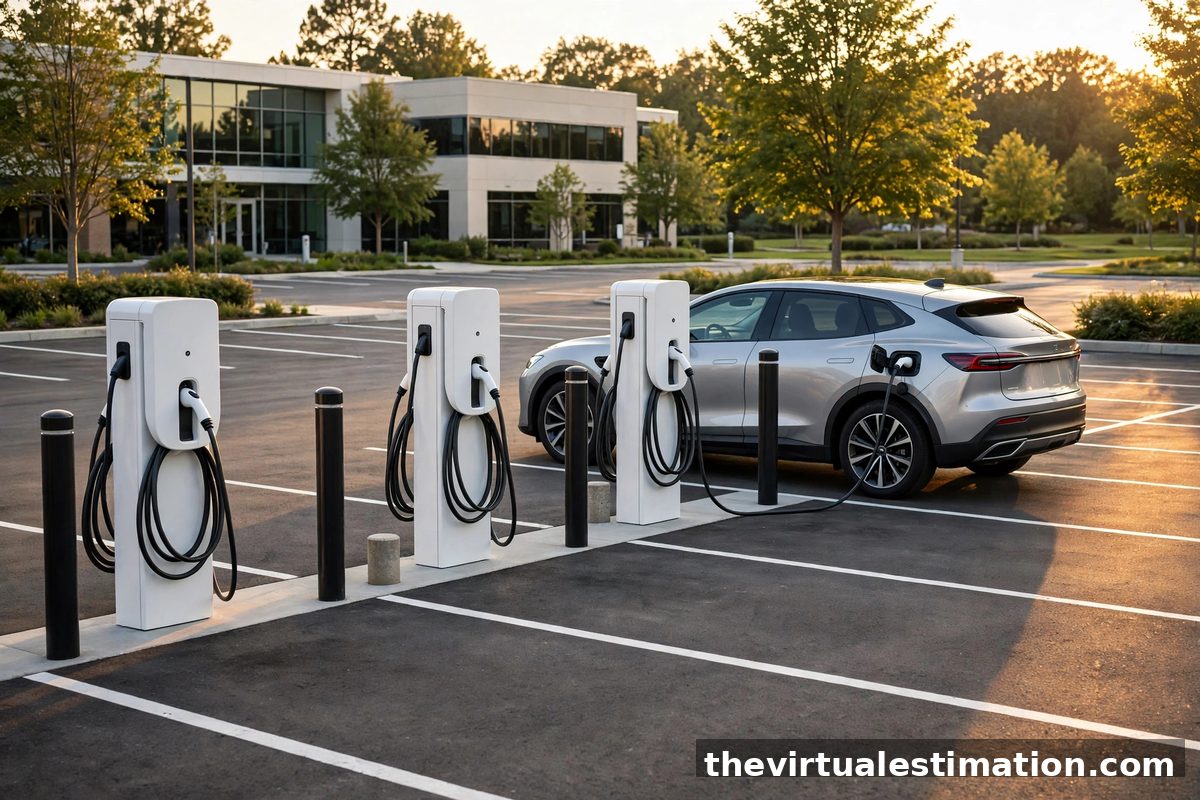
Level 2 is the workhorse for anywhere vehicles park for hours: offices, apartments, hotels, retail with long stays, overnight fleets and depot charging. Chargers deliver 3.3 to 19.2 kW on a dedicated 208V or 240V circuit, adding roughly 20 to 40 miles of range per hour, and a typical full charge takes 4 to 10 hours, per Qmerit. Hardware is the smallest part of a Level 2 job: Verdek puts it at $700 to $5,000 per port, and networked, payment-ready units cost more than basic ones. The installed range is set by the site. A port beside an electrical room with spare panel capacity lands near the low end. A port 250 feet from the panel, across a paved lot, lands near the high end.
Two choices lower the per-port price on most Level 2 jobs. Load management shares available power across ports and can avoid a costly service upgrade entirely. Installing more ports at once spreads the fixed costs, trenching, permitting and mobilization, across more chargers. If you are trenching anyway, run extra conduit for later chargers now, priced as an option, because digging up the lot again costs far more. Dual-port pedestals help too, since they share a pad, a trench and communications across two ports.
DC Fast Charging Costs, Line by Line
DC fast charging is a different category of project. You are no longer adding a circuit, you are building small power infrastructure. Chargers run 50 to 500 kW and need 480V three-phase service, which many sites do not have today. A typical full charge takes under an hour for most EVs, which is why DC fast fits travel centers, high-traffic public sites and fleets that need fast turnaround. Unlike Level 2, the equipment itself is a major part of the bill: Qmerit puts DC fast hardware alone at $10,000 to $200,000 or more per unit, and Verdek puts it at $35,000 to $140,000 per charger.
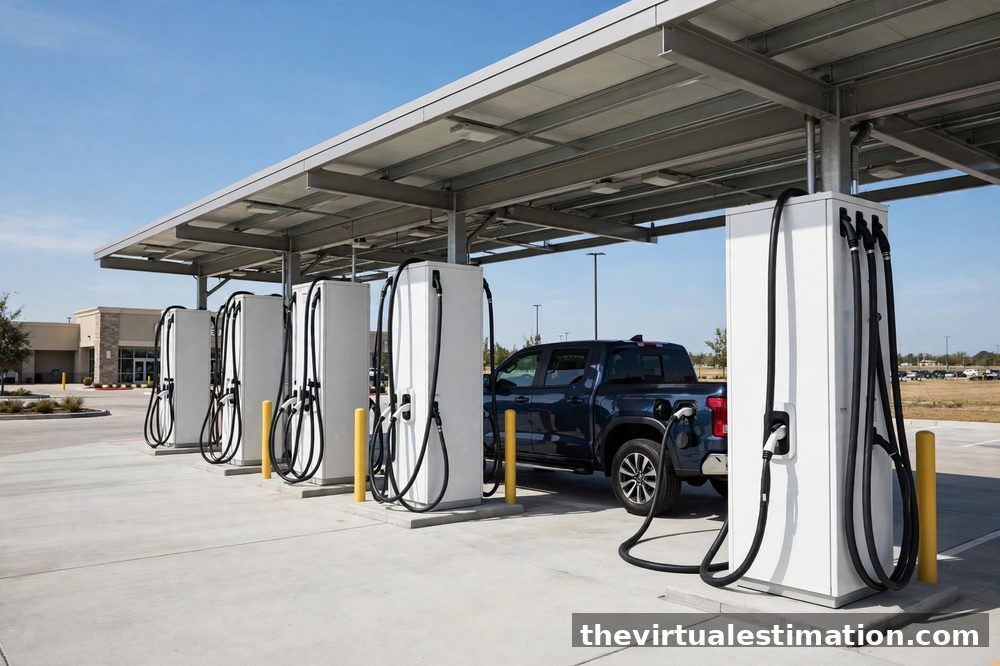
Bigger is not always better. Many vehicles cannot accept 350 kW, charging speed tapers as the battery fills, and for a 30 to 45 minute retail stop a 150 kW unit often delivers better value than the largest option. The utility side is where DC fast estimates blow up. Verdek puts transformer and utility service work at often $20,000 to $80,000 on DC fast sites, with lead times commonly 12 to 26 weeks. Qmerit cites transformer delays of 6 to 24 months, sourced from the U.S. Department of Energy and the National Renewable Energy Laboratory. Those are different scopes, so do not conflate them into one lead-time figure. A DC fast project typically takes 6 months to more than two years from first site assessment to energized chargers, according to the Department of Energy, and utility coordination is the stage most likely to stretch the timeline. A Level 2 project at a site that already has enough power can take anywhere from a day to six months.
What Moves a Project From the Low End to the High End
Qmerit shows the gap with two sites running the same four Level 2 ports. Site A is an office building with power about 20 feet away, wall-mounted chargers near the electrical room, no trenching, and an existing panel that handles the added load. It lands at the low end of the $3,500 to $15,000 range. Site B is a retail center with power about 200 feet away, pedestal-mounted chargers in the parking lot, about $15,000 to $30,000 of trenching, and a service upgrade or new transformer, often $10,000 to $50,000 or more depending on the utility. It lands at the top of the range, or above it. Same chargers, different bills. The distance from the panel is the quiet budget killer.
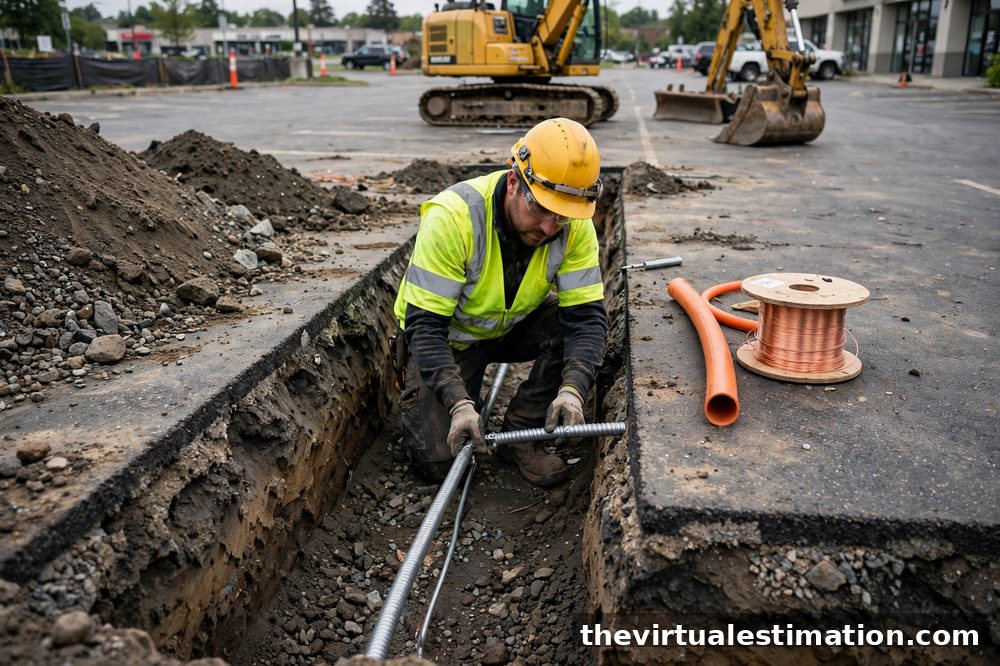
Trenching is the line where the two sources disagree, so quote both and average neither. Qmerit prices trenching at $75 to $150 per linear foot in its retail site example. Verdek prices it at $40 to $120 per linear foot, and notes that a 200-foot run across a paved lot adds $8,000 to $24,000 before you buy a single charger. Cutting and repairing pavement drives the high end in both ranges. The underground utilities estimating guide covers trenching and conduit runs in more depth, and the same logic applies here: wall-mounted chargers near existing service are usually the cheapest to install.
The other cost drivers, in order: spare electrical capacity, because a full panel is not a free slot; power level, because higher kW means thicker cable, larger switchgear and often a new transformer; surface and site conditions, because cutting and repaving asphalt costs far more than running conduit through landscaping; accessibility and local rules; and phasing, because installing spare conduit and panel capacity now is far cheaper than trenching again later.
The NEC Load Rules That Set Your Service Size
This is the estimating lever most first-timers miss. EV charging loads are continuous loads, and no demand factor in Article 220 reduces an EVSE count. The edition that governs is the one your state has adopted for the permit date, so name it in the estimate. Many states are still on the 2023 NEC, and the 2026 edition moves load calculations from Article 220 to Article 120, so do not present the 2026 NEC as adopted nationally.
NEC 220.57 sets the EVSE load for feeder and service calculations at 7,200 VA or the nameplate rating, whichever is greater. A 32 amp unit on 208V commercial supply is 32 times 208, which is 6,656 VA, below the floor, so it still calculates at 7,200 VA. NEC 625.40 requires an outlet installed to supply EVSE to be served by an individual branch circuit, for equipment over 16 amps or 120V, so do not price shared circuits. NEC 625.42 treats EV charging loads as continuous, which means conductors and overcurrent protection are sized at 125 percent of the continuous load under NEC 210.20(A) and 215.3, unless the assembly is listed for 100 percent continuous operation, which most panels are not.
Worked example, labelled hypothetical, not a real project. Take 12 Level 2 ports, each a 32 amp unit on 208V. Each port calculates at the 7,200 VA floor, so the service load is 12 times 7,200 VA, or 86.4 kVA. Each branch circuit is sized at 125 percent of 32 amps, which is 40 amps, so each port takes a 40 amp breaker. Now add a listed automatic load management system under NEC 625.42(A) and (B) and Article 750.30. Where one is used, the maximum equipment load on the service and feeder is the maximum load permitted by that system, not the sum of every charger at full output. If the system caps the 12 ports at 60 kW total, the service load drops from 86.4 kVA to the 60 kW setpoint, and the service upgrade you were about to price may disappear. At larger scale, a secondary worked example from Entogo shows 200 Level 2 spaces calculating as 1,440 kVA without management, and an energy management system holding those spaces to 400 kW taking the transformer from 2,000 kVA to 500 kVA. Load management is a priced scope in the estimate, not a footnote.
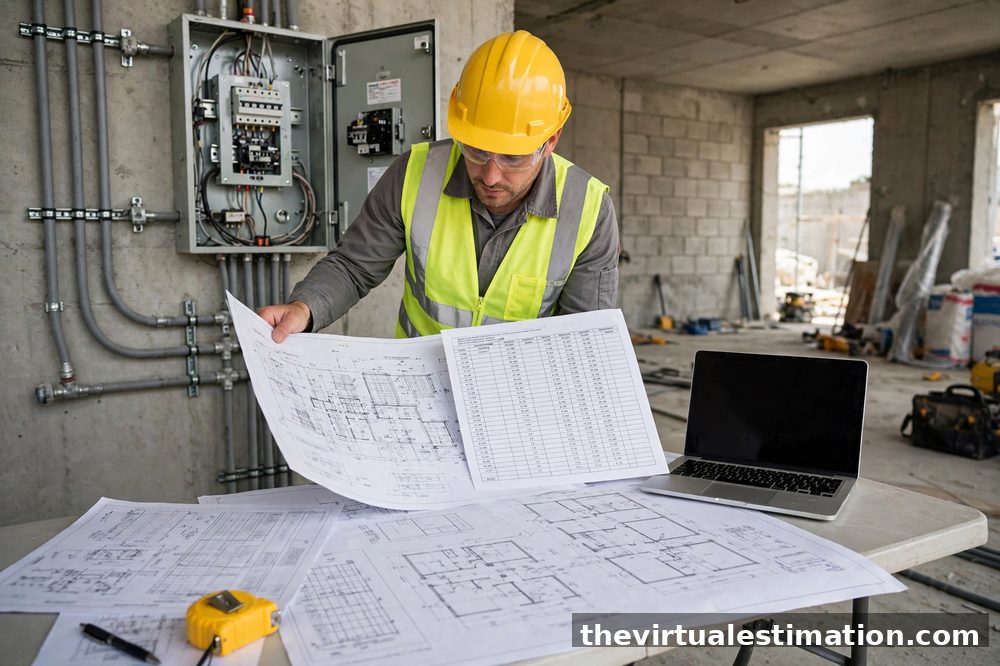
Scope lines estimators most often miss: spare panel capacity, load management as a priced scope, utility lead time for transformers, demand charges, which are an operating cost and must not be folded into the per-port installed figure, and future expansion, priced as an option. For the combined trades picture on a larger job, the MEP estimating guide shows how the three trades price together, since EV charging often lands in the same project as HVAC and plumbing work.
The 30C Credit Is Gone. What Still Helps
Many older articles still present the federal Alternative Fuel Vehicle Refueling Property Credit, known as 30C, as available. It is not. The credit, which once covered up to 30 percent of charger costs for qualifying business property, capped at $100,000 per item, ended for chargers placed in service after June 30, 2026, under P.L. 119-21. The IRS Form 8911 instructions, revised December 2025, state plainly that no claim may be made for property placed in service after that date. A bill introduced in the Senate on August 3, 2026, S. 5215, would restore the credit through 2031, but its only action so far is referral to the Senate Finance Committee. Do not present restoration as likely or available, and never count an incentive in a per-port total until it is sanctioned.
What still exists varies by place. Utility make-ready programs, which pay for part of the electrical work behind the charger such as conduit, wiring and panels, are now the most valuable source of savings for most properties. Coverage varies a lot: New York investor-owned utilities offer rebates covering up to 90 percent of eligible infrastructure costs, while PECO in Pennsylvania has offered 50 percent rebates for qualifying non-public commercial sites, according to Verdek. Federal NEVI funding for public DC fast charging can cover up to 80 percent of eligible costs, with the applicant paying the remaining 20 percent. Most programs require approval before construction starts, so apply first and build second. Check the program that applies to your project at estimate time, and quote no state or utility incentive amount without checking that program.
Running Costs After the Chargers Turn On
A quote shows what you pay to build. It rarely shows what you pay to run. Budget the running costs separately, because they decide whether a public or shared site earns its keep. ChargePoint lists its commercial cloud plan at $475 per port per year, per Qmerit. Verdek puts networked Level 2 software fees at roughly $120 to $300 per year, and routine maintenance near $400 per Level 2 port and near $1,800 or more per DC fast charger each year, excluding electricity. Extended warranties for DC fast chargers can top $800 per charger per year. Ask vendors for a five-year cost view, not just the purchase price, and check whether the charger supports OCPP, the open standard that lets you switch network providers later without replacing hardware. The low voltage estimating guide covers the networking, payment and communications cabling these fees sit on top of.
Demand charges are the running cost that surprises owners most. Many commercial electric rates bill for the highest power draw in a month, not just total energy used. Verdek works an example from one Massachusetts utility rate of $13.36 per kW: a 150 kW fast charger that reaches full power even once in a month can trigger $2,004 in demand charges, and at $0.50 per kWh with a typical visit delivering 50 kWh, each session brings in $25, so about 80 sessions are needed just to cover that one demand charge, before paying for the electricity itself. Load management that caps total power, lower-power chargers where speed is not critical, utility EV rate plans and on-site battery storage are the four tools that help, and load management is usually the cheapest place to start.
EV Charging Takeoff Checklist
Build the takeoff from the port count and the dwell time, not from the charger brochure. Level 1 runs on 120V at 1.4 to 2.4 kW and is the slowest option. Level 2 runs on 208 or 240V at 3.3 to 19.2 kW and fits workplaces, multifamily buildings and retail. DC fast runs on 480V three-phase at 50 to 500 kW and fits highway stops, fleets and high-turnover sites. Match charger power to how long cars sit, not to the highest kW on the brochure. Vehicles parked four hours or more belong on Level 2. Stops of 20 to 45 minutes justify DC fast. Fleets often need both.
| System | Quantity | Unit | Scope line |
|---|---|---|---|
| Charger hardware and dispensers | Port count by power class | Each | Hardware only, networked and payment-ready where specified |
| Branch circuits, conduit and wire | Circuit count and run length | LF | Individual branch circuit per NEC 625.40, sized at 125 percent |
| Panelboards and service upgrade | Panel and breaker count | Each | Spare capacity checked first, upgrade priced separately |
| Transformer and utility-side work | 1 | Lot | Lead time 12 to 26 weeks per Verdek, 6 to 24 months per DOE and NREL for larger upgrades |
| Trenching, boring and concrete | Run length | LF | $40 to $120 per LF (Verdek), $75 to $150 per LF (Qmerit), attribute both |
| Bollards, wheel stops, protection | Per port | Each | Site protection, including traffic control during construction |
| Networking, payment, software | Per port | Per year | Cloud plan and maintenance, operating cost, not construction |
| Signage, striping, ADA spaces | Per space | Each | Accessible routes and spaces where required by local code |
| Permits and inspection | 1 | Lot | About 10 to 20 percent of the project per Verdek, fees vary by city and county |
| Commissioning and testing | Per charger | Each | Inspection, testing and network activation before handover |
In the per-port total: hardware, circuits, conduit, panel work, trenching, protection, signage, permits and commissioning. As a priced option: spare conduit and panel capacity for future ports. Outside the total: utility-side transformer and service work unless the quote says otherwise, electricity, demand charges and software fees, and any incentive not yet sanctioned.
Frequently Asked Questions
How much does a commercial EV charging station cost? A commercial Level 2 port typically costs $3,500 to $15,000 installed, and a DC fast charging port typically costs $40,000 to $350,000 or more installed, per Qmerit. Where your project lands depends mostly on distance from power, spare electrical capacity and the utility work the site needs.
Is there a federal tax credit for commercial EV chargers in 2027? Not for new projects. The federal 30C credit ended for chargers placed in service after June 30, 2026. Utility make-ready programs, state rebates and NEVI grants for highway fast charging are still available in many areas, but amounts vary by state and utility.
Will I need a service upgrade for EV charging? Often, but not always. A site with spare panel capacity and chargers close to the electrical room may need nothing more than branch circuits. A site with a full panel, long conduit runs or DC fast chargers may need a subpanel, a service upgrade or a new transformer. A load and capacity study before you request quotes removes most of the mystery, and a load management system can avoid the upgrade altogether on many Level 2 jobs.
Price the site, not just the charger. Two properties with the same chargers can land at opposite ends of the price range, and the difference comes down to distance from power, spare capacity and what the utility needs to do. Start with the port count and the dwell time, run the NEC 220.57 load calc before you size anything, and put a scope line on every per-port number you send out. If you want a second set of eyes on the takeoff, The Virtual Estimation prices commercial EV charging and the electrical work behind it every day. Email info@thevirtualestimation.com with your drawings, or start with our construction estimating services to get a detailed, line-item estimate for your project.