Low Voltage Estimating: Data Cabling, Security Systems, AV and Access Control Takeoffs
Low voltage scope keeps growing on commercial projects. A building that needed basic data and phone cabling ten years ago now needs cameras, access control, AV and often nurse call or paging systems all on the same job.
This guide breaks down how to estimate the four low voltage systems contractors run into most: structured cabling, security and access control, audio visual and specialty systems like nurse call.
Why Low Voltage Estimates Get Missed
Low voltage drawings often arrive late in the design process and change more than any other trade before construction starts. That creates three common estimating problems.
- Counting devices from a riser diagram without checking the actual floor plan device locations
- Pricing cable by device count without adding cable footage and pathway separately
- Missing head end equipment, racks and power requirements that support the field devices
A complete takeoff prices devices, cable, pathway and head end equipment as separate line items, not one bundled number per device.
Step 1: Take Off Structured Cabling
Structured cabling covers data, voice and wireless access point cabling throughout the building. Start with the floor plans, not the riser diagram, to get an accurate device count.
| Item | Cost Range |
|---|---|
| Cat6 cable drop, including jack and termination | 80 to 150 dollars per drop |
| Cat6A cable drop, including jack and termination | 110 to 190 dollars per drop |
| Fiber backbone cable, per strand per floor | 150 to 400 dollars |
| Wireless access point drop | 100 to 180 dollars per drop |
Cable footage matters as much as drop count. A building with long runs to a single closet costs more in raw cable than a building with closets on every floor, even with the same device count.
| Task | Labor Rate |
|---|---|
| Cable pull, accessible ceiling | 6 to 10 drops per hour per technician |
| Cable pull, tight or congested ceiling | 3 to 5 drops per hour per technician |
| Termination and testing, per drop | 0.25 to 0.40 hour |
Step 2: Estimate Network Racks and Head End Equipment
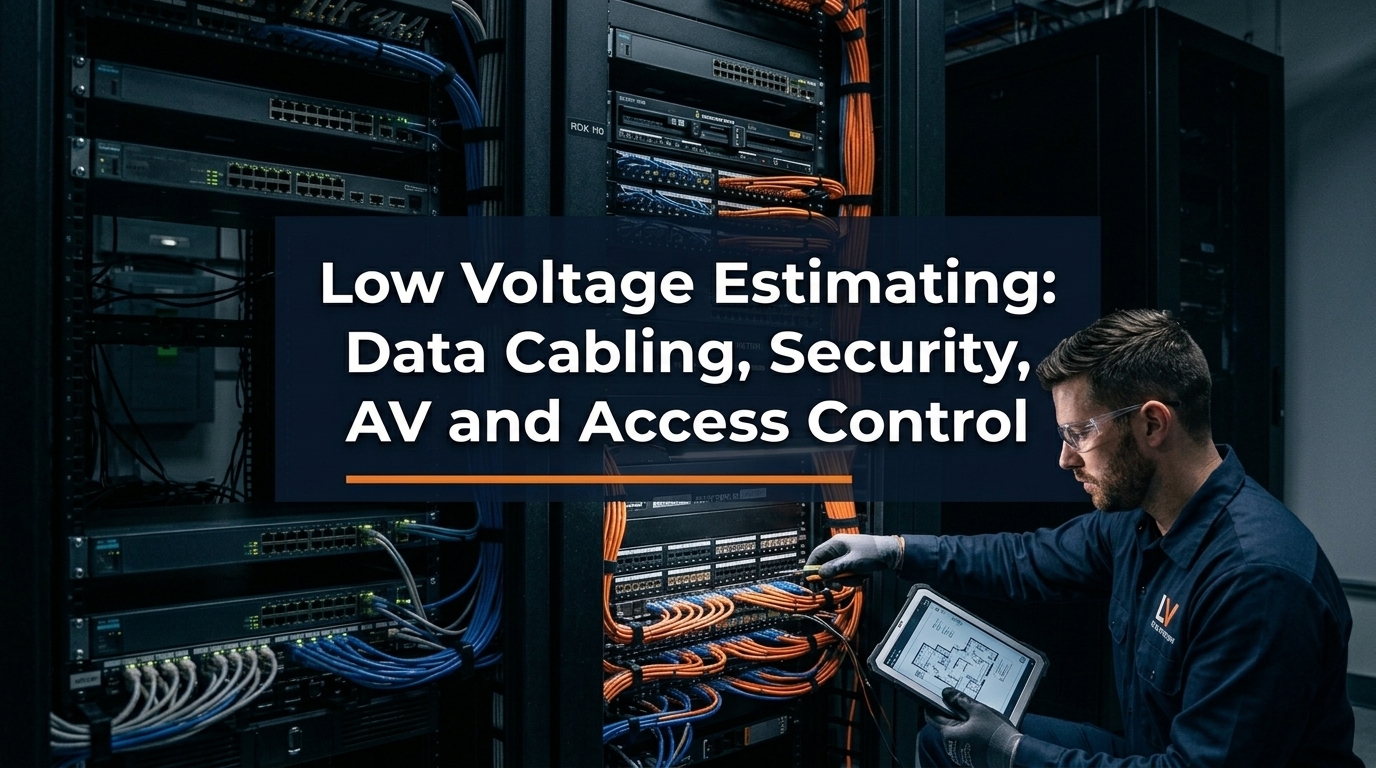
Every cabling system needs a home run point. Price the rack room separately from the field devices.
| Component | Cost Range |
|---|---|
| Open frame rack, standard size | 300 to 700 dollars per unit |
| Enclosed cabinet rack | 800 to 2000 dollars per unit |
| Patch panel, 48 port | 150 to 350 dollars per unit |
| Cable management and grounding | 200 to 500 dollars per rack |
| UPS battery backup | 500 to 2500 dollars depending on capacity |
Confirm the number of telecom rooms on the project early. A building with a main distribution frame and multiple intermediate distribution frames needs rack equipment priced at every location, not just the main room.
Step 3: Estimate Security Camera Systems
Camera systems get priced by camera type, then adjusted for cable run length and recording infrastructure.
| Component | Cost Range |
|---|---|
| Fixed dome camera, standard resolution | 250 to 450 dollars per unit installed |
| PTZ camera | 800 to 1800 dollars per unit installed |
| Cable run per camera, average distance | 80 to 150 dollars per camera |
| Network video recorder, per channel capacity | 30 to 60 dollars per channel |
| Video management software licensing | 100 to 250 dollars per camera |
A 50 camera commercial project typically needs between 60 and 90 labor hours for camera mounting, cabling and system configuration combined, depending on ceiling type and mounting height.
Step 4: Estimate Access Control Systems
Access control pricing depends heavily on door hardware integration and the number of controlled openings.
| Component | Cost Range |
|---|---|
| Card reader, standard | 250 to 500 dollars per door installed |
| Electric strike or maglock | 200 to 450 dollars per door installed |
| Door position switch and request to exit | 100 to 200 dollars per door |
| Access control panel, per door capacity | 150 to 300 dollars per door served |
| Software and licensing | 50 to 150 dollars per door |
Confirm whether each opening needs a standalone reader or full access control with electric strike, since pricing nearly doubles once electrified hardware enters the scope.
| Task | Labor Rate |
|---|---|
| Reader and device install per door | 2 to 3 hours |
| Panel programming and commissioning per door | 0.5 to 1 hour |
Step 5: Estimate Audio Visual Systems
AV scope ranges from simple conference room displays to full building paging and digital signage. Price by room type and equipment tier.
| Room Type | Cost Range |
|---|---|
| Basic huddle room, display and soundbar | 1500 to 3500 dollars |
| Standard conference room, display, camera and audio | 4000 to 9000 dollars |
| Executive boardroom, full video conferencing system | 10000 to 25000 dollars |
| Digital signage display, per unit | 1200 to 3500 dollars |
| Building wide paging system | 8000 to 20000 dollars depending on building size |
AV labor runs higher per device than standard cabling because of equipment programming and commissioning time.
| Task | Labor Rate |
|---|---|
| Display mounting and connection | 2 to 4 hours per room |
| Full conference room commissioning | 4 to 8 hours per room |
Step 6: Estimate Specialty Systems
Healthcare and institutional projects often need nurse call, intercom or specialty paging systems in addition to standard low voltage scope.
| System | Cost Range |
|---|---|
| Nurse call station, per room | 600 to 1200 dollars per room |
| Nurse call master station | 3000 to 6000 dollars per unit |
| Intercom station, door entry | 400 to 800 dollars per door |
| Emergency call station, ADA compliant | 500 to 900 dollars per unit |
Nurse call systems carry strict code requirements in healthcare facilities. Confirm the governing code section early, since master station count and call priority levels both affect final system pricing.
Step 7: Account for Pathway and Conduit
Cable pathway often gets bundled into the cabling cost, but large projects benefit from pricing it separately.
- Cable tray, per linear foot, runs 8 to 18 dollars depending on size and type
- Conduit for low voltage cable, per linear foot, runs 4 to 9 dollars including fittings
- J hooks for open cable runs, per unit, run 3 to 6 dollars
A building with long horizontal runs above corridors needs significantly more cable tray than a building with closets placed near the served devices.
Common Mistakes to Avoid
- Counting devices from the riser diagram instead of the floor plan
- Pricing camera and access control devices without adding cable run cost
- Missing rack room equipment at intermediate distribution frames
- Underestimating AV commissioning labor on complex conference rooms
- Skipping pathway and conduit costs on long cable runs
When to Bring in a Professional Estimator
Low voltage scope spans multiple systems that all interact with each other, from network infrastructure to security to AV. A missed device or cable run on one system often affects pricing on another.
The Virtual Estimation builds low voltage takeoffs system by system, cross referencing floor plans against riser diagrams so every device, cable run and piece of head end equipment gets counted correctly. Turnaround runs 24 to 48 hours, with accuracy near 98 percent on every package.
For projects with combined electrical and low voltage scope, pairing this takeoff with an electrical estimating review keeps power and low voltage rough in coordinated from the same drawing set.
Final Thoughts
Low voltage systems carry more hidden cost than most contractors expect, between head end equipment, pathway and commissioning labor that rarely shows up clearly on a floor plan. Price each system separately, confirm cable run lengths and never skip the rack room scope.
If your next project needs a complete low voltage takeoff, send the drawings to info@thevirtualestimation.com and get a free quote today. Browse more trade guides on the blog, or check service areas to confirm coverage across the US, Canada, Australia and the UK.