A VRF estimate is won or lost on the refrigerant piping and the branch controllers, not on the outdoor units. If you count the equipment and guess the rest, you will underprice the job by 15 to 25 percent, because the copper, the branch selector boxes, the condensate runs, the controls points and the startup allowance are where the money hides. This guide shows you how to take off a variable refrigerant flow system line by line, what it costs per ton and per square foot in 2027, and the six misses that blow up VRF bids.
Who this is for: mechanical contractors, HVAC estimators and general contractors pricing commercial VRF work in offices, hotels, schools and multi-tenant buildings. If you bid rooftop units today and VRF is new to you, start here.
What a VRF System Actually Is
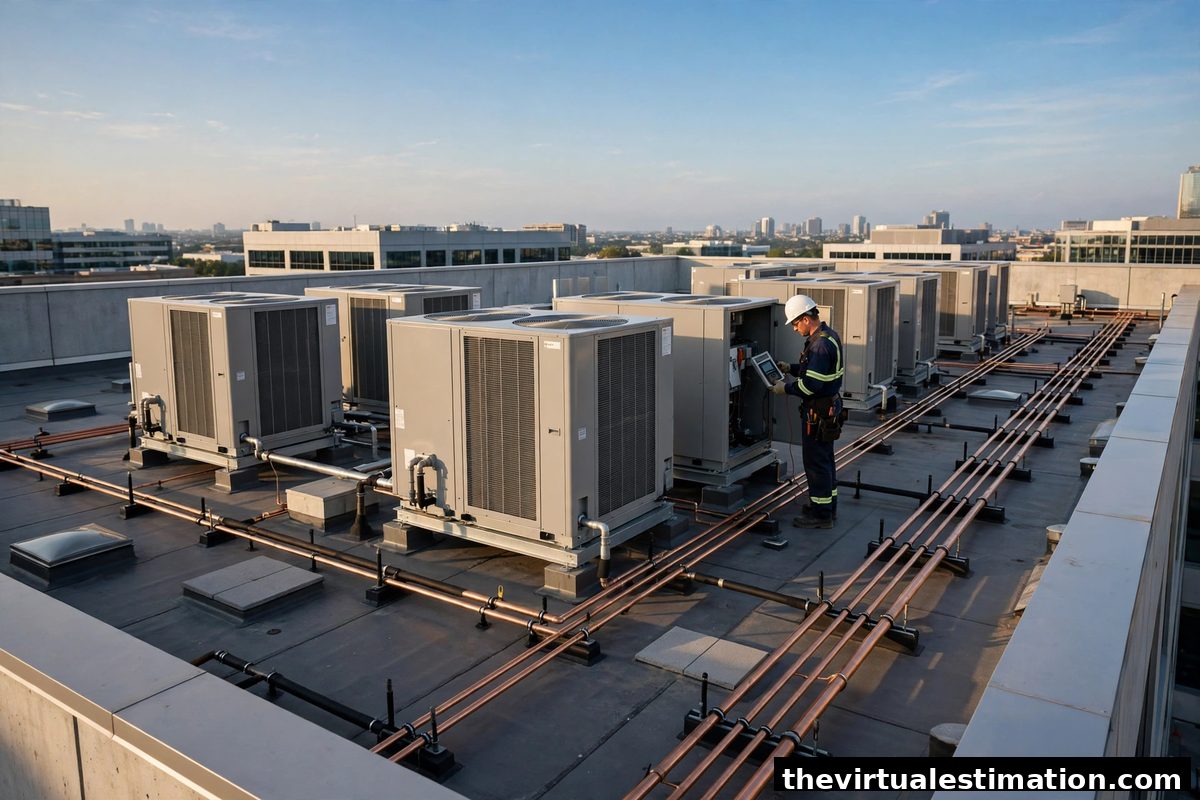
VRF stands for variable refrigerant flow. One or more outdoor condensing units connect through copper refrigerant lines to many indoor units, and each indoor unit controls its own zone. A variable-speed compressor matches output to real-time demand, so the system runs at part load most of the day instead of cycling on and off at full power. That is the whole efficiency story, and it is why owners keep asking for VRF in multi-zone buildings.
There are two types, and the estimate changes with the choice. A heat pump VRF system heats or cools the whole building at one time. A heat recovery VRF system heats some zones while it cools others at the same time, moving heat from the zones that need cooling to the zones that need heat. Heat recovery costs more because it needs branch controller boxes, a third refrigerant pipe in most designs, and more controls points. When the drawings say heat recovery, price the branch controllers and the extra piping, or the estimate is wrong before you start. VRF suits hotels, medical offices, schools, mixed-use buildings and any project where different rooms need different temperatures at the same time.
What Goes Into a VRF Takeoff
A VRF takeoff has six buckets. Miss one and the bid is short. Work through them in this order, because the equipment schedule drives everything else. On a larger job, a construction estimating services breakdown keeps the VRF scope split out by system and by floor, so the bid reviewer can see it instead of guessing.
| Takeoff bucket | What to count | Where it lives on the drawings |
|---|---|---|
| Outdoor units | Units by tonnage, model and location, plus curbs, pads, stands and refrigerant charge | Mechanical equipment schedule, roof plan |
| Indoor units | Units by type (wall, cassette, ducted, floor) and capacity, with thermostats | Mechanical floor plans, equipment schedule |
| Branch controllers | Selector boxes by port count, only on heat recovery jobs | Mechanical plans, refrigerant piping diagram |
| Refrigerant piping | Copper pipe by size and length, liquid and gas lines separately, plus fittings, joints and insulation | Refrigerant piping diagram, riser diagram |
| Condensate and drains | Drain pipe by size and length, condensate pumps, traps and cleanouts | Mechanical and plumbing plans |
| Controls and electrical | Central controllers, BACnet gateways, sensors, wiring, disconnects, breakers and feeders | Controls spec, Division 23 09 00, electrical plans |
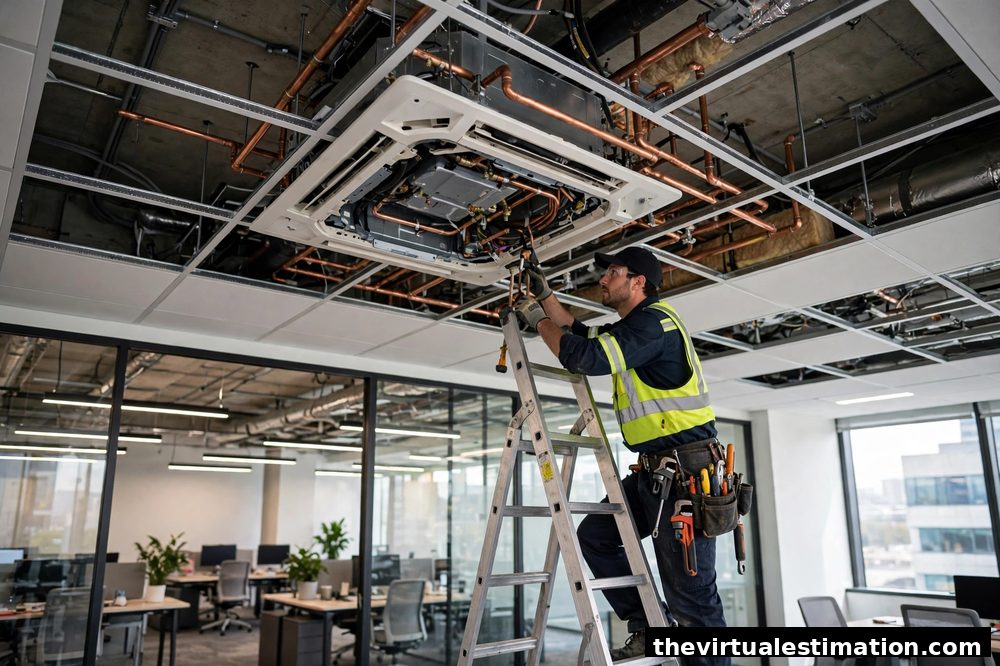
Start with the equipment schedule, not the floor plan. The schedule gives you the outdoor unit tonnage, the indoor unit count and the model numbers. Then walk the refrigerant piping diagram, because it shows the pipe sizes, the branch controller locations and the longest run. Then count the indoor units room by room on the floor plans and reconcile the two counts. If the plan count and the schedule count disagree, stop and ask the engineer.
Refrigerant piping is the bucket most estimators get wrong. Count liquid and gas lines as separate runs, measure by pipe size, and add fittings as a percentage of straight length or count the joints from the diagram. Copper is priced by the pound and by the foot, and the price moves with the copper market, so get a current supplier quote instead of carrying last year's number. Insulate every refrigerant line and count the insulation by the same lengths.
Controls is the second most undercounted bucket. Count every thermostat, every central controller, the BACnet gateway if the building automation system needs one, and the leak detection sensors the code now requires. The controls scope lives in three places at once: the mechanical drawings, the controls specification and sometimes a separate Division 25 section. Read all three.
VRF Cost in 2027: What the Numbers Say
Published 2026 market data gives three ways to check a VRF price, and a good estimate should pass at least two of them. The ranges below come from 2026 sources and are shown as 2026 figures, because relabelling them as 2027 numbers would be dishonest. Use them as the anchor, then adjust for your market, your labor rates and the refrigerant transition described below.
| Check | 2026 range | Source |
|---|---|---|
| Installed cost per square foot, all in | $24 to $38 per sq ft | Design Estimation and Terrapin Construction Group, 2026 |
| Installed cost per ton, whole building | $3,500 to $5,500 per ton | Estimator Florida, 2026 |
| Heat pump VRF, installed | About $4,000 per ton | LegalClarity, 2026, citing trade forums |
| Heat recovery VRF, installed | About $5,000 per ton | LegalClarity, 2026, citing trade forums |
| Premium over packaged rooftop units | 20 to 40 percent more per ton | ProJul and LegalClarity, 2026 |
| Energy savings vs rooftop units | 20 to 40 percent | ProJul and Kahn Mechanical, 2026 |
The per-ton and per-square-foot numbers disagree on purpose, and knowing why keeps you out of trouble. The per-ton figures track equipment and installation closely, while the per-square-foot figures are all-in numbers that include ductwork, refrigerant piping, controls, startup and balancing. A 50-ton system at $4,500 per ton is $225,000, which is only $11.25 per square foot on a 20,000 square foot building, and that gap is the piping, controls, electrical and commissioning scope that the per-ton figure does not carry.
For comparison, packaged rooftop unit systems ran $14 to $28 per square foot installed in the same 2026 data, so VRF adds roughly $10 to $12 per square foot for the zoning flexibility and efficiency. Owners pay that premium in hotels and multi-tenant offices, where individual zone control is the point of the project, and they push back on it in single-zone buildings, where it buys nothing.
Three cost drivers move a VRF price more than anything else. First, building height. Every extra floor adds refrigerant riser length, and long runs need larger pipe and more refrigerant charge. Second, zone count. Forty small indoor units cost more to buy, pipe and wire than ten large ones, even at the same total tonnage. Third, the controls scope. A basic programmable setup runs about $2 per square foot, while a Niagara or Tridium based building automation system with graphics, metering and fault detection runs $5 to $6 per square foot, according to Terrapin Construction Group 2026 data.
Worked Example: 50-Ton VRF for a 20,000 Sq Ft Office
Here is a worked takeoff for a two-story, 20,000 square foot office with 40 zones, priced as a heat recovery VRF system. The unit prices are example assumptions for illustration, stated so you can see the math. Replace every one of them with current supplier quotes and your own labor rates before you bid. The sizing uses the common rule of one ton per 400 square feet, which gives 50 tons. That rule is for budgets only.
| Line item | Quantity | Example unit price | Amount |
|---|---|---|---|
| Outdoor units, 10-ton each | 5 EA | $18,000 | $90,000 |
| Indoor units, mixed cassette and ducted | 40 EA | $1,800 | $72,000 |
| Branch controller boxes | 5 EA | $4,500 | $22,500 |
| Refrigerant piping, copper, installed | 4,200 LF | $18 | $75,600 |
| Condensate piping, pumps and traps | 1 LS | $12,000 | $12,000 |
| Controls, central controller and BACnet gateway | 1 LS | $28,000 | $28,000 |
| Electrical, disconnects, feeders, breakers | 1 LS | $24,000 | $24,000 |
| Insulation, hangers and penetrations | 1 LS | $18,000 | $18,000 |
| Startup, commissioning and balancing | 1 LS | $15,000 | $15,000 |
| Installation labor, mechanical crew | 1 LS | $85,000 | $85,000 |
| Subtotal | $442,100 | ||
| Overhead and profit, 15 percent | $66,315 | ||
| Total | $508,415 |
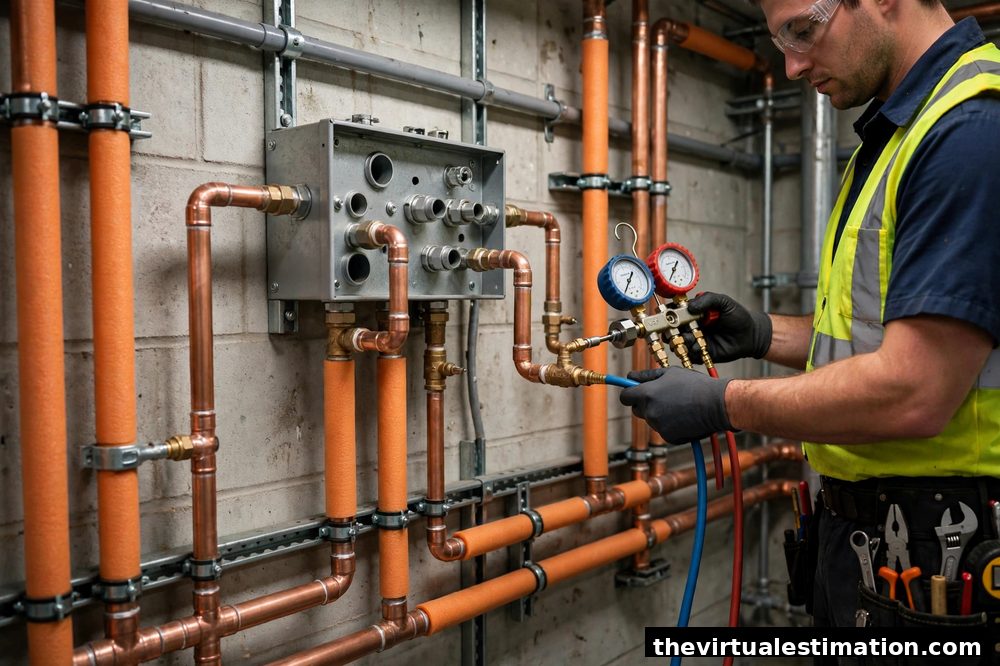
That total is $25.42 per square foot and $10,168 per ton, which sits inside the published $24 to $38 per square foot band for VRF. If your number lands below $24 per square foot, something is missing, and the missing item is usually refrigerant piping, controls or startup. If it lands above $38, check the zone count and the controls scope. Either way, the band is the check, not the price. Notice what dominates the total. Equipment is $184,500, about 42 percent of the subtotal, while piping, insulation and condensate add another $105,600 and controls and electrical add $52,000. The estimate that prices only the equipment is missing more than half the job.
The 6 Misses That Blow Up VRF Bids
1. Pricing heat pump scope on a heat recovery job. Heat recovery needs branch controllers, a third pipe in most designs and more controls points. If the drawings say heat recovery and your estimate has no branch controller line, add it now.
2. Counting refrigerant pipe once instead of twice. Liquid and gas lines are separate runs. Measure each, price each, insulate each. The same mistake on the condensate side leaves a zone with nowhere for water to go.
3. Forgetting the longest run. VRF manufacturers limit total piping length and the vertical distance between the outdoor unit and the farthest indoor unit. A run that exceeds the limit needs a different layout, larger pipe or a second outdoor unit. Check the piping diagram against the manufacturer's limits before you price it.
4. Carrying last year's refrigerant price. The industry moved from R-410A to A2L refrigerants such as R-454B and R-32 under the EPA Technology Transitions Rule, and new equipment can no longer use R-410A. Equipment pricing on A2L systems ran 12 to 18 percent above legacy R-410A in early 2025 and had compressed to roughly 6 to 10 percent above by the first quarter of 2026, according to AHRI data cited by Terrapin. Price the equipment the drawings specify, not the equipment you priced last year.
5. Treating startup as free. Manufacturer startup and commissioning on VRF equipment runs $8,000 to $22,000, according to Terrapin 2026 data, and testing, adjusting and balancing is typically 1 to 5 percent of equipment cost. The manufacturer will not release the warranty without it, so it is not optional and it is not free.
6. Ignoring lead time. VRF equipment lead times stretch to 20 weeks on some models, and the 2026 refrigerant transition made it worse. A bid that assumes eight-week delivery and gets twenty weeks pays for extended general conditions, temporary heating or cooling, and a schedule the owner will not forgive. Confirm lead time with the supplier before you submit, and carry the general conditions for the real schedule. On a multi-trade job, the general contractor estimating scope is where that extended schedule shows up, so the mechanical bid and the GC bid have to agree on the same dates.
Refrigerant, Code and Lead Time Notes for 2027
The refrigerant transition is the biggest pricing fact in VRF work right now, and it is still moving. Under the federal AIM Act, the EPA set a 700 global warming potential limit for new air conditioning equipment starting January 1, 2025. R-410A, at a GWP of 2,088, is out. R-454B, at a GWP of 466, and R-32, at a GWP of 675, are the replacements. Kahn Mechanical reported the transition adding 10 to 15 percent to new system prices industry-wide in 2026, and the Bureau of Labor Statistics producer price index for HVAC equipment rose 7.4 percent in the twelve months ending March 2026. Carry current supplier pricing on every VRF bid, and date-stamp the quote, because a price from six months ago is not a price anymore.
Code is moving with the refrigerant. ASHRAE Standard 15, updated in 2024, sets the rules for A2L refrigerant safety, including leak detection, ventilation and charge limits in occupied spaces. Several states are also tightening electrification and energy code requirements. Check the local code adoption status on every job.
One tax note, because it affects the owner's decision even though it is not your line item. The Section 179D energy efficient commercial buildings deduction does not apply to property where construction begins after June 30, 2026, under the One Big Beautiful Bill Act enacted in July 2025. If the owner was counting on that deduction to justify the VRF premium, the math changed. Flag it in the bid review.
Methodology: How to Price a VRF Estimate
Price a VRF estimate in this order, and do not skip a step. First, take off the quantities from the drawings: equipment counts, pipe lengths by size, branch controllers, condensate runs, controls points and electrical feeders. Second, price material from current supplier quotes, dated and in writing, because copper and equipment prices move. Third, apply labor hours by crew and task. Fourth, add startup, commissioning and balancing as their own lines. Fifth, add overhead, profit and the project conditions, including the real lead time. Sixth, check the total against the per-square-foot band and against a second method, such as the per-ton figure, and investigate any gap before you submit.
State the pricing basis in the estimate itself: material from supplier quotes current at bid time, labor from crew and productivity assumptions, location adjustment for the project market, and the date the prices were verified.
Frequently Asked Questions
How much does a commercial VRF system cost per ton in 2027?
Published 2026 figures put heat pump VRF at about $4,000 per ton installed and heat recovery VRF at about $5,000 per ton, with whole-building ranges of $3,500 to $5,500 per ton. Check the total against the all-in range of $24 to $38 per square foot, because the per-ton figure alone leaves out piping, controls and commissioning.
Is VRF cheaper than rooftop units?
No, not upfront. VRF typically costs 20 to 40 percent more per ton than packaged rooftop units, and about $10 to $12 more per square foot all in. It earns the premium back through 20 to 40 percent lower energy use and individual zone control, with payback often in 5 to 8 years according to Kahn Mechanical 2026 data.
What is the biggest mistake in VRF estimating?
Undercounting refrigerant piping. Estimators count the equipment, count the pipe once instead of twice, forget the branch controllers on heat recovery jobs, and leave out the insulation. The piping, controls and startup scope is more than half the job on most VRF projects.
If you are pricing a VRF system and want quantities you can defend, send your plans to The Virtual Estimation. We build VRF takeoffs the way this guide describes them, equipment, piping, branch controllers, controls and startup, priced from current supplier quotes and delivered in 24 to 48 hours. Email your drawings to info@thevirtualestimation.com or start with our construction estimating services page, and we will price the VRF scope as a standalone takeoff or as part of the full mechanical package.