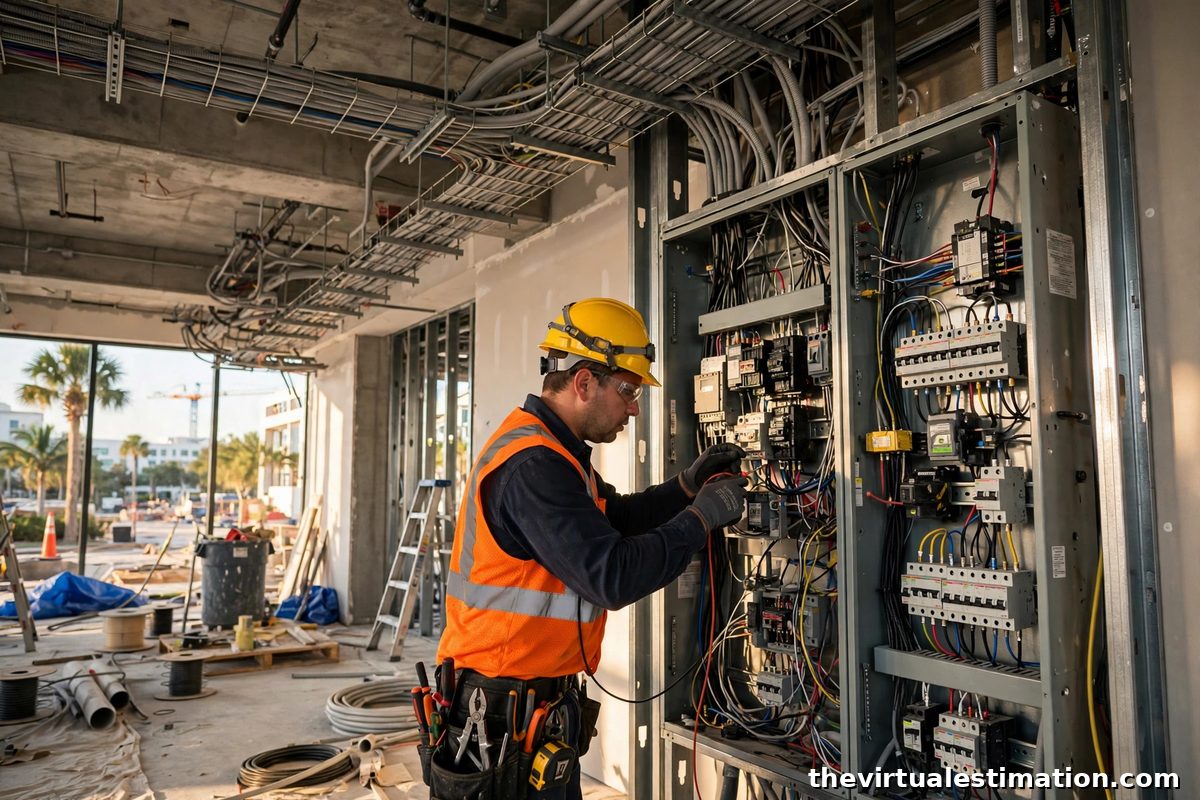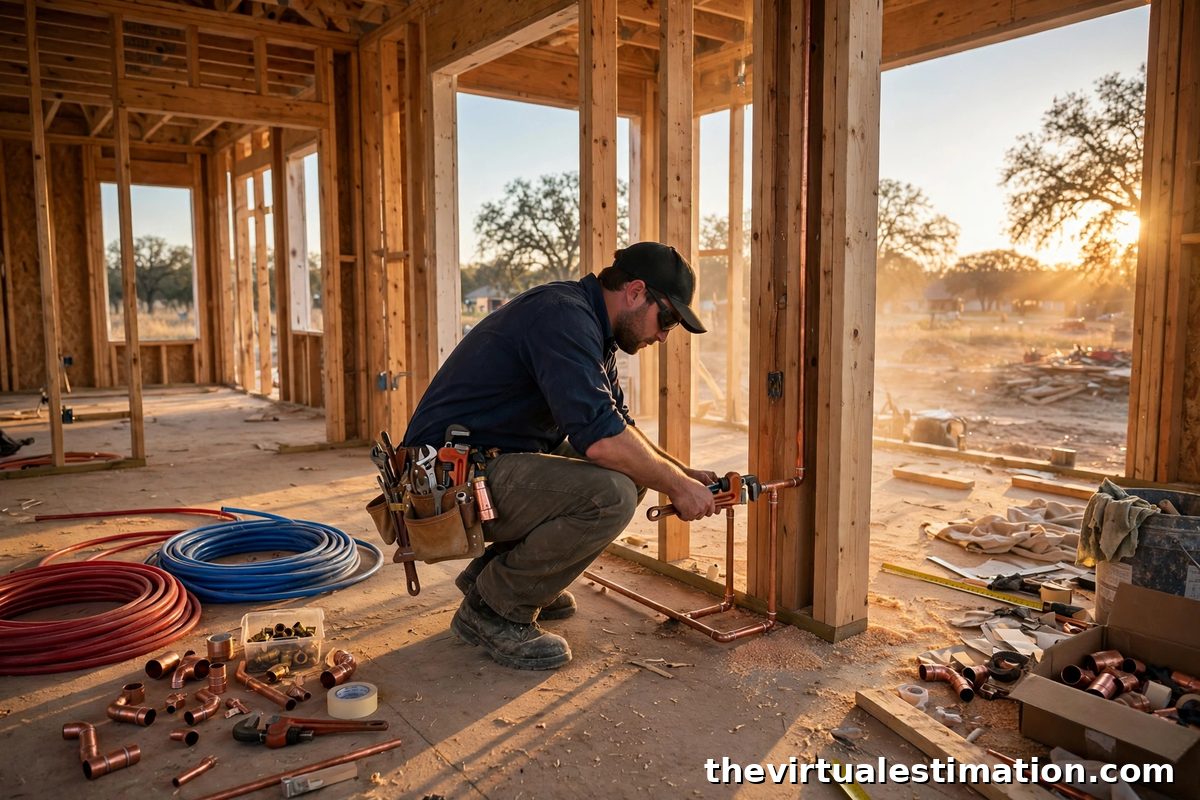
If you are bidding plumbing work in San Antonio, price it as a San Antonio job, not as a generic Texas job. The permit fee on a 2,400-square-foot new home runs $179.40 for plumbing plus $73.60 for sewer and $73.60 for gas before surcharges, the code in force is the 2024 International Plumbing Code as adopted on January 30, 2025, and the water and sewer scope answers to a second authority, the San Antonio Water System, on top of the city building code. A national unit price with a small regional adjustment will miss what actually moves a San Antonio plumbing bid: which jurisdiction the parcel sits in, the SAWS service and connection scope, backflow and inspection fees priced per fixture and per device, and the expansive clay soil that breaks buried lines when a slab moves.
Who this is for: plumbing contractors, general contractors, developers, and owners pricing residential, commercial, or remodel plumbing work in San Antonio and Bexar County, Texas, including estimators who need a San Antonio plumbing takeoff that survives plan review and inspection.
Start with the jurisdiction, not the takeoff
San Antonio is not one permit authority. It is four, and the plumbing answer changes with each one. Work inside the San Antonio city limits goes through the City of San Antonio Development Services Department, known as DSD, which issues the building and plumbing permits and runs plan review. Land in the city's extraterritorial jurisdiction, called the ETJ, is not full-purpose city land, and its permitting path is different. Enclave cities inside the metro run their own arrangements: Alamo Heights, Balcones Heights, Leon Valley, Castle Hills, and the other small cities surrounded by San Antonio each have their own permitting and inspection setup. Parcels in unincorporated Bexar County are a different authority again.
A San Antonio mailing address settles none of this. Before you price a single fixture, name the exact jurisdiction for the parcel and confirm it in writing. If the job is a City of San Antonio DSD permit, the fee schedule and code citations in this guide apply. If it is an enclave city or a county parcel, the fees, the submittal, and sometimes the adopted code edition change, and a bid built on DSD numbers will be wrong. Good plumbing estimating services start by pinning the jurisdiction, because every line that follows depends on it.
The same rule applies to the water and sewer provider. Most parcels inside the city are on the San Antonio Water System, SAWS, for water and sewer. A parcel outside SAWS sewer runs on septic or another provider, and that changes the takeoff entirely: no SAWS sewer connection, a septic system with its own design and permitting, and different service line lengths. Name the water provider and the sewer provider for the parcel before you price service lines, meters, backflow devices, and connections.
The 2024 IPC is the code in force
On January 30, 2025, the San Antonio City Council adopted the 2024 International Code Council codes, and the list expressly includes the International Plumbing Code. That makes the 2024 IPC, as locally amended, the plumbing code for San Antonio work, replacing the 2021 IPC adopted under the earlier 2022 ordinance. The same adoption covers the 2024 International Building Code, Residential Code, Mechanical Code, Fuel Gas Code, Fire Code, Existing Building Code, and Swimming Pool and Spa Code. The National Electrical Code is listed without a stated edition year, so do not assume one from this page. The International Energy Conservation Code was excluded from this cycle and remains under the 2021 codes, which does not change the plumbing position.
For an estimator, the code edition matters in three concrete ways. First, fixture and venting rules, pipe sizing tables, and backflow requirements in your takeoff must match the 2024 IPC as amended by the city, not a 2021 takeoff template carried over from an older job. Second, DSD publishes information bulletins that sit on top of the code, including IB 121c for one- and two-family plumbing limited-service-and-repair permits, and those bulletins decide what a small repair permit can and cannot cover. Third, the Texas layer sits above the city layer: under Texas Occupations Code Chapter 1301, the Texas State Board of Plumbing Examiners, TSBPE, holds the licensing and code-adoption role, and municipalities may amend the adopted code for local concerns that do not substantially vary from board rules.
That licensing point is a bid-comparability gate, not a footnote. A San Antonio plumbing takeoff must be priced as work performed by or under a licensed plumber, with inspection by a plumbing inspector. A bid that prices plumbing as unlicensed general labor is not a comparable bid, and it will not survive the permit counter. When you compare subcontractor prices, confirm the license is in the number.
A San Antonio plumbing takeoff has three scopes, not one
Most plumbing estimates that come in low in San Antonio are missing a whole scope. The work breaks into three parts, and each one is priced differently, permitted differently, and inspected differently. Keep them as three separate lines in your estimate so nothing hides inside another line.
| Scope | What it covers | Who governs it |
|---|---|---|
| In-building plumbing | Fixtures, water and drain piping, water heaters, gas piping where in scope, vents, and backflow devices inside the building | 2024 IPC as adopted by the city, DSD permit and inspection, TSBPE-licensed installer |
| SAWS service and connection | Water service line, meter, sewer lateral and connection, backflow at the service, and work to SAWS standard specifications | SAWS Standard Specifications for Construction, SAWS review and fees |
| Site and foundation protection | Buried line routing, bedding and cover, slab and foundation movement protection, drainage, and aquifer-zone constraints | City code and UDC, Edwards Aquifer rules where applicable, licensed-engineer foundation plan |
The in-building scope is the takeoff most estimators know: count fixtures, measure pipe runs, price water heaters and gas lines, and add vents, traps, and backflow devices. The SAWS scope is where San Antonio bids go wrong, because it is easy to price only the in-building IPC scope and forget the service, meter, backflow, and sewer connection entirely. SAWS publishes its own Standard Specifications for Construction for water and sanitary sewer work, including customer yard piping, and that specification decides materials, depths, and connection details on the service side. If your takeoff has no SAWS line, it is incomplete.
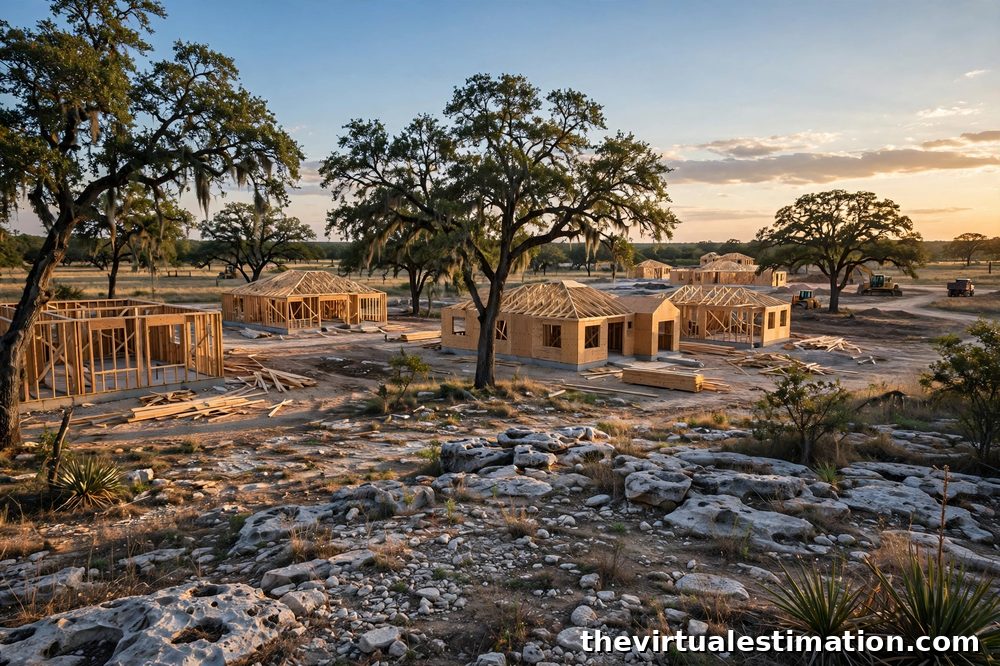
The third scope is the site and foundation line, and in San Antonio it is a plumbing line, not background. Two local conditions drive it. The first is the Edwards Aquifer recharge zone, which covers the northern part of the metro and carries water-quality and impervious-cover constraints that affect site and drainage scope. The second is expansive clay soil, which moves with moisture and is exactly what cracks slabs and breaks buried sewer and water lines. Route buried lines with proper bedding and cover, allow for movement at slab penetrations, and keep the foundation scope in the same conversation as the plumbing scope, because the foundation plan for a San Antonio home must be prepared by a licensed engineer.
Worked example: permit fees on a 2,400-square-foot new home
Permit fees are the one part of a San Antonio plumbing bid you can price to the dollar before you call anyone, because the City of San Antonio publishes them in the FY 2027 Development Fee Schedule, revised October 2026. For new residential construction, the plumbing permit fee is based on square footage and is assessed on the building permit, while sewer and gas permit fees are flat. Irrigation and multi-family residential fire protection sprinkler systems need separate permits.
Take a 2,400-square-foot single-family home inside the San Antonio city limits, on SAWS water and sewer, with a gas water heater. The fee schedule puts a 2,251 to 2,500-square-foot home in the $179.40 plumbing permit band. Add the flat sewer fee of $73.60 and the flat gas fee of $73.60. The subtotal is $326.60. All fees are subject to a 4 percent Technological Improvement surcharge and a 4 percent Development Services surcharge unless noted, which adds $26.13 and brings the permit cost to $352.73. That figure covers the plumbing, sewer, and gas permits only. It does not include plan review, re-inspection, after-hours fees, or SAWS connection charges, which are priced separately.
| Fee line | Amount |
|---|---|
| Plumbing permit, 2,251 to 2,500 sq ft band | $179.40 |
| Sewer permit, flat fee | $73.60 |
| Gas permit, flat fee | $73.60 |
| Subtotal | $326.60 |
| Surcharges, 4 percent plus 4 percent | $26.13 |
| Total permit cost | $352.73 |
The same schedule lets you scale the example. A home up to 500 square feet carries a $69.00 plumbing permit fee. A 501 to 1,000-square-foot home is $136.90. A 1,751 to 2,000-square-foot home is $171.40. A 3,501 to 4,000-square-foot home is $218.50, and a 5,001 to 6,000-square-foot home is $256.50. Sewer and gas stay flat at $73.60 each across those bands. For projects over 9,000 square feet, the schedule combines smaller increments to reach the square footage. Applications not submitted through the city's online portal carry an $11.50 convenience fee, and credit card payments add a 3 percent administrative fee.
What repair and remodel permits cost under the FY 2027 schedule
Commercial work and existing residential work are priced differently from new residential construction. Instead of a square-footage band, the schedule charges a base fee plus per-item fees. The plumbing permit base fee is $57.50. Each plumbing fixture, roof drain, reverse osmosis unit, and similar item adds $8.05. A water heater or gas and electric vent adds $9.20. Traps and interceptors run $13.80 for 0 to 500 gallons and $19.55 above 500 gallons, and a water softener is $19.55.
Run the math on a 12-fixture bathroom remodel in an existing home. The base fee is $57.50, and 12 fixtures at $8.05 each add $96.60, for a subtotal of $154.10. With the 8 percent combined surcharges, the permit costs $166.43. A water heater swap on its own is simpler: the $57.50 base fee plus $9.20 for the water heater comes to $66.70, or $72.04 with surcharges. These are the permit fees only, and they sit on top of labor, materials, and the contractor's markup, which you price from your own crew rates and supplier quotes, not from a published San Antonio rate, because no current published labor rate was verified for this guide.
Backflow is its own line and it catches estimators who forget it. A plumbing backflow permit is separate from a plumbing trade permit. The backflow preventer inspection fee is $57.50, and the device fee runs from $17.25 for a device under 1 inch to $86.25 for a device over 2 inches, priced by size. Commercial gas, sewer, medical gas, temporary meter loop, and temporary-on-permanent-set work carries flat fees by project size: for a project up to 5,000 square feet, gas is $92.00 and sewer is $115.00; under 50,000 square feet, both are $115.00; at 50,000 square feet and above, gas rises to $138.00 while sewer stays at $115.00. Plan review for plumbing is $115.00, a re-inspection is $57.50, and an underground waterline inspection runs from $11.50 for the first 100 feet upward by length, with a $57.50 base fee.
How long permits take, and what that costs you
San Antonio's stated review clock is short, and that is a schedule cost, not a convenience. The city's residential plan-review page states that initial review of building plans typically takes three business days, that a foundation plan must be prepared by a licensed engineer, and that an issued building permit expires after 180 days if no proof of construction or work progress is shown, with 180-day extensions available on a justifiable reason. A plumbing takeoff that prices only materials and labor, with no allowance for review, correction, and inspection sequencing, understates a San Antonio job. Submit a complete package the first time, because a correction cycle costs days even on a three-day clock, and a failed inspection costs a $57.50 re-inspection fee plus the crew time to return. Schedule inspections online, since the inspection schedule fee is free when scheduled online and $3.45 otherwise. Watch the 180-day expiry on longer jobs: a permit that lapses mid-project needs an extension on a justifiable reason. Carry a small allowance for one re-inspection and one correction cycle in every San Antonio plumbing bid.
Six mistakes that sink San Antonio plumbing bids
1. Pricing the wrong jurisdiction. Bidding DSD fees and timelines on an enclave-city or Bexar County parcel, or the reverse, is the most expensive easy mistake in this market. Confirm the jurisdiction first, every time.
2. Forgetting the SAWS scope. The service line, meter, backflow, and sewer connection are real work with real cost. A bid with no SAWS line is not a low bid, it is an incomplete one.
3. Using another city's fee table. Houston, Austin, and Dallas each price plumbing permits differently, and none of them matches San Antonio's square-footage bands or per-fixture fees. Use the FY 2027 San Antonio schedule, and re-check it at bid time.
4. Carrying a 2021 code takeoff. The 2024 IPC is in force. A takeoff built on the 2021 edition can miss amended fixture, venting, and backflow requirements, and the correction will land during plan review, when it costs more.
5. Pricing plumbing as unlicensed labor. Texas requires a licensed plumber for the work, and the inspection assumes one. A bid that quietly prices general labor against licensed labor is not competitive, it is non-compliant.
6. Ignoring the ground. Expansive clay and the Edwards Aquifer recharge zone decide how buried lines are bedded, routed, and protected, and a bid that ignores them buys callbacks and slab leaks.
How to build the bid: a San Antonio plumbing checklist
Work the checklist in order and the estimate builds itself. First, confirm the parcel jurisdiction and the water and sewer provider. Second, confirm the project type and size: new residential work prices by square footage, while commercial and existing residential work prices by base fee plus per-fixture and per-device fees. Third, take off the in-building scope from the drawings: fixtures, pipe runs by material and size, water heaters, gas lines, vents, traps, and backflow devices, counted to the 2024 IPC as locally amended. Fourth, take off the SAWS scope separately: service line length and material, meter size, sewer lateral, and connection details to the SAWS standard specifications. Fifth, price the site scope: buried line bedding and cover, slab penetration protection, and any aquifer-zone drainage requirements. Sixth, calculate the permit fees from the FY 2027 schedule using the worked examples above, including the 8 percent surcharges, and add plan review and one re-inspection allowance. Seventh, sequence the job around the three-business-day initial review and the 180-day permit life, with inspection slots booked online. Eighth, compare subcontractor bids like for like, license included, and flag any bid far below the rest for a scope check.
For the takeoff itself, measure from the drawings, count every fixture and device, and organize quantities by area, floor, or building section so pricing takes minutes. Our plumbing estimating guide covers pipe, fittings, fixtures, and drainage takeoffs in detail, and it pairs with this San Antonio guide: the first teaches the takeoff, this one teaches what San Antonio changes about it. If the job is part of a larger build, coordinate the plumbing takeoff with the general contractor's schedule through our construction estimating services, so the plumbing rough-in, inspection, and drywall sequence line up instead of colliding.
Where the work is in San Antonio
San Antonio's plumbing market splits three ways. The growth ring on the far North Side and West Side, around Stone Oak, Alamo Ranch, and the Loop 1604 corridor, is new single-family subdivisions and multifamily work, where the square-footage permit bands and the SAWS service scope drive the bid. Inside Loop 410, the work is infill, remodels, and replacements, priced by base fee plus per-fixture fees, where older homes bring cast iron, galvanized pipe, and slab leaks a new-build takeoff never sees. Downtown and the River Walk corridor, the medical center, and the Joint Base San Antonio area bring commercial and institutional work, where medical gas, backflow, and commercial flat fees enter the estimate. San Antonio's hard water shortens water heater and fixture life across all three markets, and the February 2021 freeze reminded every Texas estimator that exterior piping, hose bibbs, and freeze protection belong in the takeoff.
Frequently asked questions
What plumbing code is in force in San Antonio? The 2024 International Plumbing Code, adopted by the City Council on January 30, 2025, with local amendments. It replaced the 2021 IPC. Check the city's Codes and Ordinances page at bid time for any later amendment.
How much is a plumbing permit for a new home in San Antonio? It depends on square footage under the FY 2027 Development Fee Schedule, revised October 2026. A 2,400-square-foot home costs $179.40 for plumbing plus $73.60 for sewer and $73.60 for gas, or $352.73 with the 8 percent combined surcharges.
Do I need a separate permit for a water heater replacement? Yes, in most cases. The schedule charges a $57.50 base fee plus $9.20 for the water heater, or $72.04 with surcharges. A limited-service-and-repair permit under IB 121c may apply to small one- and two-family repair work, so confirm the permit type with DSD before you start.
What is SAWS and why does it matter to my plumbing estimate? The San Antonio Water System provides water and sewer service for most of the city and publishes its own Standard Specifications for Construction. Your estimate must carry the SAWS service line, meter, backflow, and sewer connection scope alongside the in-building plumbing, or the bid is incomplete.
If you are bidding plumbing work in San Antonio and want a takeoff that already carries the jurisdiction, the 2024 IPC, the SAWS scope, and the FY 2027 permit fees, The Virtual Estimation can build it for you. Send your drawings to info@thevirtualestimation.com and our estimators will return a line-item plumbing takeoff priced for the San Antonio market, or see our plumbing estimating services for trade-specific coverage. Price the jurisdiction, the code, and the ground, and the bid will hold up.