Commercial plumbing is priced per fixture installed, not per foot of pipe. A flushometer water closet in a new office restroom runs $1,800 to $3,400 installed on 2026 Terrapin Construction Group figures, and that number is fully loaded: rough-in piping back to the mains, the fixture itself, valves, trim and final connections. Pipe length matters, but fixture count drives rough-in labour more than linear feet does, because every fixture carries a trap, stops, supply risers and a waste connection. This guide prices the fixture the way an estimator does, with the ranges kept apart by source so you can see where they agree and where they do not.
Who this is for: plumbing estimators, mechanical contractors and GCs bidding commercial plumbing in the US (offices, retail, restaurants, medical) who have lost margin to a fixture count that looked small on the plan and a rough-in that was not.
What "cost per fixture" actually includes
The installed figure is a bundle, and the bundle is the whole point. It covers rough-in piping (supply, drain-waste-vent and vent) from the fixture back to the mains, the fixture itself, the trap, stops and supply lines, the trim (faucet, flush valve, seat) and the final connections, plus testing and inspection of that run. When you compare two per-fixture numbers, check the bundle first. A price that leaves out the rough-in is not cheaper, it is incomplete. The general plumbing method behind this bundle is covered in the Plumbing Estimating Guide: Pipe, Fittings, Fixtures and Drainage.
Three things sit outside the per-fixture total and belong on their own lines. Site utility laterals are a separate scope, priced where the underground utilities are priced. Grease interceptors and medical gas are separate lines, not part of a fixture price. And permit fees belong on their own line in dollars, because some jurisdictions charge per fixture and the fee moves with the count.
Installed cost per fixture, commercial
The table below is the fixture-by-fixture view, from Terrapin Construction Group's 2026 commercial plumbing guide, which cites RSMeans 2026 mechanical data and MCAA labour benchmarks with field benchmarking across 38 states. Every figure is fully loaded: rough-in piping back to the mains, fixture, valves, trim and final connections.
| Fixture | Installed range (2026) | Notes |
|---|---|---|
| Water closet, flushometer | $1,800 to $3,400 | Standard for multi-stall restrooms |
| Water closet, tank type | $1,400 to $2,400 | ADA-compliant adds $200 to $400 |
| Urinal, flushometer | $1,200 to $2,200 | Waterless models cut operating cost, not install cost |
| Lavatory, wall-hung | $1,200 to $2,200 | Includes faucet, supply stops, drain |
| Lavatory, counter-top | $1,400 to $2,800 | Counter and millwork separate |
| Service sink / mop sink | $1,400 to $2,600 | Floor or wall mount, janitorial closets |
| Three-compartment sink | $2,800 to $5,400 | Restaurant ware-washing, stainless steel |
| Drinking fountain, bottle filler | $1,400 to $2,800 | ADA height; refrigerated unit adds $400 to $800 |
| Floor drain | $480 to $920 | Cast iron body, nickel-bronze grate |
| Roof drain, primary | $920 to $1,800 | Overflow drain typically required as well |
| Hose bibb, frost-proof | $380 to $680 | Code-required at building exterior corners |
| Eye wash / safety shower | $2,800 to $5,800 | OSHA-required in labs and chemical handling |
| Grease interceptor, hydromechanical 50 GPM | $8,000 to $18,000 | Indoor restaurant scope, separate line item |
| Backflow preventer, RPZ 2 in | $4,200 to $7,800 | Required at water service entry |
All figures above are 2026. No 2027 update to this dataset was published at the time of writing, so the numbers are attributed to their 2026 source and not relabelled as 2027 figures.
Why the published ranges disagree, and what to do about it
Three reputable sources give three different answers for the same question, and the spread is scope, not error. PlumberCalc, updated May 20, 2026, puts commercial plumbing at $800 to $2,500 per fixture. CyanBuild's 2026 guide puts commercial and multifamily plumbing at $1,200 to $3,500 per fixture installed, and its own worked example bids about $992 per fixture. Terrapin prices fixture by fixture, from $480 for a floor drain to $3,400 for a flushometer water closet. Do not average them into one settled number. The blended ranges are useful as a concept-stage sanity check; the fixture table is what you build a bid from.
One line deserves a warning. CyanBuild's Common Mistakes section says new construction plumbing runs $3,500 to $7,500 per fixture installed, and that a bid of $1,200 per fixture should be rechecked. That line conflicts with the same guide's own commercial range of $1,200 to $3,500 and with its own worked example at about $992 per fixture, so treat it as a residential sanity-check line and do not quote it as a commercial installed price.
Residential figures are context only. PlumberCalc puts residential rough-in at $500 to $1,500 per fixture, and CyanBuild puts residential new construction at $600 to $1,400 per fixture installed. Do not borrow residential ranges for a commercial bid: the fixture, the rough-in and the inspection regime are all different.
Rough-in vs trim: where the money sits
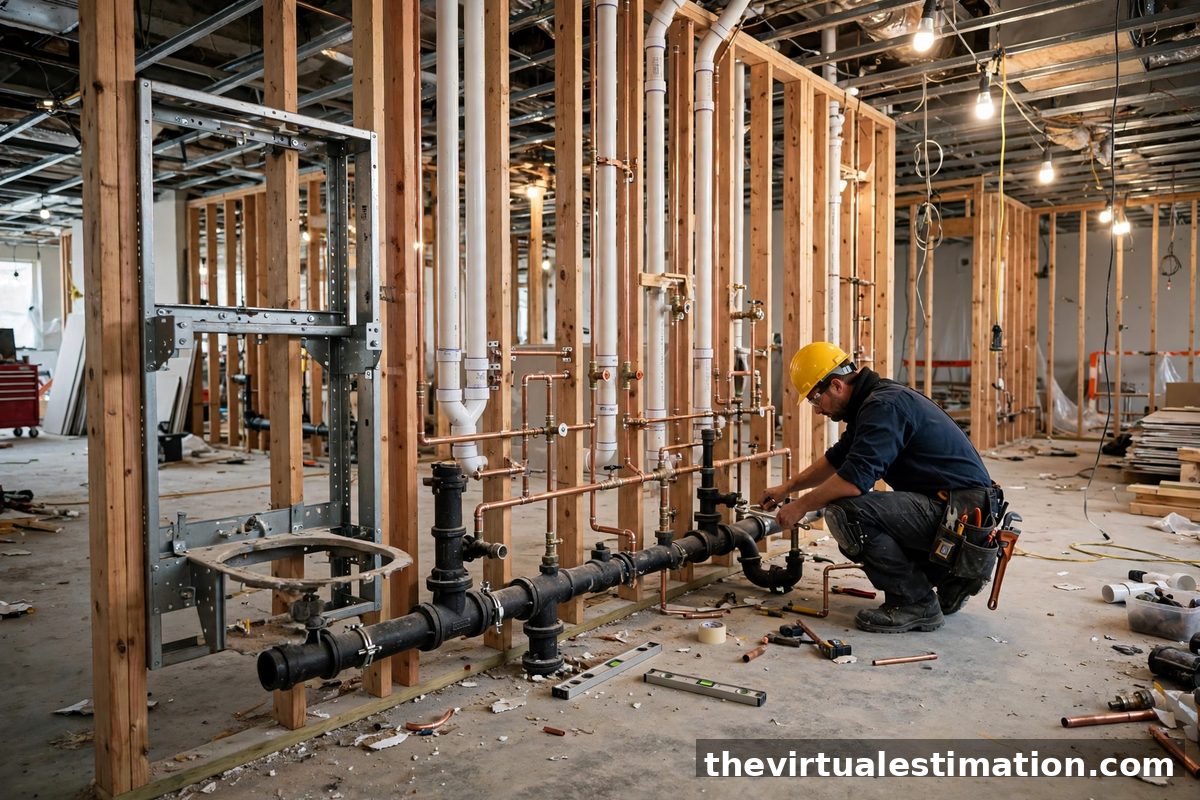
Rough-in is where most of the money goes. Terrapin puts rough-in at 60 to 70 percent of total plumbing cost and trim at 30 to 40 percent. BuildMat, in its August 2026 rough-in guide, puts finish plumbing at typically 20 to 30 percent of the plumbing budget. The two sources agree in direction and disagree in range, so present them as their own ranges, never as one split. Rough-in is supply, drain-waste-vent piping and stub-outs, ending at inspection before drywall. Trim is setting the fixture, faucet, disposal connection and final connections.
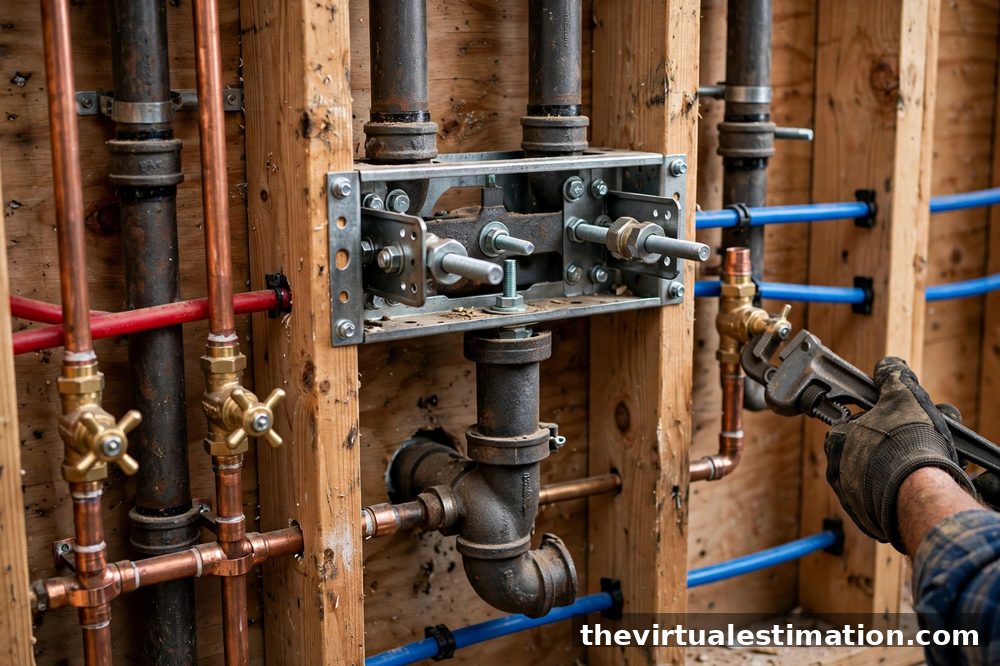
A fixture moved four feet after rough-in is a rough-in job, not a swap. Price it that way, with new supply, new drain and a new vent tie-in, or the change order will eat the margin the original bid never had.
Labour follows the same split. CyanBuild's figures, which are that guide's numbers and not a national rate, put rough-in at 2.5 to 4 hours per fixture for a journeyman and a helper, and trim at 0.75 to 1.5 hours. Burdened wage runs $35 to $65 per hour for a licensed plumber and $20 to $35 for a helper. PieceworkPro gives a different, labour-only view: toilet rough-in $75 to $125 per fixture, bathroom sink $65 to $100, kitchen sink $85 to $130, a restroom group of two toilets and two sinks $400 to $700. Do not mix piece-rate labour with fully loaded installed totals; they are different scopes. Where trim includes a disposal, remember the power side: the circuit is priced where the electrical estimating is priced, not in the plumbing fixture total.
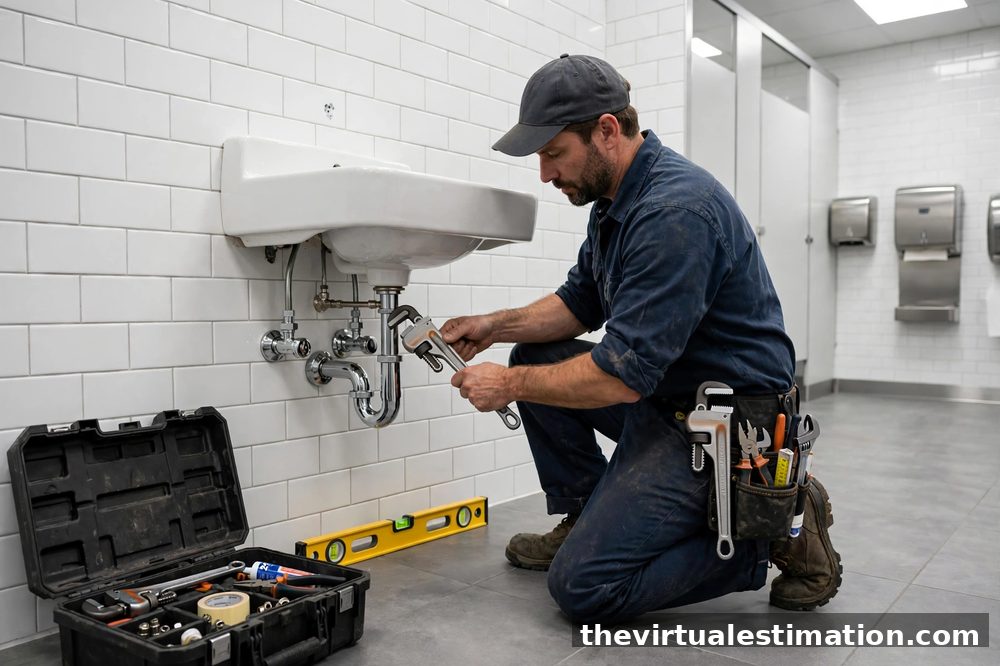
The fixture-unit method: count, convert, then size
Count fixtures first, then convert the count to load with fixture units, then size pipe from the load. Never size pipe from fixture count alone. The method has three inputs, and each one comes from the code, not from a rule of thumb.
First, the minimum fixture count. IPC Table 403.1 sets minimums by occupancy, and for a business occupancy it requires 1 water closet per 25 occupants for the first 50 and 1 per 50 for the remainder, and 1 lavatory per 40 for the first 80 and 1 per 80 for the remainder, with fractions rounded up. The jurisdiction's adopted IPC edition governs, and local amendments can change the numbers. Austin, for example, uses the UPC while San Antonio uses the IPC, so confirm which code applies before you count.
Second, drainage fixture units, which size the drains. IPC Table 709.1 gives a lavatory 1 DFU, a bathtub or kitchen sink 2 DFU, a private 1.6 gpf water closet 3 DFU, a public water closet 4 DFU, and a full bathroom group with a 1.6 gpf water closet 5 DFU (6 DFU if the flush is over 1.6 gpf).
| Fixture | Drainage fixture units (IPC Table 709.1) |
|---|---|
| Lavatory | 1 DFU |
| Bathtub or kitchen sink | 2 DFU |
| Water closet, private, 1.6 gpf | 3 DFU |
| Water closet, public, 1.6 gpf | 4 DFU |
| Full bathroom group, 1.6 gpf water closet | 5 DFU |
Third, water supply fixture units, which size the supply pipes. IPC Appendix E Table E103.3(2) gives a public flush-valve water closet 10 WSFU, a public lavatory 2 WSFU, a private lavatory 0.7 WSFU and a private flush-tank water closet 2.2 WSFU. Older tables still list the private lavatory at 1 WSFU and the private flush-tank water closet at 3; the current IPC Appendix E refines those two values, so use the edition your jurisdiction adopted. Drainage and supply units are different scales: a public flush-valve water closet is 10 WSFU on the supply side and only 4 DFU on the drainage side. Do not swap them.
Two more code numbers complete the sizing. Drainage slope under IPC Table 704.1 is 1/4 in per ft for pipes 2-1/2 in and smaller, 1/8 in per ft for 3 to 6 in, and 1/16 in per ft for 8 in and larger. The UPC differs, with a 1/4 in per ft general minimum, so do not present UPC figures as IPC figures. Demand comes from IPC Table E103.3(3), which converts WSFU to peak gallons per minute with separate columns for flush-tank and flushometer systems. At 10 WSFU the flush-tank curve reads 14.6 gpm and the flushometer curve reads 27.0 gpm: the same load nearly doubles when the system is flushometer-predominant, which is why the valve type belongs in the takeoff, not in a footnote.
Worked example: a two-stall office restroom group
Hypothetical office job, no real project data. Arithmetic only from the figures above.
Take a small office restroom group: 2 public flush-valve water closets and 2 public lavatories. Drainage load is 2 x 4 DFU for the water closets plus 2 x 1 DFU for the lavatories, a total of 10 DFU. Supply load is 2 x 10 WSFU for the water closets plus 2 x 2 WSFU for the lavatories, a total of 24 WSFU. Installed cost from the Terrapin table is 2 flushometer water closets at $1,800 to $3,400 each, or $3,600 to $6,800, plus 2 wall-hung lavatories at $1,200 to $2,200 each, or $2,400 to $4,400, for a group total of $6,000 to $11,200 before the shared rough-in, vent and drain mains. At the 60 to 70 percent rough-in share, $3,600 to $7,840 of that group total sits behind the wall.
The cost of skipping the fixture-unit step is a main sized by rule of thumb. Counting four fixtures and adding a nominal flow per fixture oversizes the main and the risers, and it hides the flush-valve demand spike: the 10 WSFU contrast above (14.6 gpm on the flush-tank curve, 27.0 gpm on the flushometer curve) is the difference between a main that works and one that starves the farthest fixture at peak use. The fixture-unit step is what keeps the pipe schedule honest, and it is also what keeps the estimate honest, because every fixture unit you skip is pipe and labour you never priced.

What moves the number
Fixture grade is the biggest material swing. CyanBuild prices a builder-grade toilet at $90 to $150, a mid-grade lavatory faucet and bowl at $150 to $400, a water heater at $500 to $1,800 and a tankless unit at $1,200 to $2,500. A builder-grade fixture package for a two-bath home runs $3,000 to $5,000, mid-grade $6,000 to $10,000, and custom over $20,000. Rough-in labour barely moves with grade; the material number jumps fast, so lock the fixture schedule before you lock the price.
Distance to the stack, stories and access move the labour. A two-story building shares vertical chases and shortens runs; a spread-out single-story plan carries more pipe per fixture. Slab work carries its own premium: PieceworkPro puts the under-slab premium at plus 20 to 30 percent per fixture. Grease and medical gas are separate lines, not part of the per-fixture total: Terrapin prices medical gas at $14 to $42 per LF plus $1,800 to $4,800 per outlet station, and a hydromechanical grease interceptor at $8,000 to $18,000. Backflow prevention adds 1.5 to 3.5 percent to the plumbing total. Piped mechanical systems are a different takeoff altogether: where hydronic, chilled water and steam are priced, see the mechanical piping estimating guide.
Region moves the labour too. Terrapin's office baseline runs $5.40 to $10.40 per SF in the Sunbelt and Texas, $7.80 to $14.80 in the Northeast, and $8.80 to $16.80 on the West Coast, with union markets and prevailing wage pushing the premium. Materials trade nationally; the plumber's rate does not.
The per-square-foot sanity check, by building type
Use per-square-foot only as a concept-stage check against the fixture buildup, never as the bid. Terrapin CG puts commercial plumbing at $6 to $42 per square foot across the main building types in 2026, and the spread is fixture density, process scope and grease management, not pricing volatility.
| Building type | $/SF (2026) | What drives it |
|---|---|---|
| Office | $6 to $12 | Restroom clusters, about 1 fixture per 800 to 1,400 SF |
| Retail / tenant improvement | $7 to $16 | Existing risers, chase constraints |
| Hotel / hospitality | $11 to $22 | Bathroom per key, 3 to 5 fixtures per key |
| Restaurant / QSR | $24 to $42 | Grease scope, about 1 fixture per 70 to 150 SF |
| Medical office | $14 to $26 | Medical gas, exam and lab sinks |
| Hospital | $32 to $58 | Full medical gas, NFPA 99 compliance |
| Food processing | $18 to $38 | Process water, trench drains |
| Industrial / manufacturing | $4 to $14 | Sparse fixtures across large floor plates |
| Cold storage / warehouse | $3 to $9 | Minimal fixtures, restrooms and eye-wash only |
Check your fixture buildup against the row that matches the building. If an office bid lands at restaurant money, the fixture count is wrong or the scope is not what you think it is. For the package view, where plumbing is priced alongside HVAC and electrical as one coordinated scope, see the MEP estimating guide.
Takeoff checklist: price it in this order
Work the takeoff in the same order the job is built, so nothing is priced twice and nothing is missed.
| System | Count it as | Scope line |
|---|---|---|
| Fixtures by type and count | Each | Installed total per fixture, from the table above |
| Rough-in piping | LF by size and material | Supply, DWV, vent, gas where in scope |
| Water heaters and equipment | Each | Gas, electric, tankless, recirc pumps |
| Valves, backflow preventers, interceptors | Each | RPZ at service entry, grease where in scope |
| Hangers, supports, sleeves | LF or each | Per run, per penetration |
| Testing and inspection | Lump sum | Pressure test, backflow certification |
| Permits | Dollars | Some jurisdictions charge per fixture |
| Commissioning and startup | Lump sum | Where in scope |
In the per-fixture total: rough-in piping back to the mains; the fixture, valves, trim and final connections; testing and inspection of the fixture run.
Not in the per-fixture total: owner-supplied fixtures; site utility laterals; grease interceptors and medical gas (separate lines); finish work beyond the fixture set.
Pricing methodology
Every figure in this guide carries its source and its year. Terrapin Construction Group 2026 figures cite RSMeans 2026 mechanical data and MCAA labour benchmarks, with field benchmarking across 38 states. PlumberCalc figures come from its calculator page, updated May 20, 2026. CyanBuild figures come from its 2026 estimating guide, and its labour hours and burdened wages are that guide's figures, not a national rate. BuildMat figures are from its August 2026 rough-in guide. PieceworkPro figures are labour-only piece rates. Code figures are from the 2021 IPC as published by the ICC, with the adopted-edition caveat, and UPC figures are never presented as IPC figures. Where sources disagree, the ranges are shown side by side and never averaged into one settled number. No 2026 figure in this guide was relabelled as a 2027 figure.
Frequently asked questions
How much does commercial plumbing cost per fixture?
It depends on the fixture type and the source. Terrapin CG 2026 puts a flushometer water closet at $1,800 to $3,400 installed and a wall-hung lavatory at $1,200 to $2,200. PlumberCalc's blended commercial range is $800 to $2,500 per fixture, and CyanBuild's is $1,200 to $3,500. Use the fixture table, not a single average.
Is rough-in or trim the bigger cost?
Rough-in, by a wide margin. Terrapin puts rough-in at 60 to 70 percent of total plumbing cost, with trim at 30 to 40 percent. BuildMat puts finish work at typically 20 to 30 percent of the plumbing budget.
How do fixture units change the pipe size?
Fixture count converts to drainage fixture units for drains and water supply fixture units for supply pipes, and IPC tables convert the load to a pipe size. A public flush-valve water closet is 10 WSFU but only 4 DFU, so the two sides size differently, and the demand curve nearly doubles between flush-tank and flushometer systems at the same fixture-unit load.
Can I bid commercial plumbing per square foot?
Only as a concept-stage check. Office runs $6 to $12 per SF and restaurants $24 to $42 per SF on 2026 figures, so a single per-SF number hides the fixture density that drives the real cost. Build the bid from the fixture count, then check it against the per-SF row.
If the fixture count on your next commercial bid looks small on the plan, send the drawings to The Virtual Estimation for a plumbing takeoff priced fixture by fixture, with the rough-in, trim and fixture-unit sizing shown as separate lines. Email info@thevirtualestimation.com or start with our construction estimating services and tell us the building type and fixture schedule. The count is where the margin lives, and it is worth getting right before the walls close.