
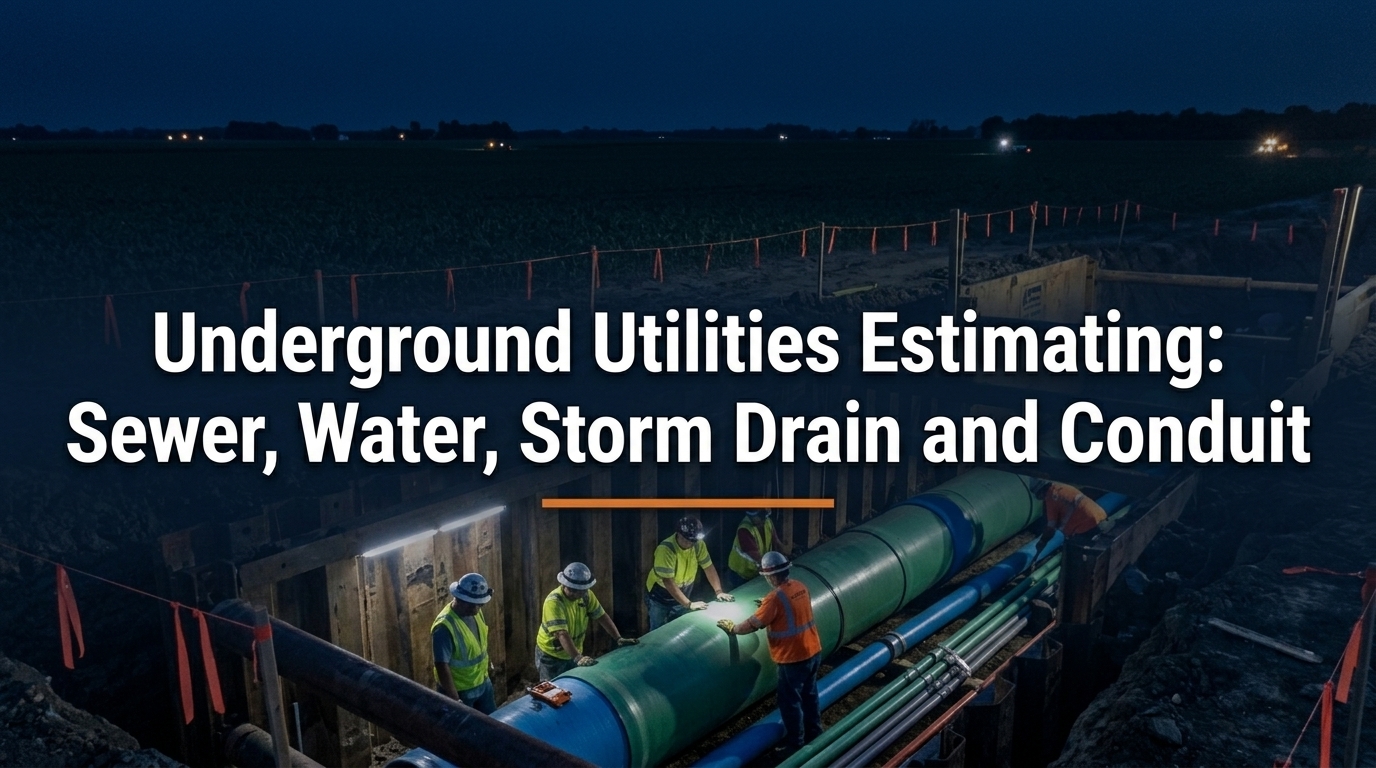
Underground utility estimating is the most depth-dependent scope in site construction. Every foot of additional depth adds trench excavation cost, adds shoring cost where required, adds pipe bedding material, and adds backfill. A sanitary sewer manhole at 8 feet deep costs almost twice as much to install as the same manhole at 4 feet deep. An estimator who prices all utility work at a flat rate per linear foot without accounting for installation depth consistently produces inaccurate bids on any project with significant grade variation or deep utility lines.
This guide covers exactly how professional utility estimators read civil utility plans, measure each utility system separately, calculate trench volumes, count structures and appurtenances, and price the complete installed scope for accurate commercial site utility bids in 2026.
For professional underground utility takeoffs with 98% accuracy and 24 to 48 hour turnaround, The Virtual Estimation serves civil and site contractors across all 50 states. Contact us at info@thevirtualestimation.com or visit our construction estimating services page.
What Underground Utility Estimating Requires Before Measuring Begins
Professional utility estimators gather five documents before starting any takeoff: the utility plan, the grading plan, the utility profile drawings, the structure detail sheets, and the project specifications.
The utility plan shows the horizontal layout of every underground system on the site sanitary sewer, storm drainage, water main, fire line, gas, electrical conduit, and telecommunications. Each system uses a different line type defined in the drawing legend. The grading plan shows the finished grade across the site, which the estimator uses to calculate pipe cover depths at every location.
The utility profile drawings are critical and are often overlooked by estimators working only from the plan view. Profiles show the vertical alignment of each utility run the slope of the pipe, the invert elevations at each structure, and where utility crossings occur. Without the profiles, the estimator cannot accurately calculate trench depths or identify conflicts between crossing utilities that require special installation sequencing.
The structure detail sheets show the dimensions and construction of every manhole, catch basin, junction structure, and headwall. These details define the structure depth range and the construction materials, which directly affect unit pricing.
How to Read Utility Plans for Estimating
Utility plans use a standard set of line types and symbols that the estimator must understand before starting any takeoff.
Sanitary sewer appears as a solid line with small arrows indicating the flow direction. Structure symbols for manholes appear as circles. The manhole designation and rim and invert elevations appear adjacent to each symbol.
Storm drainage appears as a dashed line or a line with a different weight from the sanitary sewer. Catch basin symbols appear as squares. Inlet structures and junction boxes appear as larger squares or rectangles.
Water main appears as a heavier solid line typically with a W designation. Fire hydrant symbols appear as specific fire hydrant drawings at hydrant locations. Valve boxes appear as small circles along the water main run.
Electrical conduit banks appear as heavy lines with conduit count and size notations. Underground ductbanks for electrical service entrances typically show the number of conduits and their arrangement in the ductbank cross-section.
Invert elevation is the most important number on any utility plan or profile. It is the elevation of the inside bottom of the pipe at a specific point. The difference between the finish grade elevation and the invert elevation equals the pipe depth plus the pipe wall thickness plus the bedding material under the pipe.
Trench Estimating: The Cost Driver in Underground Utility Work
Trench excavation is the single largest cost item in most underground utility scopes. Every linear foot of pipe installation requires trench excavation, bedding material placement, pipe installation, backfill and compaction, and surface restoration. All of these costs scale with trench depth.
Calculating Trench Dimensions
Trench width is defined in the specifications or the detail sheets for each pipe size. Standard trench widths add a minimum working space on each side of the pipe beyond the pipe outside diameter.
| Pipe Diameter | Minimum Trench Width |
|---|---|
| 4 to 6 inch | Pipe OD plus 18 inches |
| 8 to 12 inch | Pipe OD plus 24 inches |
| 15 to 24 inch | Pipe OD plus 30 inches |
| 27 to 36 inch | Pipe OD plus 36 inches |
| Over 36 inch | As specified or per OSHA |
Trench depth equals the distance from the finished surface to the bottom of the pipe bedding. Bottom of bedding equals the pipe invert elevation minus the bedding thickness, typically 4 to 6 inches of compacted granular material below the pipe.
Trench Volume Calculation
Trench volume in cubic yards equals trench length times trench width times average trench depth divided by 27.
For a 200-foot sanitary sewer run with 2.5-foot average depth, 8-inch pipe (nominal trench width 2.67 feet), the trench volume is 200 times 2.67 times 2.5 divided by 27, which equals 49.4 cubic yards of trench excavation.
Shoring Requirements
OSHA requires shoring, sloping, or benching of any trench deeper than 5 feet. The shoring method depends on the soil classification from the geotechnical report.
| Soil Classification | OSHA Requirement for Trench Over 5 Feet |
|---|---|
| Type A (stable cohesive) | Slope at 3/4H:1V or shoring |
| Type B (medium cohesive) | Slope at 1H:1V or shoring |
| Type C (granular or flowing) | Slope at 1.5H:1V or shoring |
| Unknown or layered | Treat as Type C |
Sloped excavation adds significant extra volume beyond the minimum trench dimensions. For a Type B soil at 1:1 slope with an 8-foot deep trench, the sloped trench width at the top is the bottom trench width plus 2 times the depth, adding 16 feet of width above the minimum. This extra excavation must be calculated and added to the trench volume.
Trench boxes or shoring panels are used when sloped excavation is not practical due to site constraints or adjacent structures. Trench box rental runs $200 to $600 per week depending on size. The estimator calculates the number of weeks of trench box use based on the production rate and the total trench length.
Sanitary Sewer Estimating
Sanitary sewer collects wastewater from buildings and conveys it to the public sewer system or to an on-site treatment facility. Commercial site sewer systems include service laterals from each building, branch sewer mains connecting laterals to collector mains, and the main sewer line connecting to the public system.
Sanitary Sewer Pipe Measurement
Sewer pipe is measured by the linear foot for each diameter and each pipe material. Pipe sizes on commercial sites range from 4-inch service laterals to 15-inch or larger collector mains.
| Pipe Material | Common Application | Relative Cost |
|---|---|---|
| PVC SDR 35 | Gravity sewer, most commercial | Base |
| PVC DR 18 | Pressure sewer force mains | 20 to 40% higher |
| Ductile iron | High load areas, road crossings | 80 to 150% higher |
| HDPE | Directional drill, curved alignments | 60 to 100% higher |
| Concrete RCP | Large diameter collectors | Similar to DI |
The estimator measures each pipe run from manhole to manhole on the utility plan, confirming pipe sizes from the plan notation and pipe slopes from the profile drawings. Each pipe size and material is a separate line item because unit costs differ significantly.
Manhole Counting and Depth Pricing
Manholes are counted from the utility plan. Every manhole requires separate pricing based on its depth because manhole cost increases approximately linearly with depth.
Precast concrete manholes are the standard for most commercial sewer installations. The base section includes the manhole slab and the first riser section. Additional riser sections are added for every additional 4 feet of depth. The cone section sits at the top to transition from the riser diameter to the 24-inch frame and cover opening.
| Manhole Component | Unit |
|---|---|
| Manhole base (to 4 feet depth) | Each |
| Additional riser sections | Each section per 4 feet |
| Cone section | Each |
| Frame and cover | Each |
| Steps | Each |
| Manhole frame adjustment rings | Each |
The estimator calculates the depth of each manhole from the rim elevation shown on the plan and the lowest pipe invert elevation entering or leaving the manhole. Rim elevation minus lowest invert elevation equals the inside depth. Adding 12 inches for the slab thickness gives the total manhole depth for pricing purposes.
Service Laterals and Cleanouts
Building service laterals connect from each building's sewer stub-out to the main sewer line. Laterals are measured from the building connection point to the manhole or sewer main connection. Each lateral includes a cleanout at the property line or at the building foundation, depending on local code requirements.
Cleanouts are priced as each, including the cleanout body, the watertight plug, and the concrete pad or extension to grade. One cleanout per lateral at minimum, two cleanouts on laterals longer than 100 feet.
Storm Drainage Estimating
Storm drainage collects surface runoff from paved areas, roofs, and landscaping and conveys it through a piped system to detention facilities, infiltration systems, or direct outfall to streams and channels.
Storm Drain Pipe Measurement
Storm drain pipe is typically larger diameter than sanitary sewer because it must handle peak storm flows. Pipe sizes range from 12-inch inlets to 48-inch or larger trunk mains on commercial sites.
Reinforced concrete pipe is the standard for storm drainage in most commercial applications. HDPE corrugated pipe is used where weight is a consideration or where flexible pipe is advantageous for installation. Both materials are measured by the linear foot for each diameter.
The estimator measures each storm drain run from structure to structure on the utility plan, recording the pipe size and length for each segment. The slope of each run, shown on the profile, confirms the pipe depth at each end and determines the trench depth calculation for each segment.
Catch Basin and Inlet Counting
Catch basins collect surface runoff at pavement low points. Inlets collect runoff at curb lines. Junction boxes connect multiple pipes without collection function. Each structure type is counted from the utility plan and priced based on its depth and inlet configuration.
| Structure Type | Pricing Basis |
|---|---|
| Standard catch basin to 4 feet | Each |
| Deep catch basin, per additional foot | Linear foot |
| Curb inlet | Each |
| Area drain | Each |
| Junction box | Each, by size |
| Outlet control structure | Each, by design |
Trash racks, outlet protection riprap, and erosion control at outfall locations are separate line items counted from the detail drawings.
Water Main Estimating
Water main distributes potable water from the public main to the building service connections and to fire hydrants throughout the site.
Water Main Pipe Measurement
Water main pipe is measured by the linear foot for each diameter. Ductile iron is the standard material for commercial water mains. PVC pressure pipe is used in some applications where soil conditions allow it and local codes permit.
| Pipe Size | Common Application |
|---|---|
| 4 inch | Service laterals, short dead ends |
| 6 inch | Standard site distribution |
| 8 inch | Primary site loop, fire flow required |
| 12 inch | High-demand sites, large facilities |
The estimator measures each water main run from valve to valve, recording the pipe size and length. The water main profile shows the pipe depth, which is typically 4 to 6 feet of cover over the top of the pipe in most climate zones. In cold climates, the minimum cover increases to prevent freezing.
Fittings and Valves
Water main fittings — elbows, tees, reducers, and crosses — are counted individually from the utility plan at every direction change, branch connection, and size transition.
Gate valves or butterfly valves are located at every branch connection, at regular intervals along the main, and at the connection to each building service. The estimator counts every valve from the plan and prices each valve assembly including the valve, the valve box with extension, the concrete pad, and the operating nut extension if required.
Thrust Blocks
Thrust blocks are concrete poured against undisturbed soil at every fitting that changes the direction or velocity of water flow. They resist the unbalanced hydraulic forces at elbows, tees, reducers, and dead ends.
The thrust block size is calculated from the pipe size and the operating pressure. The estimator calculates the concrete volume for each thrust block location and adds the forming and placement labor. A simplified approach uses a standard thrust block allowance per fitting type and size from the detail drawings.
Fire Hydrant Assembly
Each fire hydrant assembly includes the hydrant barrel and head, a 6-inch lead pipe from the water main, an isolation valve with valve box, and a concrete anchor block. The estimator counts every hydrant from the utility plan and prices the complete assembly for each one.
Fire hydrant spacing requirements come from the fire code based on the building occupancy and size. The estimator verifies that the hydrant count on the plan meets the code requirements for the project.
Electrical and Communications Conduit Estimating
Underground electrical conduit for site lighting, parking lot lighting, utility service entrance ductbanks, and site communications is measured and priced similarly to above-grade conduit but with the additional cost of trench excavation and backfill.
Conduit Ductbank Measurement
Electrical service entrance ductbanks carry multiple conduits from the utility transformer pad or vault to the building electrical service entrance. The ductbank cross-section shows the number of conduits, their arrangement, and the dimensions of the concrete encasement.
The estimator measures the ductbank length from the utility plan and prices the complete installed ductbank including trench excavation, bedding sand, conduit supply, conduit spacers, concrete encasement pour, backfill, and surface restoration.
The number of conduits in the ductbank is confirmed from the electrical engineer's site plan or from the utility company's specifications. Spare conduits — empty conduits installed for future use — are typically included at the utility company's requirement and must be priced even though they carry no current conductors at the time of installation.
Site Lighting Conduit
Site lighting conduit connects each light pole base to the lighting panel or to the next pole in the circuit. The estimator traces each lighting circuit on the site plan, measuring the conduit run from the panel to each pole and from pole to pole along the circuit.
Each pole base includes a conduit stub-out from the base to grade level where it connects to the underground run. The pole base stub length is typically 18 to 24 inches and is included in the pole base unit price rather than the underground conduit measurement.
Pipe Bedding and Backfill Estimating
Every underground utility requires bedding material under the pipe and select backfill above the pipe to the trench zone boundary.
Bedding Material Calculation
Pipe bedding is granular material placed at the trench bottom to provide uniform support under the pipe. Bedding thickness is typically 4 to 6 inches below the pipe bottom and 6 to 12 inches above the pipe top to the zone boundary, as specified in the detail drawings.
The bedding volume for each pipe run is calculated as the trench width times the bedding thickness times the run length, divided by 27 for cubic yards. The estimator prices bedding material at the delivered cost per ton converted from cubic yards using the material density.
Trench Backfill
Trench backfill above the bedding zone uses either compacted on-site material or imported granular material depending on the specifications and the suitability of the excavated soil.
| Backfill Zone | Material | Compaction |
|---|---|---|
| Pipe zone (bedding to 12 in above pipe) | Granular, imported | 90 to 95% Proctor |
| Haunch zone (below pipe springline) | Granular, imported | 90% Proctor |
| Initial backfill (12 in above pipe to zone boundary) | Granular preferred | 90% Proctor |
| Final backfill (zone boundary to grade) | On-site if suitable | 95% Proctor under paving |
Under pavement, all backfill typically requires granular material compacted to 95 percent Proctor. Under landscaped areas, on-site material compacted to 90 percent is usually acceptable. The estimator confirms the backfill specification for each zone and prices accordingly.
Surface Restoration
Surface restoration after underground utility installation is a significant cost item that is often underestimated.
Under new asphalt paving that will be placed as part of the project, the trench surface is included in the paving scope and requires only fine grading to the correct subgrade elevation. In this case, no separate surface restoration is needed.
Under existing paving that must be cut and restored, the estimator adds saw cutting of the existing pavement before trenching and asphalt patch replacement after backfill. Saw cutting runs $3 to $8 per linear foot for a standard 14-inch cut width. Asphalt patch replacement is priced per ton or per square foot of patch area at a premium over new paving because of the smaller quantities and the match-to-existing requirement.
Under existing concrete sidewalk or curb, the estimator adds concrete removal before trenching and new concrete replacement after backfill. The removal cost includes saw cutting, breaking, and disposal. The replacement cost includes forming, pouring, and finishing new concrete to match the existing.
How Underground Utility Estimating Connects to Related Trades
Underground utility estimating connects directly to several other trade scopes on every commercial site.
The earthwork estimating guide covers the rough grading that establishes the site grades before utility installation begins. Confirming the scope boundary between rough grading and utility trench excavation prevents double-counting of the trench excavation volume in both scopes.
The sitework estimating guide covers asphalt paving and curb work that follows utility installation. The utility contractor typically installs all underground systems before the paving contractor begins base course preparation.
The plumbing estimating guide covers the building sewer and water service inside the building. The site utility contractor typically terminates at 5 feet outside the building foundation wall. Confirming this boundary with the plumbing contractor prevents scope gaps at the building connection point.
For civil and site contractors working across Texas, California, Florida, and all major US construction markets, visit our service areas page for regional estimating support.
The Virtual Estimation delivers complete underground utility takeoffs within 24 to 48 hours at flat-rate pricing. Email info@thevirtualestimation.com to submit your drawings and receive a quote within one hour.
Frequently Asked Questions About Underground Utility Estimating
How does pipe depth affect underground utility cost?
Pipe depth affects four costs simultaneously: trench excavation volume increases with depth, shoring requirements begin at 5 feet and add significant cost on deeper trenches, manhole and structure costs increase with every additional vertical foot of depth, and safety requirements become more stringent at greater depths. A utility run at 10 feet average depth typically costs 60 to 100 percent more per linear foot than the same pipe at 4 feet average depth.
What is the most commonly missed item in underground utility estimates?
Service connections from the main lines to individual buildings are the most frequently missed items. The utility plan shows the main lines clearly but service laterals are sometimes shown only as short stubs or on a separate detail drawing. Every building on the site requires a sanitary sewer lateral, a water service connection, and in most cases an electrical conduit stub from the site ductbank. Missing these connections can represent 15 to 25 percent of the total utility scope on a multi-building commercial site.
Should I estimate utility crossings separately?
Yes. Where utilities cross each other at the same depth, one line must be lowered or the other raised to maintain the required separation distance. OSHA and utility standards require minimum separations of 18 inches between water and sewer and 12 inches between other utility types. Each crossing that requires vertical adjustment adds special bedding, pipe encasement, or lowering that is a separate scope item from the standard trench installation.
How do directional drilling costs compare to open trench installation?
Horizontal directional drilling installs pipe under existing pavement, buildings, or obstacles without open trench excavation. HDD costs typically run 3 to 8 times the cost of open trench installation for the same pipe type and diameter because of the specialized equipment, the pilot bore, and the pullback operation. HDD is cost-effective when open trench would require disrupting heavily trafficked roads or when environmental permits prohibit open excavation.
What file formats work best for underground utility takeoffs?
PDF civil drawings at correct scale work with all digital takeoff tools. DWG files allow direct measurement. For best results, submit the utility plan, the grading plan, the utility profiles, and the structure detail sheets together at submission. Email files to info@thevirtualestimation.com to start your underground utility estimate.