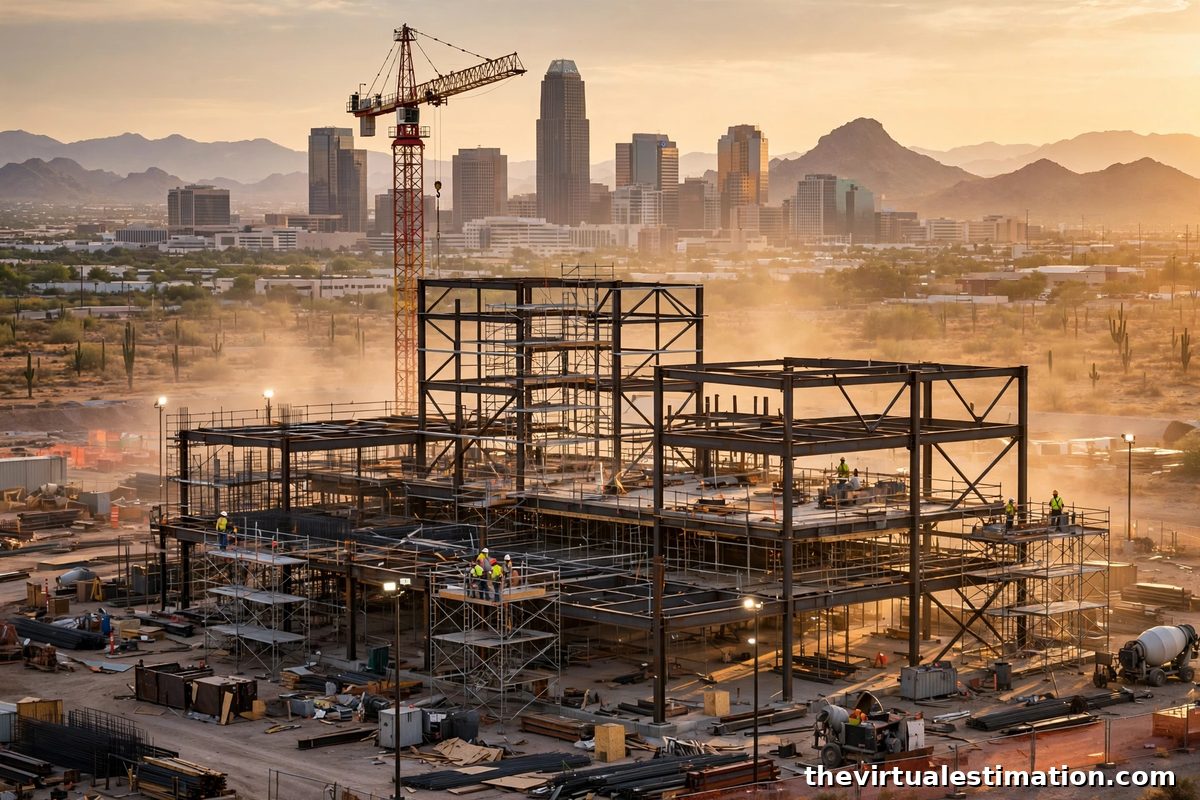
Phoenix does not bid like the rest of the Sun Belt, and any estimate built on a national average will prove it. This is a market where a semiconductor campus in north Phoenix can pull electricians off your commercial job, where a summer pour scheduled for noon can cost you a crew, and where the permit fee on two identical buildings can differ because one sits in Phoenix and the other sits in a neighboring Valley city. If you want to win work in the Valley of the Sun and keep your margin, you need a Phoenix estimate, not a generic estimate with Phoenix typed into the header.
This guide covers what is actually getting built in Phoenix in 2026, what permits and labor really cost, which desert conditions change your numbers, and how to bid so the heat, the soil, and the labor market do not eat your profit. It is written for general contractors, subcontractors, and developers pricing real projects in Maricopa County. For a full quantity takeoff on your drawings, construction estimating services from The Virtual Estimation can price the job line by line before you submit.
What is actually getting built in Phoenix right now
The headline driver is semiconductors. TSMC's campus near Loop 303 and Interstate 17 in north Phoenix has grown from an initial fab announcement into a planned cluster reported at $265 billion, with 12 fabrication and packaging facilities plus a research center. The first fab is producing chips on the 4-nanometer process, the second fab is aimed at 3-nanometer volume production in 2027, and a third fab has broken ground. Around it, a roughly 2,300-acre development called Halo Vista is preparing industrial construction, Amkor is expanding advanced packaging in Peoria, Intel continues to anchor Chandler, and data center builders including Meta, Google, CyrusOne, and Digital Realty are active across the west Valley.
That matters to you even if you never bid a fab. Every one of those projects hires from the same trade pool, buys from the same suppliers, and creates housing demand for thousands of workers. ConstructConnect reported that Maricopa County manufacturing construction starts, on a 12-month moving average, rose from $14.7 million in October 2020 to $2.7 billion in October 2025. The secondary wave follows the fabs: warehouses and logistics buildings along Loop 303 and Interstate 10, supplier facilities, hotels, retail, schools, clinics, and housing in Peoria, Glendale, Surprise, Buckeye, and Goodyear.
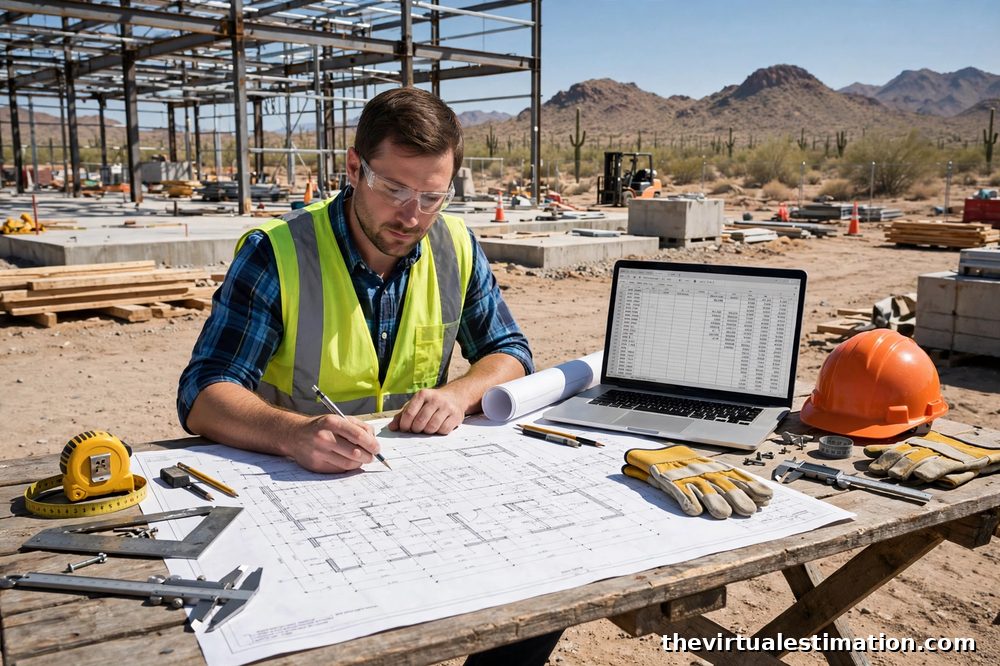
At the same time, the residential side is split. A wave of roughly 30,000 new rental units came online across the metro heading into 2026, softening rents in several Valley cities and pushing landlords to offer concessions. That does not mean multifamily work stopped. It means developers are pickier, lenders are tighter, and a multifamily estimate with soft numbers will not survive value engineering. Single-family building continues in the growth corridors, especially Buckeye, Queen Creek, and the northwest Valley, while casitas and accessory dwelling units remain a steady niche inside Phoenix itself.
Price each segment on its own terms: industrial and semiconductor-adjacent work is hot and labor-competitive, data centers and warehouses are steady, multifamily is selective, and ADU work rewards accurate small-job pricing.
The permit math: a worked Phoenix example
Phoenix permit fees are valuation based, which means the fee follows the declared construction value, not just the square footage. The City of Phoenix Planning and Development fee schedule effective January 20, 2026 sets tiered permit fees, and plan review for projects valued above $50,000 runs at 80 percent of the permit fee, with minimums applying. Certain review services are billed at $195 per hour. That structure produces a very different total from a flat-fee city, so run the math on every bid instead of carrying a plug number from your last job.
Here is a worked example using the published valuation table. Take a commercial project valued at $500,000. The table charges $1,601 for the first $200,000 plus $7 for each additional $1,000 of valuation. The additional $300,000 adds $2,100, for a permit fee of $3,701. Plan review at 80 percent adds $2,961. The combined permit and plan review total is $6,662, before grading, drainage, inspection, impact, or utility fees. That is the number to carry, not the permit fee alone.
| Valuation band | Published permit fee basis |
|---|---|
| $1,001 to $10,000 | $150 for the first $1,000, plus $9 per additional $1,000 |
| $10,001 to $50,000 | $231 for the first $10,000, plus $8 per additional $1,000 |
| $50,001 to $200,000 | $551 for the first $50,000, plus $7 per additional $1,000 |
| $200,001 to $1,000,000 | $1,601 for the first $200,000, plus $7 per additional $1,000 |
| $1,000,001 to $10,000,000 | $7,201 for the first $1,000,000, plus $4 per additional $1,000 |
For smaller residential work, published 2026 cost guides put a typical Phoenix building permit in the $500 to $3,180 range, with a room addition around $1,100 and simpler permits far lower. A detached casita is a different animal: recent Phoenix ADU cost guides put standard construction at $325 to $375 per square foot, with permit and impact fees adding $10,000 to $25,000 on top. If your casita estimate shows a $2,000 fee allowance, you are already short before the first inspection.
Three permit traps catch out-of-town bidders. Re-inspection fees and revision reviews stack up fast when plans change mid-job, so price at least one re-inspection cycle on complex work. Grading and drainage review is a separate cost driver on desert lots that need retention or flood control. And Phoenix fees are not Valley fees: Scottsdale, Mesa, Tempe, Chandler, Peoria, and Glendale each run their own schedules. Confirm the jurisdiction from the parcel, not the mailing address, because a Phoenix mailing address can sit inside another city's limits.
Labor in the Valley: two markets in one city
Phoenix labor looks affordable on a national table and expensive on a fab-adjacent jobsite, and both facts are true. Bureau of Labor Statistics mean hourly wages for the Phoenix-Mesa-Chandler metro put electricians at $30.95, plumbers and pipefitters at $33.95, carpenters at $29.03, HVAC installers at $29.91, and construction laborers at $23.40. Those are mean wages, not burdened billing rates, and not what a semiconductor or data center job pays.
| Trade (Phoenix-Mesa-Chandler mean wage) | Hourly wage | What to watch in 2026 |
|---|---|---|
| Electricians | $30.95 | Fab and data center premiums run well above the mean |
| Plumbers and pipefitters | $33.95 | UA Local 469 pipefitter rates reported above $43.90 on fab work |
| Carpenters | $29.03 | Non-union rough and form work typically $20 to $31 |
| HVAC installers | $29.91 | Cooling load drives demand every summer |
| Construction laborers | $23.40 | Heat and dust make retention a real cost |
Market postings for 2026 put journeyman electricians on semiconductor and data center sites at $40 to $55 per hour, and journeyman pipefitters at $43.90 per hour or more on fab work. That gap is your estimating problem. If you price a commercial tenant improvement in north Phoenix at the metro mean wage while a fab down the road pays a $15 premium, your crew will leave, your schedule will slip, and your replacement labor will cost what the market charges that week, not what your estimate assumed.
Arizona is a right-to-work state with a largely non-union commercial market, and it has no state prevailing wage law for private work. Federally funded work is different: Davis-Bacon wage determinations apply, and those rates must be priced trade by trade from the determination for the project, not from a metro average. On private work, the practical rule is simple. Price the labor market you are actually hiring from. A job near Loop 303 competes with fab wages. A job in south Phoenix or the southeast Valley competes with a different pool. A single Valley-wide labor rate is a fiction, and it will cost you on one end or the other.
Also carry the burden honestly. Workers compensation, payroll taxes, insurance, supervision, small tools, and travel across a wide metro all belong in the labor line. Compare burdened rates and crew composition, not bare wages, when you benchmark against a competitor.
Heat, dust, and dirt: the desert line items most estimates miss
Phoenix sits in Climate Zone 2, hot and dry, and the climate is not background scenery. It changes quantities, productivity, and schedule, and an estimate that ignores it will look precise and still lose money.
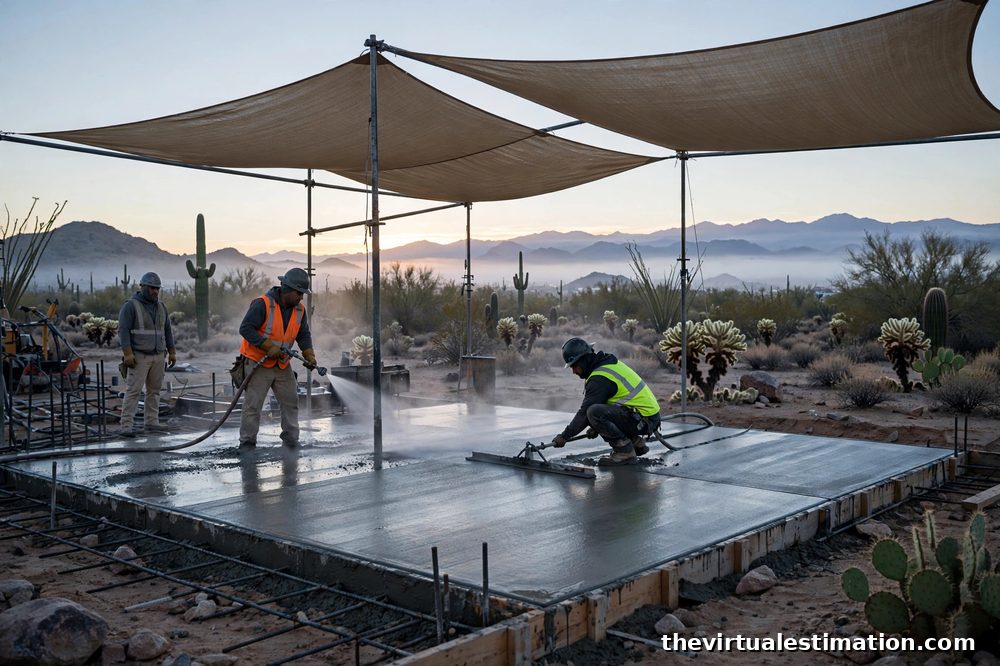
Start with heat. Summer temperatures regularly pass 110 degrees, and heavy work in the middle of the day is slow, dangerous, and sometimes impossible to staff. Price early starts, shade structures, water and ice, rest rotations, and heat illness prevention into your general conditions. Concrete work is the clearest example: early morning pours, curing compounds, evaporation control, and protection from rapid moisture loss are not extras in Phoenix, they are the job. A slab poured at noon in July without a curing plan is a callback waiting for a change order fight.
Next, price the cooling load. High-performance windows, radiant barriers, reflective roofing, duct design, and right-sized HVAC equipment add $2,000 to $5,000 above national averages on a typical casita, according to recent Phoenix ADU cost guides, and the same logic scales to houses and small commercial buildings. Undersize the system and the owner pays in comfort complaints. Oversize it and you pay in equipment cost and short cycling. The estimate should show the HVAC scope as a designed system, with Manual J loads and ductwork, not as a tonnage allowance copied from another climate.
Then there is the ground. Caliche, a cemented desert soil, and expansive soils can turn a routine excavation into rock breaking, over-excavation, engineered fill, or a redesigned foundation. Budget a geotechnical report on any project where the soils are unknown, and carry a defined allowance for rock excavation with a clear unit price for extra work. Monsoon season, roughly June through September, brings dust storms and sudden downpours that shut down crane work, flood open excavations, and delay inspections. Build weather days into the schedule for summer work, protect open trenches and materials, and price stormwater and dust control measures that the site will actually need.
Water deserves its own pre-bid check. Supply is scrutinized for new subdivisions in the Phoenix Active Management Area, so confirm water, sewer, and fire flow capacity early. A project that looks feasible on paper can stall on utility capacity, and hydrant flow testing belongs in the pre-bid checklist, not in a post-award surprise.
Codes and jurisdictions: Phoenix is not the whole Valley
The City of Phoenix building construction code is based on the 2018 International Building and Residential Codes with local amendments, and the city updates its codes through a Development Advisory Board process rather than on a fixed cycle. Recent Phoenix code updates added electric vehicle charging readiness for new homes, streamlined connections to existing sewer infrastructure with water-efficient fixtures, and approval of mass timber construction up to 18 stories. That last point matters for mid-rise developers: mass timber can cut schedule and cost against steel and concrete on the right project, but only if the estimate prices the timber package, fire protection, and connections correctly.
Do not assume the code edition from your last Valley job. Verify the adopted code, amendments, and energy path for the specific jurisdiction before you price, because the city, the county, and neighboring cities can differ on energy, fire, grading, and native plant rules. Native plant protection carries its own permits and relocation costs on desert sites in some jurisdictions. If the drawings are silent on a code item, raise it as a clarification before bid day, not as a change order after award.
What Phoenix projects cost to build in 2026
Use these ranges as estimating anchors, not as quotes. Every project needs its own takeoff, and the ranges below come from the published sources cited in this guide, adjusted for the Phoenix market conditions described above.
| Project type | 2026 Phoenix planning range | Main cost driver |
|---|---|---|
| Standard residential build or casita | $325 to $375 per square foot | Cooling, envelope, and permit plus impact fees of $10,000 to $25,000 |
| Commercial tenant improvement | Price per scope, not per square foot | Labor competition near fab and data center sites |
| Warehouse and light industrial | Price per scope, with steel and concrete as swing items | Tariff pressure on steel, aluminum, and copper |
| Multifamily | Selective, lender-tested budgets | Softening rents demand tighter estimates |
The direction of travel matters as much as the level. Mortenson's Construction Cost Index for the third quarter of 2026 put Phoenix non-residential construction costs up 6.32 percent year over year, above the national 5.60 percent, with mega projects named as the primary driver. Quarter over quarter, Phoenix rose 1.21 percent against a national 1.58 percent, which suggests the market is hot but not runaway. The Bureau of Labor Statistics counted an average of 41,200 workers in construction of buildings in Phoenix in the first half of 2026, up 4 percent from the same period in 2025, so labor is available, but the premium trades are the ones every big project wants.
On materials, budget with current supplier quotes and a dated price validity, not a national index from last quarter. Tariff-driven increases on steel, aluminum, and copper are showing up directly in 2026 bid prices. Lock steel and equipment pricing in writing where the bid schedule allows it, and state the validity in your bid letter.
How to bid Phoenix work without giving margin away
Winning in Phoenix is not about being the cheapest number on the bid tab. It is about being the number the owner can trust. Owners and general contractors in this market have seen low bids turn into change order battles, and they remember which estimators priced the permit, the soil, and the summer honestly.
Price the jurisdiction, not the metro. Pull the fee schedule, the code edition, and the inspection process for the actual city or county. Price the labor pool, not the metro mean. If the job sits near a fab or data center corridor, price the premium and explain it in one sentence in your bid letter. Price the season, not the calendar. A June start and a November start are different jobs in Phoenix, and the schedule, the concrete plan, and the crew plan should show that you know it.
Break out the items owners question most: permits and impact fees, soils and rock excavation, HVAC design and equipment, and general conditions for heat management. A transparent estimate invites fewer challenges than a low lump sum, and a line item the owner accepted before award is far easier to defend than a cost discovered after mobilization. For general contractors assembling a full bid, GC estimating support can keep trade scopes aligned so gaps between packages do not become your problem at the end of the job.
Finally, protect your schedule in writing: assumed start date, crew size, inspection sequence, and weather allowance, plus what happens if the owner changes scope. In a fast market, the change order is where margin is won or lost, and a bid that is clear about assumptions is the bid that gets you invited back.
Phoenix estimating checklist before you submit
- Confirm the jurisdiction and pull its current fee schedule, not the neighboring city's.
- Run the valuation-based permit and plan review math, and carry re-inspection allowance.
- Price labor from the trade pool near the site, with fab and data center premiums where they apply.
- Check Davis-Bacon applicability on any federally funded scope.
- Order or confirm the geotechnical report, and price rock excavation as a defined unit.
- Plan concrete pours for early morning, with curing and evaporation control priced.
- Confirm water, sewer, and fire flow capacity before you finalize site work pricing.
- Verify the adopted code edition and energy path, including EV readiness and mass timber options.
- Date every material quote, state its validity, and lock steel and equipment pricing where possible.
- Show permit, soils, HVAC, and heat management as separate lines, not hidden allowances.
Frequently asked questions about construction estimating in Phoenix
How much do Phoenix building permits cost?
Phoenix permit fees are valuation based under the fee schedule effective January 20, 2026. A $500,000 commercial project works out to about $3,701 in permit fees plus $2,961 in plan review, for $6,662 combined before other fees. Smaller residential permits typically run $500 to $3,180, while a casita can carry $10,000 to $25,000 in permit and impact fees. Always confirm the schedule for the exact jurisdiction.
Why are Phoenix construction costs rising faster than the national average?
Mortenson's third quarter 2026 index put Phoenix non-residential costs up 6.32 percent year over year, above the national 5.60 percent, driven mainly by mega projects. Semiconductor, data center, and industrial work is pulling premium labor and materials into the same market where housing, warehouse, and commercial projects also compete.
What should out-of-state contractors price differently in Phoenix?
Price the specific jurisdiction's fees and codes, the labor premium near fab and data center corridors, summer heat management and early concrete pours, caliche and expansive soils, monsoon schedule risk, and cooling system design for a hot, dry climate. A national template that misses those five items will underprice the job and overpromise the schedule.
Phoenix rewards estimators who respect the desert and the market at the same time. The work is real, the growth is real, and the contractors winning the best projects are the ones whose numbers hold up in July, in inspection, and at final payment. If you are pricing a Phoenix project and want numbers you can defend, The Virtual Estimation provides detailed takeoffs and estimates for contractors across the Valley. Send your plans to info@thevirtualestimation.com or start with construction estimating services and get a bid-ready estimate before your next Phoenix deadline.