Ask five Atlanta contractors what a permit costs and you will get five different answers, and all five of them may be right. That is the first thing you need to understand about estimating construction work in metro Atlanta: "Atlanta" is not one permitting city. It is the City of Atlanta plus Fulton, DeKalb, Gwinnett, Forsyth, Cherokee, and a ring of fast-growing exurban counties, each with its own fee schedule, review clock, and plan review quirks. A bid priced as if the whole metro were one jurisdiction is wrong before the first takeoff line is even written.
This guide is written for contractors and developers who bid work across that metro, and for owners trying to read a bid and tell whether the estimator actually knows the market. It covers the jurisdiction problem first, then 2026 cost ranges, the code change that took effect this year, labor rates, a worked interior example, and the seven costs Atlanta bids most often forget. If you only take one habit from this article, make it this one: name the exact jurisdiction for the parcel on page one of your estimate, and price the permit, the review time, and the inspection sequence for that jurisdiction, not for "Atlanta" in general.
Name the jurisdiction before you price anything
The City of Atlanta itself is split across two counties, Fulton and DeKalb, and the metro sprawl means a job ten minutes down the road can sit under a completely different authority. A warehouse in Gwinnett County, a tenant improvement in a Midtown high-rise, and a ground-up office in Forsyth County go through different doors, and the review times in the table below show why that matters to your bid schedule as much as to your price.
| Jurisdiction | Typical commercial review | What changes your estimate |
|---|---|---|
| City of Atlanta | 4 to 12 weeks; over 25,000 sq ft site plus building, 12 to 20 weeks | Valuation-based fees; tree and arborist review now sits in front of the application for affected sites |
| Gwinnett, Forsyth, Cherokee counties | 8 to 12 weeks for larger site plus building work | Suburban review pace is often steadier, but civil and site work review can still gate the building permit |
| Fulton and DeKalb (outside city limits) | Varies by county and project type | County fire, sewer, and land development reviews run alongside the building review |
On fees, the City of Atlanta's own Office of Buildings page confirms the floor: the minimum cost for a permit is $150, plus a $25 technology fee, with the full fee schedule set out in the City's Code of Ordinances. Secondary summaries of that fee table list $7 per $1,000 of construction cost, but treat that rate as reported, not as a number to copy blindly into a bid, because fee tables are amended and the valuation basis (declared cost versus the city's own valuation) decides the final figure. For a $2 million interior job, the difference between a correct valuation and a guessed one is thousands of dollars, and it lands in your general conditions whether you planned for it or not. When you hire construction estimating services for an Atlanta job, ask whether the estimator priced the permit for the parcel's actual jurisdiction. If the answer is a single flat permit allowance for every metro job, that is a warning sign.
Review time is a cost too, not just a calendar note. Twelve to twenty weeks of review on a large city job means twelve to twenty weeks of carrying costs, extended general conditions, and material price exposure. Smart Atlanta estimators now show two dates on every bid: the permit submittal date and the earliest realistic start date after review, with escalation priced to the second date, not the first.
What construction costs in metro Atlanta in 2026
Terrapin Construction Group's 2026 metro Atlanta cost data puts commercial ground-up work in a wide band, and the width of the band is the point. Tilt-up distribution space is the cheapest commercial product in the metro; cold storage and food processing with an insulated metal panel envelope is the most expensive, because refrigeration, washdown, and panel detailing are not extras, they are the building.
| Project type | 2026 metro Atlanta range | What drives the top of the range |
|---|---|---|
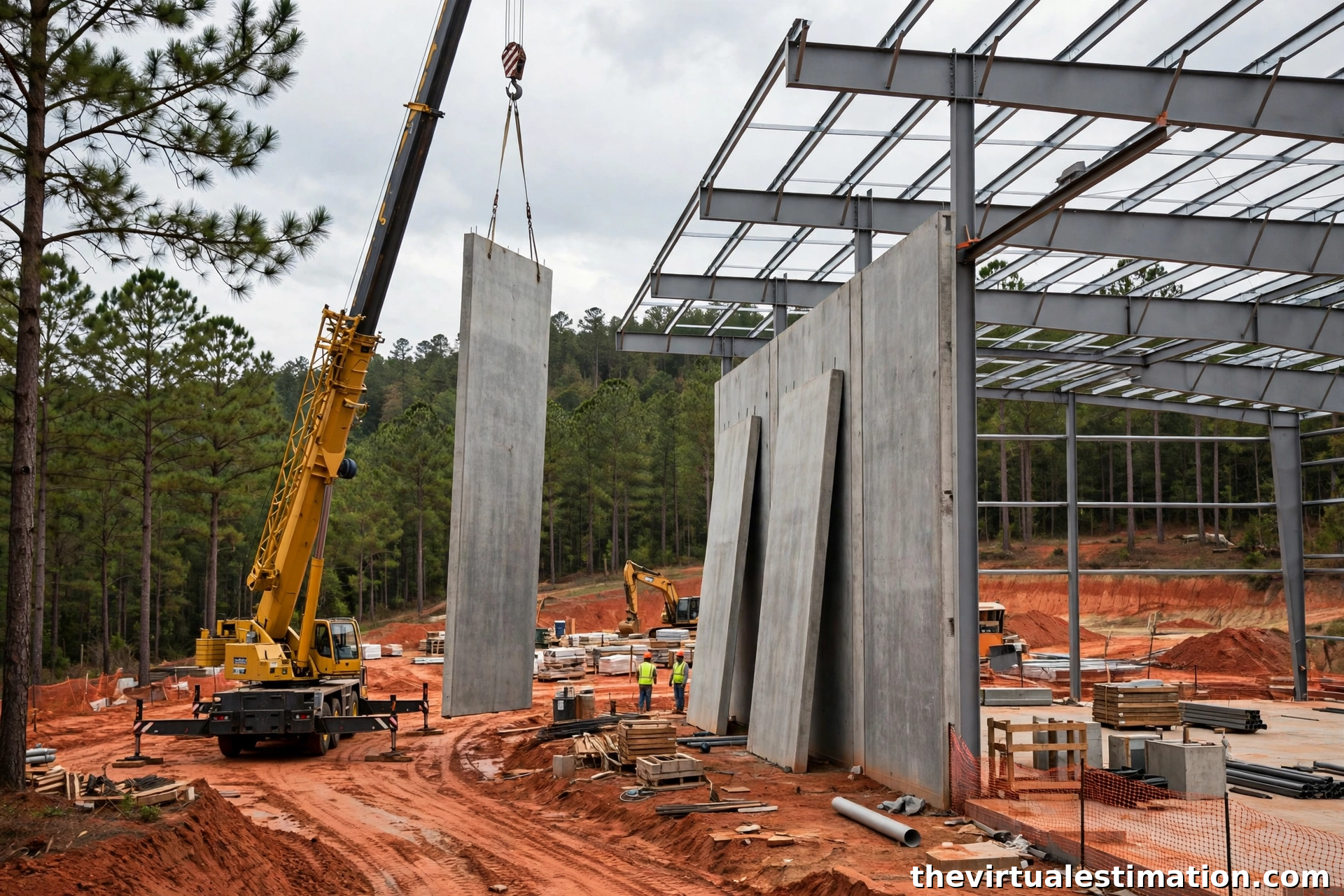
| Tilt-up distribution warehouse | $185 to $235 per sq ft | Dock equipment, ESFR sprinklers, trailer parking, and site work on red clay |
| Class A office interior | $280 to $420 per sq ft | Glass fronts, acoustic ceilings, MEP density, and after-hours work in occupied towers |
| Cold storage or food processing | $260 to $520 per sq ft | Insulated panels, refrigeration, floor flatness, and washdown detailing |
| Residential, production to custom | $130 to over $400 per sq ft | Production homes at the low end; custom and premium metro Atlanta homes at the top |
Those ranges come from a single 2026 commercial cost source, so use them as a sanity band for your own takeoff, not as a substitute for one. A tilt-up bid at $170 per sq ft in 2026 should make you ask what was left out, usually site work, dock levelers, or the fire pump. An office interior at $500 per sq ft should make you ask what is gold-plated, or whether the job is phased nights and weekends in an occupied Midtown tower, which genuinely costs that much. For a general contractor assembling a full bid, GC estimating that separates shell, interiors, site work, and permit and fee lines lets you see which of those questions to ask first.
The code change that quietly moved your takeoff
Atlanta moved to the 2024 International Codes for permit submissions on January 1, 2026, with all new applications required to comply from February 1, 2026. If your takeoff library still prices to the older code cycle, three things have probably drifted. First, energy and envelope requirements can change insulation, glazing, and mechanical sizing, which changes both material quantities and the mechanical subcontractor's price. Second, fire and life safety detailing, including egress and sprinkler coordination, can move ceiling and shaft quantities. Third, any detail your team copied from a 2024 or 2025 Atlanta job without re-checking it against the 2024 codes is now a resubmittal risk, and resubmittals in the city run 5 to 10 business days when the responses are clean, longer when they are not.
Practical fix: before you price an Atlanta job this year, confirm the code edition on the permit application itself, then run your standard details against it. Estimators who do this once per jurisdiction, and keep a one-page code note per county, stop paying the resubmittal tax that quietly eats margin on repeat Atlanta work.
Labor: what Atlanta crews actually cost in 2026
Bureau of Labor Statistics May 2025 figures for the Atlanta area, as compiled in a 2026 metro jobs guide, put annual wages at about $71,490 for electricians, $72,170 for plumbers and pipefitters, $65,630 for carpenters, $63,600 for drywall installers, $52,030 for construction laborers, and $85,390 for cost estimators. Those are employee wages, not burdened billing rates, so do not paste them into a bid as labor cost. Burden, supervision, small tools, and markup sit on top, and the gap between a wage and a bid rate is where inexperienced estimators lose money.
The tighter story in 2026 is competition for the same crews. Hyperscale data centers in Douglas and Coweta counties, battery plants tied to Kia, Rivian, and SK, and film-studio buildouts are all pulling electricians, concrete crews, and interior subs at the same time. One secondary source reports skilled trade wages up 9 to 12 percent year over year in 2026, and switchgear, transformer, and generator lead times of 60 to 110 weeks are now driving sequencing on large jobs. That means an Atlanta estimate written today may need a procurement line the client did not expect: order the long-lead electrical gear at permit submittal, not at groundbreaking, or price the delay. A bid that assumes a 12-week gear delivery in this market is not optimistic, it is fiction.
A worked example: a 10,000 sq ft Midtown office interior
Numbers land better than advice, so here is a simplified interior buildout for a 10,000 sq ft Class A office floor in Midtown, priced inside the $280 to $420 per sq ft band above. This is an estimator's planning example, not a quote, and your actual numbers will move with glass, ceiling, and after-hours requirements.
| Division | Planning allowance | Notes for an Atlanta tower job |
|---|---|---|
| Demolition and prep | $8 to $12 per sq ft | After-hours haul-out and elevator protection in an occupied building |
| Drywall, framing, and ceilings | $38 to $55 per sq ft | Acoustic ceilings and glass fronts push the top end |
| Millwork and doors | $22 to $35 per sq ft | Hardware schedules and lead times on custom fronts |
| Electrical and low voltage | $45 to $70 per sq ft | Density of power, data, and AV in a modern office |
| Mechanical and plumbing | $40 to $60 per sq ft | Rebalancing an existing system, not a new one |
| Flooring, paint, and finishes | $30 to $45 per sq ft | Carpet tile versus hard surface in open areas |
| General conditions and fees | $35 to $55 per sq ft | Permit fees, supervision, and extended review time |
| Total planning range | $218 to $332 per sq ft, before contingency | High-end glass and night work push toward and past $420 |
Read that table the way a reviewer would. The two lines most likely to be underpriced are electrical and general conditions. Electrical is underpriced when the estimator counts devices but not the gear, the panel work, and the low-voltage coordination. General conditions are underpriced when the estimator prices a 4-week review and the city takes 12. Add a 5 to 10 percent estimating contingency on top of the planning range for scope gaps, and show it as its own line, so the client sees it as prudence, not padding.
The Savannah line most Atlanta estimates skip
Atlanta is an inland city with a port-city supply chain. Steel, insulated metal panels, and MEP equipment land at the Port of Savannah and truck up I-16 and I-75 into the metro. One commercial cost source claims that routing shaves 4 to 8 percent off material freight versus inland markets like Nashville or Birmingham. Treat that as a claim to test on your own quotes, not as a discount to bake into every bid, because fuel, driver availability, and port congestion move it quarter to quarter.
What is not a claim is the estimating habit behind it: price freight to the Atlanta site, not to a national average. A panel quote that is FOB Savannah is not an Atlanta price until the trucking, the staging, and the crane time are in it. Estimators who break freight out as its own line catch the jobs where a "cheap" material quote is actually the expensive one once it reaches Gwinnett or Forsyth.
How Atlanta general contractors actually award work
Atlanta's bid rooms in 2026 reward speed and completeness in a specific way. General contractors here are juggling industrial, office, data center, and film work at the same time, which means a subcontractor bid that arrives complete, with alternates priced and exclusions stated, gets read first. A bid that arrives as a single lump sum with no breakdown gets read last, if it gets read at all, because the GC cannot level it against the other three bids without calling you, and the GC does not have time to call everyone.
Three habits win Atlanta work. First, state your exclusions in plain language: permit fees, after-hours premiums, and long-lead gear, each named, so the GC is not guessing what your number leaves out. Second, price alternates the GC actually asked for, plus one value option of your own, because a single alternate that saves the owner real money without cutting performance is remembered on the next job. Third, confirm your crew availability for the actual start date, not the bid date. With data center and battery work pulling the same trades, a bid that promises a crew in January for a March start is only useful if that crew is still free in March.

Seven costs Atlanta bids forget
- Tree and arborist review. Since June 2025, projects in the City of Atlanta that may affect trees must complete an arborist meeting before the permit application. Price the meeting, the survey, and the delay, not just the trees.
- County fire review fees. Fire review sits alongside building review and carries its own fee and timeline, especially for occupied commercial space.
- Red clay site work. Metro Atlanta soils mean erosion control, dewatering, and undercut are not contingency items, they are base scope on many sites.
- Occupied-building premiums. Night and weekend work, elevator protection, and dust control in a Midtown or Buckhead tower are real costs, not goodwill.
- Long-lead gear deposits. Switchgear and generators ordered at submittal need deposit and storage lines, or the schedule slips.
- Reinspection and resubmittal time. Budget at least one resubmittal cycle on a city job, and price the supervision time it consumes.
- Freight to site, not to port. Savannah pricing is only an Atlanta price once trucking, staging, and crane time are added.
Frequently asked questions
How long does a commercial permit take in Atlanta?
For the City of Atlanta, plan on 4 to 12 weeks for a commercial permit, and 12 to 20 weeks for a larger site plus building job over 25,000 sq ft. Suburban counties such as Gwinnett, Forsyth, and Cherokee typically run 8 to 12 weeks for larger work. Always confirm the clock for the parcel's jurisdiction, because a single metro average will mislead you.
What is the minimum building permit fee in the City of Atlanta?
The City's own Office of Buildings page states a minimum of $150 plus a $25 technology fee, with the full schedule in the Code of Ordinances. The total fee is valuation-based, so the final figure depends on the project's declared or assessed construction value.
Which Atlanta building code applies to new applications in 2026?
Atlanta moved to the 2024 International Codes for permit submissions on January 1, 2026, with compliance required for all new applications from February 1, 2026. Check the code edition on your specific application, because county and city adoption notes can differ.
Why do Atlanta estimates vary so much between contractors?
Because the metro is not one market. Jurisdiction, review time, soil, crew competition from data center and battery work, and freight routing all move the number, and two estimators who price different scopes for the same building will produce different totals. A line-item breakdown, not a lump sum, is how you compare them fairly.
Atlanta rewards the estimator who does the unglamorous work first: confirm the jurisdiction, confirm the code edition, confirm the review clock, and only then build the takeoff. Do that, and your bid stops competing on optimism and starts competing on accuracy, which is the only competition worth winning in a market this busy. If you want that discipline applied to your next Atlanta job, talk to The Virtual Estimation, reach the team at info@thevirtualestimation.com, or start with construction estimating services priced for the parcel you actually own, not for "Atlanta" in general.