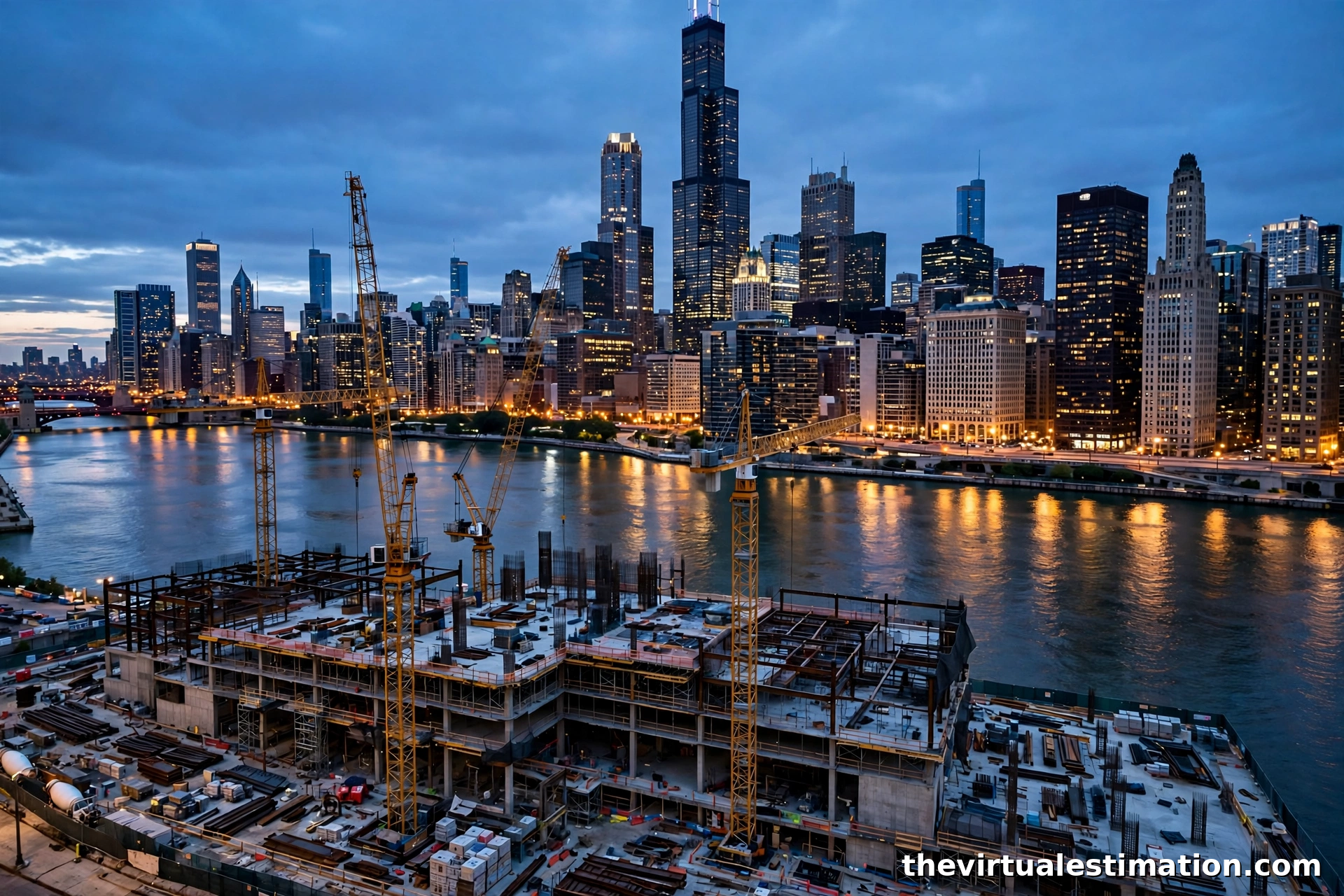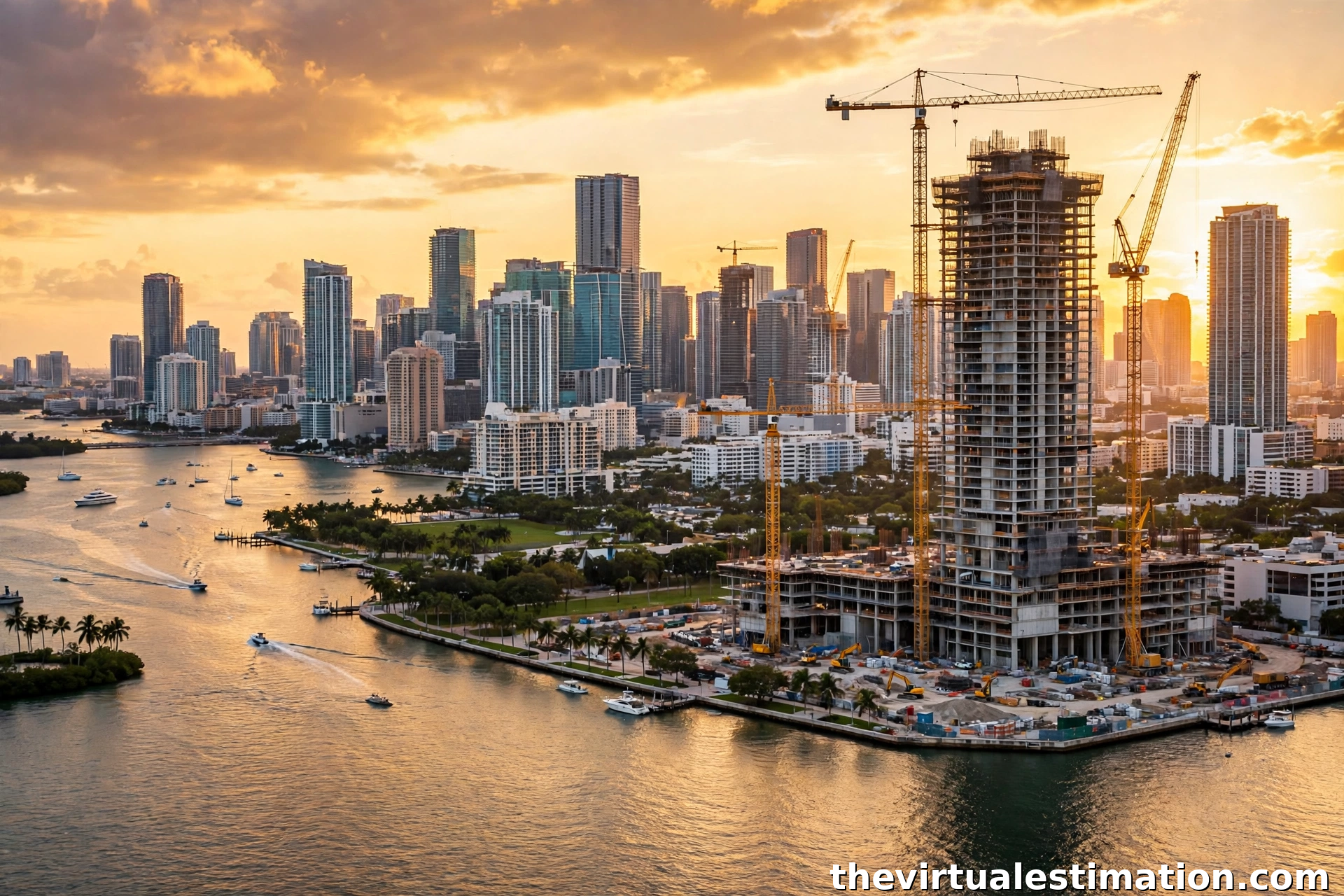
Price a Miami job the way you would price the same job inland, and you will lose money twice: once when a cheap looking bid wins, and again when the permit reviewer, the flood map, and the product approval list send it back. Miami is a different estimating problem, shaped by hurricane wind rules, salt water, a condo stock now under the strictest inspection regime in the country, and a permit system that changes when you cross a municipal boundary. If your estimate does not price those four things separately, it is not a Miami estimate.
In October 2026, the week's largest South Florida permit was a $104.1 million filing for NR Investments' UniDos tower at 1445 North Miami Avenue: a 30 story workforce building of nearly 400 units and 594,800 square feet, with total construction cost reported at $190 million. The same week brought a $46 million University of Miami renovation permit and a $30 million multifamily filing in northwest Miami. A good construction estimating service has to price luxury towers, workforce housing, and institutional renovation without using the same square foot number for each.
First, decide which Miami you are bidding in
There is no single Miami permit counter. The City of Miami, unincorporated Miami-Dade County, Miami Beach, Coral Gables, Doral, and Hialeah each run their own review, fee schedule, and timeline. An address alone does not tell you the authority having jurisdiction. The parcel, zoning, and municipality do, and getting that wrong at takeoff stage means pricing the wrong impact fees and review clock.
Miami Beach is the clearest warning: many projects must pass Design Review Board or Historic Preservation Board review before a permit is even filed, and barrier island flood rules add another layer. Coral Gables adds its own design and historic review culture. Doral and unincorporated Miami-Dade are usually simpler on design, but impact fees still vary by municipality and square footage. Name the municipality and review path in your assumptions, not in a generic "permits" allowance.
| Market | What changes the estimate |
|---|---|
| Brickell and Downtown | High rise towers, crane and logistics costs, tight staging, condo work rules |
| Miami Beach | Design and historic review, higher flood and freeboard rules |
| Coral Gables and Coconut Grove | Older stock, custom detailing, site and tree constraints |
| Doral, Hialeah, unincorporated Miami-Dade | Warehouse and workforce housing volume, fees by municipality |
| Older coastal condos | Recertification and reserve funded repair, priced from an engineer's report |
Published 2026 guides put simple Miami projects around 18 days and complex projects around 28 to 35 days, with Miami Beach running longer. Treat any timeline as an assumption with re-review contingency. Permits generally expire after 180 days without an inspection, and City of Miami guidance puts reinspection fees around $57, so a stalled job starts costing money before it restarts.
The HVHZ premium, priced line by line
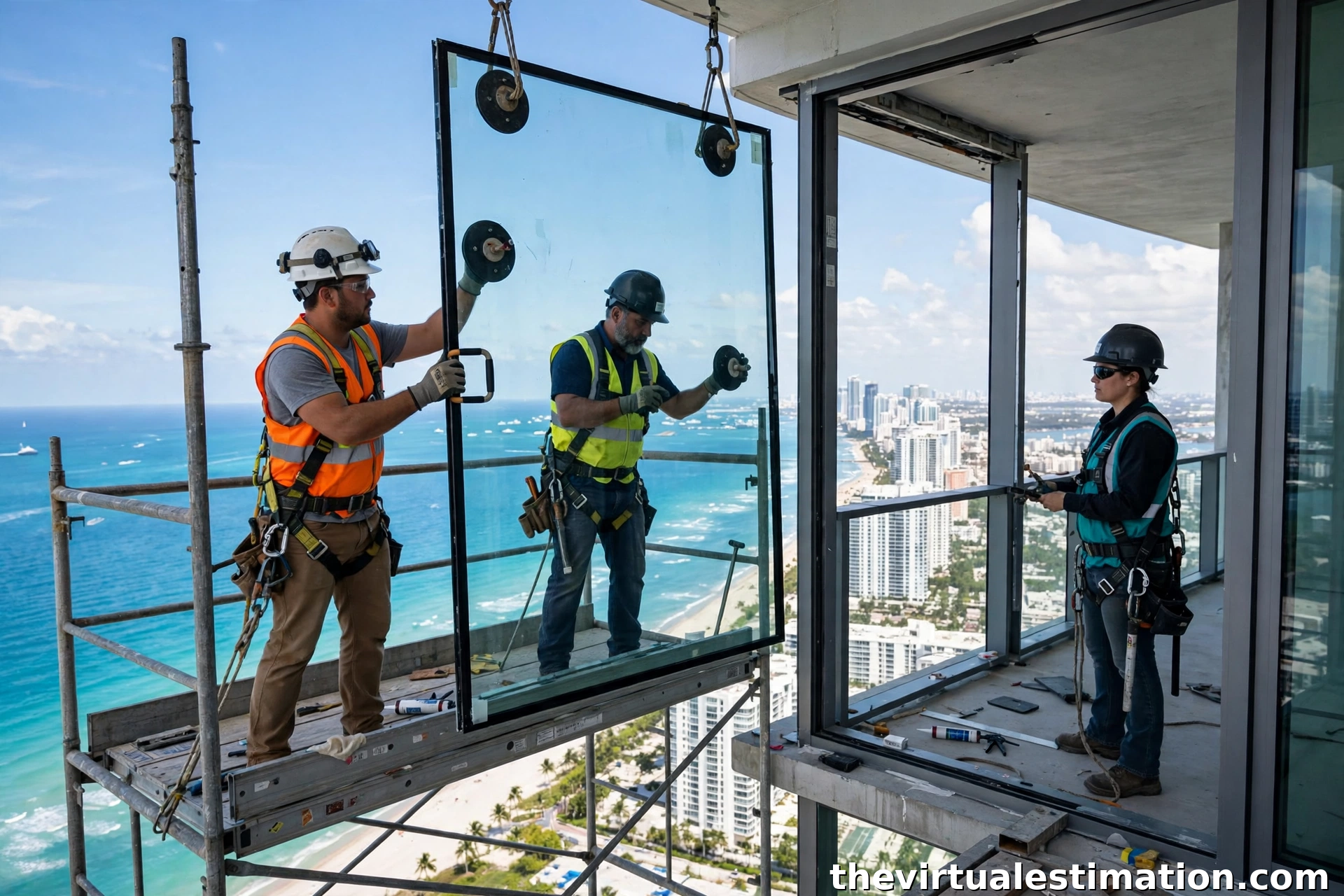
Miami-Dade and Broward are the only two counties in Florida's High Velocity Hurricane Zone (HVHZ), and that fact drives more of the Miami price gap than any other code item. For Risk Category II buildings, the design wind speed in Miami-Dade is typically around 175 mph (3 second gust). The county requires mandatory Exposure Category C, wind borne debris protection countywide, and a Miami-Dade Notice of Acceptance (NOA) for exterior products. Windows, doors, roof coverings, cladding, skylights, and garage doors must pass the TAS 201, 202, and 203 protocols: large missile impact with a 9 pound 2x4, followed by 9,000 pressure cycles. A product without a current NOA is not a cheaper alternate. It is a permit rejection.
Never carry a single "windows" line in Miami. Break it out by opening, product, and NOA number, and price separately: impact glazing or approved shutters for every opening; roof to wall connections, deck fastening, and secondary water barrier details; garage doors and large openings; lead time for NOA products, where a 6 to 10 week order is common and a substitution after submittal can restart review; and inspection sequencing, because a failed envelope inspection holds the trades behind it.
On a general contractor estimate, put HVHZ items in the envelope and general conditions divisions where the reviewer and the sub can both see them, not in a lump sum. When a sub offers an alternate, ask for its NOA number in writing before you accept the price. If the number is expired or for a different assembly, the saving is fictional.
Water sets the floor, literally
Miami estimating also starts below grade. Much of the market sits at low elevation, close to Biscayne Bay, with a high water table and salt in the air and soil. Three water lines show up in almost every honest Miami estimate. First, flood elevation: base flood elevation and freeboard shape finished floor height, fill, foundation design, and equipment placement, especially on Miami Beach, so price the elevation certificate, survey, and fill or flood vent work as named lines. Second, dewatering and soil: a high water table means excavation needs dewatering allowances and a geotechnical report, with Miami-Dade pool guidance routinely budgeting $500 to $1,500 for a soil report. Third, salt and corrosion: salt air accelerates rebar corrosion and concrete spalling, so stainless fasteners, coated rebar, and proper concrete cover belong in the specification and takeoff.
What permits and fees actually cost in 2026
Miami-Dade permit fees are generally valuation based, and impact fees for new construction sit on top, covering schools, parks, transportation, and water and sewer infrastructure. Published 2026 planning ranges show why a flat permit allowance fails:
| Project type | Typical permit cost range reported for 2026 |
|---|---|
| Roof replacement, single family | $300 to $650 |
| Window or door replacement, per opening | $80 to $200 |
| HVAC system replacement | $180 to $320 |
| Pool installation | $1,200 to $2,400 |
| Major addition, 500 to 1,000 square feet | $2,500 to $5,500 |
| New custom home, 3,000 square feet | $18,000 to $32,000, plus impact fees often $8,000 to $24,000 more |
Use these ranges only as a budgeting starting point. The fee that matters is the one the authority calculates from your declared construction value, and that value must match the estimate you bid from.
A worked example: the envelope on a Brickell condo renovation
Take a 1,850 square foot condo interior renovation in a Brickell tower, with 9 window and door openings, a kitchen and two baths, and no structural change. An inland estimator might carry windows as one line. A Miami estimator breaks the job into pieces a reviewer can approve. Openings: 9 openings, each with its own impact rated product and NOA number, with permit fees alone at the reported $80 to $200 per opening range running $720 to $1,800 before product, labor, and disposal. Interior: kitchen and bath quantities taken room by room from the drawings, not from a square foot rate. Building rules: association approval, elevator reservation, work hours, and common area protection priced as logistics, because many Brickell buildings restrict noisy work to weekday windows. Contingency: a separate line for hidden conditions behind existing walls, rather than padding every trade by the same percentage. Put the same unit in a 40 year old coastal building under recertification, and balcony concrete repair and waterproofing driven by an engineer's report may surround it. Bid the interior without reading that report and you have priced half a job.
Labor in Miami: what the published rates actually say
Florida has no state prevailing wage law of its own. On federally funded work, Davis-Bacon wage determinations apply, and on Miami-Dade County work, the county's Responsible Wages and Benefits schedule applies. The 2026 Davis-Bacon residential determination for Miami-Dade lists an electrician at $40.24 per hour plus $14.94 in fringe, a crane operator at $37.07 to $40.40 depending on crane size plus $14.90 in fringe, an ornamental, reinforcing, and structural ironworker at $28.84 plus $15.72 in fringe, a painter at $23.84 plus $14.75 in fringe, and a sprinkler fitter at $35.03 plus $24.00 in fringe. The county's 2026 heavy construction schedule lists a plumber at $32.98 plus $7.30 health and $6.34 pension, for a combined $46.62 per hour. A published worked example for a Miami-Dade pipefitter puts base pay at $43.38 plus $16.70 in fringe, for a $60.08 combined rate before overtime.
None of those numbers is a market rate for private work. What they show is the floor for public work, the size of the fringe burden, and the spread between trades. Private South Florida wages run lower for some entry level roles, with non-union carpentry tracks starting around $25 per hour in some programs, while experienced journeymen and foremen command far more. Price labor by trade, classification, and burden, and state whether the job is Davis-Bacon, county schedule, or open shop. Also price the schedule you can staff: summer heat and afternoon rain cut exterior productivity from June through September, and hurricane season planning affects crane days and inspections through November.
The condo recertification economy: Miami's estimating niche
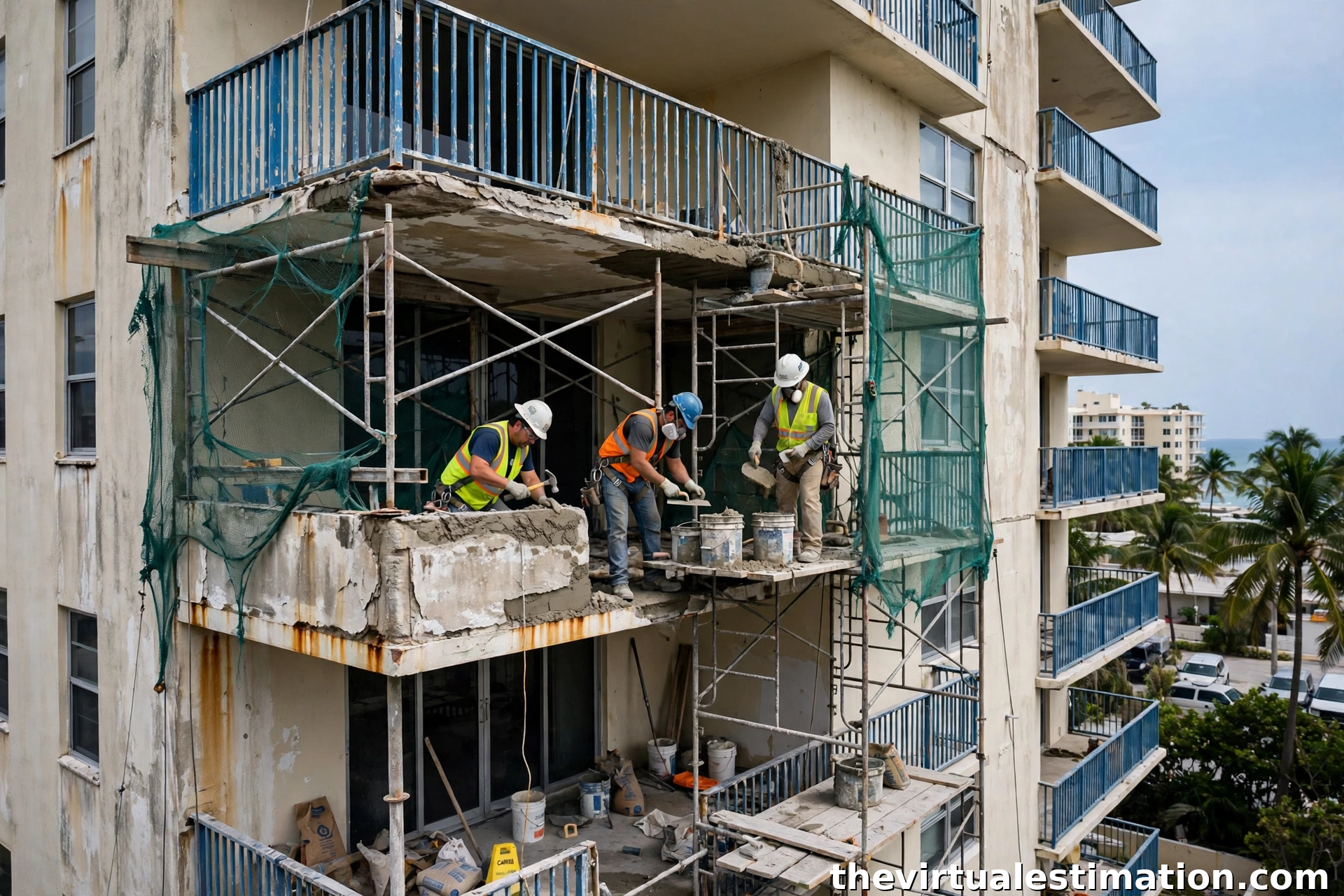
No other city in this series has a market quite like Miami's condo recertification work. Miami-Dade has required building recertification since 1975, and Broward since 2006. Buildings generally come due at 40 years, then every 10 years, with coastal condo and co-op towers now due as early as 25 to 30 years under the post 2022 update. On top of the county programs, Florida's statewide milestone inspection law (SB 4-D) applies to condo and co-op buildings three stories and taller, and the Structural Integrity Reserve Study (SIRS) requires associations to plan and fund reserves for structural items that generally can no longer be waived.
For an estimator, much Miami renovation work starts with an engineer's deficiency list, not an owner's wish list: concrete spalling from rebar corrosion, balcony slab integrity, post-tension cable condition, waterproofing failures, and electrical panel age. Published ranges put inspection and reporting for a mid-size condo building (about 20 to 100 units) at roughly $10,000 to $25,000, with repairs from minimal for a well maintained building to several hundred thousand dollars where maintenance was deferred. Minor remediation is often quoted at $5,000 to $20,000, moderate structural work at $20,000 to $80,000, and significant work at $80,000 to $300,000 or more, before electrical upgrades of $15,000 to $60,000.
At Mariner's Bay in North Miami, a 46 unit building estimated a special assessment of at most $20,000 per owner before the pandemic, the Surfside collapse, and the new rules. After meeting the new requirements, the assessment reached $200,000 per unit, and monthly HOA fees rose from $850 to $3,000. That is an extreme case, not a typical one, but it shows why recertification repair must never be priced from a photo or a square foot rate. Price it from the engineer's report and the SIRS, broken by balcony, elevation, and repair type, and show the board the gap between inspection cost and full repair scope.
Where the work is right now, and how contractors bid it
Brickell remains the headline market. About 2,794 new ultra luxury condo units are expected there between 2026 and 2030, on top of roughly 11,126 units built since 2000, according to a building by building count in the Brickell Real Estate Market Report for the first quarter of 2026. The Residences at Mandarin Oriental on Brickell Key reported $1.7 billion in condo sales before construction, with 80 percent of its 228 unit south tower sold and prices up about 30 percent since sales launched in 2024. Published entry pricing for Miami-Dade pre-construction condos in September 2026 ran from roughly $1,100 to roughly $4,000 per square foot, with the urban core mostly between $1,400 and $2,600. The Miami River corridor alone has more than 10,000 units planned or under construction. Miami therefore has three bid markets at once: luxury towers where finish and envelope drive price, workforce housing where speed drives it, and older condo restoration where the engineer's report drives it.
Miami contractors bid the envelope early, because NOA lead times set the schedule for everything behind them. They carry alternates explicitly, with a named NOA product as base bid and a second named NOA product as alternate, price and lead time differences both shown. They price logistics as a trade, hoisting and elevator time in a tower, laydown and rain protection on a suburban site, and they keep a separate contingency for permit re-review and for July and August rain days and crane wind limits.

Before you send the number
- Municipality and authority having jurisdiction confirmed from the parcel, not the mailing address.
- Design wind speed, risk category, and exposure stated, with HVHZ provisions noted.
- Every envelope product listed with its NOA number, Florida Product Approval status, and lead time.
- Flood zone, base flood elevation, and freeboard confirmed, with elevation certificate and survey priced.
- Permit fees calculated from the same construction value as the bid, with impact fees shown separately.
- Labor priced by trade and classification, with Davis-Bacon, county schedule, or open shop status stated.
- For condo work, the recertification or milestone report and the SIRS read before pricing, with repair tied to deficiency items.
- Logistics, hoisting, elevator time, and work hour restrictions priced, not assumed.
- Rain days, crane wind limits, and re-review contingency carried in general conditions, with exclusions stated plainly.
Five Miami mistakes that cost real money
- Using a non-HVHZ window price: a standard impact window from another Florida market is not a substitute for an NOA product in Miami-Dade.
- Pricing the permit from a different value than the bid: keep one value for permit, insurance, and bid.
- Treating a condo interior as a standalone job: in an older building, read the recertification report first.
- Forgetting flood and dewatering: fill, elevation, survey, and dewatering change the foundation section.
- Bidding a summer exterior schedule with no rain days: Miami's summer rain is a season, not a surprise.
Frequently asked questions
Do all Miami buildings need impact windows?
In Miami-Dade County, in practical terms, yes. The whole county is a wind borne debris region inside the HVHZ, so every opening needs impact rated glazing or approved protection, and every exterior product needs a current NOA. The same logic applies in Broward. Outside the HVHZ, the rule depends on design wind speed and distance from the coast, which is why a product legal in Orlando can still fail in Miami.
How long does a Miami permit take?
It depends on the municipality and the project. Published 2026 guides put simple projects around 18 days and complex projects around 28 to 35 days, with Miami Beach longer because of design review. A new single family home in Miami-Dade is often quoted at 3 to 6 months for the full permit path. Build re-review time into your schedule rather than promising the fastest published number.
Miami rewards estimators who do the local homework: the municipality, the NOA list, the flood map, and the building report, in that order. Skip any one of them and the bid will look competitive until the permit reviewer, the inspector, or the condo board finds the gap. For a bid built that way, from drawings and quantities rather than from a square foot guess, reach out to The Virtual Estimation or email info@thevirtualestimation.com, and ask for a construction estimating service priced for your Miami project, your municipality, and your building type.