A Tampa concrete bid lives or dies on three numbers: the ready-mix price per yard, the rebar tonnage, and the permit and code scope that out-of-town estimators miss. In 2026, plan on $130 to $175 per cubic yard for delivered ready-mix in the Tampa market, $6 to $9 per square foot installed for a basic 4-inch slab, and $10 to $16 per square foot for a warehouse slab. This guide shows you how to build those numbers from a real takeoff, what Tampa permits actually cost, and which Florida Building Code rules change your concrete scope before you ever set a form.
Who this is for: concrete subcontractors, general contractors and developers bidding flatwork, foundations and structural concrete in Tampa, Hillsborough County and the wider Tampa Bay market.
What a Tampa concrete estimate has to cover
Concrete looks simple on a bid sheet until the quantities start moving. A complete Tampa concrete estimate prices every one of these lines, not just the yards of concrete:
- Ready-mix concrete, priced by strength, slump, admixtures and haul distance from the batch plant. Tampa has several plants, but a job in Riverview or Plant City can sit 20 miles from the nearest one, and haul charges add up fast.
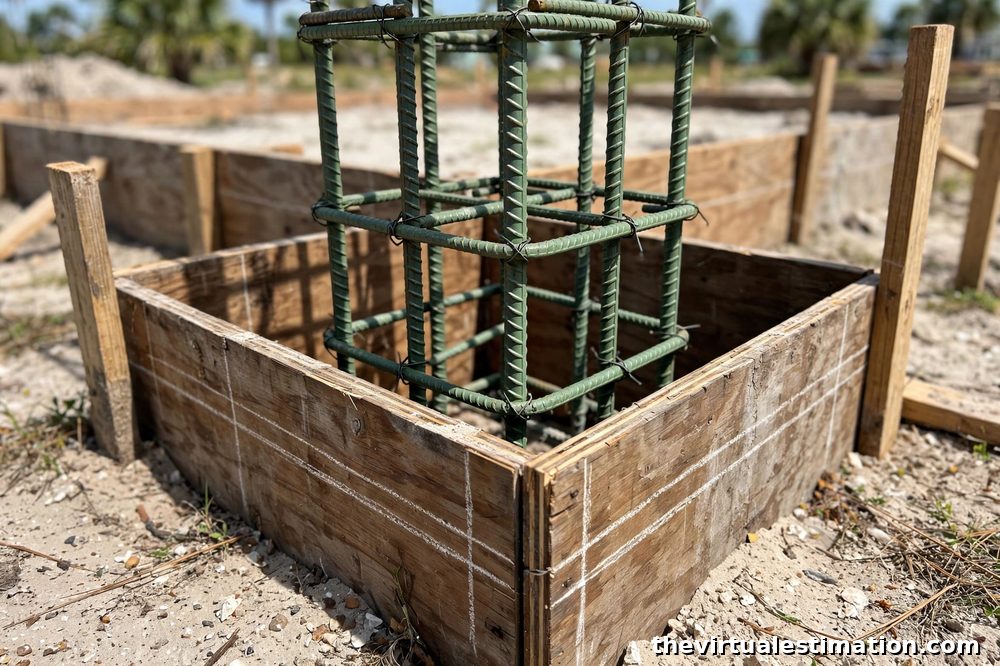
- Reinforcement, rebar by the ton or wire mesh by the sheet, including chairs, ties and lap waste. Coastal and waterfront work often needs epoxy-coated bar, which costs roughly double the price of plain carbon steel in Florida.
- Formwork, by the linear foot for footings and walls, or by the square foot of contact area for columns and beams. High-rise work in downtown Tampa is mostly formwork and labor, not concrete volume.
- Place and finish labor, including the pump truck, screed crew, curing compound and saw cutting. Summer pours in Tampa need more crew, not less, because the concrete sets faster in the heat.
- Testing and inspection, slump and cylinder tests, plus the special inspections the Florida Building Code requires on structural concrete.
- Permits and fees, which are small next to the concrete bill but still belong in the estimate, not absorbed into overhead.
If your estimate skips any of these, the job will still cost you the money, it just will not show up until the pour. A professional construction estimating service prices all six lines from the drawings, so the number you bid is the number you can build to.
Tampa ready-mix prices in 2026
Ready-mix is a local commodity, so the price is set by the batch plants near your job, not by a national table. The ranges below come from 2026 trade reporting for the Southeast and Florida markets, and they match what Tampa suppliers are quoting this year. Always confirm with a written quote from your plant before you lock a bid.
| Mix | Typical use in Tampa | Delivered price per cubic yard |
|---|---|---|
| 3,000 psi, standard | Sidewalks, patios, non-structural flatwork | $130 to $150 |
| 3,500 psi | Driveways, garage floors, residential slabs | $140 to $160 |
| 4,000 psi | Commercial slabs, footings, structural work | $145 to $170 |
| 4,500 to 5,000 psi | High-rise columns, post-tension decks, heavy industrial | $160 to $185 |
| Corrosion-resistant mix (coastal) | Waterfront and bayfront structures | Add $15 to $25 per yard |
Three surcharges catch Tampa bidders off guard. Short loads under 10 cubic yards carry a fee of roughly $50 per yard on the missing volume. Saturday pours add about $8 per yard. And a job more than 20 miles from the plant adds around $9.50 per mile. A small driveway pour can carry $300 to $500 in surcharges that never appear in a per-yard price table, so price them as their own line.
Worked example: a 2,400 square foot warehouse slab in East Tampa
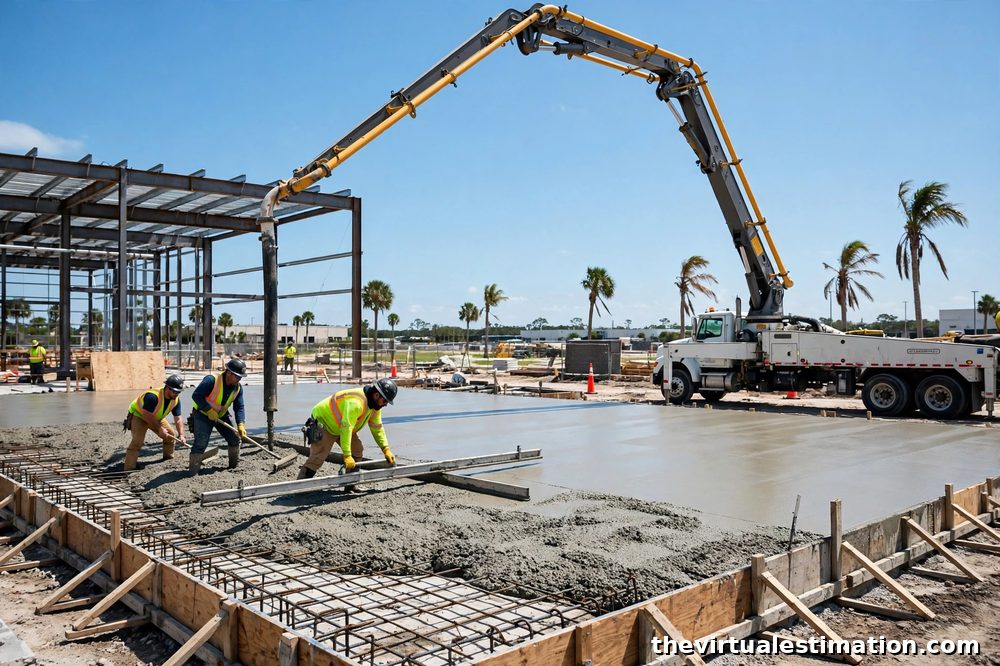
Here is a real takeoff for a 40 by 60 foot warehouse slab, 6 inches thick, 4,000 psi concrete, with Number 4 rebar at 18 inches on center both ways. This is the kind of slab going into the industrial parks around East Tampa and Brandon, where Tampa Bay has about 5.2 million square feet of industrial space under construction.
Concrete volume. 2,400 square feet times 0.5 feet deep equals 1,200 cubic feet, which is 44.4 cubic yards. Add 10 percent for waste, over-excavation and uneven subgrade, and you order 49 cubic yards. At $145 to $165 per yard for 4,000 psi mix, the concrete line is $7,105 to $8,085.
Rebar. Bars running the 60-foot direction: 40 feet divided by 1.5-foot spacing, plus one, gives 28 bars at 60 feet, or 1,680 lineal feet. Bars running the 40-foot direction: 60 feet divided by 1.5-foot spacing, plus one, gives 41 bars at 40 feet, or 1,640 lineal feet. Total 3,320 lineal feet of Number 4 bar at 0.668 pounds per foot equals 2,218 pounds, or 1.11 tons. Florida material pricing for carbon steel rebar runs $1,080 to $1,440 per ton in 2026, so the bar material is $1,199 to $1,598. Rebar installation labor in Florida runs $1.10 to $1.93 per square foot, which adds $2,640 to $4,632 for this slab.
Place and finish. National 2026 reporting puts place and finish labor at $3 to $8 per square foot. For a straightforward 2,400 square foot warehouse pour with good access, budget the middle of that range and confirm with your finishing crew.
| Line item | Quantity | Cost |
|---|---|---|
| Ready-mix, 4,000 psi | 49 cubic yards | $7,105 to $8,085 |
| Rebar material, Number 4 | 1.11 tons | $1,199 to $1,598 |
| Rebar installation labor | 2,400 square feet | $2,640 to $4,632 |
| Place and finish labor | 2,400 square feet | $7,200 to $19,200 |
| Total, slab only | 2,400 square feet | $18,144 to $33,515 |
That works out to $7.56 to $13.96 per square foot. Check it against the market: public bid data puts installed warehouse slabs at about $10 to $16 per square foot in 2026. The low end of our range assumes easy access, no pump and no admixtures, so a real bid usually lands in the upper half. Excluded from this table, and priced separately on a real job: the pump truck, vapor barrier, gravel base, formwork, saw cutting, curing compound and cylinder testing.
Tampa permit fees that belong in your estimate
Tampa charges flat fees by permit type instead of a valuation formula, which makes this part of the estimate easy to get right. The figures below come from the City of Tampa Development and Growth Management fee schedules, verified in 2026. Every permit also carries the Florida Building Permit Surcharge of 2.5 percent, with a $4 minimum.
| Permit | Fee |
|---|---|
| New construction building permit (average paid under the existing schedule) | $0.67 per sq ft residential, $0.25 per sq ft non-residential |
| Standalone general building permit | $120, or $124 with surcharge |
| Residential driveway, patio slab or deck | $214 (commercial $527) |
| Foundation stabilisation or repair | $120 |
| Roofing or siding permit | $177, or $181.43 with surcharge |
| Trade permits (plumbing, electrical, HVAC) | $120 each, or $124 with surcharge |
| Flood determination letter | $120 |
Two things to watch. First, Tampa prices major building permits per square foot of new development and prices smaller work from flat trade and miscellaneous schedules, so there is no single flat concrete-permit table. The per-square-foot figures above are averages paid under the existing fee schedule, from the City's July 7, 2026 fee study, not a quoted rate for a specific project. Permits are filed online through the City's Accela Citizen Access portal, and the Construction Services Division works out of 2555 E. Hanna Avenue. A Tampa mailing address alone does not prove a property is inside city limits, so confirm jurisdiction before you price the permit, because unincorporated Hillsborough County permits go through a different portal with different fees. Second, the same fee study proposes raising permit fees by about a third by 2029, to $0.81 residential and $0.52 non-residential per square foot, but nothing has been proposed or voted on, and city staff have said no changes take effect before March 1, 2027. Carry today's fees in your bid and flag the study to the client as a schedule risk, not as a cost.
The Florida Building Code rules that change concrete scope
Tampa builds under the 2023 Florida Building Code, 8th edition, which took effect December 31, 2023, with Tampa local amendments under Ordinance 2024-15 effective February 1, 2024. One timing point matters for bids submitted now: the 9th Edition (2026) takes effect December 31, 2026, and applications submitted before that date are generally reviewed under the 8th Edition, while applications on or after it fall under the 9th. If your project straddles that date, the submittal timing is a deliberate decision, not an accident. Three parts of the code in force today land directly on concrete estimates.
Wind-borne debris region. Under the 2023 code, the debris region covers areas within 1 mile of the coastal mean high water line where the ultimate design wind speed is 130 mph or greater, and any area where it reaches 140 mph or greater. Much of Tampa's waterfront and bayfront work falls inside it. That does not change the concrete itself, but it changes the building the concrete supports: heavier anchorage, more hold-downs, and more embedded steel in the walls and roof connections. Price the embeds and the extra inspection time, not just the yards.
Structural concrete design. Reinforced concrete design follows ACI 318, referenced by the Florida Building Code. Minimum 3,000 psi at 28 days is the common baseline for foundations, and the code sets minimum cover over reinforcing bars that drives formwork and bar support quantities. When the drawings call for a higher strength or a special exposure class, the mix price and the testing frequency both move.
Flood zones. Large parts of Tampa sit in FEMA flood hazard areas, and commercial plan sets must show site elevations in NAVD 88 with the flood zone marked. Elevated slabs, stem walls and flood vents are concrete scope, and the city keeps the lead on plan review and inspections in flood hazard areas even when a private provider handles the rest of the review. Check the flood zone on every Tampa parcel before you price the foundation, because a slab-on-grade bid and an elevated-structure bid are different jobs. One rule decides repair scope after storm damage: if repair cost reaches or exceeds 50 percent of a structure's pre-damage market value, the whole building must be brought into compliance with current floodplain regulations, which usually means elevation. Run that 50 percent determination before you set the scope, not after demolition, because it decides whether the job is a repair or a rebuild.
Tampa ground and weather: three things that break concrete budgets
High water table. Tampa sits a few feet above sea level, and the water table is shallow across much of the city. Footings and below-grade work need dewatering, and slabs need a proper vapor barrier and a compacted base that will not pump under load. Estimators who price Tampa footings like inland Texas footings leave the dewatering line out and pay for it later.
Sinkhole risk. West-central Florida sits on limestone, and sinkhole activity is a real design consideration in Hillsborough County. Geotechnical reports drive foundation type here more than in most markets, and deep foundations, grade beams and soil improvement show up on jobs where a simple spread footing would do elsewhere. Read the geotech report before you price the foundation, and never carry a foundation allowance from another city.
Salt air and summer heat. Chloride exposure near the bay shortens the life of plain carbon steel reinforcement, which is why epoxy-coated or galvanized bar appears on waterfront work at roughly double the material price. And Tampa's summer heat changes the pour itself: concrete sets faster, finishing windows shrink, and retarders or night pours become part of the plan. A July pour in Tampa needs more finishers on the deck than the same pour in January, and your labor line should show it.
Where the concrete work is in Tampa right now
Tampa Bay leads Florida in industrial permit volume, and the concrete demand follows the cranes. Downtown, Water Street Tampa is a $3.5 billion, 50-acre mixed-use district, and its second phase, unveiled in August 2025, adds a residential condo tower, a 500,000 square foot trophy office tower and a new entertainment district with a 3,500-seat live music venue, with groundbreaking targeted for 2027. Next door, the Gasworx district is turning 50 acres at the edge of Ybor City into up to 5,000 residences, with the first building already open. ONE Tampa, a 42-story, 519-foot condo tower with 225 residences, reached its full height in August 2026 after rising about one floor a week.
Flooding is also driving public concrete work. In September 2026 the Tampa City Council approved the South Howard Flood Relief Project by a 4-3 vote: about a mile of 10-by-10-foot underground box culverts to move stormwater out of South Tampa into the bay, with a $92.71 million construction contract and a $100.4 million total project cost. Utility relocation is expected in late 2026 and major drainage work starts in spring 2027. In October 2026, Bern's Steak House and five other property owners filed two class-action lawsuits seeking to halt construction, alleging the city diverted stormwater fee money and awarded the contract without following selection rules. Those claims are allegations, not tested in court, and construction remains on track unless a judge orders otherwise. For estimators, the point is simpler: stormwater, drainage and floodplain elevation are priced lines in Tampa, not boilerplate.
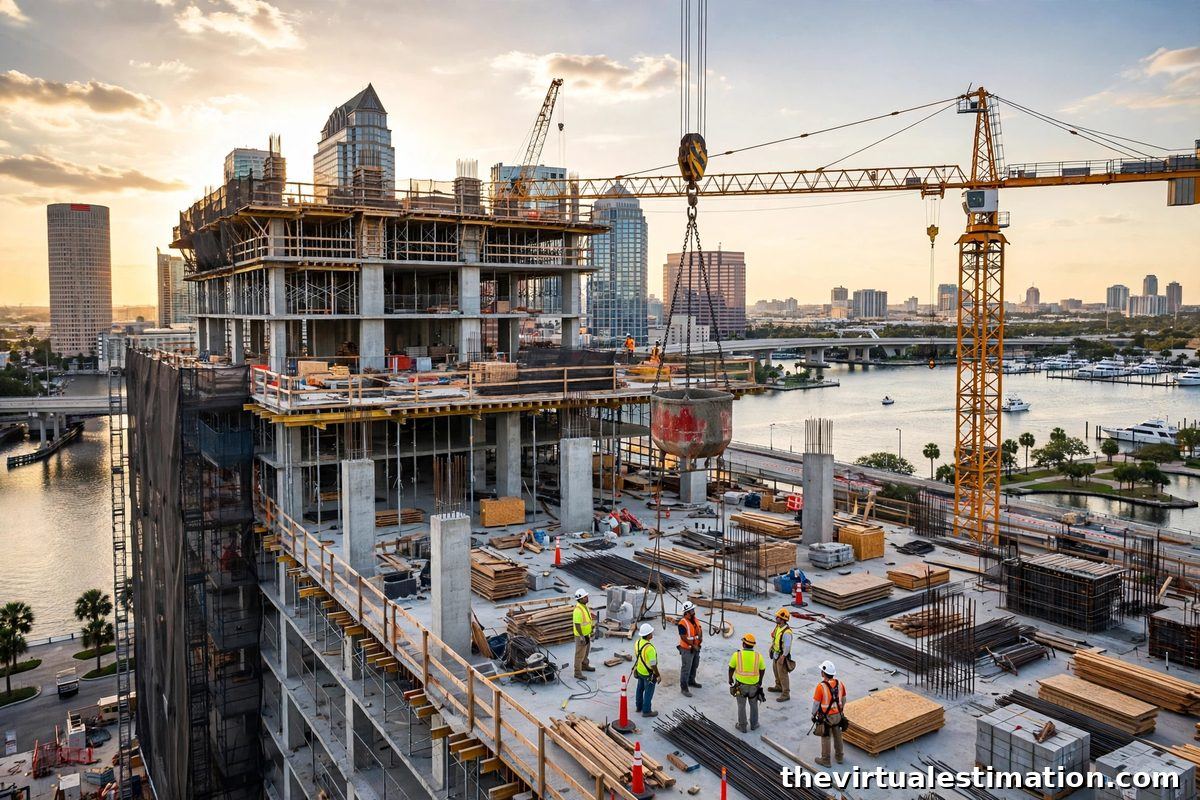
That high-rise work is concrete-heavy: post-tension decks, core walls, columns and podium parking, all of it placed by pump and crane in tight downtown sites. The industrial side is flatwork-heavy: warehouse slabs, tilt-up panels, truck courts and dock aprons around East Tampa, Brandon and the Port of Tampa. The two markets need different estimators. Tower work is won on formwork cycles and pumping logistics; warehouse work is won on slab quantities and production rates. Know which one you are bidding before you open the drawings.
For a sense of how another fast-growing Texas market compares, our Austin construction estimating guide covers a city with similar high-rise and industrial demand but very different soil and code conditions, which is exactly why local pricing matters.
Seven mistakes that cost Tampa concrete bidders money
- Pricing ready-mix from a national average. Tampa plants quote $130 to $175 a yard depending on strength and haul. A national $150 average is right by luck and wrong by $25 a yard on a 500-yard pour.
- Forgetting the short-load fee. Small pours under 10 yards carry a surcharge of about $50 per yard on the missing volume. Price it, or the plant will.
- Carrying plain rebar on waterfront work. Epoxy-coated bar costs $2,160 to $3,000 per ton against $1,080 to $1,440 for carbon steel. Miss that line and the rebar budget doubles.
- Ignoring the water table. Dewatering, vapor barrier and base work are real lines on Tampa foundations. They are not contingency.
- Bidding a slab-on-grade price on a flood-zone lot. Check the FEMA zone and the NAVD 88 elevation before you price the foundation, not after you win the job.
- One finishing crew for a July pour. Hot-weather concrete sets fast. A short crew means cold joints, rework and a finish you cannot fix.
- Leaving the permit out of the bid. Tampa permit fees are small but fixed, and the client notices when they appear as a surprise after award.
How to build your Tampa concrete bid
A reliable Tampa concrete estimate follows the same order every time. Start with the takeoff: measure every slab, footing, wall, column and beam from the structural drawings, and list quantities by element, not by lump sum. Then price the concrete by mix and strength, with haul and surcharges as separate lines. Price rebar by weight from a bar bending schedule, with the right coating for the exposure. Price formwork by contact area, and remember that reuse drops the unit cost on repetitive floors. Add place and finish labor by crew and production rate, not by a percentage of material. Then add testing, permits and a contingency that reflects the geotech report, not a flat 5 percent on every job.
Finally, check the total against the market. A basic 4-inch residential slab in the Southeast runs $6 to $9 per square foot installed, and a warehouse slab runs about $10 to $16. If your number sits far outside those bands, find out why before you submit. Either you found a real difference, or you missed a line. A general contractor estimating review catches that kind of miss before the bid goes out, which is cheaper than catching it on the pour.
Frequently asked questions
How much does concrete cost per cubic yard in Tampa in 2026?
Plan on $130 to $175 per cubic yard delivered for standard 3,000 to 4,000 psi ready-mix, based on 2026 trade reporting for the Southeast and Florida. Corrosion-resistant mixes for coastal work add $15 to $25 per yard, and short loads, Saturday pours and long hauls add their own surcharges. Get a written quote from your batch plant for the exact mix and address.
What does a concrete slab cost in Tampa?
A basic 4-inch residential slab runs $6 to $9 per square foot installed in the Southeast, and a typical Tampa concrete driveway runs $4,080 to $5,590 for a 576 square foot job. Warehouse and industrial slabs run about $10 to $16 per square foot installed, depending on thickness, reinforcement and finish.
Do I need a permit for concrete work in Tampa?
Yes, for most structural and flatwork beyond minor repair. A standalone general building permit is $120 plus the state surcharge, and a residential driveway, patio or slab permit is $214. Permits are filed through the City's Accela Citizen Access portal, and properties outside city limits permit through Hillsborough County instead.
Which building code governs concrete in Tampa?
The 2023 Florida Building Code, 8th edition, effective December 31, 2023, with Tampa local amendments effective February 1, 2024. Structural concrete design follows ACI 318, and waterfront work falls in the wind-borne debris region, which changes anchorage and embed requirements.
Tampa rewards estimators who price the city as it actually is: a coastal market with a shallow water table, strict wind rules, flat permit fees and a building boom that runs from downtown towers to warehouse slabs. Get the takeoff right, price the rebar and the code scope honestly, and check your total against the market before you submit. This post closes our 20-city series, and each of those 20 guides was priced from its own jurisdiction, code and site conditions, not from one template. From here, the daily blog returns to the varied-topic rotation. If you want that takeoff done for you, The Virtual Estimation delivers detailed concrete takeoffs and cost estimates for Tampa Bay contractors in 24 to 48 hours. Email your drawings to info@thevirtualestimation.com and get a number you can bid with confidence.