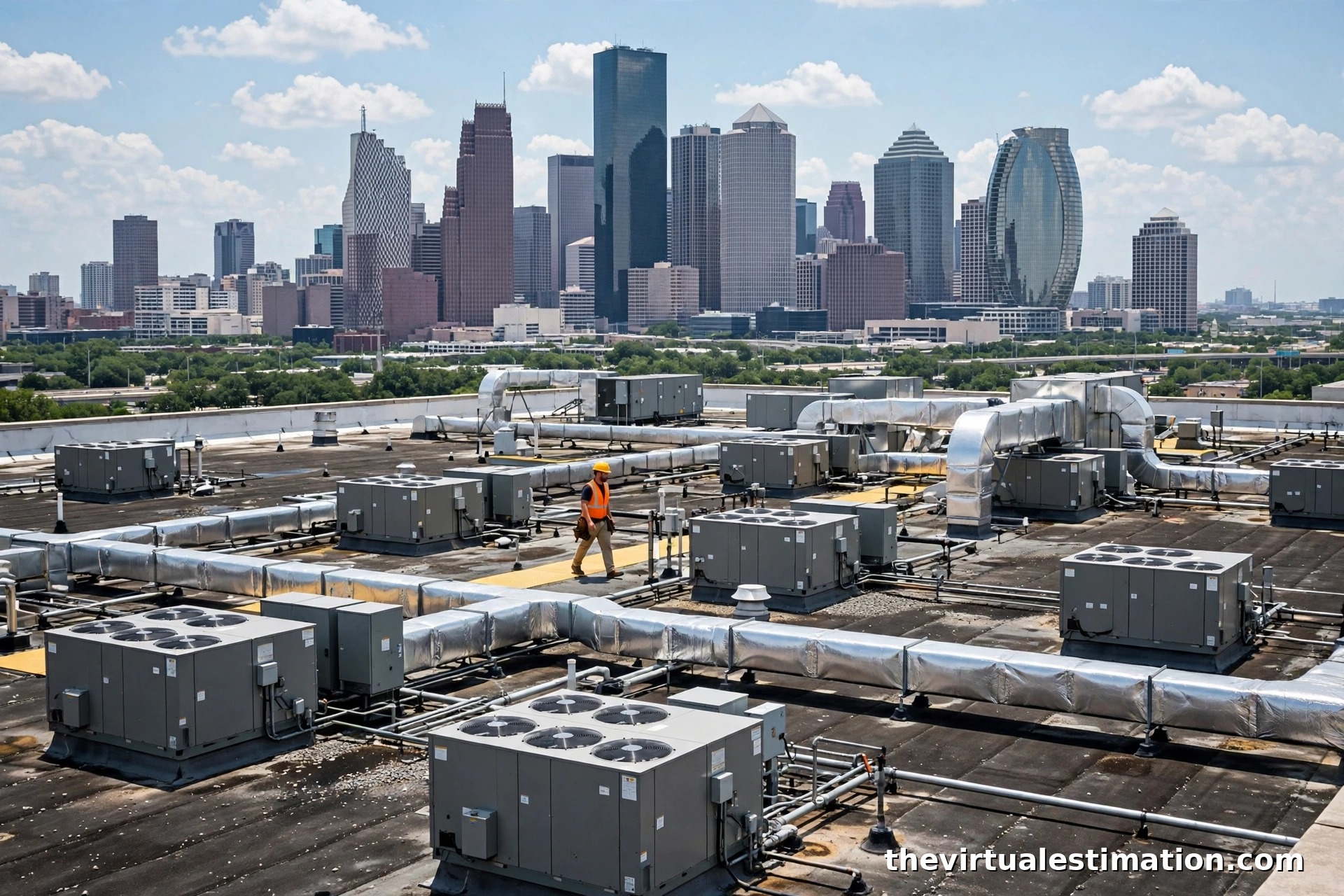
If you estimate HVAC work anywhere else and then move your numbers to Houston, you will lose money. This market sizes systems for latent load, not dry bulb. It runs ducts through attics that cook at 140 degrees. Its permit office charges you a percentage of your contract value to install a condenser. And right now its best mechanical crews are getting pulled onto data centers and hospitals, so last spring's labor number is already stale. Here is how to build a Houston HVAC estimate that holds up.
The Sizing Mistake That Sinks Houston HVAC Bids
The most expensive line in a Houston HVAC estimate is the one nobody wrote: an oversized system. Houston sits in IECC Climate Zone 2A, hot-humid, which means the real enemy is moisture, not heat. A system that is too big satisfies the thermostat in twenty minutes, shuts off, and never runs long enough to pull humidity out of the air. The owner gets a clammy 72 degrees, the system short cycles for ten years, and you get the callback.
Rule-of-thumb sizing, one ton per 500 square feet or anything like it, is how you end up in that trap. The only defensible way to size here is a Manual J load calculation against the right design conditions for Harris County, with infiltration, orientation, and window solar gain modeled honestly. If you are pricing a changeout and the old unit says 5 tons, do not quote 5 tons reflexively. Half the oversized systems in this city got that way because every replacement for thirty years copied the nameplate before it.
From an estimating standpoint, this means two things. First, put the load calculation in your scope as a priced line, not a favor. Second, when you see an engineer-specified system in a plan set, check the sensible heat ratio. Houston needs sensible heat ratios in the 0.65 to 0.75 range on residential work. Anything north of 0.8 tells you the designer sized for Arizona and you should flag it in your bid notes.
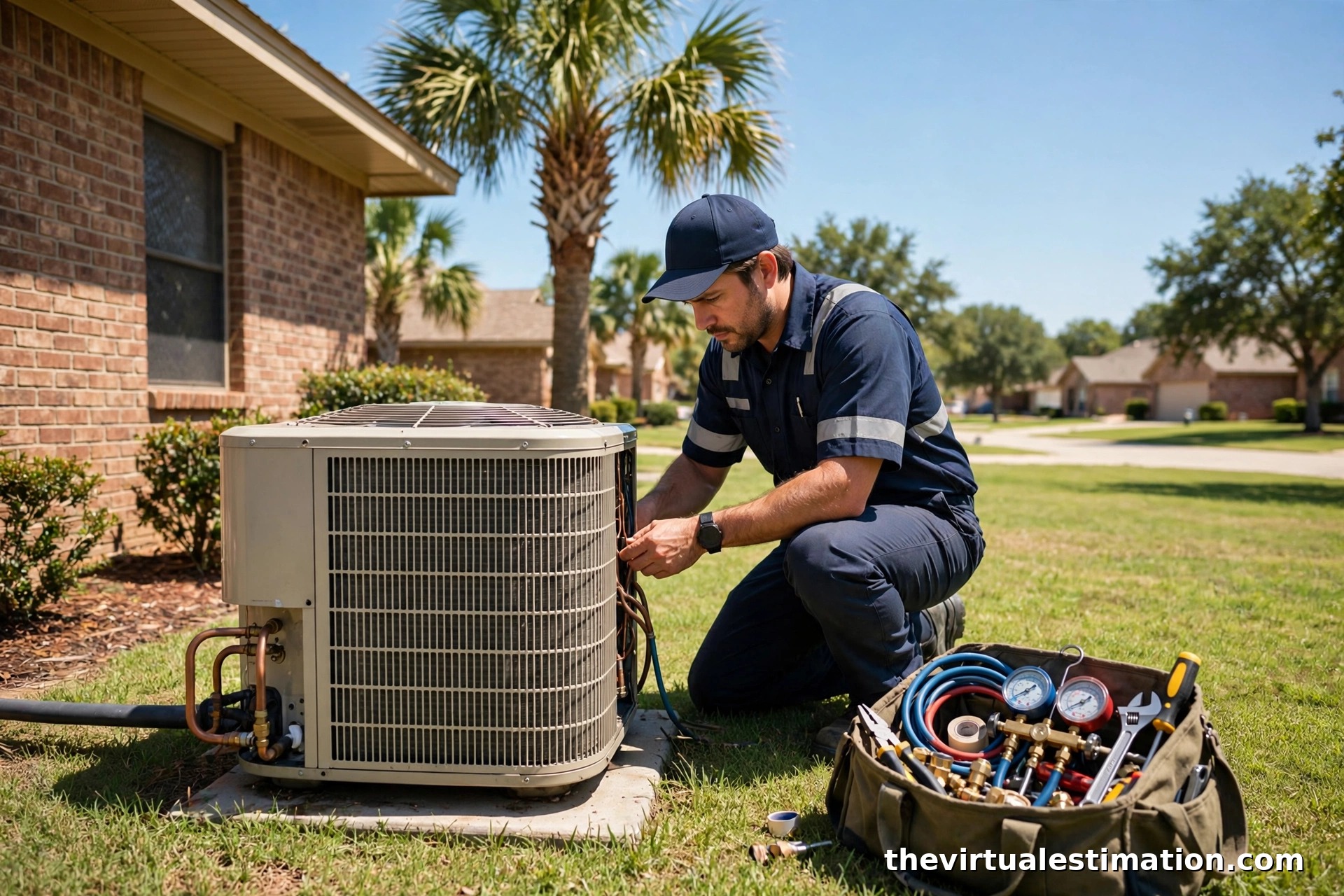
What the Houston Market Is Doing to Your Labor Number
Houston is the fastest-growing metro in the country. The Census Bureau shows 126,720 new residents between July 2024 and July 2025, and Dodge Data expects total construction starts to climb 6 percent in 2026, with nonresidential up 11.7 percent. The region added 11,200 construction jobs between February 2025 and February 2026, the most of any metro area in the nation.
What matters for your estimate is where those workers are going. Data centers and healthcare are pulling mechanical talent off the street. One recent industry panel put it bluntly: only a handful of HVAC subcontractors in this city can handle data center and advanced manufacturing work, and construction managers are courting them before they even pick a general contractor. Texas has $9.9 billion in data center starts in the pipeline, and Apple and Foxconn are building major manufacturing facilities here. All of it draws from the same pool of sheet metal workers, pipefitters, and startup techs you need for a Tuesday school retrofit.
The wage data confirms it. Construction wages nationally are running about 4.2 percent against 3 percent for the private sector, and Texas skilled trades are seeing 4 to 6 percent annual wage growth, with the sharpest pressure on trades tied to data centers and healthcare. In Houston, residential HVAC labor runs $75 to $200 per hour, with total labor on a full system replacement landing between $1,500 and $4,500. After-hours calls run $150 to $290 an hour. If your labor tables still carry 2024 rates, add the escalation before you submit. For mechanical contractors bidding multi-week projects here, a professional HVAC estimating package with current Houston labor data built in is worth more than the margin it costs you.
Five Climate Factors That Change the Takeoff
Each of these adds lines to your material and labor takeoff. Miss them and you are buying the difference.
1. Attic temperatures north of 140 degrees
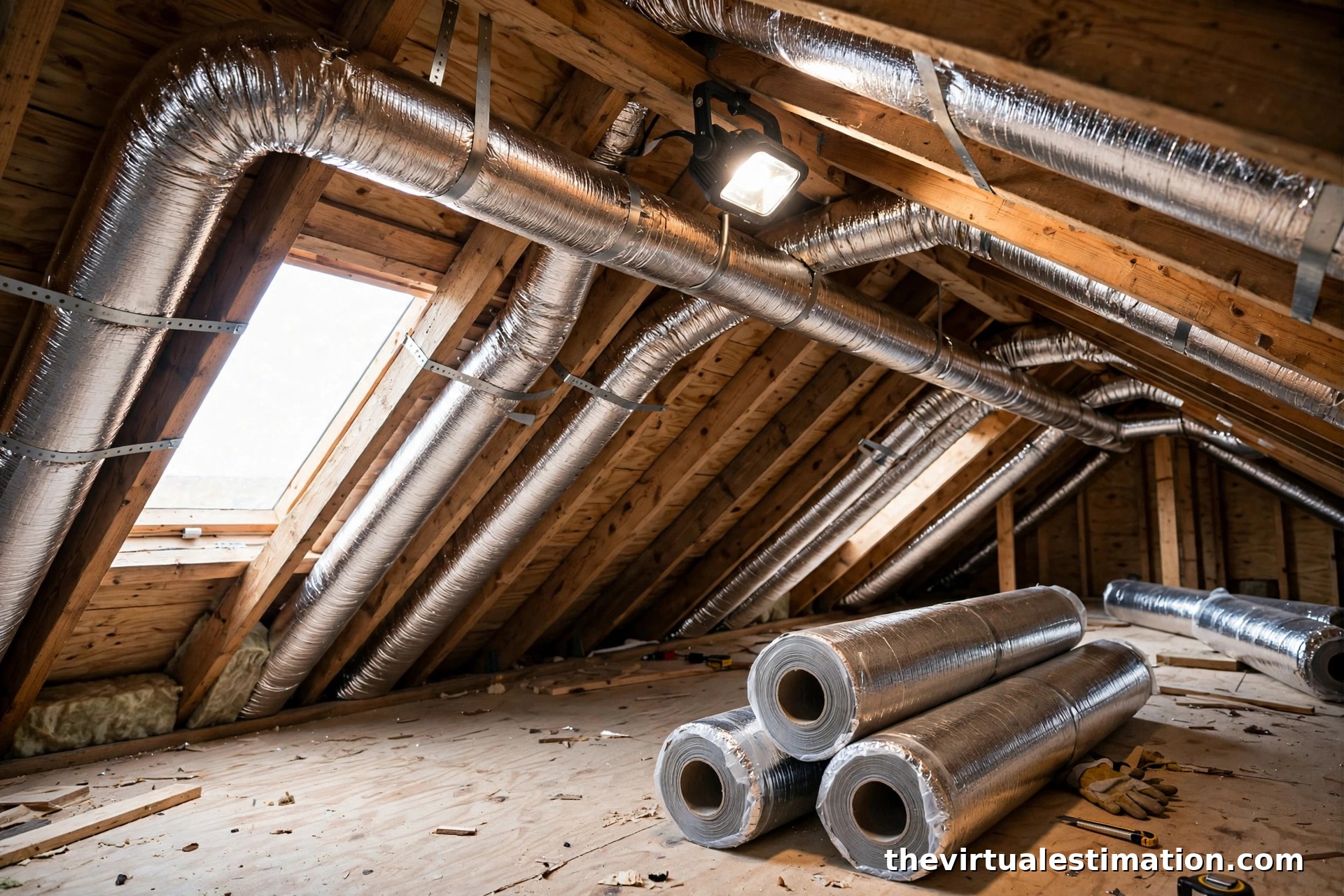
Most Houston homes route ductwork through unconditioned attics. In August that attic tops 140 degrees, and flex duct inner liners crack, joints open, and insulation degrades faster here than almost anywhere else. Code (2021 IRC, which Houston follows) requires ducts in unconditioned space to be insulated to R-8. When you take off a duct system for Houston, you are taking off R-8 foil-jacketed duct, sealed with mastic at every joint. Duct sealing alone prices at $400 to $1,500 for a typical system. If the drawings show no insulation spec, carry R-8 and note the assumption.
2. Humidity you have to engineer against
When cooling alone cannot hold indoor humidity in the shoulder seasons, a whole-home dehumidifier is a standard alternate, installed at $1,500 to $3,000. If you leave it out of the base bid, price it as a clean alternate. Either way, condensate management is a real takeoff item: primary and secondary drain pans, float switches, and condensate pump runs, all of which fail first in a climate that wrings this much water out of the air.
3. The refrigerant transition is a line item now
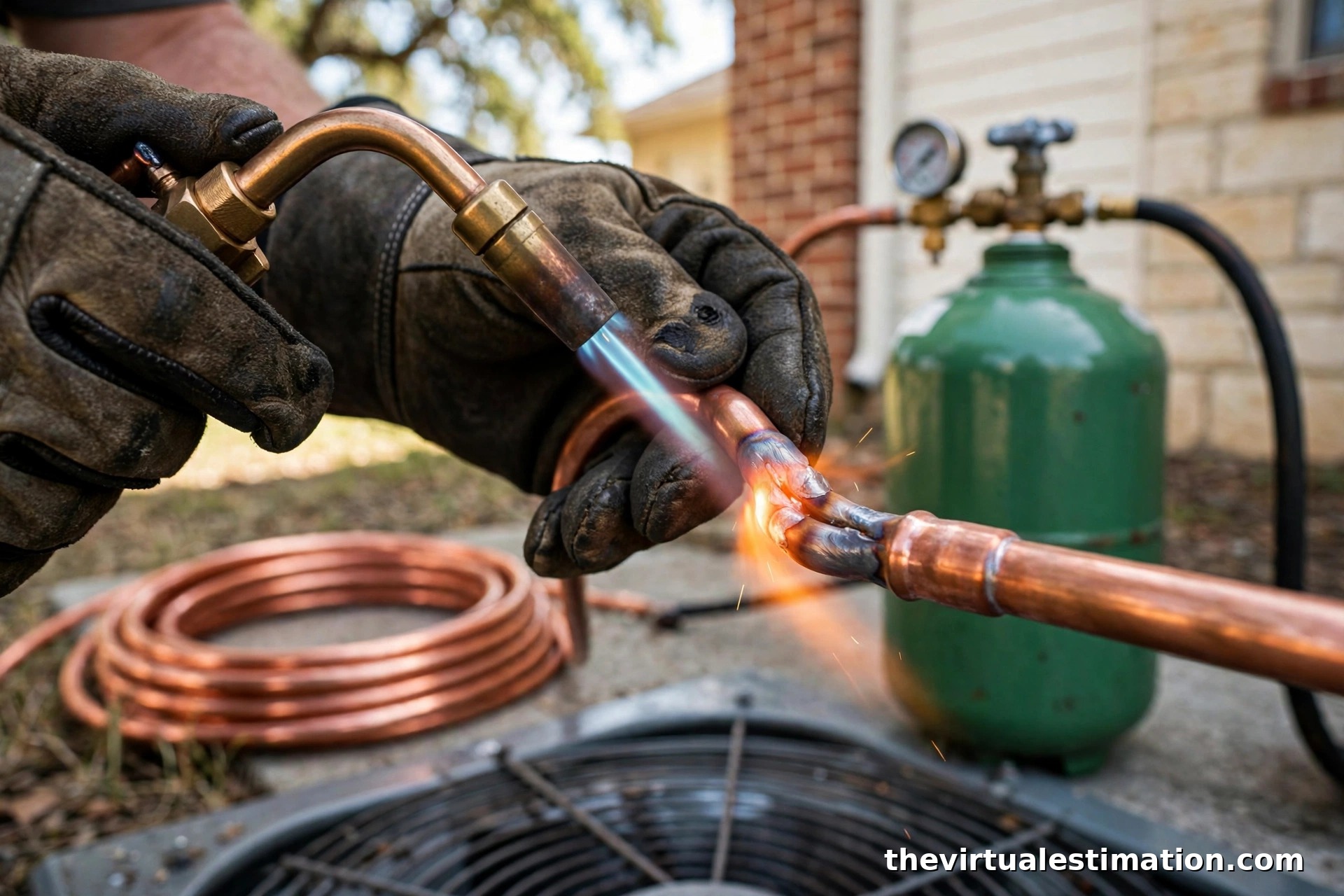
New systems are moving from R-410A to A2L refrigerants like R-454B under federal mandates. A2L equipment brings different leak detection and ventilation requirements for installation and service, so your estimate carries sensors, ventilation provisions where required, and tech hours at a higher skill level than a straight R-410A swap. Texas is adopting the 2024 IMC effective September 1, 2026 specifically because the 2021 codes do not address A2L protocols. Price the transition, or you will absorb it.
4. Wind, storms, and the coast
Houston work near the coast carries windstorm considerations: equipment anchoring, elevation, and salt-air resistant selections. If a project falls under TWIA (Texas Windstorm Insurance Association) territory, the mechanical anchoring and certification path changes, and your estimate should carry the documentation hours. Even inland, outdoor units sit in a flood-prone metro, so elevated pads are standard practice, not upgrades.
5. A cooling season that runs half the year
The Houston cooling season stretches roughly April through October, and contractor labor tightens from late May through September. Summer work commands premium rates and longer lead times, and attic work in August is slower. Your estimate should show it.
Codes That Change the Price in 2026
Houston runs its own code clock, and your estimate has to follow it. In October 2023 the Houston City Council adopted the 2021 I-Codes, effective January 2, 2024, so the 2021 IMC and 2021 IECC govern mechanical and energy work in the city right now. At the state level, Texas moves to the 2024 IMC, IFGC, and IRC effective September 1, 2026, which puts this transition squarely inside your bid season. The 2024 mechanical code is the one that finally addresses A2L refrigerant installation protocols, so if you are bidding equipment with a 2027 startup, read both editions.
On the efficiency side, the federal minimum for new split-system air conditioners in the southern region, which includes Houston, is 14.3 SEER2. In practice, Houston homes price well above that minimum because the climate pays back higher-efficiency equipment faster than almost any other market. On the licensing front, Texas HVAC contracting runs through the TDLR with a TACLA license, so your labor assumption should be a licensed shop. Estimates built on unlicensed labor numbers are why so many Houston mechanical bids look cheap and finish expensive. A full mechanical scope review, from equipment through controls, is what a mechanical estimating service should deliver before you commit to a number.
Houston Mechanical Permit Fees: What to Budget
The Houston Permitting Center runs mechanical permits on a valuation-based fee schedule, and the numbers are specific enough to carry in your estimate. Residential HVAC replacement permits generally land between $50 and $300, averaging around $195. Commercial work follows the city's mechanical fee schedule:
| Permit item | Fee basis |
|---|---|
| Minimum permit fee | $82.78 |
| Ventilating systems or heat-only systems (other than boilers) | 2.0% of valuation, plus $42.72 |
| Repairs or alterations to existing HVAC or refrigeration systems | 2.0% of valuation, plus $42.72 |
| Ducts and grilles only, valuation under $500 | $42.72 per lease space |
The 2 percent of valuation math is the trap for estimators coming from flat-fee jurisdictions. A $40,000 commercial alteration does not pay a $200 permit fee here; it pays 2 percent of valuation plus the base fee, so carry roughly $840 on that scope. Plan review and reinspection fees stack on top, and the licensed contractor pulls the permit and schedules the inspections, so that administrative time belongs in your labor number.
2026 Houston HVAC Cost Benchmarks
Use these as check figures against your own takeoffs, not substitutes for them. All are 2026 Houston-area market data, and all assume licensed labor.
| Residential system replacement | Installed range, Houston 2026 |
|---|---|
| Standard central AC, 14 to 16 SEER2 | $4,500 to $7,500 |
| High-efficiency system, 17 SEER2 and above | $6,000 to $10,000 |
| High-tonnage system, 5 tons and up | $7,000 to $12,000 |
| Whole-home duct replacement, 2,000 to 3,000 sq ft home | $2,959 to $5,000 |
| Duct sealing only, existing system | $400 to $1,500 |
| Whole-home dehumidifier, installed | $1,500 to $3,000 |
| Dedicated circuit or new disconnect | $200 to $800 |
| Electrical panel upgrade (if required) | $1,500 to $3,000 |
| Common repair | Typical Houston range, 2026 |
|---|---|
| Capacitor replacement | $150 to $300 |
| Refrigerant recharge, R-410A | $300 to $500 |
| Refrigerant leak: find, repair, and recharge | $250 to $1,500 |
| Condenser fan motor | $450 to $800 |
| Blower motor (ECM) | $400 to $900 |
| Evaporator coil replacement | $1,350 to $2,600 |
| Compressor replacement | $1,200 to $3,500 |
Two notes an estimator should keep. First, repair pricing here skews toward replacement economics fast: when an evaporator coil or compressor ticket crosses the $2,000 to $3,000 line on a system over twelve years old, most Houston contractors pivot the conversation to changeout, and your service estimate should flag that threshold. Second, the diagnostic fee ($75 to $150 in this market) is the cheapest line on the ticket and the one most often left out of the estimate entirely.
How to Bid Mechanical Work in Houston Without Getting Burned
Four practices separate the shops that make money in Houston from the ones that bid volume into a loss.
Carry a labor escalation clause on anything over 90 days. With trade wages growing 4 to 6 percent a year and data center work absorbing the best crews, a bid held at spring rates and built in August is a donation. Tie your labor to a defined window or reprice it.
Price the attic. Houston ductwork lives in attics, and attic labor productivity in a Houston summer is not the same as conditioned-space labor. If your duct installation unit assumes a clean mechanical room, add a productivity factor for attic work in season, and carry the R-8 duct, mastic sealing, and strap quantities the drawings imply but do not spell out.
Separate base scope from climate scope. The dehumidifier, the elevated pad, the condensate overflow provisions: carry them as priced alternates or explicit base-bid inclusions, never as afterthoughts. Owners in this market understand climate add-ons when they are priced clearly.
Document your assumptions. Sensible heat ratio, design conditions used, R-value carried on duct, SEER2 of the quoted equipment, permit fees by line: put it in the bid. In a market this competitive, the contractor who shows the math wins the tie-breakers. If you need outside help holding the math together, a professional HVAC estimating breakdown with ductwork, equipment, controls, and commissioning separated out is the standard your competitors are already buying.
Worked Example: 2,400 Sq Ft Home, Full System Replacement
Here is how the numbers stack on a typical Houston changeout: a 2,400-square-foot single-story home in the suburbs, Manual J at 4 tons, 16 SEER2 equipment, existing attic ductwork that tests leaky but serviceable, panel adequate.
| Line item | Estimate |
|---|---|
| 4-ton 16 SEER2 condenser and air handler, matched set | $5,800 |
| Copper line set, disconnect, whip, pad, and miscellaneous material | $900 |
| Labor: two techs, two days at current Houston rates | $3,200 |
| Duct sealing and mastic at accessible joints | $850 |
| Mechanical permit and inspection scheduling | $195 |
| Start-up, commissioning, and refrigerant charge verification | $450 |
| Subtotal | $11,395 |
| Contingency, 7 percent (attic unknowns, summer labor) | $800 |
| Bid total | $12,195 |
Priced as alternates: whole-home dehumidifier at $2,200 installed, full duct replacement at $4,100. What gets missed most often on jobs like this: the condensate drain reroute when the new air handler sits two feet left of the old one, the attic access enlargement for a 4-ton coil that does not fit through the original hatch, and the second inspection trip when the first one fails on a float-switch detail. Carry a trip charge allowance.
FAQ
Do I need a mechanical permit to replace an AC system in Houston?
Yes. The Houston Permitting Center requires a mechanical permit for HVAC replacement work, with residential permits running $50 to $300 depending on scope. Commercial alterations pay 2 percent of valuation plus a $42.72 base fee, with an $82.78 minimum.
What SEER2 rating is required in Houston in 2026?
The federal minimum for new split-system air conditioners in the southern region, which includes Houston, is 14.3 SEER2. Most Houston installations price above that because the long cooling season pays back higher-efficiency equipment quickly.
Why do Houston HVAC bids vary so much between contractors?
The spread comes down to four things: Manual J sizing versus rule of thumb, whether ductwork scope is fully carried, whether permit and inspection costs are included, and whether labor reflects current Houston market rates. Compare the assumptions, not just the bottom lines.
Is a whole-home dehumidifier worth it in Houston?
Often, yes. In the shoulder seasons, when it is humid but not hot enough for long cooling cycles, a dehumidifier at $1,500 to $3,000 installed keeps indoor humidity in the comfort zone without overcooling the house. Price it as an alternate and let the owner decide with real numbers.
If you are bidding mechanical work in the Houston market, get the numbers right before the number is final. The Virtual Estimation delivers detailed, trade-specific takeoffs for HVAC and mechanical scopes, with Houston labor rates, permit fees, and code requirements built into every estimate. Send your plans to info@thevirtualestimation.com and see what a clean bid package looks like, or start with our construction estimating services for full multi-trade coverage.