If you are bidding work in Charlotte, North Carolina, price it as a Charlotte job, not as a generic North Carolina job. The market runs hotter than the state average, commercial costs were projected to rise 6.5 to 7.8 percent in 2026 against a national range of 4.5 to 6.2 percent, and the two halves of the city, Uptown conversions and fast suburban greenfield work, do not price the same way. A national unit price with a small regional adjustment will miss the items that actually move a Charlotte bid: stormwater and sitework on Piedmont clay, a longer and more layered permit sequence, and a tight skilled labor market where good subs book out weeks ahead.
Who this is for: general contractors, subcontractors, developers, and owners pricing commercial, multifamily, or residential work in Mecklenburg County and the surrounding Charlotte metro, including Union, Cabarrus, Iredell, and Gaston counties.
What a Charlotte estimate must price differently
Charlotte is the second largest banking center in the United States, a major distribution and logistics hub, and one of the fastest growing metros in the country. That combination creates demand in three directions at once: offices and hotels converting in Uptown, apartments and mixed use buildings filling in South End and the University area, and single family subdivisions, warehouses, and retail pushing outward into Ballantyne, Matthews, Huntersville, Mooresville, and across the state line into Fort Mill and Rock Hill, South Carolina. Each direction carries its own cost profile, and an estimator who applies one blended rate to all three will be high where the work is simple and low where it is not.
The practical difference shows up in the takeoff. On a suburban greenfield lot, earthwork, erosion control, stormwater controls, and utility extensions can rival the cost of a trade package. On an Uptown conversion, the shell already exists, but demolition, selective structural work, life safety upgrades, and working around an occupied building or a tight downtown site drive the number. On a South End multifamily building, repetition helps, but podium construction, parking, and amenity space punish any takeoff that counts typical floors and forgets the ground floor. Construction estimating services that are built from the drawings for the specific site, rather than from a square foot shortcut, catch those differences before bid day.

Charlotte is two bid markets, not one
Think of Charlotte as a core market and a ring market, with a state line running through the ring. The core is Uptown and South End. The ring is the suburban counties and the South Carolina suburbs just south of the city. Dodge Data and Analytics projected total Charlotte construction starts at 13.2 billion dollars in 2026, up from 10.2 billion dollars in 2024, with residential starts projected at 8.7 billion dollars, including 6.6 billion dollars in single family work and 2.0 billion dollars in multifamily work. That recovery is broad, but it is not uniform, and the bid strategy should change with the submarket.
| Submarket | What is being built | What moves the estimate |
|---|---|---|
| Uptown | Office to hotel and apartment conversions, office upfits, civic and institutional work | Demolition and abatement scope, structural unknowns, phased work, downtown logistics and parking |
| South End and University area | Multifamily, mixed use, student housing, retail | Podium and parking structure, amenity and ground floor scope, fast absorption that keeps subs busy |
| Ballantyne, Matthews, and South Charlotte | Subdivisions, offices, retail, medical and grocery anchored centers | Sitework on clay soils, stormwater controls, utility tap fees, longer haul distances for materials |
| North Charlotte, Huntersville, and Mooresville | Subdivisions, warehouses, light industrial | Lake Norman area grading and rock, warehouse slab and dock packages, competition for concrete and steel crews |
| Fort Mill and Rock Hill, South Carolina | Subdivisions, distribution, retail serving Charlotte commuters | Costs typically 4 to 8 percent lower than comparable Charlotte work, but a different permit and code jurisdiction |
A job ten minutes south of the border is not a Charlotte job with a lower labor rate pasted on. It is a South Carolina job, with its own permitting authority and inspections. Price the jurisdiction you are actually building in, and carry crew travel and delivery terms as explicit lines.
Multifamily deserves its own warning. Charlotte delivered roughly 32,500 apartments across 2024 and 2025, absorption stayed strong even as rents softened, and starts then fell sharply. The 2026 pipeline is thinner and more competitive, so a takeoff that pads every unit by the same percentage will lose to one that separates typical units from corridors, amenity space, and parking.
The five cost drivers that move a Charlotte number
1. Labor, and the wait for it. Commercial labor rates in Charlotte were projected to rise 5.5 to 7.2 percent in 2026, with journeyman electricians averaging 38 to 45 dollars per hour and experienced HVAC installers earning 36 to 42 dollars per hour. North Carolina is a right to work state with no broad state prevailing wage law for private work, while federal work follows Davis-Bacon determinations where they apply, so check the funding source first. On private work the risk is availability: projects have seen three to six week delays from subcontractor availability. Confirm sub availability before you submit, and price extended general conditions as a range, not a single optimistic week count.
2. Material and MEP escalation. Mechanical, electrical, and plumbing systems represent 25 to 35 percent of total commercial construction cost, and MEP escalation in Charlotte was projected at 6.5 to 8.5 percent for 2026, ahead of overall cost growth. That is why a lump sum allowance for MEP is the most dangerous line in a Charlotte commercial estimate. Break MEP into equipment, rough in, fixtures, and controls, lock supplier quotes with validity dates, and state the escalation assumption in the bid letter. If a supplier quote expires in 30 days and your bid holds for 90, you own the gap.
3. Stormwater and sitework. Charlotte-Mecklenburg stormwater requirements are among the most comprehensive in North Carolina, adding an estimated 15,000 to 35,000 dollars per acre for commercial site development depending on project specifics. The city Unified Development Ordinance, effective June 1, 2023, brings drainage, urban forestry, and zoning review into the same Accela process as the building permit, and post construction stormwater controls need a licensed professional engineer or registered landscape architect on the plan. An estimator who prices a building and treats sitework as a percentage will miss detention, water quality controls, buffers near creeks, tree protection, and erosion control for sites with an acre or more of disturbance. Price sitework from the civil drawings and the stormwater plan, line by line.
4. Permit time, not just permit fees. Mecklenburg County Code Enforcement, part of the Land Use and Environmental Services Agency (LUESA), handles building, electrical, plumbing, and mechanical permits, and the city handles land development review. Code Enforcement will not open building plan review until the zoning use permit is approved, so sequence matters. Plan review runs roughly 10 business days for projects under 10,000 square feet and about 15 days for larger jobs, while a full residential timeline is commonly three to six weeks. Permits expire if work has not started within six months or stops for 12 months, a third review cycle can trigger re-review at 145 dollars per hour, and expedited review costs 500, 1,500, or 3,000 dollars by level. For a single family home, the average county building permit is around 1,600 dollars, with sewer and water inspections around 5,000 dollars and impact related fees around 2,000 dollars, before utility tap fees of 3,000 to 12,000 dollars. Commercial fees are valuation based under the LUESA fee ordinance revised July 1, 2026, so run the county fee estimator for the actual valuation.
5. The residential cost baseline. For houses, Charlotte builds at 120 to 220 dollars per square foot for standard to mid grade work excluding land and sitework in published 2026 guides, with true custom homes commonly cited at 350 to 600 dollars per square foot excluding land and sitework, and overall building costs about 7 percent above the national average. Land is the swing factor: buildable infill lots in Mecklenburg County were cited at 400,000 to 1,500,000 dollars in 2026. If your estimate bundles land, sitework, and vertical construction into one square foot rate, a client comparing two Charlotte builders will be comparing two different scopes. Separate the three, and the conversation becomes honest.
A worked example: how escalation and sitework change a bid
Take a straightforward commercial upfit valued at 2,400,000 dollars, with MEP at 30 percent of the total, or 720,000 dollars, and a one acre site component priced separately. This is a planning illustration using the published Charlotte ranges above, not a quote, and it shows why two bidders can be 200,000 dollars apart on the same drawings.
| Line | Calculation | Result |
|---|---|---|
| Base construction value | Given | 2,400,000 dollars |
| MEP at 30 percent | 2,400,000 x 0.30 | 720,000 dollars |
| MEP escalation at 7.5 percent (midpoint of the 6.5 to 8.5 percent range) | 720,000 x 0.075 | 54,000 dollars |
| Overall escalation at 7 percent on the balance | 1,680,000 x 0.07 | 117,600 dollars |
| Stormwater and site controls, one acre | Midpoint of 15,000 to 35,000 dollars | 25,000 dollars |
| Illustrated adjusted value before contingency | 2,400,000 + 54,000 + 117,600 + 25,000 | 2,596,600 dollars |
The point is not the final figure. It is that escalation alone, applied honestly, adds about 171,600 dollars to this example, and a bidder who holds last year's MEP price and omits stormwater controls will look cheaper by nearly 200,000 dollars and lose money on the job. State your escalation, your stormwater allowance, and your exclusions in the bid letter so the owner can compare scope, not just totals. A general contractor estimate that shows its math wins more work in Charlotte than a lower number that hides it, because owners and construction managers in this market have seen the cheaper bid turn into a change order before.
Climate, soil, and site conditions Charlotte estimators check first
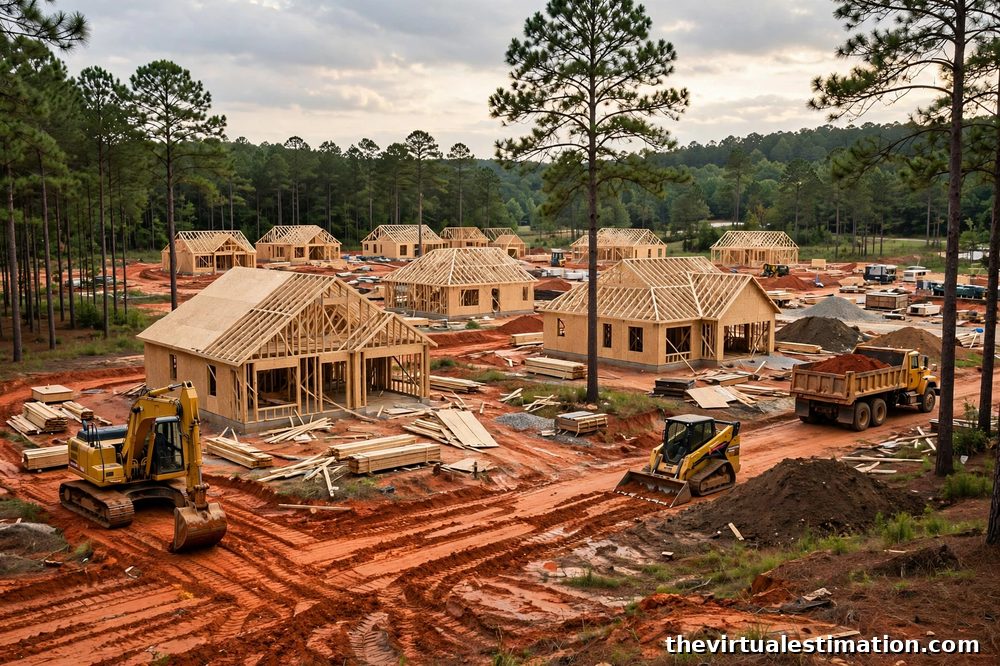
Charlotte sits in the Piedmont, on red clay that expands and shrinks with moisture, over rock that appears without warning in grading. That soil profile changes foundation, slab, and earthwork pricing in ways a coastal or mountain estimate does not face. Carry a geotechnical report line, price moisture conditioning and compaction testing, and do not assume a standard footing detail works on every lot in the same subdivision. Expansive clay, poor drainage, and tree roots near foundations are recurring Charlotte change order sources, and they are all cheaper to price than to fix.
Climate adds its own lines. Charlotte summers are hot and humid, which affects concrete curing, roofing schedules, and crew productivity, and summer thunderstorms can shut down earthwork for a day at a time. Hurricane remnants and heavy rain events drive the stormwater and erosion control scope discussed above, and floodplain buffers under the UDO limit what can be built near creeks. Winters are mild compared with northern markets, but freeze thaw cycles still affect exterior work and paving. Price weather days, curing and protection, and erosion control maintenance as real lines, not as a footnote. A schedule that assumes perfect weather from June through September in Charlotte is not a schedule.
How contractors actually bid in Charlotte
Three habits separate winning Charlotte bidders from busy ones.
First, bid the drawings you have, and list what you do not have. If the civil set is preliminary, say so, and carry sitework as an allowance with a defined basis. If the MEP schedules are not issued, carry equipment as an allowance by unit, not as a percentage. Owners respect a bid that names its gaps.
Second, confirm the local supply chain. Charlotte suppliers serve both Carolinas, and lead times for switchgear, HVAC equipment, and specialty materials can stretch a schedule even when the price holds. A bid that assumes eight week delivery on a 20 week item is a delay claim waiting to happen. Get the lead time in writing and build it into the schedule.
Third, price the inspection sequence. Mecklenburg County inspections run through Accela, and failed inspections cost trips and days. A takeoff that assumes one inspection per trade, passed first time, is optimistic on any complex job. Carry re-inspection time and the cost of keeping the site ready, especially on phased conversions where occupied areas limit work hours.
Charlotte bid checklist: run this before you submit
- Zoning use permit approved before building plan review is assumed in the schedule, with city land development review sequenced alongside the county permit.
- Stormwater plan, erosion control, tree protection, and utility tap fees priced from the civil drawings, not as a percentage of building cost.
- MEP broken into equipment, rough in, fixtures, and controls, with supplier quote validity dates and an escalation line stated in the bid letter.
- Labor priced at current Charlotte market rates by trade, with sub availability confirmed and extended general conditions tied to a realistic schedule range.
- Geotechnical scope, rock excavation allowance, and clay soil treatment carried as explicit lines on greenfield and infill work.
- South Carolina scope, if any, priced under South Carolina jurisdiction, with travel, delivery, and tax treatment separated from the Charlotte scope.
- Contingency separated from escalation, so the owner can see what is unknown scope and what is price movement over time.
- Exclusions and allowances listed in plain language, including what happens if a plan review cycle triggers re-review fees or a permit expires.
Run that list on every Charlotte bid for a month and you will find at least one missing line per bid. That missing line is usually where the margin went on the last job.
What to send for an accurate Charlotte estimate
Send the full plan set, including civil, architectural, structural, and MEP drawings, the specifications, the geotechnical report if one exists, the site address and parcel information, and the bid date and validity period you need. Note whether the work is in the city of Charlotte, in another Mecklenburg County town such as Matthews, Mint Hill, Huntersville, or Cornelius, or across the line in South Carolina, because the permitting authority changes with the address. Note the delivery method too: lump sum, guaranteed maximum price, or design build each need a different takeoff structure. The more complete the set, the tighter the number, and the fewer allowances an owner has to interpret.
Charlotte rewards contractors who bid with local knowledge and show their work. Price the city you are building in, line by line, and your bids will hold up after you win them.
For a detailed, drawing based estimate for your next Charlotte project, contact The Virtual Estimation at info@thevirtualestimation.com and send your plans for a fast, trade by trade takeoff. Pair that with our construction estimating services to get a bid ready number built for the Charlotte market, not a national average.