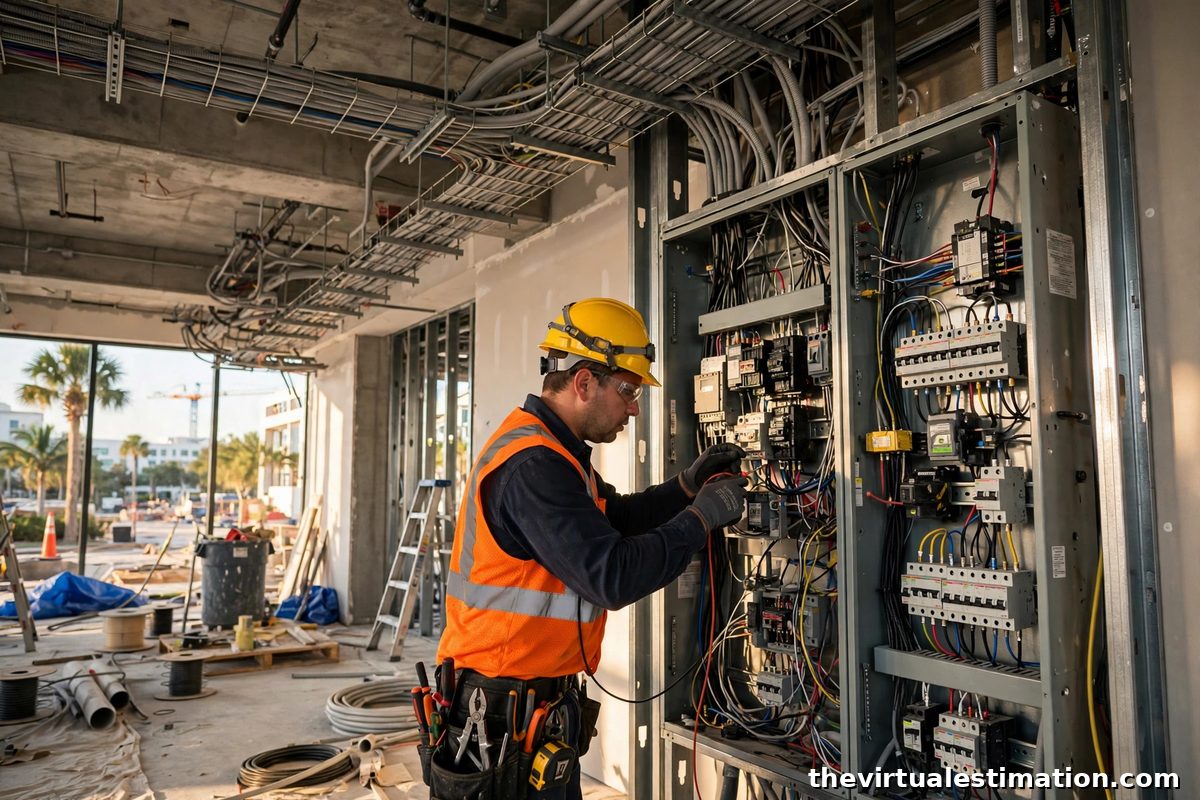
If you are bidding electrical work in Orlando, the most accurate estimate starts with three answers, not with a device count: which authority issues the permit for this exact parcel, which utility serves it, and whether the application will be judged under the code in force today or the code that takes effect on December 31, 2026. Get any one of those wrong and the rest of the takeoff, however careful, prices the wrong job. This guide shows how to price electrical work for the Orlando market the way a local estimator does: jurisdiction first, utility second, code timing third, and only then quantities, labor, permit fees, and review time.
Who this is for: electrical contractors, general contractors, developers, and estimators bidding residential, multifamily, hotel, or commercial electrical work in the Orlando metro, including firms that bid Orlando jobs from out of town and need to avoid the local traps that do not show up on a plan set.
1. The December 31 decision comes first, not last
Orlando enforces the Florida Building Code, 8th Edition (2023), for applications submitted after December 30, 2023, with the 2020 National Electrical Code (NEC) adopted as the electrical code through Florida Building Code Chapter 27, and residential electrical provisions in Florida Building Code Residential Chapters 34 to 43. That is the edition in force on November 2, 2026. The 9th Edition (2026), based on the 2024 International Codes and the 2023 NEC, is scheduled to take effect December 31, 2026, under Florida Statute 553.73(7)(e), and the edition in effect when you apply generally governs the permitted work for the life of that permit.
For an estimator, that makes submittal timing a pricing decision in November and December. A job you can submit complete before the cutoff is priced to the 8th Edition and the 2020 NEC. A job that will slip past the cutoff must be priced, and its panel schedules, surge protection, GFCI and AFCI scope, and device requirements checked, against the 9th Edition and the 2023 NEC. Do not price a December bid to one edition and assume the other will be accepted at plan review, and do not present the 2023 NEC as already in force in Florida before December 31. If a bid straddles the date, state the assumed submittal date and the assumed edition on the estimate itself, so a reviewer, a client, and your own crew are pricing the same code.
One more caution on local amendments: secondary guides claim Orlando panel labelling, clearance, and tamper resistant outlet amendments, but no primary city amendment text was verified for this guide. Check the current City of Orlando amendment list for your scope before you add or remove a line for a claimed local rule. A claimed amendment that is not in force is just as costly as a real one you missed.
2. Four maps, one mailing address
An Orlando mailing address does not settle jurisdiction, and this is the sharpest estimating trap in the metro. Inside City of Orlando limits, permits go through the City of Orlando Permitting Services Division at 400 South Orange Avenue. Outside city limits, in unincorporated Orange County, permits go through the Orange County Division of Building Safety, which runs the FastTrack system from 201 South Rosalind Avenue. Nearby places with Orlando area mailing addresses, including Winter Park, Maitland, Kissimmee in Osceola County, and Altamonte Springs in Seminole County, each run their own departments, with their own fees and review clocks.
Then there is a fourth world. Walt Disney World sits in the Central Florida Tourism Oversight District (CFTOD, formerly Reedy Creek), which has its own Building and Safety Department, requires contractors to register with the District before applying, and runs its own online permitting through Accela Citizen Access. Never price a resort project on CFTOD land to City of Orlando fees, review times, or utility rules, and never present a Disney or Universal resort project as a City of Orlando permit. The practical rule for every Orlando bid is simple: name the exact jurisdiction for the parcel on the first page of the estimate, and price fees, review time, and inspection sequencing to that jurisdiction only. For the wider estimating picture, our construction estimating services start from the same discipline, jurisdiction and scope before quantities.
3. The serving utility is a second jurisdiction question
For electrical work, the utility is not a detail to confirm later. Inside the city, electric service is normally the Orlando Utilities Commission (OUC), the municipally owned utility serving Orlando and parts of unincorporated Orange County and St. Cloud. Outside OUC territory, most of Orange County is Duke Energy Florida, which is running a multi-billion dollar grid modernisation and storm hardening programme that includes substantial undergrounding.
That split changes service size, meter requirements, temporary service, and, for solar, interconnection steps. An estimate that assumes one service provider, one meter and service standard, and one interconnection process for every Orlando parcel will be wrong on the exact lines a reviewer checks first. Before you price service, panel, and feeder work, name the serving utility for the parcel, confirm its service standard and meter requirements, and price temporary service to that utility's process. A bid that says "OUC service" for a Duke Energy parcel, or the reverse, tells the reviewer you did not check the site.
4. Work the permit fee from the January 2026 formula, not from memory
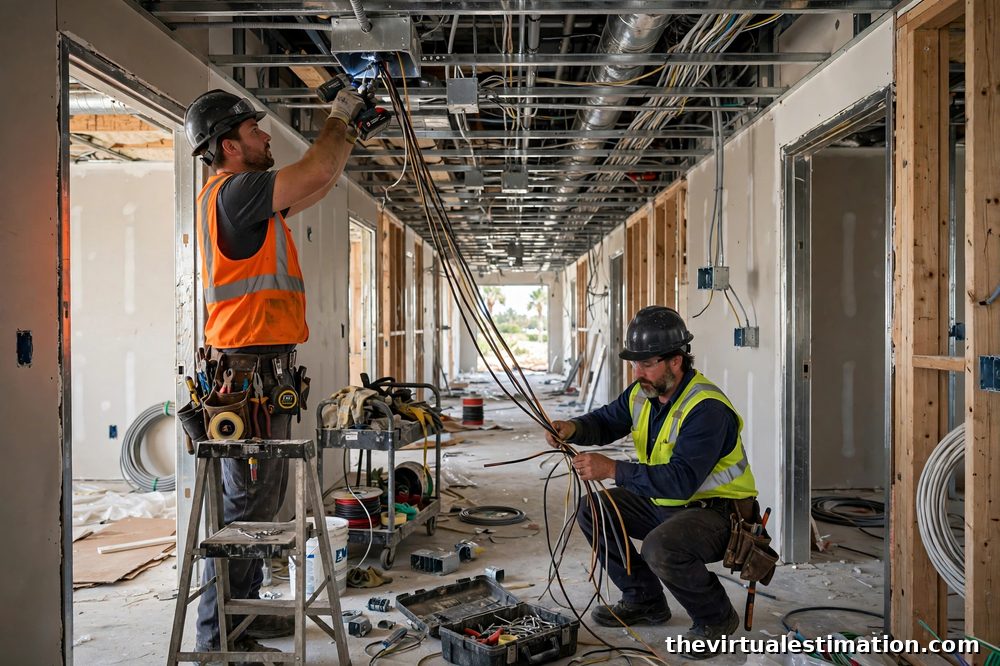
Permit fees are where old guides do the most damage, because Orlando's electrical fee is a formula on construction cost, not a flat number. The current residential electrical formula on the City of Orlando schedule effective January 2026, as verified September 27, 2026, is $66.24 for the first $1,000 of construction cost or fraction, plus $11.03 per additional $1,000 up to $25,000, then $8.28 per additional $1,000 above $25,000. Surcharges apply on every permit: a 1.5 percent Administrative Inspection Fund surcharge and a 1 percent DCA Operational Trust Fund surcharge, each with a $2 minimum, plus a 3 percent technology surcharge. Building permits on the same schedule also carry a 5 percent concurrency surcharge, which is a building permit line, not an electrical line, so do not copy the building formula into an electrical estimate. The building formula itself is different, at $66.24 plus $4.41 per additional $1,000.
Here is the formula worked on two stated construction cost values, so you can check your own arithmetic. These are fee calculations on the stated values, not quotes for a job.
| Electrical construction cost | Fee before surcharges | With 5.5 percent surcharges |
|---|---|---|
| $20,000 | $66.24 plus 19 x $11.03 = $275.81 | $290.98 |
| $40,000 | $66.24 plus 24 x $11.03 plus 15 x $8.28 = $455.16 | $480.19 |
Two flat lines matched the earlier June 2023 city schedule and were unchanged in the September 2026 verification: swimming pool electrical at $50, temporary service pole at $50, and re-inspection at $150. No updated low voltage, alarm sticker, or safety check figure was confirmed in that verification, so this guide does not quote those as current. Be equally careful with secondary guides that quote a $38 minimum electrical permit fee: that figure conflicts with the January 2026 formula above and is not used here. The honest limit on the fee figures in this guide is worth stating plainly. The January 2026 city PDF located in this research covers planning and development fees only, so the electrical formula above is attributed to the January 2026 city schedule as verified September 27, 2026, through a secondary verification of that schedule, not quoted from the PDF text itself. If the city's own building permit schedule contradicts these figures at bid time, the city's schedule wins.
One lever is worth pricing as an option, not as a saving you have already banked. Orlando publishes tiered private provider reductions under Florida Statute 553.791: for 1 to 2 unit residential projects, electing a private provider for both plan review and inspections reduces the Florida Building Code fee component by 75 percent, and for commercial projects and 3-plus unit residential projects up to 200,000 square feet, the combined election reduces that component by 63 percent. The reduction applies to the Florida Building Code fee component only, not to land development, technology, or impact fees, so show it as a separate line and only where the client has actually made the election.
5. Price the review clock, not just the fee
A fee is a single number. A review clock is a schedule risk, and Orlando estimators price it as one. The City of Orlando's own Florida Statute 553.792 guidelines set statutory windows that are not the same measure as the turnaround ranges in secondary guides, so keep them separate on your estimate. Under the city's guidelines, the city reviews an application for completeness within 5 business days, responds with approval or comments within 30 business days for a complete single family application under 7,500 square feet, and requires corrections to rejection comments within 10 business days, after which a missed deadline can mean denial and resubmittal with fees.
Secondary reported ranges, from a permit guide rather than a city guarantee, run longer for larger work: simple residential permits at 2 to 5 business days, residential additions and remodels at 3 to 6 weeks, commercial initial plan review at 6 to 8 weeks, commercial new construction initial review at 8 to 12 weeks, each correction cycle adding 2 to 4 weeks, and total commercial elapsed time at 10 to 16 weeks with corrections. A private provider election is secondary reported at 1 to 3 weeks. Use the statutory windows for the permit types they actually cover, use the secondary ranges as planning allowances labelled as such, and never present either as a city guarantee. On a phased hotel or multifamily job, the cost of a correction cycle is crew standby and remobilisation, not just a second fee, so the estimate should carry a review contingency note where the schedule is tight.
6. Hotel electrical is not house electrical scaled up
Orlando's electrical demand is hospitality shaped, and that is why this guide treats hotel work as its own takeoff, not as a bigger house. Colliers' Q1 2026 Florida hospitality report puts Orlando RevPAR at $179.55, with average daily rate at $228.76 and occupancy at 78.3 percent, above the five year average of 69.7 percent, with 2025 deliveries of six hotels and about 2,500 rooms, and 8,053 rooms under construction in Q1 2026. On October 28, 2026, Civitas Capital announced a $386 million construction loan for the 700 key InterContinental Orlando at 8001 International Drive, with about 105,000 square feet of meeting and pre-function space and a six level, about 730 space parking garage. That loan figure is financing, not construction cost, and no per key or per room electrical cost is quoted from it here, because no verified per key electrical figure was found.
The estimating point is in the takeoff structure. Guestroom branch circuits, food and beverage loads, meeting space distribution, parking garage lighting and electric vehicle provision, pool and amenity feeders, and phased energisation for a resort that must keep operating are separate takeoff lines, each with its own panel, feeder, and inspection sequence. A hotel takeoff that prices branch circuits well and lumps meeting space, garage, and amenity loads into one allowance will miss exactly where the reviewer and the owner will ask questions. Our electrical estimating work separates those systems for the same reason: the quantities must match the way the building will actually be powered and inspected, phase by phase.

7. Multifamily: bid the pullback, not the boom
The second Orlando signal runs in the opposite direction, and estimators who miss it will misread crew availability and lead times. Cushman and Wakefield, reported in a September 2026 Central Florida analysis, put 11,007 apartment units under construction across the Orlando metro in Q1 2026, down 34.1 percent year over year, the lowest volume since the development boom began in 2020, with Q1 deliveries of just 1,796 units, down 45.7 percent year over year. Against that pullback, the metro added an estimated 64,800 residents in 2025, Orange County's Vision 2050 plans for more than 500,000 additional residents over 25 years, and the RoseArts District mixed use project, with more than 5,500 residences, began construction in September 2026.
Read both directions together. A residential electrical takeoff that assumes the 2021 to 2023 apartment boom is still running will overstate crew pressure and may overprice labor or promise a schedule the market no longer requires. A takeoff that assumes no demand will understate the population and hospitality pipeline that keeps large projects moving. For multifamily electrical, price unit branch circuits, common area and amenity distribution, garage and site lighting, and phased turnover as separate lines, and confirm lead times for panels, switchgear, and fixtures against current supplier quotes rather than boom era assumptions. This is also where the Orlando construction estimating service page differs from this guide: the service page describes the service, while this guide prices the market conditions behind a specific bid.
8. Service, surge, and pool lines estimators miss
Three Orlando lines are routinely underpriced because they look like accessories. They are not. First, service equipment. Under NEC 230.67, as adopted in Florida, a Type 1 or Type 2 surge protective device (SPD) is required at dwelling unit services when service equipment is installed or replaced. Price the SPD as a service equipment line with its trigger stated: a panel change or a new service carries it, an untouched existing panel does not automatically gain one, and a takeoff that prices an SPD for every existing home regardless of scope is as wrong as one that omits it from a panel change. Do not promise that an SPD protects against a direct lightning strike. Central Florida's thunderstorm frequency makes surge protection a real priced line, but the device addresses induced and nearby surges, not a direct hit. GFCI and AFCI expansion, tamper resistant receptacles, and interconnected smoke alarms belong on the same new or replacement service scope check, as scope lines, not as boilerplate.
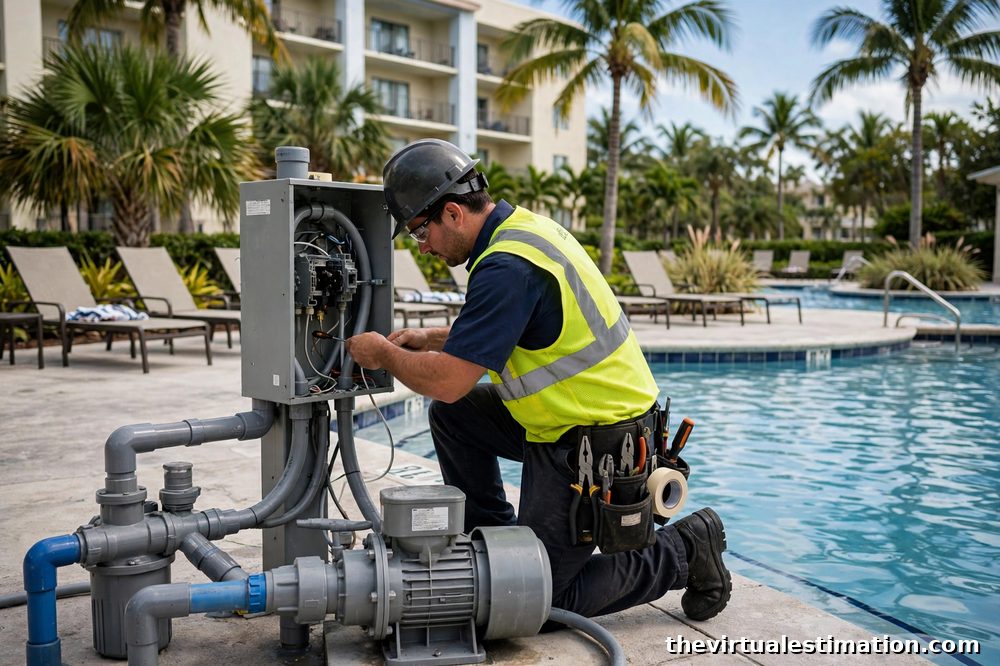
Second, pool, spa, and outdoor electrical. Orlando is a pool heavy market, and pool electrical carries its own NEC Article 680 bonding, GFCI, and equipment scope, plus the separate temporary service and safety check permit lines the city schedule lists. Price the pool equipment feeder and bonding as a separate line, and never price a pool or amenity package as ordinary branch circuit work. Third, storm hardening, kept as three distinct lines rather than one hurricane percentage. Orlando is inland, so the storm story is wind, lightning, treefall, and outage duration, not coastal surge, and OUC's own storm hardening reporting notes its territory is not subject to storm surges. Duke Energy's undergrounding programme and OUC's frontage corridor underground and overhead standards change what service work looks like parcel by parcel. Wind and vegetation resilience, underground versus overhead service, and surge protection each get their own line, and Miami high velocity hurricane zone language has no place in an Orlando estimate, because Orlando is not in that zone.
9. Labor: build your burdened rate, do not borrow a statewide average
No Orlando specific labor rate or per square foot electrical cost figure is quoted in this guide, because no city specific figure was verified from a primary source, and borrowing another city's rate would repeat the template error this series exists to avoid. What the secondary evidence does support is the method. A 2026 Florida labor guide puts journeyman electrician base rates at $30 to $55 per hour, with loaded costs typically 1.3 to 1.6 times the base rate, and describes Central Florida, including Orlando and Tampa, as moderate, with a deep subcontractor pool and production volume. Florida is a right to work state and residential construction is largely non-union, so rates are set by the local market rather than union scale, with public and prevailing wage jobs as the exception. The Bureau of Labor Statistics May 2025 survey puts the statewide mean for all Florida electricians at $27.72 per hour, which is a survey figure, not a bid rate and not an Orlando rate.
Use those ranges only to sanity check your own build up. Price labor from your crew's actual burdened rate, including taxes, insurance, supervision, small tools, and vehicle costs, applied to labor units from your takeoff, and refresh material pricing from supplier quotes at bid time. An estimate that starts from a statewide average and works backward to a bid price will look tidy and fail in the field, because Orlando hotel, multifamily, and pool work do not share the same crew mix, productivity, or inspection sequence.
10. Pre-bid checklist: what to verify before you price
Use this checklist as the original artifact for your next Orlando electrical bid. If any line is blank, the estimate is not ready to submit.
| Check | What to record on the estimate |
|---|---|
| Jurisdiction | City of Orlando, unincorporated Orange County, named neighbouring city, or CFTOD, with the permitting office named |
| Utility | OUC or Duke Energy Florida, with service standard, meter requirements, and temporary service confirmed |
| Code edition | Assumed submittal date and edition: 8th Edition with 2020 NEC, or 9th Edition with 2023 NEC after December 31, 2026 |
| Permit fee | January 2026 formula applied to the stated construction cost, with surcharges shown separately |
| Review plan | Statutory windows where they apply, secondary planning ranges labelled as such, and any private provider election |
| Takeoff split | Guestroom, meeting, garage, amenity, pool, and service lines priced separately, never lumped |
| Service scope | SPD trigger, GFCI and AFCI scope, and Article 680 pool bonding checked against the adopted NEC |
| Labor and material | Your burdened rate and current supplier quotes, not a statewide average or another city's rate |
When you send a job for an outside estimate, send the parcel address and jurisdiction, the serving utility if you know it, the panel and fixture schedules, the one line diagram, the assumed submittal date, and the phasing plan for any operating hotel or occupied building. Those five items let an estimator price the Orlando specific lines in this guide instead of guessing them, and they are the difference between a takeoff that survives plan review and one that comes back with corrections.
Questions estimators ask in Orlando
Can I price an Orlando electrical job from the city fee schedule alone? No, unless you have first confirmed the parcel is inside City of Orlando limits. Unincorporated Orange County, neighbouring cities, and CFTOD land each have their own schedules, and the January 2026 city formula in this guide applies only to City of Orlando residential electrical permits.
Does the December 31, 2026 code change affect a job already permitted? Generally, the edition in effect when you apply governs the permitted work for the life of that permit, so a complete application submitted before the cutoff is judged under the 8th Edition. Confirm the cutoff with the permitting office for your jurisdiction, because local processing rules can differ.
Should every Orlando panel change include surge protection? A new or replacement service should include a Type 1 or Type 2 SPD under NEC 230.67 as adopted in Florida. An untouched existing panel does not automatically require one, and an SPD should never be sold as protection against a direct lightning strike.
Orlando rewards the estimator who checks the map, the meter, and the calendar before counting devices. Price the jurisdiction, the utility, and the code edition first, work the permit fee from the January 2026 formula with its surcharges shown, split hotel, multifamily, pool, and service work into the lines a reviewer will actually inspect, and build labor from your own burdened rate. That is how an Orlando electrical estimate holds up at bid time, at plan review, and in the field.
For help pricing your next Orlando electrical bid, contact The Virtual Estimation or email info@thevirtualestimation.com, and see our electrical estimating services for the full scope we cover.