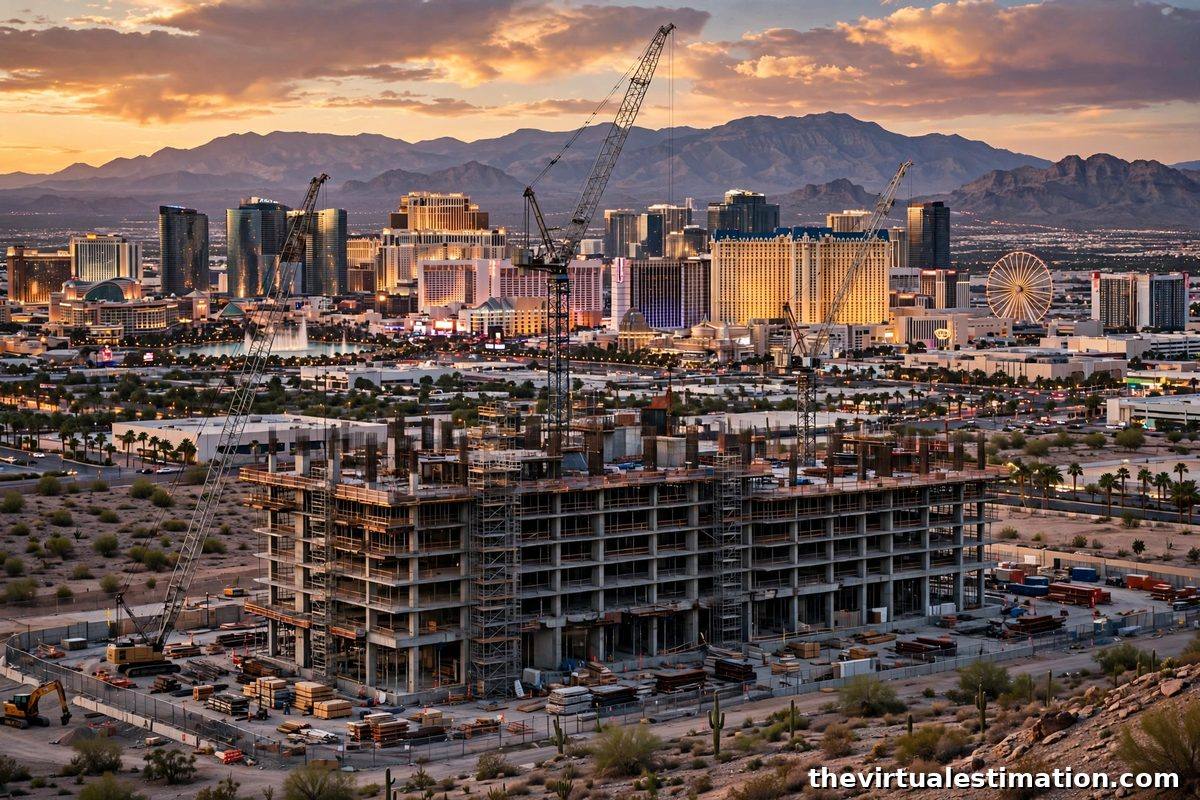
If you are bidding construction work in Las Vegas, the answer to the question most estimators ask first, what will this job cost to build, starts with a different question: which Las Vegas is this parcel in? The City of Las Vegas, unincorporated Clark County, Henderson, and North Las Vegas each permit work, apply fees, and run review clocks on their own terms, and the famous Strip itself sits almost entirely outside the City of Las Vegas. On top of that split map, the whole valley moved to the 2024 building codes in January 2026, on four different effective dates. An estimate that names the wrong jurisdiction, or prices to the old code edition, is wrong before the first quantity is counted. This guide gives you the jurisdiction, code, ground, review, and market checks that make a Las Vegas estimate hold up at bid time.
Who this is for: general contractors, subcontractors, developers, and estimators bidding residential, multifamily, hospitality, or commercial work anywhere in the Las Vegas Valley, plus firms deciding whether a parcel is a city, county, Henderson, or North Las Vegas job.
Start with the parcel, not the postcard
Las Vegas is the sharpest jurisdiction trap in this city series, because the name on the mailing address tells you almost nothing about who issues the permit. The City of Las Vegas covers only part of the valley. Henderson and North Las Vegas are separate incorporated cities with their own building departments. Almost everything else, including the entire Las Vegas Strip south of Sahara Avenue, Summerlin South, and the resort corridor, is unincorporated Clark County, served by the Clark County Building Department. The county itself states that it provides municipal services, including building inspections, to more than 1,026,144 residents in the unincorporated area, and that most residents south of Sahara Avenue and in much of the outskirts are not inside any city boundary. Six unincorporated towns, Paradise, Winchester, Spring Valley, Enterprise, Sunrise Manor, and Whitney, are county jurisdiction, not city jurisdiction.
That distinction changes real money. A resort tower on the Strip is a Clark County permit, in Paradise or Winchester township, not a City of Las Vegas permit, even though every tourist in the building thinks they are in Las Vegas. A warehouse in Henderson and a retail center in North Las Vegas are not interchangeable with a county job either. Your takeoff template should carry a jurisdiction field, filled in from the parcel address and checked against the City of Las Vegas jurisdiction finder for any address that is not obviously inside city limits, before any fee, code, or timeline line goes on the estimate. Your scope letter should name that jurisdiction in plain words, so a client comparing two bids is comparing the same permit path.
A construction estimating service built for this valley prices the permit and fee lines from the parcel and the permit class, not from a flat Las Vegas allowance, because the same building can carry a different fee and a different review clock on opposite sides of a jurisdiction line. If a bid you are leveling shows one generic permit allowance for every Las Vegas job, treat that line as unpriced, not as priced low.
| Jurisdiction | What sits there | Estimating consequence |
|---|---|---|
| City of Las Vegas | Part of the valley, including downtown and the city core north of Sahara Avenue | City fee schedule, city review targets, city submittal portal |
| Unincorporated Clark County | The Strip, resort corridor, Summerlin South, and the six unincorporated towns | County fee schedule and county review path; never call this a city permit |
| Henderson | Separate incorporated city southeast of the valley | Its own fee schedule, code effective date, and review queue |
| North Las Vegas | Separate incorporated city north of the valley | Its own fee schedule, code effective date, and review queue |
Four January 2026 code dates, not one valley date
The second trap is quoting one valley-wide code date. The valley coordinated its move to the 2024 codes, then staggered it. The City of Las Vegas adopted the 2024 International Building Code, Residential Code, Existing Building Code, Swimming Pool and Spa Code, Uniform Plumbing Code, Uniform Mechanical Code, Energy Conservation Code, Fire Code, and Wildland Urban Interface Code on July 16, 2025, effective January 5, 2026, with any project first submitted on or after that date designed to the 2024 codes. Clark County adopted the 2024 International Building Codes effective January 11, 2026, with all permit applications except standard plans filed from that date required to comply, and 2024 energy code compliance required for all new building permit applications from the same date. Henderson's effective date was January 2, 2026, and North Las Vegas's was January 1, 2026, according to the IAPMO adoption summary for Southern Nevada.
For a November 2026 submittal, the working position is simple: the 2024 codes are the edition in force in all four jurisdictions, and an estimate priced to the 2018 codes plus the old Southern Nevada Amendments is stale. That matters on scope, not just on paper. The move to the 2024 energy code raises envelope and mechanical requirements, and the city worked with industry specifically on energy items such as slab-edge insulation, so a 2018 envelope allowance is wrong on quantity, not just on edition. Confirm no later amendment has superseded the January 2026 adoption for your parcel's jurisdiction at bid time, and record the edition on the estimate cover sheet. A bid that assumes one valley-wide effective date can misstate the code edition for a parcel across a jurisdiction line by up to 10 days, which is exactly the kind of gap that matters for a project whose submittal straddled the January window.
| Jurisdiction | 2024 code effective date |
|---|---|
| North Las Vegas | January 1, 2026 |
| Henderson | January 2, 2026 |
| City of Las Vegas | January 5, 2026 |
| Clark County (unincorporated) | January 11, 2026 |
Price the ground, not the desert
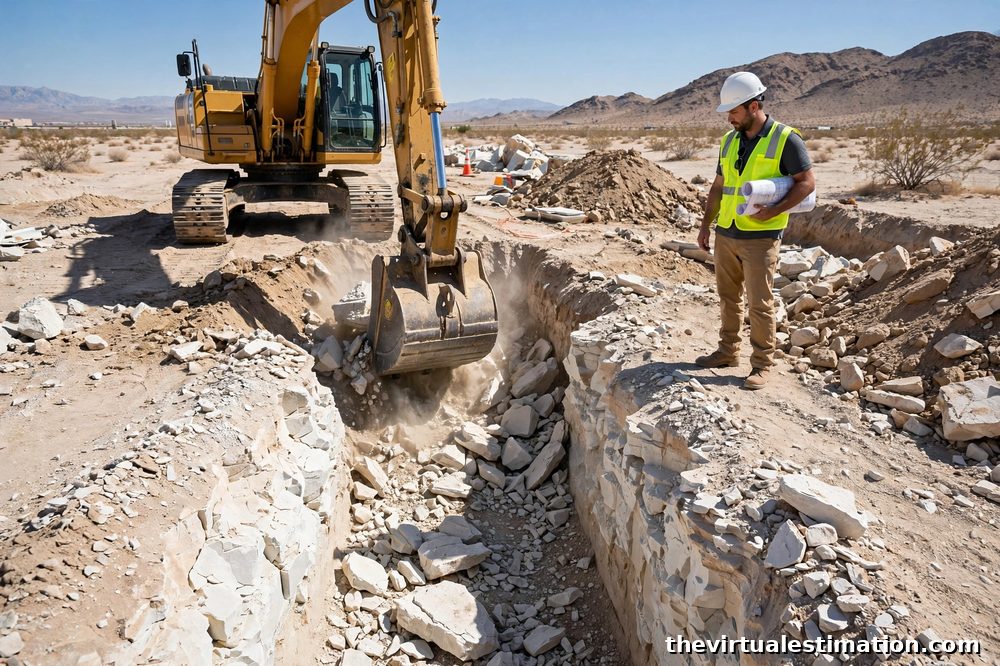
Las Vegas excavation is not ordinary desert sand, and a takeoff that prices it that way misses the job's biggest ground risk. The ground story here is caliche, a rock-like calcium-carbonate layer formed as groundwater rises and evaporates in desert soil, cementing gravel, sand, and silt into a layer that behaves like concrete. Its depth is erratic. A crew can hit it at 18 inches on one parcel and not until four feet on another. Its hardness is erratic too, from thin layers a pick can break to layers that need hydraulic hammers, heavy equipment, or even blasting. The City of Las Vegas Building and Safety Department confirms there is no code prohibition on basements. They are rare because caliche excavation is unpredictable and expensive, and because a basement in this valley is a second liability story, which the flooding section below covers.
Turn that into takeoff practice. Price excavation with a parcel-specific soil test, not a valley average. Carry caliche as a separate contingency line, with the test result behind it, and break out rock excavation, hammer time, and haul separately from ordinary earthwork, because lumping them hides the exact cost that overruns. Price a basement, if a client insists on one, as a specialty scope with its own waterproofing, drainage, and excavation pricing, and warn in writing that the test, not the plan, sets the number. Do not apply a flat percentage premium for caliche from a secondary writeup. No single percentage fits a layer whose depth and hardness change from lot to lot, and a flat number on a bid is a guess dressed up as a quantity. The same warning applies in reverse: do not borrow a Phoenix or Denver excavation allowance and call it a Las Vegas number. Phoenix shares desert ground, Denver shares no-basement habits for different reasons, and neither explains a Las Vegas parcel's caliche profile.
Split the review clock, or your schedule is fiction
Las Vegas review time is stated, short, and split by review type, and an estimate that quotes one generic permit timeline misstates the critical path. The City of Las Vegas Building and Safety page states routine project review at 1 week for non-structural reviews and 2.5 weeks for structural reviews, land development reviews at 2 weeks for building permits, 2 weeks for civil plan review, and 2 weeks for utilities, and fire reviews for building permits at 3 weeks, with express plan review available by appointment. Treat those as the city's stated review targets, not as guaranteed turnaround for a complex or incomplete submittal, and confirm them at bid time. From January 1, 2026, all new commercial, residential, and civil building plans submitted to the city must be submitted electronically, so a paper-submittal workflow in your schedule is also stale.
The estimating point is the split. Fire review at 3 weeks can be the long pole on a commercial job even when structural review is only 2.5 weeks, and civil and utilities reviews run on their own 2-week clocks. Your schedule should show structural, civil, utilities, and fire as separate lines, each with its own target, its own resubmittal allowance, and its own owner. A GC estimating package for a Las Vegas commercial job should also price general conditions against that split clock, because a week of fire-review delay costs different money than a week of structural-review delay when it lands on different trades. If your bid shows a single permit duration with no breakdown, a reviewer who knows this market will read it as a schedule that has not been planned.
| City of Las Vegas review type | Stated target |
|---|---|
| Routine non-structural review | 1 week |
| Routine structural review | 2.5 weeks |
| Land development, building permits | 2 weeks |
| Civil plan review | 2 weeks |
| Utilities review | 2 weeks |
| Fire review, building permits | 3 weeks |
Do not copy a fee table from a blog
Permit fees are the line most likely to be wrong on a Las Vegas estimate, and the honest reason is worth stating plainly. Fees are valuation-based and they differ by jurisdiction, permit class, and scope, and the city and county schedules in force on the bid date are the only figures that belong on a bid. This guide deliberately does not reproduce a fee table. The only full valuation table found during research was a secondary reproduction, not the county's own schedule, and a city fee-study process reported in early 2026 means a schedule copied from an older post may not be the schedule in force now. Copying that table, or copying another city's table, would give you a clean number and a wrong bid.
Price fees the slow way, every time. Identify the jurisdiction, identify the permit class, run the parcel through the current city or county fee schedule or permit fee calculator, and attach the calculation to the estimate. State the valuation basis you used, because a fee quoted without its valuation is unverifiable. If a competing bid shows a fee line with no jurisdiction, no permit class, and no valuation, bid leveling should flag it, not match it. A fee line you can trace beats a fee line that looks precise.
Heat, flooding, and water are three lines, not one desert allowance
Las Vegas estimators lose money by merging three separate conditions into one desert allowance. Keep them apart on the takeoff, because each one hits different trades, different schedule windows, and different contingencies.
Heat is a schedule and curing line. Summer heat drives concrete curing, worker productivity, and thermal expansion and contraction on south- and west-facing walls. Price curing compounds, night or early-morning pour windows, shade and hydration for crews, and schedule float for heat days as their own lines, and sequence heat-sensitive work out of the worst weeks where the program allows. Flooding is a grading, drainage, and floodplain line. The July through September monsoon drives flash flooding off steep surrounding terrain onto dry, floodplain ground, and the city itself names that flood risk as a second reason basements are a liability here. Price grading, drainage, retention, and floodplain verification separately, and never let a floodplain question ride on a generic sitework allowance. Water is a supply and conservation line. Desert water scarcity drives its own infrastructure, from Southern Nevada Water Authority conservation rules to the water-supply side of any large project. Price conservation fixtures, irrigation limits, and supply coordination as their own scope, and check the parcel's water conditions before you price landscaping or amenity water features. One desert allowance hides all three risks. Three lines let you defend each one.
Pools, spas, and the wildland edge are scopes, not extras
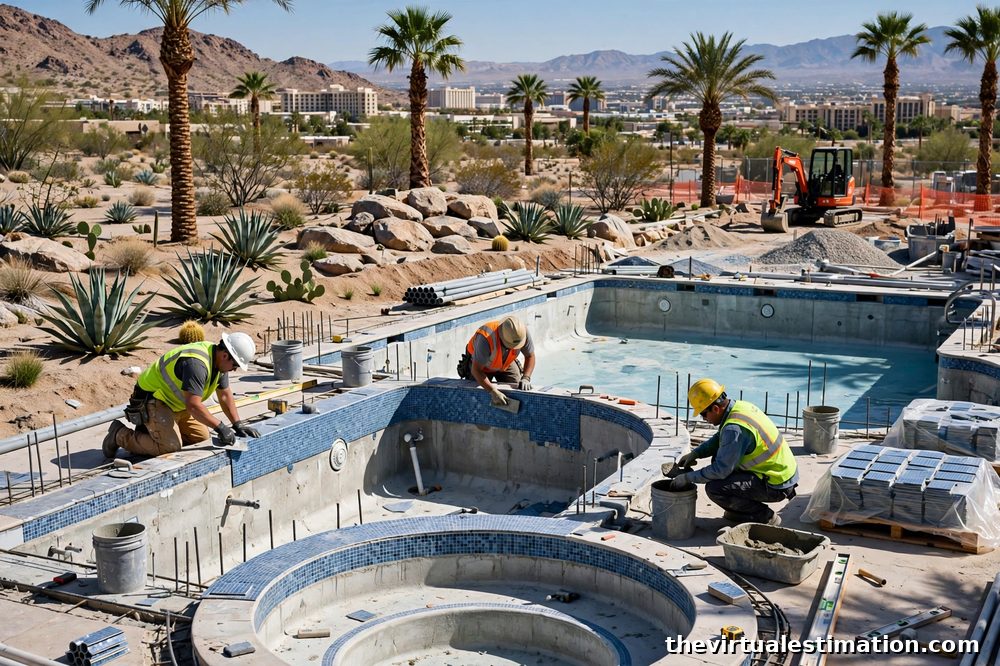
Las Vegas is a pool-heavy market and a valley-ringed market, and both facts create scope that a generic takeoff misses. The 2024 International Swimming Pool and Spa Code was adopted valley-wide in the January 2026 package, so pool and spa work carries its own code, barrier, equipment, and inspection scope. Price a Las Vegas home or resort amenity package with a separate pool and spa line, including barrier, equipment pad, plumbing, electrical, and inspection, instead of burying the pool in a landscaping or amenity allowance. A pool priced as an extra is a pool priced late, and late pool pricing is where change orders breed.
The wildland edge is the matching scope at the valley rim. The City of Las Vegas also adopted the 2024 International Wildland Urban Interface Code in the January 2026 package, so parcels at the valley edge toward the Spring Mountains and the foothill master plans carry wildland-interface scope that an interior-valley takeoff does not. Price defensible space, ignition-resistant materials, and access and water-supply requirements for those parcels as their own lines, and confirm the parcel's interface status before you price exterior materials. An interior-valley material allowance applied to an edge parcel is the same error as a city fee applied to a county parcel: right market, wrong parcel.
Read the 2026 market both ways at once
The 2026 market signal in Southern Nevada is a pullback, not a boom, and an estimator who reads only one side of it will misprice labor and schedule. Secondary reporting citing UNLV's Lied Center for Real Estate states that Southern Nevada residential building permits fell 35 percent in the first half of 2026 versus 2025, the largest decline among the 55 largest US metros, with closed new-home sales down 21 percent through August 2026 according to Home Builders Research. Read that direction, not a boom assumption, into a residential takeoff: a crew-short, price-rising market is not the market the permit data describes, and a residential bid that assumes it will overstate both labor pressure and schedule risk.
Against that pullback, the mega-project pipeline is still pulling crews in the other direction. The Athletics ballpark on the former Tropicana site at Tropicana and the Strip is reported at a cost risen into the 2 billion dollar range, with the public contribution capped at 380 million dollars under Senate Bill 1 of 2023, 33,000 seats, targeted for April 2028, with roof steel going up in August 2026. Brightline West's 218-mile Las Vegas to Rancho Cucamonga line is reported as scheduled for late 2029, with its Las Vegas station on Las Vegas Boulevard south of the Strip between Warm Springs and Blue Diamond roads, but its reported cost conflicts across 2026 sources, from 12 billion dollars plus to about 21 billion dollars, and its federal loan status is reported as still unapproved. Do not present either project as complete, and do not quote the Brightline cost range as settled. The estimating point is the crew pull, not the headline cost: a commercial takeoff that ignores the ballpark and rail station demand for skilled crews misreads the labor market just as surely as a residential takeoff that ignores the permit pullback. Price labor with both signals in the same conversation, and name both in your bid notes so the client sees why your labor line is neither boom-priced nor recession-priced.
Your Las Vegas estimate intake checklist
Use this checklist before you count a quantity. It is the original working tool in this guide, and it is the fastest way to catch the errors above before they reach a client. If any line is blank, the estimate is not ready to send.
| Check | What to record |
|---|---|
| Jurisdiction | City of Las Vegas, Clark County, Henderson, or North Las Vegas, verified from the parcel address |
| Code edition | 2024 codes, with the jurisdiction's January 2026 effective date noted |
| Soil test | Caliche depth and hardness for this parcel, with rock excavation broken out |
| Review split | Structural, civil, utilities, and fire targets shown as separate lines |
| Fee calculation | Current city or county schedule, permit class, and valuation basis attached |
| Separate scopes | Pool and spa, wildland-interface, heat, flood, and water lines priced apart |
| Market note | Permit pullback and mega-project crew pull both acknowledged in bid notes |

What to send for a Las Vegas estimate
Send the drawings, the parcel address, and the permit history, and say in your first message whether the job is a city, county, Henderson, or North Las Vegas parcel, or whether you are unsure and want that checked. Include any soil report you already have, because a Las Vegas bid without a soil test is priced on an assumption about caliche. Include the pool, spa, and amenity scope as a separate package, not as a line inside landscaping, and flag any valley-edge parcel so wildland-interface scope is priced from the start. The more of the checklist you can fill in before takeoff, the fewer assumptions your estimator has to carry, and the fewer change orders your project has to absorb later.
For a detailed, trade-by-trade estimate built around the parcel, the jurisdiction, and the 2026 codes that govern it, contact The Virtual Estimation. Send your drawings and project details to info@thevirtualestimation.com, and ask for a construction estimating service quote for your Las Vegas project. You get an estimate priced for the valley your parcel actually sits in, so your bid goes in accurate, complete, and on time.