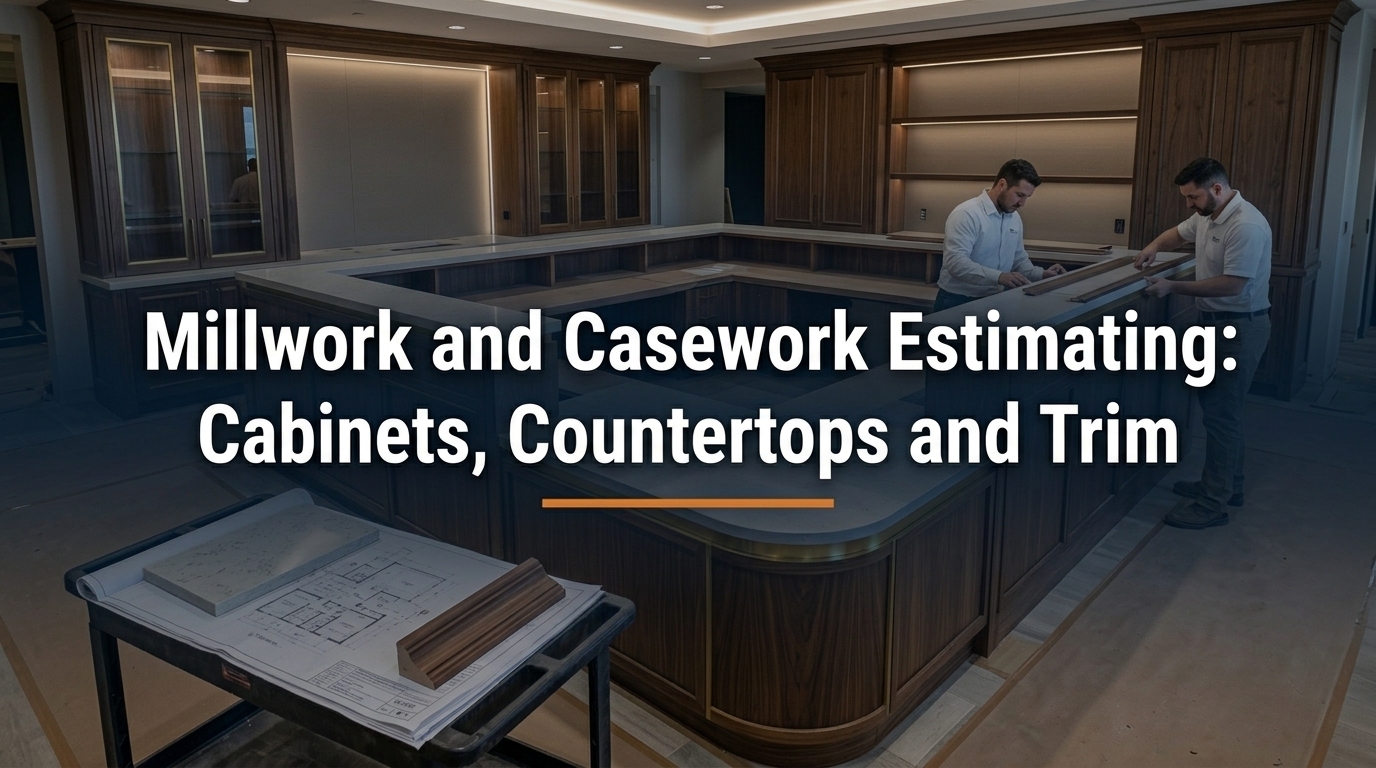
Millwork estimating trips up contractors who come from other trades because the unit of measurement keeps changing. Cabinets are priced by the linear foot of run or by the box count. Countertops are priced by the square foot or by the linear foot depending on who you ask. Trim is priced by the linear foot. Custom casework is priced by the shop hour. None of these units are interchangeable, and using the wrong one produces numbers that are hard to defend when the shop calls with the actual quote.
The other thing that catches people is the difference between stock, semi-custom, and custom millwork. Stock cabinets from a building supply house cost $80 to $180 per linear foot installed. Semi-custom from a regional manufacturer runs $250 to $550 per linear foot. Full custom architectural casework in a corporate lobby or healthcare facility runs $600 to $1,500 per linear foot and sometimes higher. The drawings look similar. The cost is not.
This guide covers how to read millwork drawings, count cabinets, measure countertops and trim, and build an estimate that accounts for the grade of work the project actually requires.
For professional millwork takeoffs with 98% accuracy and 24 to 48 hour turnaround, contact The Virtual Estimation at info@thevirtualestimation.com or visit our construction estimating services page.
Reading Millwork Drawings Before You Touch a Scale
Millwork estimates start with three documents: the architectural floor plan, the millwork elevations, and the millwork schedule or specifications. Using only the floor plan is the single most common reason millwork estimates miss the actual scope.
The floor plan shows where millwork is located in plan view. It does not show cabinet heights, the number of drawers versus doors, the hardware type, the finish, or the countertop edge profile. All of that is on the millwork elevations and in the schedule.
The interior elevations show each millwork unit from the front. This is where the estimator reads the actual configuration: upper cabinets versus lower cabinets, open shelving versus closed doors, glass door panels, pull-out trays, and specialty inserts. Each of these components has a different cost at the shop level.
The millwork schedule, when provided, lists every unit by a designation number that matches the plan and elevations. The schedule defines the species, the finish, the hardware, and the construction method. On a project with a complete millwork schedule, the estimator works from the schedule. On a project with only floor plans and elevations, the estimator reads every detail from the elevations and lists them manually.
Cabinet Estimating: Linear Foot vs Unit Count
Two approaches work for cabinet estimating. Linear foot pricing is faster and appropriate for preliminary estimates or for repetitive layouts like office kitchenettes. Unit count pricing is more accurate for complex layouts, custom work, or any project where the cabinet configuration varies significantly from room to room.
Linear Foot Method
Measure the total length of each cabinet run separately for upper and lower cabinets. Upper and lower cabinets price differently because lower cabinets include the base, the box, doors and drawers, and hardware. Upper cabinets are shorter and typically simpler in configuration.
For a kitchen with 12 linear feet of lower base cabinets and 8 linear feet of upper wall cabinets, the estimate starts with two separate line items at their respective unit rates. Do not combine upper and lower into one total linear footage.
Measure to the centerline of any corner cabinet rather than the outside corner. Corner base cabinets are wider than standard cabinets and their pricing reflects the added material.
Specialty base cabinets such as lazy susan corners, sink bases, pull-out trash inserts, and appliance garages price as premium items above the standard linear foot rate. Count each specialty unit separately and add the premium for each type.
Unit Count Method
Unit count pricing lists every cabinet box individually with its width, height, depth, door and drawer configuration, and hardware. This method takes longer but produces a more accurate estimate and a document the millwork shop can price directly.
Standard cabinet widths run in 3-inch increments from 9 inches to 48 inches. The most common sizes are 12, 15, 18, 21, 24, 27, 30, 33, 36, 42, and 48 inches wide. Cabinets outside these standard sizes are typically custom-sized and carry a surcharge of 15 to 35 percent over the nearest standard size.
A base cabinet list for a typical commercial break room might include four B30 base cabinets, one B36 sink base, one B24 three-drawer unit, and one BC36 blind corner base. Each unit is priced individually and the total box count gives the millwork shop a clear quantity to price.
Countertop Estimating
Countertop quantities are measured in square feet for ordering from the fabricator and in linear feet for pricing the installed run. Both units appear on the same estimate.
Measuring Countertop Area
Measure the overall length of each countertop run including the overhang at the front edge and the backsplash at the rear. Standard countertop depth for residential and commercial break room applications is 25.5 inches including the 1.5 inch overhang at the front. Commercial transaction counters and reception desks vary and must be measured from the drawings.
Countertop area in square feet equals the run length times the depth. For a 14-foot run at 25.5 inch depth, the area is 14 times 2.125 feet equals 29.75 square feet.
Add 10 percent waste for rectangular countertops and 15 to 20 percent for L-shaped or U-shaped configurations because the miter cuts at corners waste material.
Cutouts for sinks, cooktops, and electrical outlets reduce the finished countertop area but do not reduce the material ordered. The fabricator still cuts from the same slab. Price cutouts as additional fabrication charges.
Countertop Material Comparison
| Material | Installed Cost Range | Durability | Common Application |
|---|---|---|---|
| Laminate | $25 to $60 per sq ft | Moderate | Residential, office break rooms |
| Solid surface | $75 to $150 per sq ft | Good | Healthcare, laboratories |
| Engineered quartz | $80 to $180 per sq ft | Excellent | Residential, commercial |
| Granite | $70 to $200 per sq ft | Excellent | Residential, high-end commercial |
| Marble | $80 to $250 per sq ft | Moderate | High-end residential, hospitality |
| Stainless steel | $100 to $300 per sq ft | Excellent | Commercial kitchen, laboratory |
| Phenolic resin | $120 to $250 per sq ft | Excellent | Science labs, industrial |
The specification or the schedule defines which material applies. Estimating laminate prices for a project specified with quartz misses the cost by a factor of two or more.
Edge Profiles and Backsplash
Edge profiles add fabrication cost to any stone countertop. A square eased edge is the least expensive. A full bullnose, ogee, or waterfall edge adds $15 to $40 per linear foot of finished edge compared to a simple eased edge.
Integrated backsplash from the same countertop material adds the backsplash area to the total square footage. A 4 inch backsplash on a 14-foot run adds 14 times 0.33 equals 4.7 square feet to the countertop area. Measure the backsplash separately because some materials price the backsplash differently from the field.
Trim Estimating: Linear Footage Is Everything
Architectural trim includes base molding, crown molding, chair rail, wainscot cap, window casing, door casing, and any specialty profile the architect has specified. All of it is measured and priced by the linear foot.
Base Molding
Measure the perimeter of every room receiving base molding. Deduct for door openings at each door width, typically 3 feet for a standard interior door. Do not deduct for any opening less than 3 feet wide because the base returns into the opening on both sides and uses more material than a straight run would.
Add 10 percent waste on simple rectangular rooms. Add 15 percent on rooms with many corners, bay windows, or cased openings. Base molding waste comes from fitting around outside corners where both pieces are cut long and the offcut is often too short to reuse.
Price base molding material by the species and profile. Finger-jointed pine painted is the standard economical choice at $0.80 to $1.50 per linear foot material cost. Clear pine or poplar for natural finish runs $2.00 to $4.00 per linear foot. Solid wood species like oak, maple, or cherry for stained finish runs $3.50 to $8.00 per linear foot. Exterior-grade MDF for high-humidity applications runs $1.00 to $2.50 per linear foot.
Crown Molding
Crown molding measurement follows the same perimeter approach as base but with different waste factors because crown cuts at inside corners are more complex than base cuts. Add 15 percent waste on standard rooms. Add 20 to 25 percent on rooms with vaulted ceilings, coffered ceilings, or many corners.
Crown molding labor runs significantly more per linear foot than base because the crew must work overhead with pieces held at a compound angle. Where base molding runs 150 to 250 linear feet per person per day, crown molding on complex profiles in high ceiling rooms runs 60 to 120 linear feet per person per day.
Window and Door Casing
Casing surrounds window and door openings on both faces of the wall. Count every opening from the door schedule and window schedule. Each door casing set includes two side pieces and one head piece. Each window casing set includes two side pieces, one head piece, and a stool and apron assembly on the interior.
Price casing as a per-opening unit rate that includes all pieces cut and installed at that opening, or measure the linear footage of each piece individually. The per-opening method is faster. The linear footage method is more accurate when profiles and sizes vary across openings.
Built-In Casework: Commercial Applications
Commercial casework differs from residential millwork in construction method, hardware specification, and project delivery timeline. Most commercial casework is specified under AWMAC quality standards: Grade A for the highest quality visible surfaces, Grade B for standard commercial, and Grade C for concealed or utilitarian applications.
Reading the Casework Schedule
Commercial projects use casework schedules that assign a unit designation to every piece of built-in casework in the building. The designation appears on the floor plan at each unit location. The schedule lists the unit dimensions, the construction grade, the species or laminate color, the hardware, and any special features.
The estimator works through the schedule systematically, counting every unit designation and recording the dimensions, the configuration, and the specification grade. Units with glass doors, locking hardware, file drawer slides, or electrical data ports price higher than standard box-and-door units at the same size.
Nurse Stations, Reception Desks, and Custom Units
Healthcare nurse stations and commercial reception desks are among the most complex and expensive millwork units in any building type. A nurse station in a medical office might span 20 linear feet with transaction counters at two heights, built-in computer monitor risers, task lighting, locking medication cabinets, and integrated electrical and data outlets throughout.
These units do not price by the linear foot using standard residential cabinet rates. They price by shop hours for design, fabrication, and installation. A qualified commercial millwork shop will provide a lump sum quote from the drawings. The estimator's job is to provide complete and dimensioned drawings to the shop and to include the shop quote in the bid without modification.
Allow adequate lead time. Custom commercial casework typically requires 6 to 12 weeks from shop drawing approval to delivery. Projects with tight schedules need millwork ordered before construction begins.
Millwork Installation Labor
Installation labor for millwork depends heavily on the complexity of the unit and the conditions on site.
Stock and semi-custom cabinets in standard residential layouts run 200 to 350 linear feet per installer per day in good site conditions with a helper. Complex custom casework in commercial interiors runs 80 to 150 linear feet per installer per day because each unit requires more precise setting, shimming, and scribing to the finished walls and ceilings.
Countertop installation runs 150 to 250 square feet per two-person crew per day for laminate and solid surface. Stone countertops with seams and cutouts run 80 to 150 square feet per two-person crew per day because of the weight handling and the precision cutting required at sinks and appliances.
Trim installation in simple residential applications runs 200 to 350 linear feet per installer per day for base and casing combined. Complex commercial trim with multiple profiles, reveals, and built-up assemblies runs 100 to 180 linear feet per installer per day.
The Items Most Commonly Left Out of Millwork Estimates
Blocking and backing in the walls behind casework is sometimes excluded from millwork estimates because it is installed before the drywall by the framing or drywall contractor. Confirm who is responsible for wall blocking before finalizing the scope. If it is the millwork installer's responsibility, measure every linear foot of hanging rail and blocking location and price accordingly.
Touch-up and adjustment after the trades punch out is underestimated on commercial projects. Doors need adjustment after the building climate stabilizes. Hardware needs re-tightening. Scribes need filling. Budget four to eight hours of touch-up labor per major millwork area in a commercial project.
Delivery and unloading is sometimes listed separately from installation labor, especially on upper floor work where elevator access is limited. Price the unloading and staging labor when the delivery conditions are not straightforward.
Related guides worth linking: The drywall estimating guide covers the wall and ceiling surfaces that millwork installs against. The painting estimating guide covers the painted finish that follows millwork installation and priming.
Visit our service areas page for regional millwork estimating coverage across all 50 states.
Frequently Asked Questions
How do you estimate custom millwork without shop drawings?
Measure everything you can from the architectural drawings: overall dimensions, door and drawer configurations, countertop areas, and trim linear footages. List all unknowns and assumptions clearly. Send the drawings to two or three qualified millwork shops and ask for budget pricing with stated assumptions. Use the budget shop quotes rather than unit rate book pricing for custom work. Custom millwork deviates too much from standard units for book pricing to be reliable.
What is the difference between millwork and casework?
Millwork traditionally refers to wood products manufactured in a mill including trim, moldings, doors, windows, and stair components. Casework refers specifically to cabinet units and built-in storage. In practice the terms are used interchangeably on most commercial projects, and the millwork subcontractor typically furnishes and installs both. On a bid, confirm that the millwork subcontractor's scope includes all items shown on the millwork plans regardless of how they are labeled.
Should laminate color selection affect the estimate?
Not significantly for material cost. High-pressure laminate panels cost roughly the same regardless of color or pattern selection. Where color affects cost is in lead time. Stocked colors ship quickly. Custom colors or patterns require a minimum order and an extended lead time. If the project is on a tight schedule and the specified laminate is a custom color, confirm availability before bid day rather than discovering the problem after award.
How do you handle millwork in phases on renovation projects?
Renovation millwork often installs in phases around occupied areas. Phase work adds relocation of protection materials, multiple mobilizations, and careful coordination with the building operations staff. Price each phase separately with its own mobilization cost and access time assumptions. A millwork scope that would take 10 days in a continuous unoccupied installation might take 18 to 22 days in a phased occupied renovation.