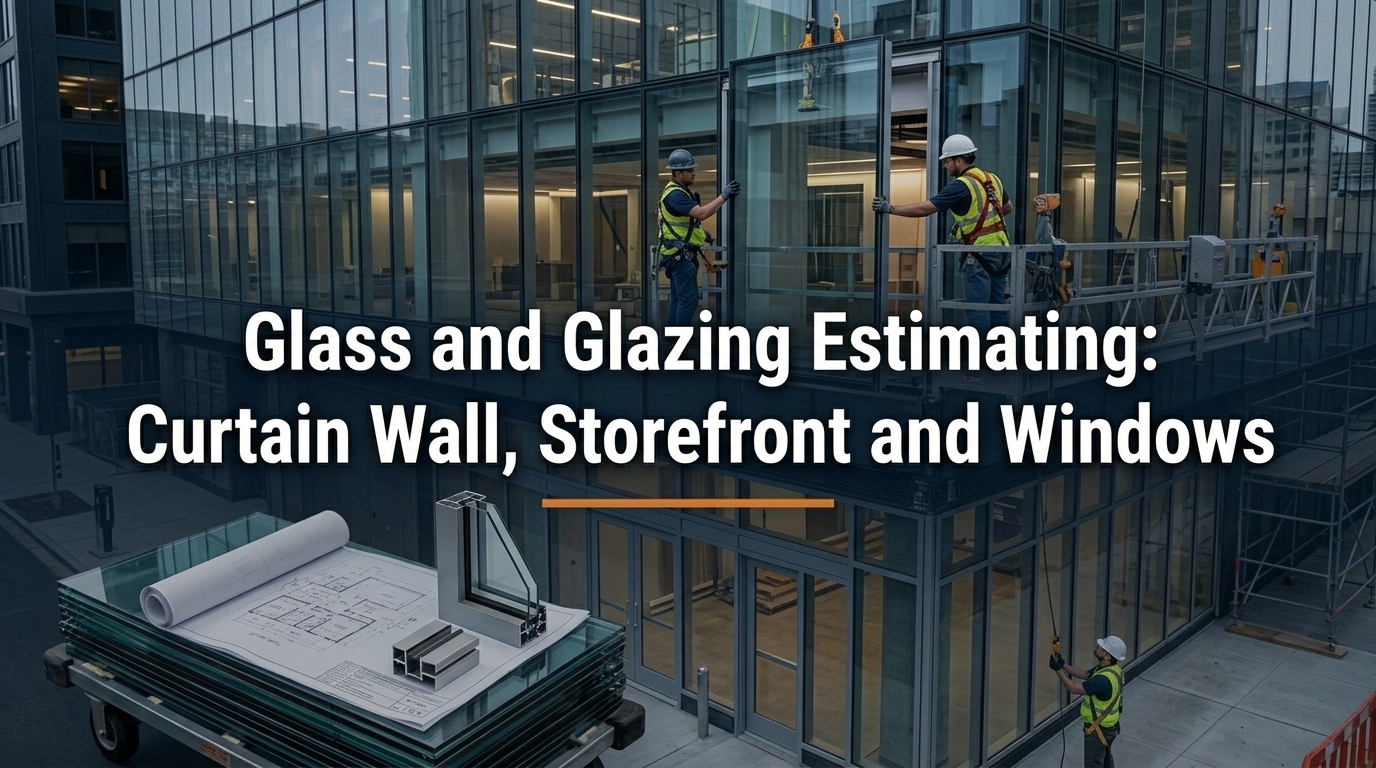
Glass and glazing is one of the more expensive envelope scopes in commercial construction, and it is one of the hardest to estimate accurately from drawings alone. The reason is that the cost difference between system types is enormous. Stick-built curtain wall on a 10-story office building and a simple aluminum storefront on a single-story retail strip mall both look like "glass and aluminum" on the drawings, but they price completely differently by a factor of three to five times on a per-square-foot basis.
Get the system type right before you measure anything. Then measure it correctly. Then count every accessory that the drawings show but the system quote does not include. That is the job.
This guide covers how to estimate curtain wall, storefront, aluminum windows, and glass doors for commercial projects what to measure, how to count accessories, how sealant quantities work, and where the labor hours go.
For professional glazing takeoffs with 98% accuracy and 24 to 48 hour delivery, contact The Virtual Estimation at info@thevirtualestimation.com or visit our construction estimating services page.
Read the Spec Before You Measure Anything
The specification section for glazing tells you which system applies, which manufacturer is required or approved, the thermal performance requirements, the wind load design pressure, the glass type, and the finish on the aluminum framing. Every one of these items affects cost.
A curtain wall specified at 65 psf design pressure with thermally broken framing, low-e triple glazing, and a custom Kynar 500 paint finish costs significantly more than the same square footage specified at 20 psf design pressure with non-thermally broken framing, clear double glazing, and a stock anodized finish.
The thermal performance specification is particularly important right now because energy codes in most states are tightening. Projects subject to California Title 24, ASHRAE 90.1-2022, or local energy codes beyond the minimum often specify performance values that require thermally broken framing and high-performance glass that adds 20 to 40 percent to the system cost compared to standard commercial product.
After reading the spec, pull the architectural elevations and the glazing schedule. The elevations show the extent of each glazing system. The glazing schedule assigns glass types and frame configurations to each unit or elevation zone.
Curtain Wall Estimating
Curtain wall is a non-load-bearing exterior wall system where aluminum framing attaches to the building structure and supports the glass infill panels. It does not carry floor loads. Its job is to keep the weather out, provide thermal performance, and handle wind loads.
System Types and What They Mean for Estimating
Stick-built curtain wall ships as individual components vertical mullions, horizontal transoms, glass, and anchors and assembles entirely in the field. It is flexible for complex geometry but labor intensive. Field labor runs 3 to 6 hours per 100 square feet of installed area depending on building height and complexity.
Unitized curtain wall ships as pre-glazed factory-assembled panels, typically one panel per floor per module width. Panels lift into position and interlock with adjacent panels at the interlocking vertical joints. Field labor runs 1.5 to 3 hours per 100 square feet because most assembly work happens at the factory. The material cost per square foot is higher than stick-built because of the factory labor included in the unit price, but the installed cost difference narrows on tall buildings where scaffolding and field labor costs are high.
Hybrid systems use factory-assembled horizontal spans with field-set vertical mullions. They split the difference on both cost and schedule.
Measuring Curtain Wall Area
Measure the overall glazed area from the exterior elevations. Use the outside dimensions of the framing system from slab edge to slab edge or from anchor point to anchor point, not just the glass area. The framing material in the mullions is part of the purchased system and is included in the square footage pricing.
For a 10-story building with 120 linear feet of curtain wall per floor and 12 foot floor-to-floor height, the curtain wall area is 120 times 12 times 10 equals 14,400 square feet. Deduct any areas specifically shown on the drawings as solid spandrel panel or opaque panel if those zones use a different product or different pricing.
Measure each elevation separately if the system, the glass type, or the design pressure differs between elevations. South and west exposures often specify higher performance glass than north exposures on energy-conscious projects.
Anchors and Structural Connections
Curtain wall anchors are the steel connections that attach the aluminum mullion system to the building structure. They are not always included in the glazing subcontractor's scope. Confirm with the general contractor whether the glazing contractor or the structural steel contractor furnishes and installs the anchors.
Where the glazing contractor is responsible, count every anchor from the shop drawings or the architectural details. Anchors occur at every mullion at every floor, plus any intermediate anchors required by the structural engineer for wind load resistance. On a 10-story building with 120 linear feet of curtain wall and mullions at 5 foot spacing, the anchor count is 120 divided by 5 equals 24 mullions times 10 floors equals 240 anchors minimum before intermediate anchors.
Sealants at Curtain Wall
Curtain wall requires sealant at every perimeter condition where the system meets the building structure, at any penetrations through the system for mechanical or electrical items, and at any reglet or counterflashing condition. Measure the perimeter linear footage of the curtain wall area and price sealant at that footage using the appropriate sealant type from the specification.
Structural silicone used at structural glazing joints is a specialty product priced by the linear foot at a premium over standard joint sealant. If the specification requires structural silicone anywhere in the system, confirm whether the glazing manufacturer applies it in the factory or whether it is a field application scope item.
Storefront Estimating
Storefront is the most common commercial glazing system for ground level retail, office entries, and interior demising walls. It is a pressure-equalized aluminum frame system with mechanically captured glass. It is not designed for the wind loads or the movement accommodation required in mid-rise and high-rise curtain wall applications.
Storefront framing comes in standard commercial depths 2 inch, 2.5 inch, and 4.5 inch face dimensions in most manufacturer product lines. Wider frame faces cost more material but are often specified on high-visibility entries for the architectural appearance.
Measuring Storefront
Measure storefront area in square feet from the architectural elevations. Width times height of each storefront opening gives the area of that unit. Sum all storefront areas separately from curtain wall because the system pricing is different.
Do not assume all openings are the same height. Entries that extend from floor to underside of roof deck cost more than entries that terminate at a transom below a solid head. Count and measure each unique opening configuration separately.
Header and sill conditions at the top and bottom of storefront systems add linear footage of framing material that is not captured in the area calculation. Measure the total linear footage of head receptor and sill anchor at every storefront opening. These are priced per linear foot as accessories to the system.
Storefront Doors
Storefront doors are counted individually. Standard aluminum storefront doors in 3-0 and 4-0 widths are the most common sizes. Offset pivot and concealed closer doors are specialty items at a premium above standard butt-hinge storefront doors.
Door hardware for storefront applications includes the closers, the panic hardware or push-pull hardware, the threshold, the weatherstripping, and the door sweep. Confirm whether door hardware is in the glazing scope or the hardware scope. On many commercial projects, the hardware contractor furnishes the hardware and the glazing contractor installs it. On others, the glazing contractor furnishes and installs all hardware on storefront doors.
Count every storefront door from the door schedule, confirm the hardware specification, and price accordingly.
Aluminum Window Estimating
Aluminum windows differ from storefront in that they are designed as individual punched opening units rather than as a continuous framing system. They install in framed rough openings in the wall rather than spanning from floor to floor.
Counting Windows From the Schedule
The window schedule lists every window type used on the project with its rough opening dimensions, the frame configuration, the glazing type, and the screen or accessory requirements. The architectural floor plan shows each window location with a type designation that cross-references to the schedule.
Count every window type from the plan. Multiply by the unit count to get the quantity of each type. Price each type at its unit cost including the frame, the glazing, and any standard accessories like screens, sills, and rough opening trim.
Windows that appear identical on the plan can carry different costs depending on their rough opening size, their operation type, and their glazing specification. A fixed window at 4 foot by 5 foot costs less than a projected casement at the same rough opening because of the operating sash hardware.
| Window Operation Type | Cost Relative to Fixed |
|---|---|
| Fixed | Base |
| Single hung | 15 to 25% higher |
| Double hung | 20 to 35% higher |
| Casement | 25 to 40% higher |
| Projected or awning | 25 to 40% higher |
| Slider | 15 to 25% higher |
| Tilt and turn | 40 to 70% higher |
Glazing Specifications That Affect Window Cost
Glass type is the largest single variable in window material cost. The glazing schedule or specification defines the glass for each window type.
Clear single pane glass is no longer acceptable under current energy codes in most commercial applications. Double insulated glass units are the minimum standard in most US climate zones. Triple insulated units are required in climate zones 6 and above.
Low-e coatings on the glass reduce heat transmission in both directions. There are multiple low-e specifications with different solar heat gain coefficients optimized for different climate orientations. The coating specification affects glass cost by $2 to $8 per square foot of glass area depending on the coating type.
Laminated glass for safety and security adds thickness and cost. Tempered glass is required by code in locations within 18 inches of walking surfaces, in sidelights adjacent to doors, and in other hazardous locations. The glazing schedule flags which units require safety glazing.
Glass Quantity Calculation
Glass area is the visible glass area inside the frame, not the overall window area including the frame. For a window with a 4 foot by 5 foot rough opening and a 3 inch frame all around, the glass area is (48 minus 6) times (60 minus 6) divided by 144 equals 13.75 square feet per lite.
On curtain wall and storefront, glass quantity is typically priced by the square foot of installed glass area using the unit square footage within each framing module. Measure the daylight opening of each module the clear opening between frame members and multiply by the glass thickness factor from the specification.
Insulating glass units have two or three layers of glass with an air or gas-filled spacer between. The price of the IGU includes all layers, the spacer, and the sealing compound. Price IGUs as complete units per square foot, not as individual glass layers.
Sealant and Caulking Quantities
Perimeter sealant at glazing openings is measured by the linear foot. Every window has four sides of perimeter at the interface between the window frame and the wall construction. For a 4 foot by 5 foot window, the perimeter is 18 linear feet. With 100 windows of this size, the total sealant joint is 1,800 linear feet.
Joint sealant coverage depends on the joint width and depth. A 3/8 inch wide by 3/8 inch deep joint uses approximately 1 linear foot of sealant per 4 linear feet of joint with standard polyurethane or silicone sealant. For 1,800 linear feet of joint at this size, the sealant quantity is 450 linear feet equivalent, which at approximately 150 linear feet per tube gives 3 tubes per 450 feet equals roughly 72 tubes or about 6 cases.
For better accuracy on larger projects, use the manufacturer's coverage table with the actual joint dimensions from the glazing details rather than a rule-of-thumb calculation.
Backer rod is installed behind the sealant in wider joints to control the sealant depth and achieve the correct width-to-depth ratio. Measure the same linear footage as the sealant and confirm the backer rod diameter matches the joint width from the detail drawings.
Labor Hours for Glazing Installation
Glazing installation labor varies significantly by system type, building height, and access conditions.
Stick-built curtain wall at ground level with good access runs 80 to 120 square feet per crew per day. At mid-rise with swing stage access, production drops to 50 to 80 square feet per crew per day because of the time spent moving the swing stage, securing tools, and managing material deliveries to the work face. At high-rise on a motorized building maintenance unit, production runs 40 to 70 square feet per crew per day.
Unitized curtain wall installs faster in the field. A two-person crew setting unitized panels with crane assistance runs 200 to 400 square feet per day depending on panel size and crane cycle time. The faster field installation is the primary reason unitized systems are preferred on tall buildings despite the higher material cost.
Storefront in standard commercial applications runs 150 to 250 square feet per two-person crew per day including frame setting, glass installation, and sealant. Complex storefront with radius elements, special conditions at slab edges, or difficult site access runs 80 to 130 square feet per day.
Individual aluminum window installation in rough openings runs 8 to 15 windows per two-person crew per day for standard windows. Large windows requiring hoist equipment or special anchoring conditions run 4 to 8 per day.
What Gets Left Out of Glazing Estimates
Scaffolding and access equipment is either included in the glazing contractor scope or provided by the general contractor. Confirm this before bid. On multi-story work the scaffolding can represent 10 to 20 percent of the total glazing contract value.
Shop drawings and engineering are required for curtain wall systems to confirm wind load compliance and structural attachment design. On most commercial projects the glazing subcontractor provides shop drawings as part of their scope. The cost of preparing and stamping the shop drawings is included in the system price on most bids but confirm explicitly on projects where the structural engineer requires independent peer review.
Mockup panels are specified on many medium to large glazing projects. A full-scale mockup of one typical curtain wall module is built and tested for air and water infiltration before production fabrication begins. The mockup cost includes the panel fabrication, the test chamber, and the testing fees. This is a real cost that appears in the spec and must be in the estimate.
Glass replacement during construction warranty period is sometimes specified as an allowance the glazing contractor must carry. Read the specification for any warranty glass replacement requirements before finalizing the number.
Internal Links
The drywall estimating guide covers the interior walls that connect to storefront systems at demising conditions and at interior glazed partitions. The painting estimating guide covers the sealant and paint work adjacent to glazing systems that the painting contractor performs after glazing installation. The millwork and casework guide covers the interior sill finishes and wood trim at window openings that follow glazing installation.
For glazing contractors and general contractors working across Texas, California, Florida, New York, and all other states, visit our service areas page. The Virtual Estimation delivers complete glazing takeoffs within 24 to 48 hours. Email info@thevirtualestimation.com to get a quote within one hour.
Frequently Asked Questions
How do you estimate glazing when only schematic drawings are available?
At schematic stage, measure the total glazed area from the elevations and assign a system type from the design intent description. Apply a square foot budget rate for that system type adjusted for the building location and the performance specification. Budget rates for commercial curtain wall in 2026 run $80 to $180 per square foot installed depending on the system complexity, glass performance, and market conditions. Storefront runs $45 to $95 per square foot installed. Flag the estimate clearly as budget-level with stated assumptions and request final construction documents before bidding.
What is the difference between curtain wall and window wall?
Curtain wall spans from floor to floor or from structure to structure and attaches to the building at the floor slabs or structural frames. Window wall sits on the floor slab and is laterally restrained at the underside of the slab above. Window wall is less expensive than true curtain wall because it does not need to accommodate as much differential movement between floors. The structural detail at the head and sill conditions distinguishes the two systems. Mis-identifying window wall as curtain wall overstates the cost. Mis-identifying curtain wall as window wall understates the structural complexity and the anchor scope.
Does the glazing contractor typically install the interior window stools and trim?
On commercial projects, the glazing contractor installs the aluminum frame, the glass, and the exterior perimeter sealant. Interior stools, jamb extensions, and painted trim are typically the millwork or carpentry contractor scope. Confirm the division of work from the project specifications before assigning scope.
How does wind load design pressure affect glazing cost?
Higher design pressure requires heavier aluminum extrusion profiles and more frequent anchor connections to the structure. On a coastal project with 90 mph wind speed design requirements, the curtain wall framing weight per square foot might be 30 to 50 percent heavier than an inland project at 70 mph design wind speed. Heavier profiles mean more aluminum material cost and higher shipping weight. The structural anchor count also increases, adding both material and labor cost.