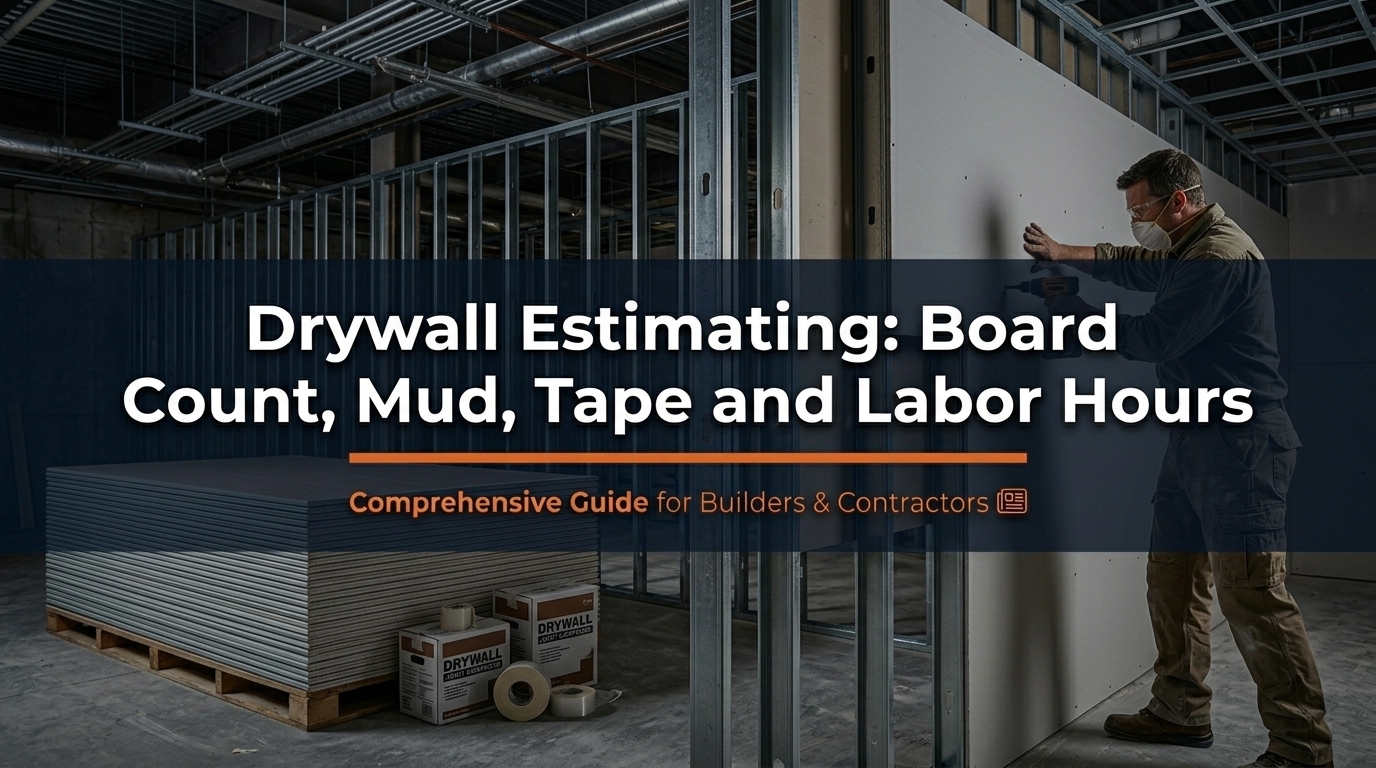
Drywall estimating is one of the most detail-intensive scopes in any construction project. Every contractor who has completed a drywall takeoff has encountered the same problem: boards run short before the job finishes, or finishing compound runs out halfway through the tape and bed phase. Both situations cost money, slow the project, and damage client relationships.
Accurate drywall estimating requires a systematic approach to every component, from the initial board count through screw quantities, joint compound buckets, paper tape linear footage, and corner bead measurement. This complete drywall estimating guide covers every step experienced estimators follow on commercial and residential projects, including the waste factors, coverage rates, and labor productivity numbers that separate profitable bids from money-losing ones.
If you need professional drywall estimating support, The Virtual Estimation provides complete drywall takeoffs with 98% accuracy and 24 to 48 hour turnaround across all 50 states. Contact us at info@thevirtualestimation.com or request a quote through our construction estimating services page.
What Is Drywall Estimating and Why Accuracy Matters
Drywall estimating is the process of calculating the exact quantity of gypsum board, joint compound, paper tape, corner bead, screws, and labor hours required to complete the drywall scope on a construction project. An accurate drywall estimate directly affects whether a contractor wins the bid at a profitable price or loses money on installation.
The gap between a rough drywall estimate and an accurate one comes down to a handful of calculation steps that most contractors skip. Waste factors applied to the wrong area, compound quantities calculated from memory rather than product coverage rates, and corner bead counts guessed rather than measured from drawings each add a small error. Combined across a full commercial project, these small errors produce a bid that loses money.
Understanding drywall estimating properly also connects directly to related scopes. Painting quantities come from the same surface areas. Acoustic ceiling installation coordinates with drywall terminations. MEP rough-in penetrations add cutting and patching labor. A thorough drywall takeoff informs the entire interior finish estimate.
What Documents You Need Before Starting a Drywall Takeoff
A complete drywall takeoff requires five documents: architectural floor plans, reflected ceiling plans, interior elevation drawings, the wall type schedule, and project specifications.
| Document | What It Tells the Estimator |
|---|---|
| Architectural floor plans | Layout of all walls and partitions |
| Reflected ceiling plans | Ceiling heights, soffits, bulkheads |
| Interior elevations | Wainscoting, specialty wall conditions |
| Wall type schedule | Board type, thickness, fire rating, layers |
| Project specifications | Product requirements, finish levels |
Working from any one of these documents without the others produces incomplete quantity calculations. The project specifications are especially important because they define which gypsum board products are required for each application. Type X fire-rated board, moisture-resistant board, abuse-resistant board, and standard wallboard are all priced differently and used in different locations.
Missing a specification requirement for a fire-rated assembly in a corridor or a moisture-resistant board requirement in a bathroom creates real cost variance between the estimate and the actual material purchase.
Drywall Board Count: Step by Step Calculation
The board count is the foundation of every drywall estimate. It is calculated from gross wall and ceiling area measured from drawings, converted to the number of standard panels required.
How to Calculate Wall Area for Drywall Estimating
Wall area for each room or zone equals the perimeter multiplied by the wall height from floor to underside of structure or ceiling height shown on the reflected ceiling plan.
For a room that is 20 feet by 15 feet with 9 foot walls, gross wall area is (20 plus 15 plus 20 plus 15) times 9, giving 630 square feet. From this gross area, deduct openings for doors and windows.
The most accurate approach is to deduct all openings larger than 32 square feet, which is the size of one standard 4 by 8 panel, and treat smaller openings as part of the waste factor. For the 20 by 15 room with one 3 by 7 door (21 square feet, deducted) and two 3 by 4 windows (12 square feet each, absorbed into waste), net wall area is 630 minus 21, equaling 609 square feet.
How to Calculate Ceiling Area for Drywall Estimating
Ceiling area equals the floor plan area of the room at the level where drywall is applied. For a flat ceiling in a 20 by 15 room, ceiling area is 300 square feet. Sloped or cathedral ceilings require a slope factor calculation, multiplying plan area by the appropriate factor for the ceiling pitch.
Soffits and bulkheads add surface area on three sides: the bottom face, the front vertical face, and if they return to a wall, the back vertical face. Measure each face separately and add to the ceiling area total.
Converting Drywall Area to Board Count
Divide net area by the coverage of the board size selected, then add a waste factor.
| Board Size | Coverage per Panel |
|---|---|
| 4 x 8 ft | 32 sq ft |
| 4 x 10 ft | 40 sq ft |
| 4 x 12 ft | 48 sq ft |
| 4 x 16 ft | 64 sq ft |
For the 20 by 15 room with 909 square feet total area, dividing by 32 gives 28.4 boards. Adding 10 percent waste gives 31.2 boards, rounded up to 32 boards.
Drywall Waste Factors by Project Type
| Project Type | Recommended Waste Factor |
|---|---|
| Simple rectangular rooms | 5 to 8 percent |
| Standard commercial offices | 8 to 10 percent |
| Complex ceilings, curved walls | 12 to 15 percent |
| Multi-layer fire-rated assemblies | 5 to 8 percent per layer |
Drywall Board Type by Application
Every board type is quantified separately because unit cost and sometimes labor rate differ between types.
| Board Type | Thickness | Where Required |
|---|---|---|
| Standard wallboard | 0.5 inch | Interior partitions, standard ceilings |
| Type X fire-rated | 0.625 inch | Corridor walls, stairwells, mechanical rooms |
| Moisture-resistant | 0.5 or 0.625 inch | Bathrooms, kitchens, utility rooms |
| Abuse-resistant | 0.625 inch | Hospital corridors, schools, detention |
Drywall Screw Quantity Calculation
Standard screw spacing is 12 inches on center in the field and 8 inches on center at perimeter and edges. For a 4 by 8 board on studs at 16 inches on center, standard installation uses approximately 32 screws per board for walls and 36 per board for ceilings.
For 500 boards, the screw quantity is 500 times 32, equaling 16,000 screws. At approximately 250 screws per pound for 1.25 inch screws, that is 64 pounds of screws, or approximately 13 five-pound boxes.
Add 15 to 20 percent overage for drops, damaged fasteners, and the tendency of experienced crews to add extra fasteners at problem areas.
Joint Compound: How to Calculate Mud Quantities Accurately
Joint compound is the most commonly underestimated drywall material. Standard Level 4 finish requires three coats: tape coat, second coat, and finish coat.
Joint Compound Coverage Rates by Coat
| Coat | Coverage per 4.5 Gallon Bucket |
|---|---|
| Tape coat | 475 square feet |
| Second coat | 575 square feet |
| Finish coat | 650 square feet |
For a project with 10,000 square feet of total drywall area:
Tape coat: 10,000 divided by 475 equals 21.1 buckets Second coat: 10,000 divided by 575 equals 17.4 buckets Finish coat: 10,000 divided by 650 equals 15.4 buckets Total: approximately 54 buckets of all-purpose compound
Level 5 finish requiring full skim coat increases compound quantity by 30 to 50 percent. Always add 10 percent overage because material left in buckets overnight skins and becomes unusable.
Paper Tape: Calculating Joint Linear Footage
Paper tape is applied at every board joint including horizontal, vertical, corner, and butt end joints. A reliable approximation is 15 to 20 linear feet of joint per sheet installed.
For 500 sheets at 17 linear feet per sheet (midpoint), total joint footage is 8,500 linear feet. Paper tape is sold in 500 foot rolls, requiring 17 rolls.
Fiberglass mesh tape costs more per linear foot than paper tape and requires more compound to cover. If mesh tape is specified, increase compound quantities accordingly.
Corner Bead: Measuring Every Outside Corner
Corner bead is measured by linear foot of every outside corner condition on the project. Inside corners are taped and covered by the tape calculation.
Outside corners appear at door jamb returns, column and pilaster corners, soffit and bulkhead edges, ceiling drop perimeters, and anywhere two drywall planes meet at an outside angle.
| Corner Bead Type | Application |
|---|---|
| Standard metal corner bead | Standard outside corners |
| Vinyl corner bead | Impact-resistant applications |
| Flexible corner bead | Curved walls and arches |
| J-bead or L-bead | Drywall termination edges |
For a 20,000 square foot commercial office floor with 50 offices, a central corridor, and multiple soffits, outside corner linear footage commonly runs 500 to 800 linear feet. Convert to pieces by dividing total linear footage by the bead length (8 or 10 foot pieces) and rounding up.
Labor Hours for Drywall Estimating: Framing, Hanging and Finishing
Drywall labor divides into three phases with separate crew types and productivity rates.
Metal Stud Framing Labor Productivity
| Wall Condition | Productivity Rate |
|---|---|
| Standard straight walls | 100 to 150 linear feet per hour |
| Complex walls, multiple heights | 60 to 90 linear feet per hour |
| Overhead ceiling framing | 50 to 70 linear feet per hour |
For 5,000 linear feet of standard partitions at 125 linear feet per hour, framing labor is 40 hours.
Board Hanging Labor Productivity
| Condition | Boards per Crew-Hour |
|---|---|
| Commercial long straight runs | 45 to 55 boards |
| Standard residential | 35 to 45 boards |
| Complex ceilings, small rooms | 25 to 35 boards |
For 500 boards at 45 per crew-hour, hanging labor is approximately 11 crew-hours, or 5.5 hours with a two-person crew.
Finishing Labor Productivity
| Phase | Square Feet per Hour |
|---|---|
| Tape coat plus second coat | 250 to 400 |
| Finish coat | 300 to 450 |
| Sanding and touchup | 20 percent of total finishing labor |
For 10,000 square feet of Level 4 finish, total finishing labor is approximately 70 hours. Level 5 skim coat adds 30 to 40 percent.
Commercial vs Residential Drywall Estimating: Key Differences
Commercial and residential drywall estimating use the same fundamental approach but differ in several important ways.
Commercial projects include metal stud framing in the drywall contractor scope. Residential projects use wood framing supplied by the framing contractor. Commercial projects frequently specify multi-layer Type X assemblies for fire ratings, multiplying board quantity while keeping compound and tape quantities similar since only the outermost layer is finished.
Fire-rated corridor and stairwell assemblies on commercial projects require full-height board installation from floor slab to underside of structure, often 14 to 20 foot heights versus 9 foot residential heights. Level 5 finish is increasingly common in commercial healthcare, hospitality, and high-end office projects, adding significant finishing labor and compound cost.
For professional commercial or residential drywall estimating, The Virtual Estimation delivers complete takeoffs within 24 to 48 hours. Our team covers drywall scopes from small tenant improvements to large commercial buildings across all 50 states. Email info@thevirtualestimation.com or visit our drywall estimating services page to get started.
How Drywall Estimating Connects to Related Trade Scopes
Drywall estimating connects directly to several adjacent trade scopes that estimators must coordinate carefully.
Acoustic ceiling systems determine where drywall terminates and where J-bead or L-bead is required. The ceiling scope and drywall scope share perimeter conditions that must be coordinated to avoid gaps or overlaps in the estimate. Learn more in our acoustical ceiling estimating guide.
Painting quantities come directly from the same wall and ceiling areas calculated in the drywall takeoff. When both scopes are estimated from the same source drawings, surface areas should match, providing a useful cross-check for accuracy. See our painting estimating guide for how painters use the same measurements.
MEP rough-in penetrations through drywall create cutting and patching labor that can add meaningful cost to the drywall scope if penetrations are numerous or installed after board is hung. Coordinating the drywall schedule with the MEP rough-in schedule controls this cost effectively.
Frequently Asked Questions About Drywall Estimating
What is the difference between Level 4 and Level 5 drywall finish? Level 4 drywall finish is the standard for commercial and residential interiors receiving flat or eggshell paint. All joints, fastener heads, and accessories are covered and the surface is smooth enough for standard paint. Level 5 adds a full skim coat over the entire board surface for critical lighting conditions, high-gloss paint, or wall coverings. Level 5 adds 25 to 40 percent to finishing labor and compound cost compared to Level 4.
How do I estimate drywall for a fire-rated wall assembly? Fire-rated assemblies require Type X 0.625 inch gypsum board in single or double layers depending on the required fire rating. A one-hour assembly typically uses one layer of Type X on each side of the stud. A two-hour assembly uses two layers on each side. Multiply board quantity by the number of layers required. Compound and tape quantities remain the same since only the outermost layer is finished.
Should metal stud framing be included in a drywall estimate? On commercial projects, metal stud framing is standard practice for the drywall contractor to include in their scope. On residential projects, the framing contractor typically provides all structural framing, so the drywall contractor scopes only board and finish work. Always confirm the division of responsibility with the general contractor before finalizing scope.
How much does professional drywall estimating cost? Professional drywall estimating services charge based on project size and complexity. The Virtual Estimation completes most commercial drywall takeoffs within 24 to 48 hours at flat-rate pricing. Contact info@thevirtualestimation.com for project-specific pricing with no obligation.
What is the most accurate method for calculating drywall waste? Apply waste factors separately to walls and ceilings rather than a single blanket factor. Simple rectangular wall areas use 5 to 8 percent. Complex ceiling conditions with multiple elevations, soffits, and penetrations use 12 to 15 percent. Applying different factors to each zone produces more accurate totals than averaging across the full scope.
How many screws does a typical drywall project use? A standard installation uses approximately 32 screws per 4 by 8 board on walls and 36 per board on ceilings. Add 15 to 20 percent overage for drops and damaged fasteners. A project requiring 500 boards needs approximately 16,000 to 19,200 screws depending on ceiling proportion.