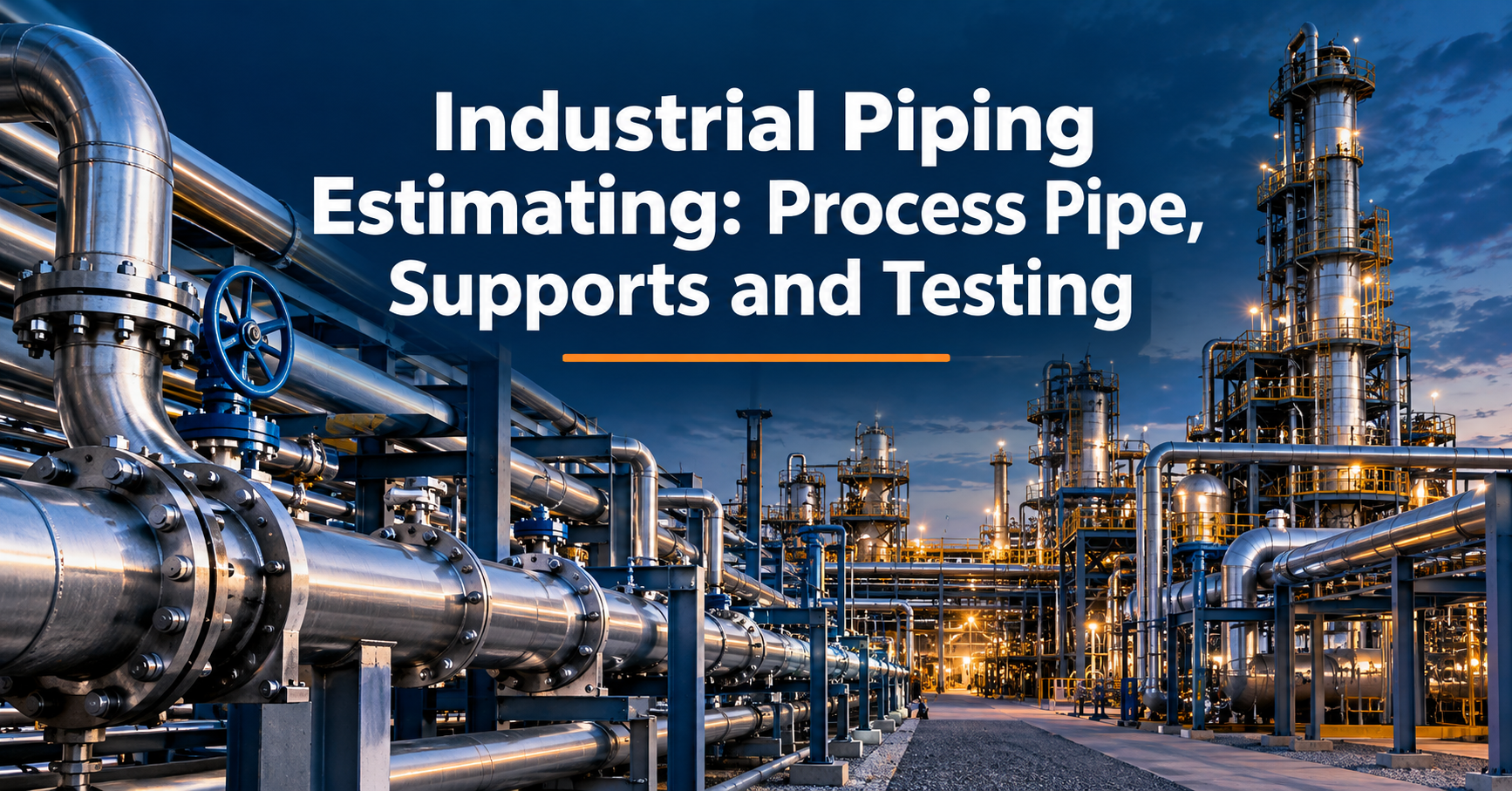
Industrial piping estimates are rarely just a matter of measuring pipe and multiplying the quantity by a unit price. On a manufacturing plant, chemical facility, refinery, pharmaceutical project, or other industrial site, the piping scope connects equipment, utilities, process systems, controls, insulation, supports, testing, and fabrication into one coordinated package.
That is why industrial piping estimating requires a different level of drawing interpretation and cost analysis than a basic commercial plumbing takeoff. A missed valve, incorrect pipe specification, incomplete support count, or overlooked testing requirement can affect both material cost and installation labor.
For contractors bidding industrial work, the objective is not simply to produce a large spreadsheet. The estimate needs to provide a traceable understanding of what is being installed, how it will be fabricated, how it will be tested, and what it will cost to put in place.
What Is Industrial Piping Estimating?
Industrial piping estimating is the process of quantifying and pricing the materials, labor, equipment, fabrication, testing, and associated installation requirements for piping systems used in industrial facilities.
Depending on the project, the estimate may include:
- Process pipe
- Utility piping
- Fittings and flanges
- Valves
- Specialty components
- Pipe supports and hangers
- Welding and fabrication
- Insulation and jacketing
- Heat tracing
- Pressure testing
- Nondestructive examination
- Rigging and access equipment
- Labor and equipment
- Material handling
- Equipment connections
The estimator must interpret several documents together rather than treating each drawing as an independent source of quantities.
For contractors handling complex process systems, process piping estimating services can cover pipe, fittings, flanges, valves, supports, instrumentation, insulation, heat tracing, welding, testing, labor, and equipment costs.
Why Industrial Piping Estimates Are More Complex
A commercial plumbing project may have relatively repetitive fixtures and straightforward piping runs. Industrial facilities can contain multiple piping classes, materials, pressure ratings, operating temperatures, joint types, insulation requirements, and testing procedures within the same project.
A single facility may use carbon steel for one utility system, stainless steel for another process line, alloy materials for corrosive service, and specialty plastic or FRP piping in chemical applications.
The estimator also has to understand how piping interacts with equipment.
A pump connection, for example, may involve pipe, fittings, valves, flanges, gaskets, supports, vibration considerations, equipment connections, and testing. Counting only the linear feet of pipe would leave a substantial part of the scope unpriced.
Current market conditions make this discipline even more important. The Associated General Contractors of America reported that the producer price index for inputs to new nonresidential construction increased 8.9% from August 2025 to August 2026, highlighting why current material and labor assumptions matter in today's bids.
Start With the Complete Drawing Package
A reliable estimate starts before the first quantity is measured.
The estimator should establish which documents define the piping scope and determine whether the drawings are coordinated.
Important documents commonly include:
P&IDs
Piping and Instrumentation Diagrams establish the process relationship between equipment, piping, valves, instruments, and flow paths.
They help identify line numbers, valves, instruments, equipment connections, and system relationships.
Piping Isometrics
Isometrics provide the detailed information required to quantify individual piping runs.
Depending on the drawing package, they can show pipe lengths, fittings, welds, elevations, supports, valves, insulation notes, and connection information.
Line Lists
Line lists can identify pipe size, material, service, insulation, design conditions, and other information needed to establish the applicable piping specification.
Piping Specifications
Material specifications are critical because two pipes with the same diameter may have completely different costs depending on material, schedule, pressure class, joint type, and service requirements.
Equipment Layouts and Schedules
Equipment layouts help establish where piping terminates and how systems connect to pumps, vessels, tanks, heat exchangers, compressors, skids, and other equipment.
The estimator should cross-check these sources rather than relying on a single document.
How to Estimate Process Pipe
The basic pipe takeoff begins by identifying each line and measuring its actual installed quantity.
Pipe should normally be organized by characteristics such as:
- Diameter
- Material
- Schedule or wall thickness
- Piping class
- Service
- Joint type
- Installation location
For example, 4-inch carbon steel process pipe should not simply be combined with 4-inch stainless steel pipe because the material, fabrication, welding, and procurement costs can be substantially different.
The same applies to different schedules and pressure classes.
A detailed quantity takeoff service can help organize measured quantities into a bid-ready format that the estimator or contractor can review against the drawings.
Fittings Need Their Own Takeoff
Pipe quantity alone does not describe the piping system.
Industrial estimates need to account for fittings such as:
- Elbows
- Tees
- Reducers
- Caps
- Couplings
- Branch connections
- Unions
- Specialty fittings
The estimator should identify fittings by size, material, connection type, and applicable rating or specification where the documents provide that information.
A large project can contain thousands of fittings, and the installation labor associated with those fittings can be significant.
Flanges, Gaskets and Fasteners
Flanged connections are another area where incomplete takeoffs can create bid gaps.
Depending on the project, the estimate may need to identify:
- Weld-neck flanges
- Slip-on flanges
- Blind flanges
- Lap-joint flanges
- Threaded flanges
- Gaskets
- Bolts and nuts
- Specialty sealing components
The estimator should verify the flange rating and material requirements rather than applying one generic allowance across the project.
Valve Estimating
Valves can represent a significant portion of an industrial piping package.
Common valve types include:
- Gate valves
- Globe valves
- Ball valves
- Butterfly valves
- Check valves
- Plug valves
- Diaphragm valves
- Control valves
- Specialty process valves
The estimate may also need to include actuators, operators, positioners, extensions, instrumentation, and other accessories.
Valve quantities should be cross-checked against P&IDs, valve schedules, isometrics, and equipment connections where applicable.
Pipe Support Estimating
Pipe supports are frequently underestimated because they are not always quantified in the same way as straight pipe.
Depending on the project, supports may include:
- Pipe shoes
- Guides
- Anchors
- U-bolts
- Clamps
- Hangers
- Rod hangers
- Structural attachments
- Spring supports
- Specialty supports
- Rack supports
The estimator should review support details and spacing requirements instead of applying a simple percentage to pipe quantity.
Support design can also influence structural steel requirements, field welding, installation access, and labor.
For larger industrial packages, support quantities should be coordinated with piping drawings and project specifications.
Pipe Stress and Flexibility Considerations
Not every piping system can be estimated as a simple collection of straight runs and fittings.
Thermal movement, equipment connections, expansion, vibration, operating temperature, and pressure can influence the support arrangement and installation requirements.
Systems requiring expansion loops, spring supports, guides, anchors, or specialty components can carry additional material and labor costs.
The estimator does not necessarily perform the engineering design, but the estimating process should recognize the scope shown or specified by the engineering documents.
If a drawing package contains specialized support or stress-related requirements, those requirements should be identified as part of the estimate rather than hidden inside a general allowance.
Welding and Fabrication Costs
Welding can have a major effect on industrial piping labor.
The estimate may need to distinguish between:
- Butt welds
- Socket welds
- Threaded connections
- Flanged connections
- Shop welds
- Field welds
- Specialty material welding
Material also matters.
Stainless steel and alloy piping can require different welding procedures, consumables, preparation, and quality-control requirements than ordinary carbon steel.
The estimator should therefore calculate labor based on the actual piping configuration rather than applying one productivity factor to every pipe size and material.
Shop Fabrication vs. Field Installation
Industrial contractors increasingly evaluate which piping should be fabricated in a controlled shop environment and which work should be completed in the field.
This distinction affects:
Shop fabrication
- Spool fabrication
- Shop welding
- Fit-up
- Cutting
- Material handling
- Inspection
- Coating or preparation
Field installation
- Rigging
- Alignment
- Field welds
- Connections
- Supports
- Access
- Testing
- Insulation
- Final installation
A good estimate should reflect the project's actual fabrication strategy.
If a project has a high prefabrication ratio, treating all welding as field labor can significantly distort the bid.
Pressure Testing and Inspection
Testing is another scope item that should not disappear into a miscellaneous allowance.
Depending on the system and specifications, testing may involve:
- Hydrostatic testing
- Pneumatic testing
- Leak testing
- Flushing
- Cleaning
- Pressure testing
- Test package preparation
- Test equipment
- Temporary blinds
- Temporary connections
- Labor
- Documentation
The estimator should determine which piping systems are included in each test package and whether testing creates additional temporary material or labor requirements.
Inspection requirements can also affect labor and project cost.
For example, project specifications may require particular nondestructive examination procedures for selected welds or piping classes.
Insulation and Jacketing
Piping insulation should be estimated separately from the bare pipe whenever the drawings or specifications require it.
The scope may include:
- Pipe insulation
- Fitting insulation
- Valve insulation
- Equipment insulation
- Vapor barriers
- Jacketing
- Weatherproofing
- Removable insulation covers
Insulation quantities can vary according to pipe diameter, insulation thickness, material, and jacketing system.
The insulation estimating service covers pipe insulation by size and length as well as fittings, equipment insulation, jacketing, and vapor-barrier requirements.
Heat Tracing and Specialty Systems
Some industrial piping systems require additional systems that are easy to overlook during a basic takeoff.
Examples include:
- Electric heat tracing
- Steam tracing
- Jacketed piping
- Double-containment piping
- Sanitary piping
- High-purity systems
- Corrosion-resistant piping
- FRP systems
- Specialty alloy piping
These systems can introduce additional material, installation, testing, and labor requirements.
For pharmaceutical, food processing, chemical, and other specialized facilities, the estimator should pay particular attention to the project specifications rather than relying on standard piping assumptions.
Process Equipment Connections
Piping does not exist independently of the equipment it serves.
The estimate should identify connections to equipment such as:
- Pumps
- Tanks
- Vessels
- Heat exchangers
- Compressors
- Reactors
- Skids
- Filters
- Separators
Equipment connections can require specialty fittings, flexible connectors, valves, strainers, supports, instrumentation, and additional installation labor.
Where equipment installation is part of the contractor's scope, the equipment estimating service can also address equipment quantities, accessories, rigging, installation labor, supports, piping connections, controls, and related requirements.
Labor Estimating for Industrial Piping
Material takeoff is only half of a complete industrial piping estimate.
Labor should account for the actual installation conditions.
Important factors include:
- Pipe diameter
- Material
- Joint type
- Number of fittings
- Weld count
- Elevation
- Accessibility
- Congestion
- Fabrication ratio
- Rigging requirements
- Testing
- Support installation
- Insulation
- Site conditions
- Shift work
- Overtime
- Prevailing wage requirements where applicable
A 2-inch pipe installed at grade in an open area is not equivalent to a 12-inch alloy pipe installed at elevation inside a congested process unit.
Using one labor factor for the entire project can therefore create a misleading estimate.
Equipment and Installation Conditions
Industrial piping may require more than pipefitters and welders.
Depending on the project, equipment costs can include:
- Cranes
- Man lifts
- Scaffolding
- Forklifts
- Welding machines
- Generators
- Rigging equipment
- Testing equipment
- Temporary facilities
- Material handling equipment
The project location and installation environment should also be considered.
A congested brownfield project can require substantially different labor and access assumptions than a new greenfield facility.
Common Industrial Piping Estimating Mistakes
The most expensive estimating mistakes are often not dramatic calculation errors. They are small scope gaps that accumulate.
Measuring pipe without cross-checking P&IDs
This can leave process lines, branches, valves, or equipment connections out of the estimate.
Applying one waste factor to everything
Pipe, fittings, valves, and specialty materials do not all behave the same way during procurement and fabrication.
Ignoring supports
Supports require material, fabrication, structural attachments, and field labor.
Missing testing requirements
Testing can require equipment, temporary materials, labor, flushing, documentation, and inspection.
Treating all welding as the same
Welding labor changes with material, diameter, joint type, accessibility, and fabrication location.
Using outdated pricing
Material and labor costs change. Current market conditions should be considered when establishing bid pricing.
Ignoring project location
Regional labor conditions, freight, supplier availability, wage requirements, and local market conditions can affect the estimate.
Failing to document assumptions
An estimate without clear assumptions and exclusions becomes difficult to review when the scope changes.
A Practical Industrial Piping Estimating Workflow
A disciplined estimating workflow can be structured as follows.
Step 1: Review the bid documents
Identify drawings, specifications, addenda, schedules, and scope instructions.
Step 2: Establish piping systems
Separate process lines, utilities, services, and specialty systems.
Step 3: Measure pipe
Record quantities by size, material, schedule, and applicable specification.
Step 4: Count components
Quantify fittings, flanges, valves, gaskets, specialty components, supports, and other accessories.
Step 5: Review equipment connections
Verify piping interfaces with pumps, tanks, vessels, skids, and other equipment.
Step 6: Calculate fabrication and welding
Separate shop and field work where required.
Step 7: Add testing and inspection
Identify test packages, temporary requirements, and inspection scope.
Step 8: Add insulation and heat tracing
Measure these systems according to the drawings and specifications.
Step 9: Calculate labor
Apply productivity assumptions based on actual installation conditions.
Step 10: Price materials and equipment
Use current and project-relevant pricing information.
Step 11: Review the estimate
Cross-check quantities, scope, assumptions, exclusions, and drawing coverage.
Step 12: Prepare the bid package
Organize quantities, costs, labor, equipment, assumptions, and alternates into a format the contractor can review quickly.
What Should an Industrial Piping Estimate Deliver?
A useful estimate should allow the contractor to understand where the numbers came from.
A professional deliverable may include:
- Detailed pipe takeoff
- Fitting schedule
- Flange schedule
- Valve schedule
- Support quantities
- Insulation quantities
- Heat tracing quantities
- Welding quantities
- Labor hours
- Material pricing
- Equipment costs
- Testing requirements
- Marked-up drawings
- Assumptions
- Exclusions
- Alternates
- Bid summary
The goal is a bid package that can be reviewed, adjusted, and used for procurement and project planning.
When Should Contractors Outsource Industrial Piping Estimating?
Outsourcing can be useful when an internal estimating team is overloaded or when a project requires specialized piping knowledge.
Typical situations include:
- Multiple bids due at the same time
- Large isometric drawing packages
- Complex process piping
- New industrial market or location
- Limited internal piping expertise
- Need for an independent quantity check
- Tight bid deadlines
- Addenda received shortly before bid submission
- Need for detailed labor-hour calculations
For broader industrial projects involving piping, equipment, structural, MEP, and other scopes, industrial estimating services can provide a wider estimating framework.
How The Virtual Estimation Supports Industrial Piping Bids
The Virtual Estimation provides trade-specific estimating support for industrial contractors, EPC firms, fabricators, and construction teams.
Its process piping scope covers pipe takeoffs, fittings, flanges, valves, instrumentation, supports, insulation, heat tracing, welding, hydrostatic testing, and material, labor, and equipment costs.
For contractors focused specifically on competitive bid preparation, bid estimating services can also support quantity review, cost analysis, scope-gap identification, assumptions, exclusions, and bid assembly.
The company also provides construction estimating support across multiple trades and project types.
Final Takeaway
Industrial piping estimating is a coordinated process, not simply a pipe-counting exercise.
A dependable estimate connects P&IDs, isometrics, line lists, specifications, pipe materials, fittings, valves, supports, fabrication, welding, testing, insulation, equipment connections, labor, and project conditions.
The strongest estimating workflow is one where every major cost can be traced back to the project documents and every important assumption is clearly identified.
For contractors bidding complex industrial work, accurate quantities are the starting point. The real objective is a complete, reviewable cost picture that helps the estimating team build a competitive bid without leaving critical piping scope behind.
Frequently Asked Questions
What is included in industrial piping estimating?
Industrial piping estimating can include pipe, fittings, flanges, valves, supports, hangers, instrumentation, insulation, heat tracing, welding, fabrication, testing, labor, equipment, and related installation requirements.
What drawings are needed for industrial piping takeoffs?
P&IDs, piping isometrics, line lists, equipment layouts, piping specifications, material specifications, schedules, and addenda are commonly needed for a detailed estimate.
Why are pipe supports included in a piping estimate?
Supports require material, fabrication, installation labor, and sometimes structural attachments. Leaving them out can understate the actual installed cost of the piping system.
Does industrial piping estimating include pressure testing?
It can. A complete estimate should review the project specifications and identify hydrostatic, pneumatic, leak testing, flushing, inspection, temporary materials, equipment, and labor requirements where applicable.
How are industrial piping labor costs calculated?
Labor is influenced by pipe size, material, joint type, weld count, accessibility, elevation, fabrication strategy, congestion, support requirements, testing, and site conditions.
Why does project location matter in industrial piping estimates?
Regional labor rates, material availability, freight, wage requirements, supplier pricing, and local installation conditions can affect the final cost.
Can industrial piping estimates include insulation?
Yes. Where required, the estimate can include pipe insulation, fitting and valve insulation, jacketing, vapor barriers, equipment insulation, and heat tracing.
What makes industrial piping different from commercial plumbing estimating?
Industrial piping typically involves more complex process systems, specialized materials, higher specification requirements, equipment connections, fabrication, welding, testing, supports, and process-specific installation conditions.