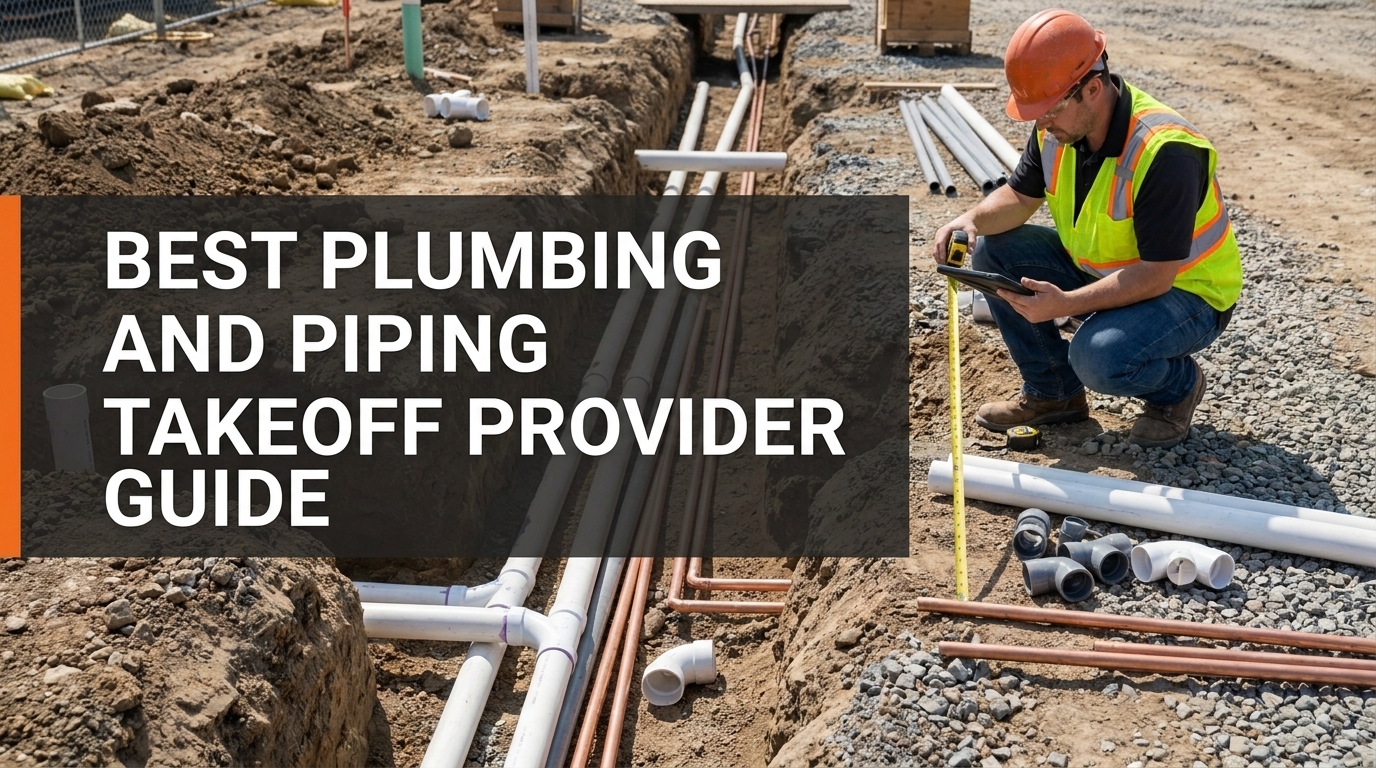
Best Plumbing and Piping Takeoff Provider Guide
Complex industrial construction projects require a higher
level of plumbing and piping estimating than standard commercial work. A
reliable takeoff provider should understand P&IDs, piping isometrics,
specifications, pipe schedules, fittings, valves, supports, insulation,
testing, labor requirements, and project location.
For most contractors, the best provider combines trade
expertise, detailed quantity measurement, current pricing, clear assumptions,
marked up drawings, and fast delivery. The Virtual Estimation provides plumbing
and process piping takeoffs for industrial contractors, EPC firms, fabricators,
general contractors, and construction managers across the USA, Canada,
Australia, and the UK. Its process piping service covers pipe, fittings,
flanges, valves, supports, instrumentation, insulation, heat tracing, testing,
labor, and equipment costs.

What Makes a Plumbing and Piping Takeoff Provider the Best Choice?
The best provider should match your project type, drawing
quality, scope, deadline, and estimating requirements.
Industrial piping involves many interconnected components. A
mistake in one area often affects material procurement, fabrication,
installation labor, and bid pricing.
Look for these seven capabilities:
1. Industrial piping experience
2. P&ID and isometric drawing expertise
3. Detailed material measurement
4. Labor hour calculations
5. Regional material and labor pricing
6. Quality control and scope verification
7. Fast and clearly documented delivery
A provider should also explain assumptions and exclusions
before you submit your bid. This gives your estimating team a clear basis for
reviewing the numbers.
The Virtual Estimation follows a digital takeoff workflow
using PlanSwift and Bluebeam Revu. Its construction estimating process also
uses RSMeans and supplier data for regional cost analysis.
Why Do Complex Industrial Projects Need Specialized Takeoffs?
Industrial projects differ from ordinary commercial
buildings because the piping system often connects production equipment,
utility systems, storage systems, process units, and control equipment.
A refinery, chemical plant, food processing facility,
pharmaceutical plant, or manufacturing facility might contain thousands of pipe
components.
A typical process piping estimate might cover:
- Pipe by diameter and material
- Pipe schedule
- Elbows
- Tees
- Reducers
- Couplings
- Caps
- Flanges
- Valves
- Gaskets
- Bolts
- Pipe supports
- Instrumentation
- Insulation
- Heat tracing
- Testing
- Welding
- Fabrication
- Rigging
- Installation labor
Estimators also need to understand how the drawings connect.
For example, a P&ID shows the process relationship
between equipment and piping. An isometric drawing shows the physical
arrangement and dimensions. A line list provides information about pipe size,
material, service, insulation, and other requirements.
A good estimator cross checks these documents instead of
measuring one drawing set in isolation.
Which Drawings Should Your Takeoff Provider Review?
A complete industrial piping takeoff should use more than
one document type.
P&IDs
Piping and Instrumentation Diagrams show process
connections, valves, instruments, flow paths, and equipment relationships.
Piping Isometrics
Isometric drawings provide detailed information about pipe
routing, dimensions, fittings, welds, elevations, and connections.
Line Lists
Line lists help confirm pipe size, material, service,
insulation, design conditions, and other requirements.
Equipment Layouts
Equipment plans show pumps, tanks, vessels, compressors,
heat exchangers, skids, and other major equipment connected to piping systems.
Specifications
Specifications define materials, installation standards,
testing requirements, welding procedures, insulation requirements, and quality
requirements.
Material Specifications
Material specifications help estimators select the correct
pipe, fitting, flange, valve, gasket, and specialty component.
A provider who reviews these documents together produces a
more dependable quantity takeoff.
What Should a Professional Plumbing and Piping Takeoff Include?
A professional takeoff should give you more than a total
pipe length.
Your estimate should break the scope into measurable and
priced components.
How Do Estimators Calculate Pipe Quantities?
Estimators start with the drawing scale, dimensions, pipe
routing, and line identification.
For isometric drawings, the estimator measures each pipe
segment and records its diameter, material, schedule, and specification.
For example, suppose a process line contains:
120 linear feet of 2 inch carbon steel pipe
80 linear feet of 3 inch carbon steel pipe
150 linear feet of 4 inch carbon steel pipe
60 linear feet of 6 inch carbon steel pipe
The estimator then adds fittings, flanges, valves, supports,
insulation, and other components associated with each line.
The estimator should also compare the total quantity against
the line list and P&ID.
This cross check helps identify missing lines, duplicated
quantities, disconnected equipment, or drawing inconsistencies.
What Waste Factors Should You Expect for Industrial Piping?
Waste factors depend on pipe material, fabrication method,
pipe diameter, spool configuration, procurement lengths, and project
requirements.
A simple estimating approach might use a small allowance for
straight pipe while applying separate allowances for fabrication and cutting.
Typical estimating allowances often fall within these
ranges:
Straight carbon steel pipe: 2% to 5%
Stainless steel pipe: 3% to 7%
PVC and CPVC pipe: 3% to 5%
Small diameter pipe with complex routing: 5% to 10%
Fabricated spool systems: 2% to 5%
These figures serve as estimating allowances rather than
universal project standards.
Your estimator should review project specifications before
applying a waste factor. A contractor should avoid adding a blanket percentage
to every material line because different components have different procurement
and fabrication patterns.
How Should Labor Hours Enter a Piping Takeoff?
Material quantities alone do not produce a complete
industrial piping estimate.
Labor often represents a major portion of installation cost.
The estimator needs to account for pipefitting, welding, fabrication, rigging,
testing, support installation, equipment operation, and related activities.
Labor productivity depends on:
- Pipe diameter
- Pipe material
- Joint type
- Weld type
- Elevation
- Access
- Fabrication ratio
- Installation location
- Testing requirements
- Site congestion
- Safety requirements
For example, a shop fabricated carbon steel spool requires
different field labor from small diameter stainless steel piping assembled
piece by piece inside a congested process area.
A professional estimate should separate shop fabrication
from field installation where the project strategy requires prefabrication.
The estimator should also identify whether the project uses
union labor, open shop labor, prevailing wage requirements, shift work,
overtime, or special industrial agreements.
What Productivity Factors Matter Most?
Productivity refers to the amount of work a crew completes
during a defined period.
For piping, estimators often evaluate productivity through
labor hours per linear foot, labor hours per fitting, labor hours per weld, or
labor hours per installed assembly.
The estimator should avoid applying one productivity rate
across the entire project.
A 2 inch pipe installed at floor level with good access
requires different labor from a 12 inch pipe installed at elevation near
operating equipment.
The same principle applies to stainless steel, alloy piping,
sanitary piping, high pressure piping, and specialized process systems.
Your provider should document the assumptions behind labor
hours so your project team understands how the estimate reached the final
number.
The Virtual Estimation includes labor hours for pipefitting,
welding, rigging, and testing within its process piping estimating scope.

How Do You Compare Plumbing and Piping Takeoff Providers?
You should compare providers using project specific criteria
instead of choosing based on price alone.
Provider comparison criteria:
Industrial experience
Check whether the provider has worked with process plants,
manufacturing facilities, refineries, pharmaceutical facilities, food
processing plants, or other industrial projects.
Trade coverage
Confirm whether the provider handles plumbing, process
piping, mechanical piping, fire protection, utilities, and related MEP scopes
when your project requires multiple systems.
Drawing capability
Ask whether the estimator works with P&IDs, isometrics,
plans, specifications, equipment schedules, and line lists.
Quantity detail
Review whether the provider gives pipe, fittings, flanges,
valves, supports, insulation, testing, and other components separately.
Labor analysis
Ask whether the estimate includes labor hours and labor
costs by activity or craft.
Pricing data
Confirm whether the provider adjusts material and labor
costs for the project location.
Quality control
Ask how senior estimators review quantities before delivery.
Delivery speed
Compare the promised turnaround with your bid deadline.
Revision support
Confirm how the provider handles revised drawings, addenda,
and scope changes.
These criteria give you a more useful comparison than a
simple price comparison.
What Should a Piping Takeoff Cost?
Piping takeoff pricing varies based on drawing count,
project size, pipe material, number of systems, detail level, and turnaround
requirements.
A small commercial plumbing takeoff requires less analysis
than a large industrial process piping package with hundreds of isometrics and
multiple piping specifications.
Factors affecting estimating service cost include:
- Number of drawings
- Number of piping systems
- Pipe diameter range
- Material diversity
- Number of fittings and valves
- P&ID complexity
- Specification requirements
- Labor analysis requirements
- Regional pricing requirements
- Revision requirements
- Bid deadline
A provider should review your plans before giving a final
service price.
Avoid choosing a provider only because the initial fee looks
low. Missing valves, supports, specialty fittings, or labor requirements often
creates a much larger cost difference in the final bid.
Why Does Regional Pricing Matter?
Industrial construction costs vary across markets.
A piping project in Texas does not carry the same labor
conditions as a project in California, New York, Washington, or Ontario.
Labor rates, material availability, freight, supplier
relationships, union conditions, prevailing wage requirements, and overtime
rules affect project costs.
A good estimator adjusts pricing to the project location
instead of applying one national average.
Regional pricing also helps contractors compare
subcontractor proposals more accurately.
The Virtual Estimation serves contractors across all 50 US
states, Canada, Australia, and the UK. Its estimating methodology uses regional
cost information and supplier data to align pricing with project conditions.
What Quality Control Should a Piping Estimator Use?
- Quality control should start before measurement.
- A strong process follows several checks.
- First, the estimator reviews the project scope and specifications.
- Second, the estimator identifies each piping system.
- Third, the estimator measures pipe and components from the drawings.
- Fourth, the estimator cross checks quantities against P&IDs, line lists, and schedules.
- Fifth, the estimator applies material and labor pricing.
- Sixth, a senior estimator reviews the completed estimate.
- Seventh, the provider checks exclusions, assumptions, alternates, and missing information.
- Marked up drawings provide another useful control. They allow your team to see where the estimator measured each system.
- This approach also makes bid review easier because your estimator does not need to rely on unexplained spreadsheet totals.
The Virtual Estimation provides marked up drawings and
organized cost summaries as part of its estimating workflow.
When Should You Outsource Plumbing and Piping Takeoffs?
Outsourcing makes sense when your internal team faces a bid
deadline, lacks specialized piping estimating capacity, or needs an independent
quantity check.
Contractors often outsource when:
- The bid package contains hundreds of drawings
- The project includes complex process piping
- Your estimator lacks industrial piping experience
- Your team has multiple bids due during the same week
- You need an independent quantity verification
- Your project requires detailed labor hour calculations
- You need regional pricing for another state or country
- You need to compare subcontractor proposals
- You need help with an addendum before bid submission
Outsourcing also helps your project managers spend more time
on active projects while a specialist handles measurement and cost analysis.
What Does a Good Deliverable Look Like?
A good piping takeoff should allow you to review quantities
without rebuilding the estimate.
A practical deliverable often includes:
- Excel quantity takeoff
- Material breakdown
- Pipe size breakdown
- Fitting schedule
- Valve schedule
- Flange schedule
- Support schedule
- Insulation quantities
- Heat tracing quantities
- Labor hours
- Material costs
- Labor costs
- Equipment costs
- Marked up drawings
- Assumptions
- Exclusions
- Alternates
- Bid summary
The Virtual Estimation organizes industrial estimates around
CSI MasterFormat and delivers detailed quantities, labor analysis, equipment
costs, and bid summaries.
Which Provider Fits Your Industrial Project Best?
The right provider depends on your project requirements.
If you need only basic fixture counts for a small commercial
building, a general quantity takeoff provider might meet your needs.
If you need detailed process piping quantities for a
chemical plant, refinery, pharmaceutical facility, food processing plant, or
manufacturing project, choose a provider with industrial piping experience.
For complex projects, prioritize:
- P&ID expertise
- Isometric takeoff experience
- Process piping knowledge
- Material specification knowledge
- Labor hour analysis
- Regional cost pricing
- Quality control
- Marked up drawings
- Fast turnaround
- Clear communication
The best provider should make your estimate easier to
verify, price, and submit.
How Fast Should an Industrial Piping Takeoff Take?
Turnaround depends on project size and drawing complexity.
A smaller piping package might require 24 to 48 hours. A
large industrial project with extensive P&IDs and isometrics requires more
review time.
Your provider should give you a realistic delivery schedule
after reviewing the plans.
The Virtual Estimation offers 24 to 48 hour turnaround for
many estimating projects and states a 99% accuracy target for its estimates.
Complex industrial packages receive project specific review before delivery.
How Do You Get Started With a Plumbing or Piping Takeoff?
Prepare the documents before sending your project.
Include:
- P&IDs
- Piping isometrics
- Plans
- Specifications
- Line lists
- Equipment schedules
- Valve schedules
- Material specifications
- Addenda
- Project location
- Bid deadline
- Scope instructions
Send your plans to info@thevirtualestimation.com with the
project name, required scope, and bid deadline.
The estimator should then review the documents, confirm
scope, identify missing information, and provide the estimating process and
delivery schedule.
For contractors seeking a specialist for complex plumbing
and process piping work, The Virtual Estimation provides trade specific
takeoffs with 99% accuracy and 24 to 48 hour delivery for qualifying projects.
Professional Takeoff Component Breakdown
|
Component |
Recommended
measurement |
|
Pipe |
Linear feet
by size, material, and schedule |
|
Fittings |
Each by type,
size, and material |
|
Flanges |
Each by type,
size, rating, and material |
|
Valves |
Each by type,
size, rating, and connection |
|
Supports |
Each by type
and installation requirement |
|
Hangers |
Each by type
and size |
|
Insulation |
Square feet
or linear feet by system |
|
Heat tracing |
Linear feet
by piping system |
|
Welding |
Weld count or
labor hours by weld type |
|
Testing |
Labor and
equipment requirements by test package |
|
Labor |
Hours by
craft and installation activity |
|
Equipment |
Lifts,
cranes, welding equipment, testing equipment, and related needs |
Frequently Asked Questions
What is the best provider for complex industrial piping takeoffs?
The best provider should have direct industrial piping
experience, strong P&ID and isometric reading skills, detailed quantity
measurement, labor analysis, regional pricing, and a documented quality control
process. For contractors seeking these services, The Virtual Estimation
provides process piping and industrial estimating services across multiple
international markets.
What does a process piping takeoff include?
A process piping takeoff typically includes pipe by size and
material, fittings, flanges, valves, supports, hangers, instrumentation,
insulation, heat tracing, testing, and related labor requirements. The exact
scope should follow the project drawings and specifications.
How accurate should an industrial piping estimate be?
The Virtual Estimation targets 99% accuracy for its
estimating work. Your final estimate also depends on drawing completeness,
specification clarity, project changes, labor conditions, supplier pricing, and
other project inputs.
How long does a plumbing or piping takeoff take?
Many projects receive delivery within 24 to 48 hours after
the estimator receives complete plans and specifications. Large industrial
projects with extensive P&IDs and isometrics require a project specific
schedule.
Does a piping takeoff include labor hours?
A detailed industrial piping estimate should include labor
hours when the contractor needs a complete cost estimate. Estimators often
separate pipefitting, welding, fabrication, rigging, testing, support
installation, and related activities.
Do piping takeoffs include valves and fittings?
Yes. A detailed takeoff should count valves, fittings,
flanges, gaskets, fasteners, supports, and other components shown in the
project documents. The estimator should organize these items by size, material,
type, and specification where the drawings provide enough information.
Can a provider estimate process piping from P&IDs?
Yes. P&IDs provide important information about process
connections, valves, instruments, equipment relationships, and line
identification. A complete takeoff should cross reference P&IDs with
isometrics, line lists, specifications, and equipment layouts.
What information does an estimator need for an industrial piping takeoff?
The estimator should receive P&IDs, piping isometrics,
plans, specifications, line lists, equipment schedules, material
specifications, addenda, project location, and bid deadline. Complete documents
help the estimator reduce assumptions and improve scope coverage.
Why do industrial piping estimates need regional pricing?
Regional labor rates, material prices, freight, union
conditions, prevailing wage requirements, and supplier availability affect
total project cost. Regional pricing gives contractors a more realistic basis
for bidding the actual project location.
Is outsourcing piping takeoffs better than hiring an estimator?
Outsourcing gives contractors access to specialized
estimating capacity without maintaining a full time estimator for every
workload level. The right choice depends on bid volume, internal expertise,
deadlines, project complexity, and long term staffing needs.
Final Takeaway

Complex industrial plumbing and piping projects require more
than basic quantity counting. Your estimator needs to understand P&IDs,
isometrics, pipe specifications, fittings, valves, supports, fabrication,
testing, labor productivity, and regional pricing.
When you compare providers, focus on industrial experience,
scope coverage, quantity detail, labor analysis, quality control, turnaround,
and documentation.
The Virtual Estimation provides plumbing, process piping,
and industrial estimating services for contractors and construction teams
across the USA, Canada, Australia, and the UK. For qualifying projects, the
company provides 99% accuracy and 24 to 48 hour delivery.
Email info@thevirtualestimation.com with your drawings and
project details to start the review.
For broader estimating support, explore the construction
estimating services. For industrial projects, review the industrial
estimating services. For process piping scopes, see the process
piping estimating services. You can also use the Get a free quote
page to submit your project.