Commercial Electrical Estimating: Cost Per Sq Ft 2027
Your client asks for a budget number before the drawings are priced. You need a commercial electrical estimating cost per square foot you can defend, not a guess. This guide gives you the 2027 ranges by building type, explains why the rate misleads, and shows a worked takeoff-first example so you can use the number the right way: as a check after the bid is built, never as the bid itself.
Who this is for: general contractors, owners, and electrical subs who need a fast commercial electrical budget before a line-item takeoff exists.
What Does Commercial Electrical Cost Per Square Foot in 2027?
Commercial electrical work runs about $8 to $14 per square foot for a standard office build-out in 2027, $15 to $25 for medical space, and $18 to $30 for restaurants. Warehouse and shell space runs $4 to $8 per square foot, while data centers run $50 to $150 per square foot because of redundant power, UPS systems, and cooling loads. These ranges cover labor, material, overhead, and profit for a complete job, based on 2026 contractor and calculator data. Use them to sanity-check a bid, not to build one.
One warning up front: electrical cost follows device count, circuit count, and panel capacity, not floor area. Two 10,000 square foot offices can differ by $60,000 or more if one has 40 devices and the other has 140. That is why the per-square-foot number is a check, never a bidding method.
Commercial Electrical Cost Per Sq Ft by Building Type
The table below pulls ranges from the sources estimators actually cite. Where sources disagree, the table shows the range, not an average. All figures are 2026 data applied to 2027 planning.
| Building type | Cost per sq ft | What drives it | Source |
|---|---|---|---|
| Warehouse / shell | $4 - $8 | Open space, few devices, high-bay lighting | EleCalculator, SnapScope AI (2026) |
| Office, open plan | $8 - $14 | Standard receptacles, LED lighting, data rough-in | EleCalculator, SnapScope AI (2026) |
| Office, private / heavy IT | $12 - $18 | More circuits, dedicated IT panels, conference rooms | AJ Long Electric, SnapScope AI (2026) |
| Retail | $6 - $16 | Display lighting, signage circuits, point-of-sale drops | EleCalculator, Caudills, SnapScope AI (2026) |
| Restaurant | $15 - $30 | Kitchen equipment circuits, hood power, refrigeration | EleCalculator, SnapScope AI (2026) |
| Medical / dental | $15 - $25 | Exam-room circuits, specialized equipment, emergency power | EleCalculator (2026) |
| Data center | $50 - $150 | Redundant power, UPS, cooling, busway | EleCalculator (2026) |
Tenant improvement work follows the same logic in tiers. Ridgeline Electric prices basic TI work, where circuits are reused and only minor devices are added, at $4 to $7 per square foot. Mid-range TI work with dedicated circuits, partial rewiring, and a subpanel runs $8 to $12. Full-scope TI work with a service upgrade, kitchen or lab circuits, and emergency power runs $13 to $25 and up. A service upgrade alone costs $10,000 to $50,000, which is why a flat per-square-foot allowance can miss by a wide margin on TI jobs.
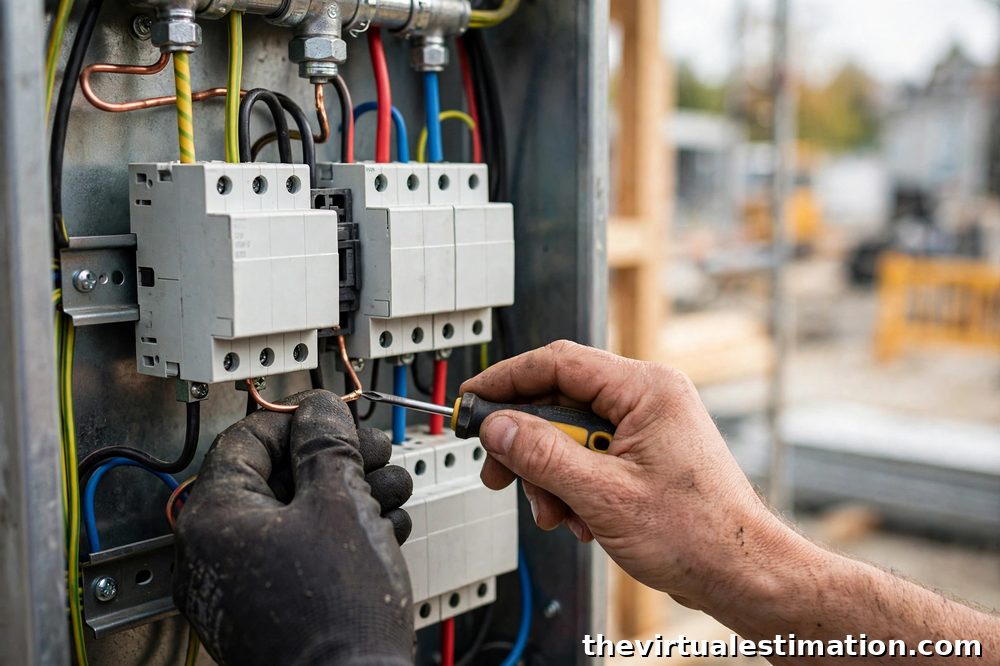
Send us your plans and we will price the electrical scope line by line, so your budget rests on a real takeoff instead of a benchmark. Email info@thevirtualestimation.com for a project-specific estimate.
Why the Per-Sq-Ft Rate Misleads
Floor area is the wrong driver for electrical cost. The real drivers are the number of devices, the number of circuits, and the size of the service. A 5,000 square foot office with 60 devices and a 200-amp service costs far less per square foot than the same footprint with 150 devices, a server room, and a 400-amp service.
Labor is the biggest swing factor. EngineerFix reports labor is typically 50 to 75 percent of the total electrical bid. That share moves with local wage rates, crew productivity, and how much of the work is rough-in versus trim. Material prices move less, but copper wire and panel lead times can still shift a bid by thousands.
The disagreement between sources proves the point. PowerBoy, a Texas contractor, quotes commercial new construction at $18 to $45 per square foot, well above the $4 to $15 national planning ranges other sources publish. That is a regional and scope variance, not an error. Full-scope new construction in a hot Texas market is a different job than a basic office TI in the Midwest. If you borrow a rate from the wrong market or the wrong scope, your budget is wrong before you start.
Worked Example: A 10,000 Sq Ft Private Office, Built From the Takeoff
This example is hypothetical, with every assumption stated. It is built from a takeoff, not from a per-square-foot rate. The rate is the check at the end.
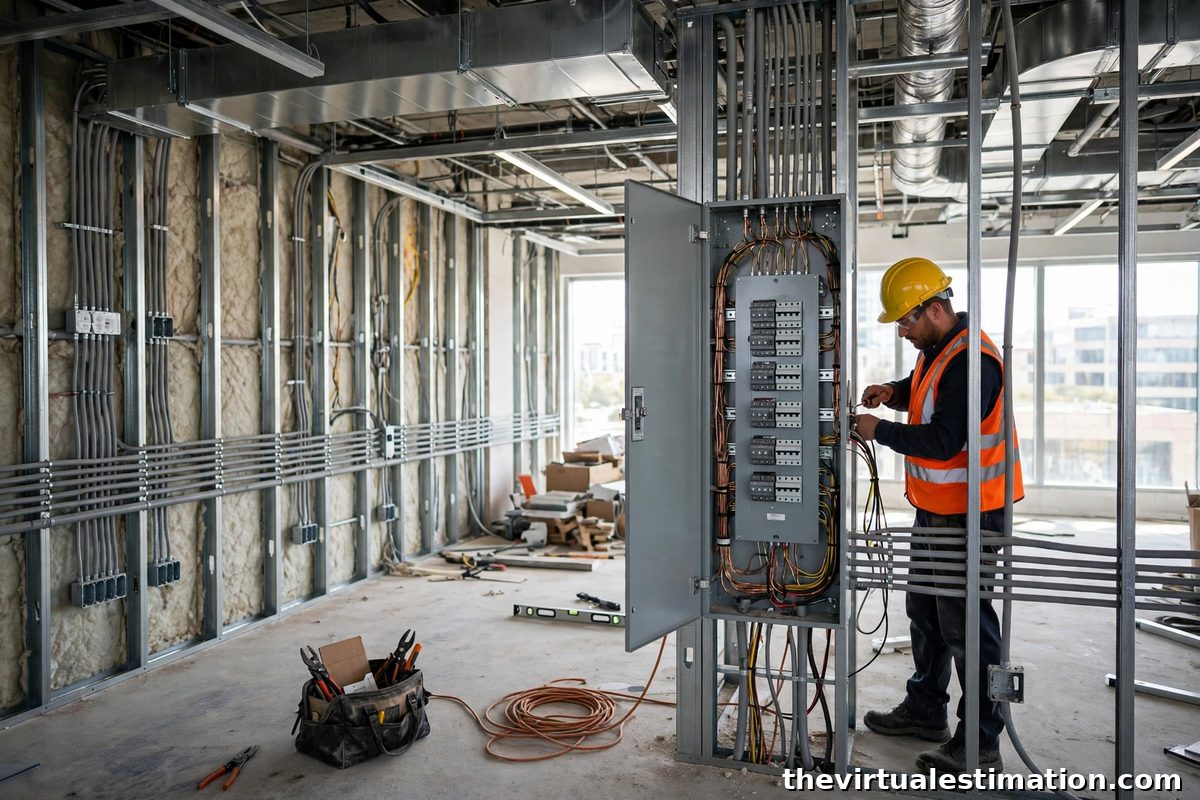
The job: a 10,000 square foot private-office build-out. The takeoff counts 120 devices (receptacles, switches, and data rough-ins), 32 branch circuits, and a 400-amp service with a main panel and two subpanels. Labor is priced at a loaded journeyman rate of $75 per hour, and material is priced at current supplier quotes.
| Takeoff line | Quantity | Installed cost |
|---|---|---|
| Devices (receptacles, switches, data rough-in) | 120 | $22,200 |
| LED light fixtures | 85 | $28,900 |
| Branch circuit wiring (conduit and wire) | 3,040 ft | $28,880 |
| 400A service, main panel, 2 subpanels | 1 lot | $18,500 |
| Data and low-voltage rough-in | 1 lot | $7,200 |
| Permits, testing, commissioning | 1 lot | $5,400 |
| Direct cost subtotal | $111,080 | |
| Overhead and profit (15%) | $16,662 | |
| Total | $127,742 |
The total comes to $127,742, or $12.77 per square foot. Now run the check: the private-office range in the table above is $12 to $18 per square foot, from AJ Long Electric and SnapScope AI (2026). At $12.77, this takeoff sits inside the range, near the low end, which fits a job with standard fixtures and no special loads. If the same takeoff had landed at $22 per square foot, something would be wrong: a missed circuit count, a double-counted panel, or a rate applied to the wrong scope. That is the only job the per-square-foot number has.
Change one input and watch the rate move. Add a server room with a dedicated 100-amp panel and 20 more circuits, and the same 10,000 square feet jumps past $16 per square foot. The floor area never changed. The devices did.
Regional Cost Adjustments
Labor rates drive most of the regional gap. Caudills publishes 2026 regional labor and installed ranges that show how far the same scope moves across the country.
| Region | Loaded labor rate | Installed per-sq-ft range |
|---|---|---|
| Northeast | $95 - $125/hr | $7 - $14 |
| Midwest | $80 - $110/hr | $5.50 - $11 |
| South | $75 - $105/hr | $5 - $10 |
| West Coast | $100 - $135/hr | $8 - $15 |
High-cost markets add 20 to 40 percent above national averages, according to EleCalculator (2026). San Francisco, New York City, and Boston sit at the top of that band. Adjust the national range by your local labor rate before you quote a number to a client, and state the region in your budget note so nobody treats a Texas rate as a California budget.
What the Per-Sq-Ft Number Leaves Out
Benchmarks almost never include these five items. Miss one and your budget is short before work starts.
- Service upgrades. A new service or panel upgrade runs $10,000 to $50,000 on TI work (Ridgeline Electric). It is priced as a lump sum, not per square foot.
- Fire alarm systems. Panels, devices, and monitoring are usually a separate scope with their own pricing.
- Data and low-voltage beyond basic rough-in. Full network drops, AV, and access control add cost the benchmark does not carry.
- Fixtures above builder grade. Decorative lighting, specialty fixtures, and owner-supplied equipment are excluded from most published ranges.
- Permit fees. Plan review, inspection, and utility fees vary by city and are rarely inside the per-square-foot figure.
Our MEP estimating guide shows how electrical, mechanical, and plumbing scopes interact on the same job, so a cost missed in one trade does not surface as a surprise in another.
Use the Rate as a Check, Not a Bid
Run this five-point check after your takeoff is built, and before the number goes to a client.
- Count every device. Receptacles, switches, fixtures, and data drops set the labor hours. A missed device count is the most common reason a per-square-foot check fails.
- Count every circuit. Homers, dedicated circuits, and panel schedules tell you whether the panel capacity matches the load.
- Check panel capacity and service size. A 400-amp service on a 10,000 square foot office is normal; a 200-amp service on the same space with a server room is not.
- List special loads separately. EV chargers, kitchen equipment, medical gear, and lab circuits are priced apart. Our EV charging cost-per-port guide shows how one special load is priced on its own.
- Compare, then investigate. If your takeoff lands outside the range for the building type, find the reason in the takeoff before you adjust the number.
For the full trade picture, pair this guide with our electrical estimating services and the per-unit pricing in our commercial HVAC cost-per-ton guide.
Frequently Asked Questions
What is the average commercial electrical cost per square foot in 2027?
A standard office build-out runs $8 to $14 per square foot, based on 2026 contractor data. Retail runs $6 to $16, restaurants $15 to $30, and medical space $15 to $25. Always confirm the range against a line-item takeoff for the specific building.
Can I bid a commercial electrical job using only the per-square-foot rate?
No. The rate is a sanity check, not a bidding method. Electrical cost follows device count, circuit count, and panel capacity, not floor area. Bid from a takeoff built on the drawings, then use the rate to catch errors in the takeoff before the price goes out.
Why do electrical cost-per-square-foot estimates vary so much?
Building type, device density, service size, and local labor rates move the number. A warehouse at $4 to $8 per square foot and a restaurant at $15 to $30 are both correct for their scope. Regional labor alone can shift installed cost by 20 to 40 percent.
Does the per-square-foot rate include a service upgrade?
Usually not. A service upgrade alone costs $10,000 to $50,000 on tenant improvement work, according to Ridgeline Electric. Price it as a separate lump sum and add it to the benchmark total before you present a budget to the client.
Conclusion
Commercial electrical cost per square foot is a useful check and a poor bid. Use the 2027 ranges in this guide to test your takeoff, investigate any result that falls outside the range, and price special loads and service upgrades apart. Then send your plans to The Virtual Estimation for a line-item electrical estimate built from your drawings, not from a benchmark. Email info@thevirtualestimation.com with your plans and we will price the scope for you.