Your mechanical sub hands you a ductwork price and you have one day to check it. The per-foot number looks tidy. The scope behind it usually is not. Commercial ductwork cost per linear foot in 2027 runs $15 to $75 installed for most galvanized systems, and the spread comes from duct type, size, pressure class, and access. This guide gives you the installed ranges by duct type, shows what the per-foot rate leaves out, and walks through the takeoff method so you can price the line item yourself.
Who this is for: commercial contractors and estimators pricing ductwork as a line item in a mechanical bid, not homeowners replacing a house system.
Commercial Ductwork Cost Per Linear Foot in 2027
Commercial ductwork costs $15 to $75 per linear foot installed in 2027. Flexible duct runs $5 to $20 per foot, spiral duct runs $15 to $45, and rectangular galvanized duct runs $25 to $75. The low end fits simple exposed runs in open space. The high end fits large rectangular trunks in tight ceilings with insulation and dampers. Fittings, insulation, and testing sit outside these rates, so add them as separate lines.
Cost by Duct Type: Installed Ranges
No single national dollars-per-foot figure exists. Sources disagree by duct type, size, access, and city. The table below keeps each source separate with its year. Never average ranges from different sources into one number.
| Duct type | Installed cost per linear foot | Source and year |
|---|---|---|
| Flexible duct, insulated R-8 | $5 to $20 | The Cooling Company, Las Vegas commercial guide, 2026 |
| Flexible duct, insulated R-8 | $9 to $15 | Estimator Florida, 2025 trends |
| Spiral round duct | $15 to $45 | The Cooling Company, 2026 |
| Galvanized sheet metal, rectangular | $20 to $45 | Estimator Florida, 2025 trends |
| Rectangular duct | $25 to $75 | The Cooling Company, 2026 |
| Fiberglass duct board | $13 to $49 | Estimator Florida, 2025 trends |
| Fabric duct | $20 to $60 | The Cooling Company, 2026 |
| Commercial average, all types | $15 to $35 | HomeGuide, 2026 |
Read the table as a planning band, not a quote. A 12-inch spiral run in an open warehouse lands near the bottom of its range. A 48-inch rectangular trunk above a finished ceiling lands near the top of its range. Size drives the number more than any other single factor, because a bigger duct uses more steel, more labor, and heavier supports.
Stainless steel is a separate specialty scope. PickHVAC 2026 puts stainless material at $20 to $100 per linear foot and installed cost at $50 to $180 or more per foot. Keep it out of your galvanized ranges and price it as its own line.
If the ductwork numbers in your bid need a second set of eyes before they go out, send us your mechanical plans and we will price the ductwork takeoff for you. Email info@thevirtualestimation.com with the drawings and the bid date.
What the Per-Foot Rate Leaves Out
The per-foot rate covers straight duct only. Everything that makes a system work sits outside it, and those items can add 30 to 50 percent to the ductwork total. Price each one on its own line so your bid stays comparable with other bidders.
- Fittings: elbows, offsets, transitions, reducers, tees, and dampers. A job with many short runs and turns can carry more fitting cost than straight duct cost. Count every fitting from the drawings and price it by size and type.
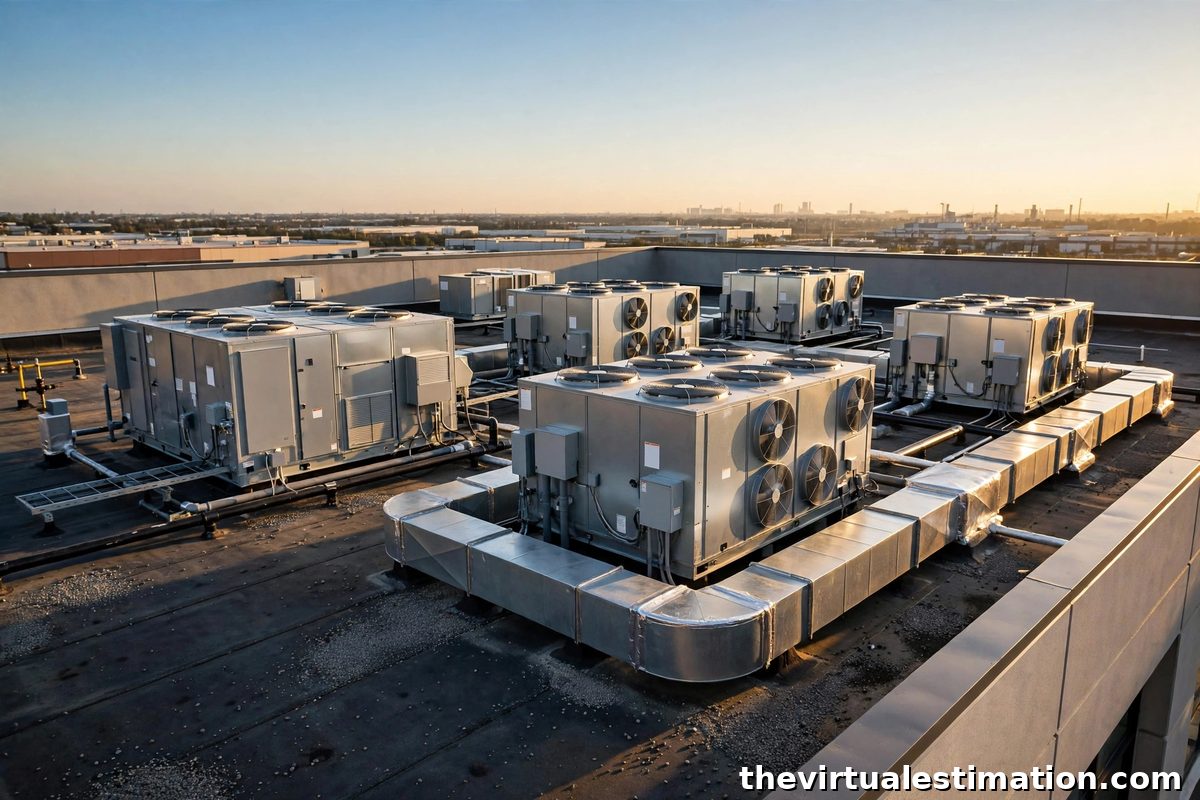
- Insulation and jacketing: field-applied or factory-applied insulation adds about $3 to $10 per linear foot, depending on R-value and jacketing (The Cooling Company, 2026). Rooftop runs need R-6 to R-8 plus a vapor barrier and UV jacketing.
- TAB, testing and leakage testing: testing, adjusting, and balancing runs $0.50 to $3.00 per linear foot, or $1,500 to $6,000 flat (The Cooling Company, 2026). Leakage testing is usually quoted apart from TAB.
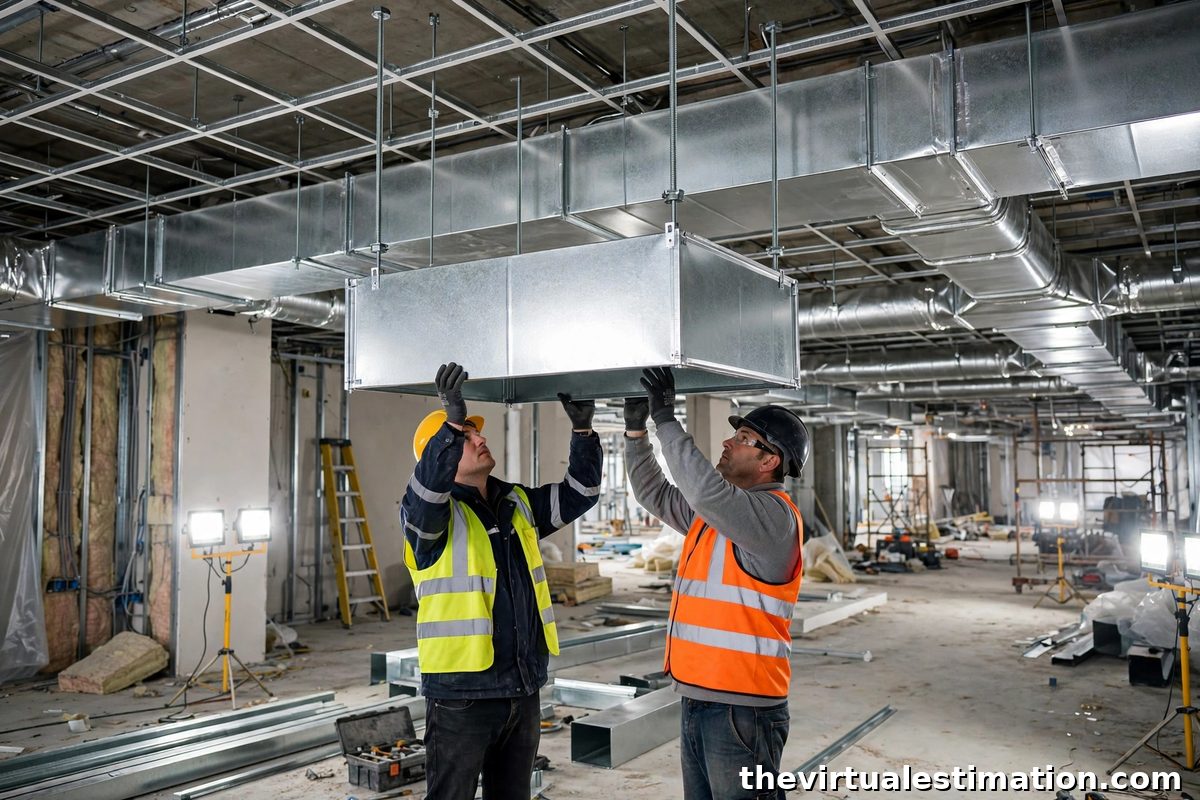
- Hangers and supports: threaded rod, trapeze supports, and anchors. Long spans and heavy duct need more steel and more labor, so count supports by spacing, not by guess.
- Sealing: mastic and tape to the specified seal class. Higher seal classes mean more labor at every joint and seam.
Residential figures do not belong in a commercial bid. Angi, updated October 29, 2026, puts new residential ductwork at $10 to $25 per linear foot installed, with labor at $5 to $15 per foot or $50 to $150 per hour. HomeGuide 2026 puts residential replacement at $25 to $55 per foot. Those numbers describe houses, not office buildings, so keep them in a separate table and never mix them into your commercial ranges.
How Estimators Measure and Price Ductwork
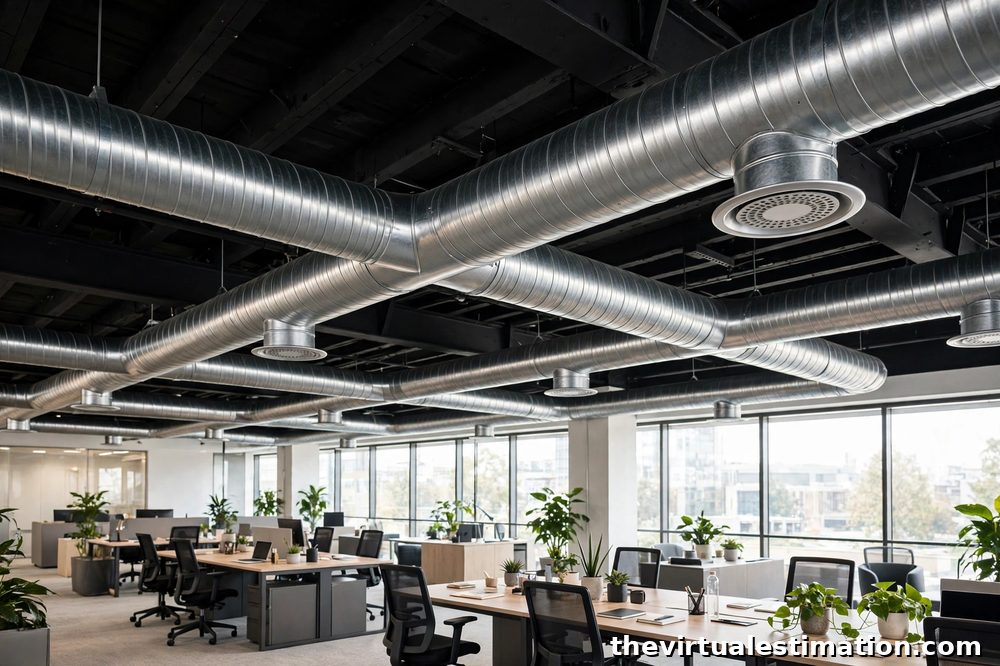
Measure straight duct in linear feet by size and pressure class. Then price fittings apart, never buried in the per-foot rate. That split is the whole method. A bidder who folds fittings into the rate cannot explain the number, and cannot adjust it when the design changes.
Start with the mechanical drawings and the duct schedule. Take off each straight run by duct size, from the equipment to the last diffuser. Note the pressure class for each run, because it sets the sheet gauge. Then count every fitting: each elbow, offset, transition, reducer, tee, and damper, by size. Count hangers by the spacing on the drawings. Add insulation by linear foot and by R-value, and add TAB as its own line.
Gauge and sealing follow the SMACNA standard. The current edition is the HVAC Duct Construction Standards, Metal and Flexible, 4th edition, ANSI/SMACNA 006-2020. It sets sheet gauge by duct size and pressure class, with classes from 1/2 inch to 10 inches of water gauge. A 2-inch water gauge trunk is the common commercial case. Seal classes run A, B, and C: Class C seals transverse joints, Class B adds longitudinal seams, and Class A adds all wall penetrations. Read the spec for the class on your job, then price the sealing labor to match it.
Cross-check your total against a per-square-foot figure. Terrapin CG 2026, cross-checked with RSMeans 2026 mechanical assemblies, puts ductwork at $8 to $14 per square foot of conditioned space: galvanized sheet metal in an open warehouse at $7 to $10 per square foot, internally lined duct in an office ceiling at $10 to $14, and coated or stainless duct at $16 to $24. If your per-foot math lands far outside that band, recheck the takeoff before you trust the number.
Material prices move on their own. RSMeans Key Materials, third quarter 2026, lists galvanized steel sheet metal ductwork at $139.98 per hundredweight and aluminum sheet metal ductwork at $11.86 per pound. Those are material-only prices. Do not turn them into an installed dollars-per-foot figure.
For the full method behind a mechanical takeoff, see our HVAC estimating guide on ductwork, equipment, controls and commissioning. It covers sizing, layout, and commissioning, so this guide stays on pricing.
Two Worked Examples
These are arithmetic only, not quoted job prices. They show how the ranges turn into a budget number.
Example 1: rectangular trunk. A job needs 400 linear feet of rectangular galvanized trunk. At $25 to $75 per foot, straight duct alone runs $10,000 to $30,000. Fittings, insulation, hangers, and TAB sit on top of that. If the drawings show 30 fittings, price each one apart and add the total to the straight duct number.
Example 2: spiral main. A job needs 1,000 linear feet of spiral duct in an open ceiling. At $15 to $45 per foot, straight duct alone runs $15,000 to $45,000. Spiral installs faster than rectangular duct, with fewer seams, so the low end of the range fits simple long runs. Add insulation at $3 to $10 per foot if the spec calls for it, and add TAB at $0.50 to $3.00 per foot or a flat $1,500 to $6,000.
Run the same math on your own takeoff and the two examples give you a quick sense check. If your total falls outside the band the examples suggest, the takeoff or the rate needs a second look.
Location, Access, and Other Price Drivers
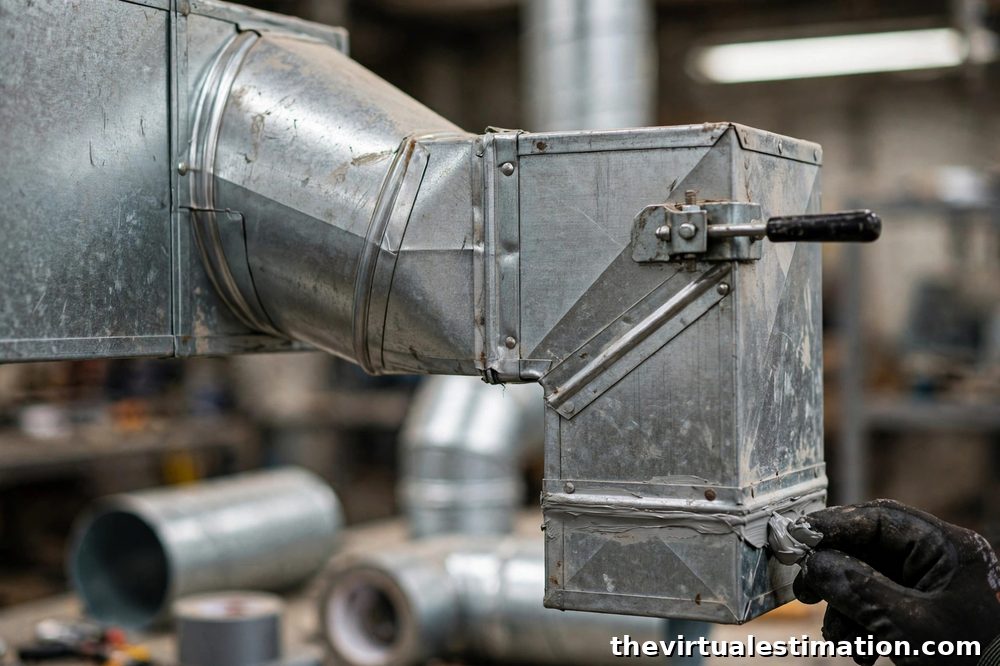
City and access move the rate as much as duct type does. HomeGuide 2026 lists size, location, and access as the three drivers of its commercial range, and every source in this guide agrees. A run in an open warehouse installs fast. The same run above a finished ceiling with lights, cable tray, and sprinkler pipe installs slow, and the rate has to show that.
Adjust for location with the RSMeans City Cost Index method. Start from the national average baseline, then apply the index for your city. An index above 100 means costs run above the national average, and an index below 100 means they run below it. For the full method, see RSMeans Pricing by Zip Code in 2027 on our sister site.
Access is the driver estimators miss most. Tight ceiling space, night work, occupied buildings, and long carries from the loading dock all add labor hours. Note the access condition on your takeoff sheet next to the rate, so the next estimator who reads it knows why the number sits where it does.
5 Mistakes That Break a Ductwork Estimate
- Burying fittings in the per-foot rate. Fittings are the most variable part of a duct system. Price them apart or the bid cannot survive a design change.
- Mixing residential and commercial figures. Residential replacement runs $25 to $55 per foot (HomeGuide 2026). That number has nothing to do with a commercial trunk. Keep the two in separate tables.
- Forgetting TAB and leakage testing. TAB at $0.50 to $3.00 per foot is a real line. Leaving it out means the job buys it from profit.
- Pricing to the wrong pressure class. A 4-inch water gauge system needs heavier gauge and more reinforcement than a 2-inch system. Check the spec class before you pick a rate.
- Skipping the per-square-foot cross-check. One bad takeoff line can hide in a long schedule. The $8 to $14 per square foot band from Terrapin CG 2026 catches it in a minute.
Frequently Asked Questions
How much does commercial ductwork cost per linear foot in 2027?
Commercial ductwork costs $15 to $75 per linear foot installed in 2027. Flexible duct runs $5 to $20 per foot, spiral duct $15 to $45, and rectangular galvanized duct $25 to $75. Fittings, insulation, and TAB sit outside these rates and get priced as separate lines.
What does ductwork insulation add per linear foot?
Insulation adds about $3 to $10 per linear foot, depending on R-value and jacketing (The Cooling Company, 2026). Rooftop runs need R-6 to R-8 plus a vapor barrier and UV jacketing. Factory-applied insulation costs more than field-applied, so check which one the spec calls for.
How do estimators measure ductwork for a bid?
Estimators measure straight duct in linear feet by size and pressure class, then count every fitting apart: elbows, offsets, transitions, reducers, tees, and dampers. Hangers, insulation, and TAB get their own lines. Gauge and sealing follow the SMACNA 4th edition, ANSI/SMACNA 006-2020.
How much does TAB cost on a commercial duct job?
Testing, adjusting, and balancing costs $0.50 to $3.00 per linear foot, or $1,500 to $6,000 flat (The Cooling Company, 2026). Leakage testing is usually quoted apart from TAB. Both belong in the bid as separate lines, not folded into the per-foot duct rate.
Price the Duct, Then Price the Rest
Commercial ductwork cost per linear foot in 2027 runs $15 to $75 installed, and the number only works when straight duct, fittings, insulation, and TAB each get their own line. Measure by size and pressure class, price fittings apart, and cross-check against the per-square-foot band before the bid goes out. That is the whole method, and it holds up on any commercial job.
Need a ductwork takeoff priced before your bid date? Send your mechanical plans to info@thevirtualestimation.com and The Virtual Estimation will return a project-specific estimate with every line item priced. For related pricing, see our commercial HVAC cost per ton guide and our MEP estimating guide.