For a commercial HVAC budget in 2027, plan on $2,500 to $4,500 per ton installed for a packaged rooftop unit on a straightforward replacement, $4,000 to $5,000 per ton for VRF, and $3,400 to $7,700 per ton for a chiller plant. Those are installed ranges, equipment plus standard labor, drawn from 2026 published pricing and federal award data. The per-ton number only works when you state what it includes. A quote that leaves out ductwork, the crane, the curb, controls and commissioning is not a lower price. It is an incomplete scope.
Who this is for: mechanical estimators pricing HVAC alternates, general contractors checking a mechanical sub's number, and owners who want to know whether a contractor's per-ton price is real before they sign.
What one ton means, and what the per-ton price must include
One ton of cooling equals 12,000 Btu per hour of heat removal. It is a capacity measure, not a weight. A 10-ton rooftop unit removes 120,000 Btu per hour. That definition never changes, which is exactly why per-ton pricing is useful: it lets you compare a 7.5-ton retail unit with a 120-ton office system on the same basis.
What changes is scope. A per-ton figure is only comparable when every quote in the comparison carries the same scope line. In this guide, "installed per ton" means equipment plus standard installation labor: the unit, setting it on the curb, refrigerant and electrical connections, and startup. It does not include ductwork replacement, a new curb, crane rental, electrical service upgrades, controls integration, or commissioning unless the table says so. When a per-ton number looks too good, check the scope line first. That is usually where the money went.
Size the system from a load calculation, not from square footage. ACCA Manual N and ASHRAE Standard 183 are the methods. The common rule of thumb is one ton per 300 to 350 square feet for ordinary commercial space, but that rule breaks on kitchens, labs, data rooms and glass-heavy facades. A 40,000 square foot office in Denver typically lands near 100 to 120 tons, or one ton per 335 to 400 square feet. The same footprint as a busy Houston restaurant can need 180 to 220 tons. If your tonnage comes from square feet alone, your per-ton price is built on a guess.
Commercial HVAC cost per ton in 2027: the benchmark table
Every figure below is a 2026 source, attributed, applied to 2027 budgeting. None of these has been relabeled as 2027 data. Use the ranges for budgeting and bid checks, then confirm with current supplier quotes before you price a live job.
| System type | Installed cost per ton | Source |
|---|---|---|
| Packaged rooftop unit, replacement | $2,500 to $7,500 (typical planning range $1,500 to $4,500) | PickHVAC 2026 commercial pricing guides |
| Packaged rooftop unit, federal replacements | Median $4,650; range $1,520 to $7,356 | USAspending.gov, 13 federal awards, Aug 2021 to Oct 2026 |
| Split DX system | $3,000 to $7,000 | The Cooling Company 2026 market guide |
| VRF heat pump | About $4,000 | Industry pricing guides, 2026 |
| VRF heat recovery | About $5,000 | Industry pricing guides, 2026 |
| Air-cooled chiller | $3,500 to $12,000+ | The Cooling Company 2026 market guide |
| Chiller replacements, federal | Median $4,645; range $3,412 to $7,741 | USAspending.gov, 7 federal awards, 90 to 500 tons |
Two things stand out. First, the federal medians for rooftop units and chillers land within five dollars of each other, about $4,650 per ton. That does not mean a chiller costs the same as a rooftop unit. The chiller figure covers the chiller scope in those awards; the pumps, piping, cooling tower and air handlers sit on separate lines. Second, the ranges are wide because the work is wide. A 3-ton light commercial unit and a 500-ton chiller plant share almost nothing except the unit of measure.
For a cross-check, per-square-foot pricing tells the same story from the other side. Terrapin CG, cross-checked against RSMeans 2026 mechanical assemblies and AHRI 2025 shipment data, puts installed costs at $14 to $28 per square foot for packaged rooftop units, $16 to $26 for split DX, $24 to $38 for VRF, $26 to $46 for air-cooled chillers, and $32 to $58 for water-cooled chiller plants. If your per-ton math and your per-square-foot math disagree by a wide margin, one of them is carrying the wrong scope. Find which one before you submit.
What moves the number
System type. Rooftop units are the lowest-cost entry point and the most common system in US commercial buildings. Packaged air conditioning served 43 percent of commercial buildings and 58 percent of commercial floorspace in the EIA's 2018 Commercial Buildings Energy Consumption Survey, and about 78 percent of single-story buildings under 100,000 square feet still run on rooftop units, per AHRI 2025 shipment data. VRF costs 20 to 40 percent more per ton than a packaged rooftop unit, and a chilled-water plant can run about three times the capital cost of an equivalent rooftop array. You pay that premium for zoning, efficiency and capacity, not for the same box.
Tonnage and scale. Per-ton pricing falls as tonnage rises. A 5-ton rooftop unit commonly runs $12,500 to $37,500 installed, while a 20-ton unit runs $50,000 to $150,000. The per-ton rate on the larger unit is lower because the crane, the curb work and the crew mobilization spread across more capacity. Chiller plants show the same pattern at a bigger scale: the 90 to 500 ton federal awards in the table above are where the per-ton chiller numbers get competitive.
Efficiency tier. Higher efficiency equipment costs more per ton and less to run. Federal rules set the floor: a new air-cooled rooftop air conditioner of 65,000 to 135,000 Btu per hour must reach an IEER of 14.8, and from January 1, 2029 the metric becomes IVEC with a minimum of 14.3 (10 CFR 431.97). Water-cooled chillers run 0.45 to 0.65 kW per ton against 0.90 to 1.20 kW per ton for air-cooled chillers, which is why the water-cooled plant costs more to build and less to operate. Price the efficiency tier the drawings actually specify. A budget built on base efficiency against a high-efficiency spec is short before it starts.
Refrigerant. Units made since January 1, 2025 must use refrigerant with a global warming potential under 700, which moved the market to A2L refrigerants such as R-454B and R-32. One 2026 industry guide puts the added equipment manufacturing cost at 15 to 20 percent, driven by new safety sensors and leak detection. An EPA rule of May 26, 2026 lets light commercial systems whose components were all made before 2025 still be installed (91 FR 31284), so replacement work on older equipment can still pencil out. Either way, confirm which refrigerant the specified equipment uses and whether the install crew is certified for it.
Climate and design temperature. Hot climates pay more per ton. In Las Vegas, where design temperatures exceed 115 degrees, rooftop units run $3,000 to $8,000 per ton installed, roughly 10 to 15 percent over national baselines, because the equipment must be high-ambient rated and the tonnage itself grows. Terrapin CG reports coastal California pricing 28 to 32 percent above a Mountain West baseline on comparable work. Apply a location factor to every national figure in this guide. A per-ton price without a city attached is a national average wearing a local project's clothes.
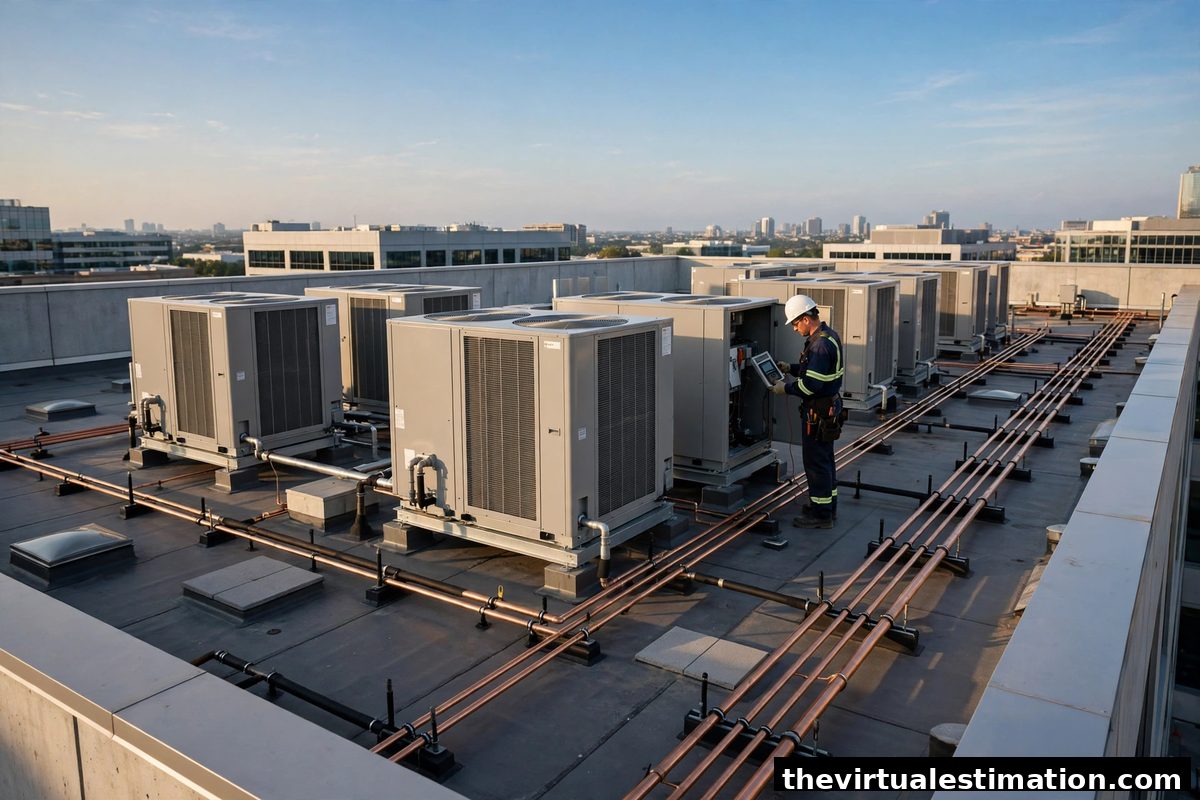
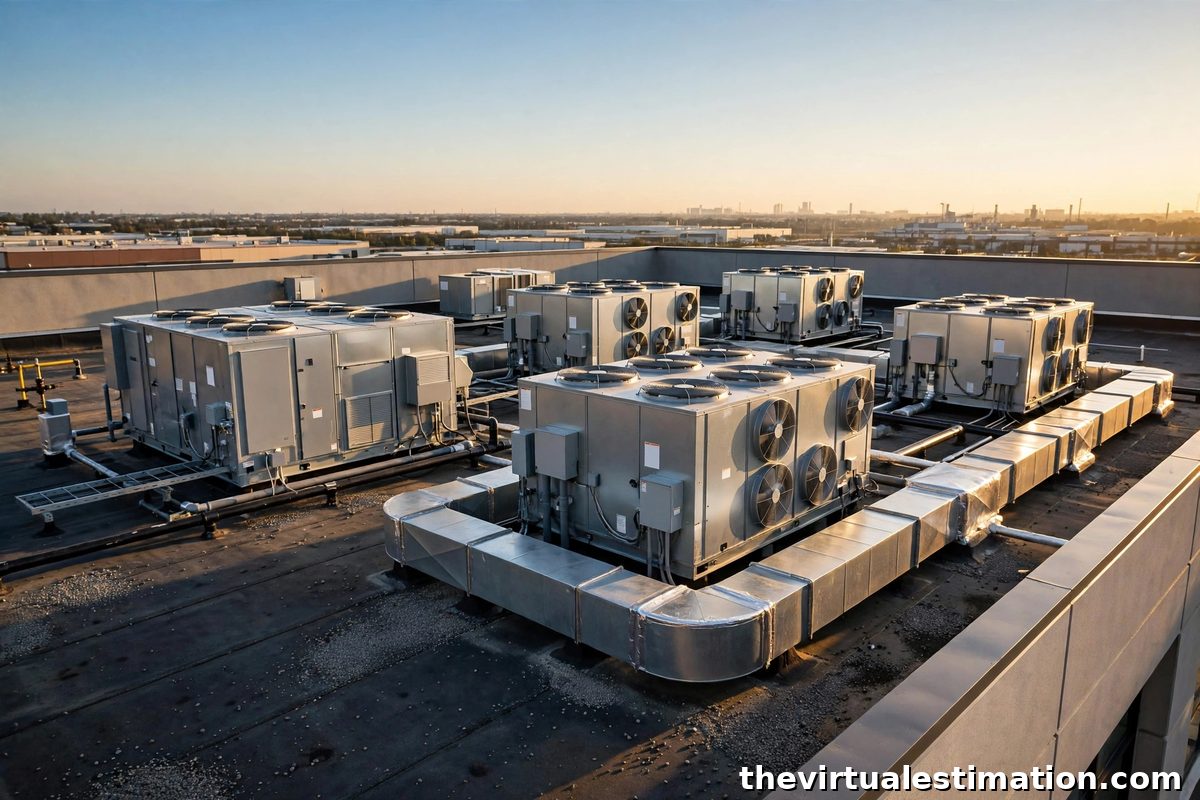
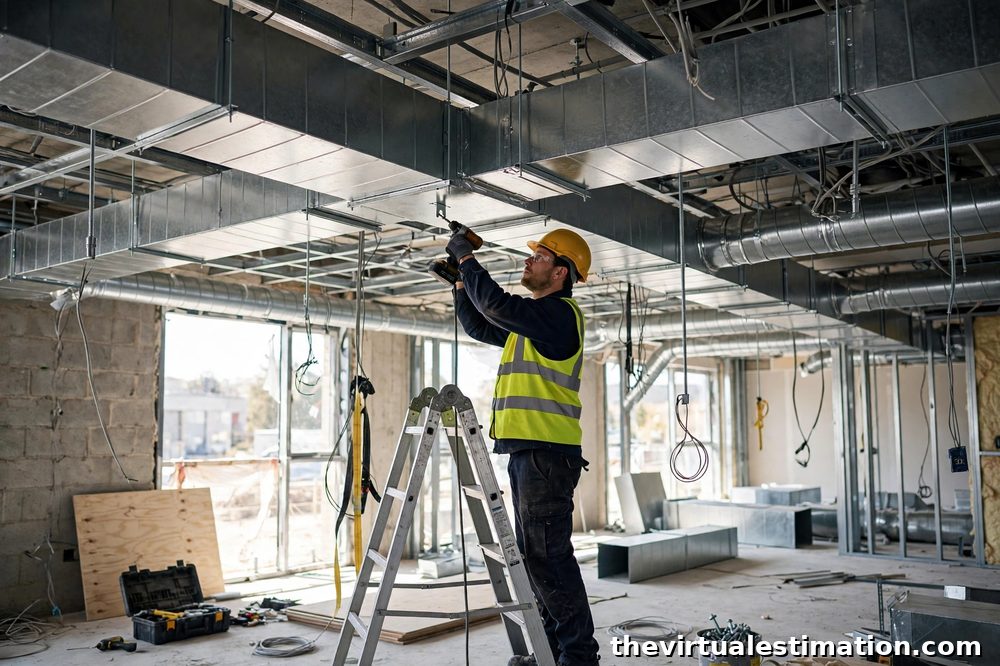
Access, curb and crane. A rooftop unit does not install itself. Curb condition, curb adapters, crane rental, roof access and street closure all sit outside the equipment price. On a straightforward replacement with a sound curb and clear crane access, these lines are small. On a tight urban roof with a deteriorated curb, they are not. Price them as separate lines so the owner can see them.
Ductwork, controls and electrical. This is where per-ton quotes most often diverge. Our HVAC estimating guide breaks down the ductwork, equipment, controls and commissioning scope that surrounds the box itself, and it is the scope most often missing from a low per-ton number. Controls integration with an existing building automation system, new electrical feeders and disconnects, and a panel upgrade if the service cannot carry the load are all real money. If the drawings show a new electrical service, the per-ton HVAC number does not cover it.
Worked example: a 120-ton office, priced three ways
This is a labelled hypothetical. The arithmetic uses the published ranges above; it is not a bid, and it is not a quote for any real building. The building is a 40,000 square foot, two-story office in a moderate climate, sized at 120 tons, or one ton per 333 square feet, from a Manual N load calculation.
| Route | Per-ton basis | Equipment and standard install | What sits outside the per-ton number |
|---|---|---|---|
| Packaged rooftop units (eight 15-ton units) | $2,500 to $4,500 per ton | $300,000 to $540,000 | Ductwork modifications, curb adapters, crane, controls points, electrical feeders, commissioning |
| VRF heat pump | $4,000 to $5,000 per ton | $480,000 to $600,000 | Refrigerant piping, branch controllers, controls, electrical |
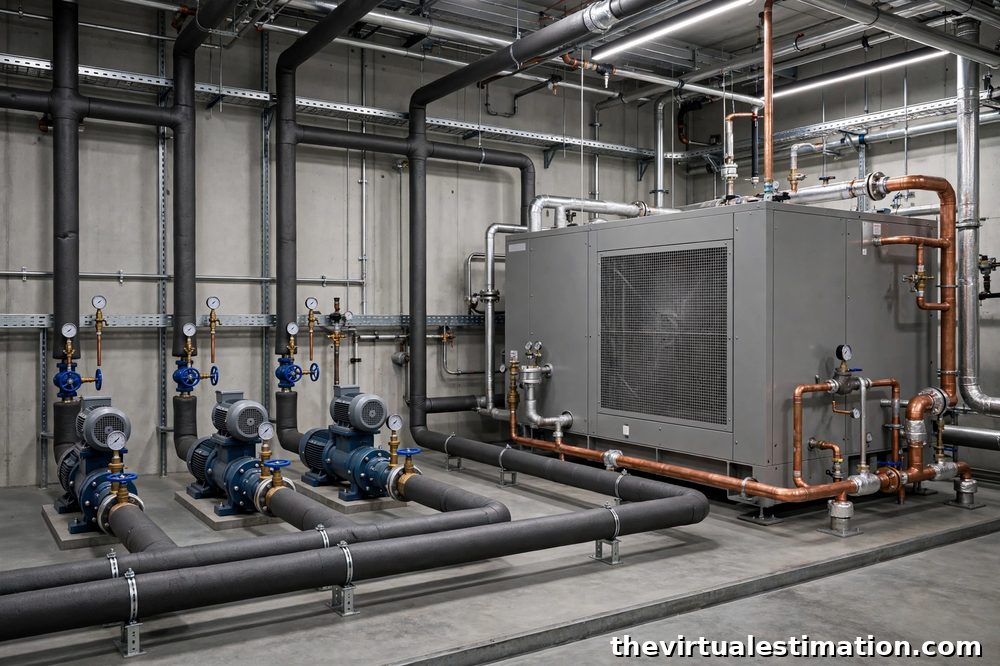
| Air-cooled chiller (federal median) | $4,645 per ton | About $557,000 | Pumps, chilled-water piping, air handlers, cooling tower if water-cooled, controls, commissioning |
Read the table across, not down. The rooftop route looks cheapest at the low end and the chiller route looks comparable at the median, but the chiller's outside lines are the largest of the three: pumps, piping and air handlers are a second system, not an accessory. The VRF route carries the highest per-ton equipment cost and the smallest outside scope, because the refrigerant piping replaces much of the ductwork. That is the real comparison. Per-ton pricing answers the equipment question. The rest of the estimate answers the project question. Our MEP estimating guide shows how the mechanical, electrical and plumbing scopes interact on a job like this, and where one trade's number hides another trade's cost.
HVAC takeoff checklist: price every line, not just the box
Use this checklist on every commercial HVAC estimate. Each line gets its own quantity, unit and price basis. If a line has no quantity, it is not estimated. It is assumed.
| Takeoff item | Quantity | Unit | Price basis |
|---|---|---|---|
| Rooftop units, chillers, air handlers | Count by tag | Each | Per-ton equipment plus install |
| Ductwork, by size and material | Measured length | Linear foot | Sheet metal, insulation, hangers |
| Refrigerant piping (VRF and split) | Measured length | Linear foot | Pipe, insulation, fittings |
| Chilled and hot water piping | Measured length | Linear foot | Pipe, valves, insulation |
| Pumps, fans, dampers, diffusers | Count by schedule | Each | Supplier quote |
| Controls points, sensors, thermostats | Count by points list | Each | Controls subcontractor quote |
| Electrical feeders and disconnects | Measured length and count | Linear foot / each | Electrical scope, coordinated with the electrical estimator |
| Curb adapters and roof curbs | Count | Each | Supplier quote |
| Crane, rigging and roof access | Days | Lump sum | Crane quote, street closure if needed |
| Condensate drains | Measured length | Linear foot | Pipe and trap |
| Startup, testing, adjusting and balancing | Scope | Lump sum | TAB contractor quote |
| Commissioning | Scope | Lump sum | Commissioning agent, per the spec |
| Permits and inspections | Scope | Lump sum | Local fee schedule |
| Removal and disposal of existing units | Count | Each | Disposal and refrigerant recovery |
For VRF work specifically, our VRF estimating guide covers the refrigerant piping, branch controllers and controls points that drive that system's takeoff. For chilled-water work, the piping, pumps and insulation quantities come from our mechanical piping estimating guide.
Scope lines estimators miss
These are the lines that turn a winning bid into a losing job. Check each one before you submit.
- Ductwork condition. Existing ductwork is assumed reusable until someone inspects it. Price the inspection, and carry an allowance for sealing or replacement where the drawings are silent.
- Curb condition. A deteriorated or wrong-size curb means a curb adapter or a new curb, plus roofing work. Verify curb dimensions against the new unit, not the old one.
- Crane access. Rooftop units need a crane, and a crane needs a street or a parking lot. Confirm the pick radius, the street closure permit and the crane day rate.
- Electrical capacity. A larger or higher-efficiency unit can need a bigger feeder, a new disconnect or a panel upgrade. Coordinate with the electrical estimator before the bid, not after award.
- Controls integration. A new unit on an old building automation system needs points, programming and graphics. Get the controls quote in writing.
- Refrigerant line length and lift. Long runs and high lifts change VRF and split system pricing and can force larger pipe or additional equipment.
- Condensate routing. Every unit needs a drain, and the drain needs a legal discharge point. Confirm the route on the drawings.
- Startup, balancing and commissioning. These are priced scopes, not handover notes. If the spec requires commissioning, carry the commissioning agent's fee.
- Permits, disposal and refrigerant recovery. Mechanical permits, old unit disposal and refrigerant recovery are small lines that add up across a multi-unit replacement.
Methodology: how these numbers were built
Pricing sources. Per-ton ranges come from PickHVAC 2026 commercial pricing guides, USAspending.gov federal award data accessed November 1, 2026, Terrapin CG 2026 cost-per-square-foot data cross-checked against RSMeans 2026 mechanical assemblies, and The Cooling Company 2026 market guides. Each figure carries its source in the table above.
Labor. The installed ranges include standard installation labor. The federal award figures are obligated contract amounts divided by tons, so they include everything in the award, labor included. No separate labor rate is published here, because the sources do not break labor out by trade or region. Apply local burdened labor rates when you build the estimate.
Location adjustment. All figures are national. Hot climates add 10 to 15 percent, per the Las Vegas market guide. Coastal California runs 28 to 32 percent above a Mountain West baseline, per Terrapin CG. Apply a city cost index, such as the RSMeans city cost index, before using any national figure on a local bid.
Size. Per-ton pricing falls as tonnage rises, because mobilization, crane and crew costs spread across more capacity. Do not apply a 5-ton replacement rate to a 500-ton plant, or the reverse.
Union and non-union. The sources do not separate union and non-union labor. Adjust with the local prevailing wage or the labor agreement that governs the project.
Overhead. The installed ranges exclude general contractor overhead and profit unless a source says otherwise. Add overhead and profit per your bid structure.
Date reviewed. November 22, 2026. All benchmark figures are 2026 sources applied to 2027 budgeting. No 2026 figure has been relabeled as a 2027 figure. Equipment producer prices rose 60.4 percent from January 2020 to September 2026 (BLS Producer Price Index), and commercial HVAC pricing moved 7.4 percent in the twelve months ending March 2026 (BLS PPI series WPU1134). Confirm current supplier pricing before you price a live job.
Frequently asked questions
How many tons of HVAC does my commercial building need?
From a load calculation, not from a rule of thumb. ACCA Manual N or ASHRAE Standard 183 gives the answer for your building, your climate and your use. The rule of thumb is one ton per 300 to 350 square feet for ordinary commercial space, but kitchens, labs, data rooms and glass facades push that number hard. A restaurant can need nearly twice the tonnage of an office on the same footprint.
Why do two per-ton quotes differ so much?
Because they carry different scopes. One quote includes ductwork, the crane, the curb, controls and commissioning. The other includes the box. Compare the quotes line by line against the takeoff checklist above, and the gap usually explains itself. If a quote has no line items, it has no scope, and you cannot compare it to anything.
Is VRF worth the premium over rooftop units?
VRF costs 20 to 40 percent more per ton than a packaged rooftop unit, and the premium buys zoning, part-load efficiency and a smaller ductwork scope. Whether it pays back depends on operating hours, utility rates and how many zones the building actually needs. Price both routes on the same building before you decide. A VRF system on a single-zone warehouse is a premium with nothing to pay it back.
Get your HVAC estimate priced per ton, with the scope attached
A per-ton price is only useful when the scope behind it is complete. If you are bidding commercial HVAC work and want the takeoff done right, The Virtual Estimation prepares detailed HVAC estimates with equipment, ductwork, piping, controls and commissioning priced as separate lines, so nothing hides inside a single per-ton number. Send your plans to info@thevirtualestimation.com or start with our HVAC estimating services page, and we will return a line-item estimate you can bid with confidence.