If you are bidding work in Boston, the first question on your estimate is not the unit price. It is the jurisdiction. Boston's Inspectional Services Department (ISD) permits only inside the City of Boston itself. Cambridge, Somerville, Brookline, Quincy, Chelsea, and every other Greater Boston municipality run their own permits, fees, and timelines. Price a "Boston area" job with Boston's fee schedule when the parcel sits in Cambridge, and your permit line, your review path, and your schedule are all wrong before you take off a single quantity. This guide shows how Boston's own rules change an estimate: the long-form permit fee, the 10th Edition code, the inclusionary zoning mix, the 2025 review thresholds, BERDO retrofit scope, demolition review, and the downtown conversion incentive open for applications through the end of 2026.
Who this is for: general contractors, subcontractors, developers, and estimators bidding residential, multifamily, or commercial work inside the City of Boston, plus firms weighing a downtown office to residential conversion.
Start with the parcel's city, not the metro name
Boston's neighbourhood names mislead estimators more than any other single factor in this market. Back Bay, South End, Dorchester, Jamaica Plain, and Roslindale are neighbourhoods inside one permitting city, so one ISD process covers all of them. Cambridge, Somerville, and Brookline look like Boston neighbourhoods on a map, but they are separate cities with separate permitting authorities. Your takeoff template should carry a municipality field, filled in from the parcel address, before any fee or timeline goes on the estimate. On a bid, name the municipality in the scope letter. A client who reads "Boston area" on your proposal and "Cambridge" on the permit application will ask why the numbers changed, and you will not have a good answer.
Long-form versus short-form: a scope decision, not paperwork
Boston.gov draws a clean line. A long-form permit covers major alterations or renovations that change the structure or use of a home, building, or lot. A short-form permit covers minor work that does not change structure or use. Treat that line as a scope decision. If your takeoff prices a job as short-form work when the scope is really long-form work, you misstate both the fee and the review path, and the correction lands after the bid is already in.
The long-form fee, as listed on Boston.gov's long-form permit page, is a $50 application fee plus $10 for every $1,000 of estimated cost of work, with fees due upfront. Run the math on a real job and you see why it matters as a line item rather than an allowance. On a renovation with an estimated cost of work of $850,000, the fee is $50 plus 850 times $10, which is $8,550. On a $2.4 million alteration, it is $50 plus 2,400 times $10, which is $24,050. That is the long-form figure only. Other permit types and plan review carry separate fees, so do not carry this rate across to a short-form job or a different permit class. State the permit type on the estimate next to the fee, the way you would state a material grade next to a unit price.
For a full takeoff on this kind of work, our construction estimating services build the permit and fee lines from the actual scope and permit class, not from a flat allowance.

The code in force: 10th Edition, and Boston's energy tier
Massachusetts building permits now run under the 10th Edition of the State Building Code (780 CMR). Mass.gov states the 10th Edition became effective October 11, 2024, and that after the concurrency period ended June 30, 2025, the 10th Edition is the only building code in effect in the Commonwealth. It is based on modified 2021 International Codes, covering the IBC, IRC, IEBC, IMC, and the energy code. If your template still cites the 9th Edition, update it before your next Boston bid. A reviewer will not treat that as a typo; it reads as a firm that has not kept up with the code cycle.
The energy tier needs the same care, because Massachusetts runs three levels and the municipality picks its tier. The base code is IECC 2021 with Massachusetts amendments. Above it sit the opt-in Stretch Code and the opt-in Specialized Code, which adds net zero oriented requirements on top of the Stretch Code. Boston was one of the first cities to opt into the Specialized Code, in spring 2023, and it applies to new, larger buildings in the city. For an estimator, the practical effect is on envelope, HVAC, and electrification allowances: a mixed-fuel building faces stronger efficiency requirements than an all-electric one. Do not price a Boston new build on base code allowances.
Inclusionary Zoning is a quantity and a mix, not a flat percentage
Boston's Inclusionary Zoning (IZ) policy, first established in 2000 as the Inclusionary Development Policy and updated in 2023 with key changes effective October 2024, now triggers at seven or more units, down from ten. The income-restricted share rose from 13 percent to 17 to 20 percent depending on building size and affordability, large rental projects add 3 percent of units as a voucher set-aside, and affordability deepened from 70 percent of Area Median Income (AMI) to an average of 50 or 60 percent AMI depending on the number of IZ units. A takeoff that still prices 13 percent at 70 percent AMI is pricing a superseded policy.
The table below shows how the mix works on a 100-unit large rental project, using Boston.gov's published structure:
| Option | Income-restricted share | What the 100 units carry |
|---|---|---|
| Large rental, Option A | 18 percent | 15 units at an average of 50 percent AMI, plus 3 voucher set-aside units |
| Large rental, Option B | 20 percent | 20 units at an average of 60 percent AMI, plus the voucher set-aside in large rental projects |
| Small project | 17 percent | 17 units per 100, at an average of 60 percent AMI, with no off-site option |
The AMI figures behind those percentages are not abstract. For 2026, Boston's published limits put 60 percent AMI at $72,000 for a one-person household and $102,840 for a four-person household. Present those as the 2026 illustration they are, never as a project entitlement, and check the current year's sheet before you finalize a bid. The estimating point is concrete: the AMI mix changes finishes, compliance documentation, and revenue on the restricted units, so a takeoff that prices only the unit count and ignores the mix understates the job.
Article 80 versus BCDC: two triggers, not one
Estimators in Boston routinely conflate two different reviews, and the August 2025 modernization made that mistake more expensive to carry. On August 13, 2025, the Boston Zoning Commission approved the first substantial changes to Article 80 in 30 years. The headline change for estimators is the Boston Civic Design Commission (BCDC) review threshold, which rose from 100,000 square feet to 200,000 square feet, while the discretionary trigger for projects of special significance was retained. Projects under 200,000 square feet no longer go through BCDC review as a matter of course, which shortens the schedule and the carrying cost on mid-size housing work.
Keep BCDC review separate from Article 80 review itself. BCDC is the design commission review inside the broader Article 80 development review process, and the 200,000 square foot figure is the BCDC trigger, not a single threshold for all review. The same 2025 amendments eased rehabilitation and conversion of existing buildings. If your schedule template still shows BCDC review on a 120,000 square foot project, it is carrying a pre-2025 trigger.
BERDO turns existing large buildings into a retrofit line
Boston's Building Emissions Reduction and Disclosure Ordinance (BERDO 2.0) covers non-residential buildings of 20,000 square feet or more and residential buildings with 15 or more units. Covered buildings report energy and water use annually by May 15 through ENERGY STAR Portfolio Manager, and emissions standards step down every five years toward net zero by 2050. The compliance year depends on the cohort, and the cohort changes the schedule:
- First cohort, standards from 2025: residential buildings with 35 or more units, and non-residential buildings of 35,000 square feet or more.
- Second cohort, standards from 2030: residential buildings with 15 to 34 units, and non-residential buildings from 20,000 to 34,999 square feet.
Do not copy another city's emissions law onto a Boston building. New York's LL97 has its own thresholds and dates; Boston's are the ones above, with its own 2050 net zero path. For a covered existing building, envelope upgrades, HVAC electrification, heat pumps, and controls are compliance scope, not optional upgrades, and they belong in the estimate as a dated line with the cohort year attached. A 20,000 square foot building is covered for reporting but is not in the 2025 emissions cohort, so pricing its retrofit on a 2025 compliance date misstates the schedule. A GC estimating package should carry that cohort year next to the retrofit quantities.
Article 85: the schedule risk on any older building
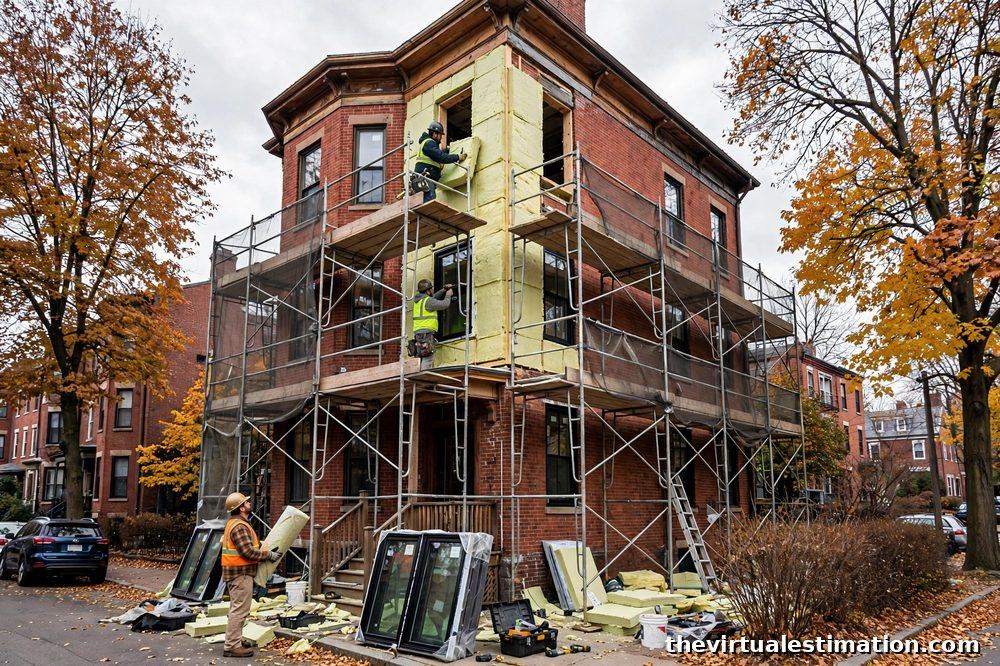
Before demolishing a building in Boston, an Article 85 application is required. It covers all buildings in Downtown or Harborpark, all other buildings at least 50 years old, and all buildings in a Neighborhood Design Overlay District. Designated landmarked buildings go through a separate Landmarks Commission or local historic district process instead. Secondary reporting describes a 90-day delay following a significance finding, after a significance determination and a public hearing step. The estimating lesson is simple: a demolition or gut scope on a 50-plus-year building must carry Article 85 review time and the possibility of a delay, and a takeoff that assumes a clean demolition permit on day one is wrong.
Downtown conversion: the PILOT is the lever, and the window is closing
Boston's Downtown Office to Residential Conversion Program, created in 2023, is a separate estimating world from new construction. Qualifying owners enter a payment in lieu of taxes (PILOT) agreement that provides an average abatement of up to 75 percent of fair market assessed residential value for up to 29 years, with terms negotiated with the Assessor. Conversion projects also get fast-tracked Article 80 and permitting processes, and participating projects carry a 17 percent deed-restricted set-aside at up to 60 percent AMI.
The program's current position is what makes it urgent rather than theoretical. Applications remain open through December 31, 2026, and approved projects must pull a full building permit and begin construction by December 31, 2027. Since launch, the program has drawn more than 20 applications covering over 1,500 proposed units and about 1.3 million square feet, with 15 projects approved, six under construction, and the first conversion, a 15-unit project at 281 Franklin Street, already opened. State support of $15 million was added in 2024 for larger-scale conversions.
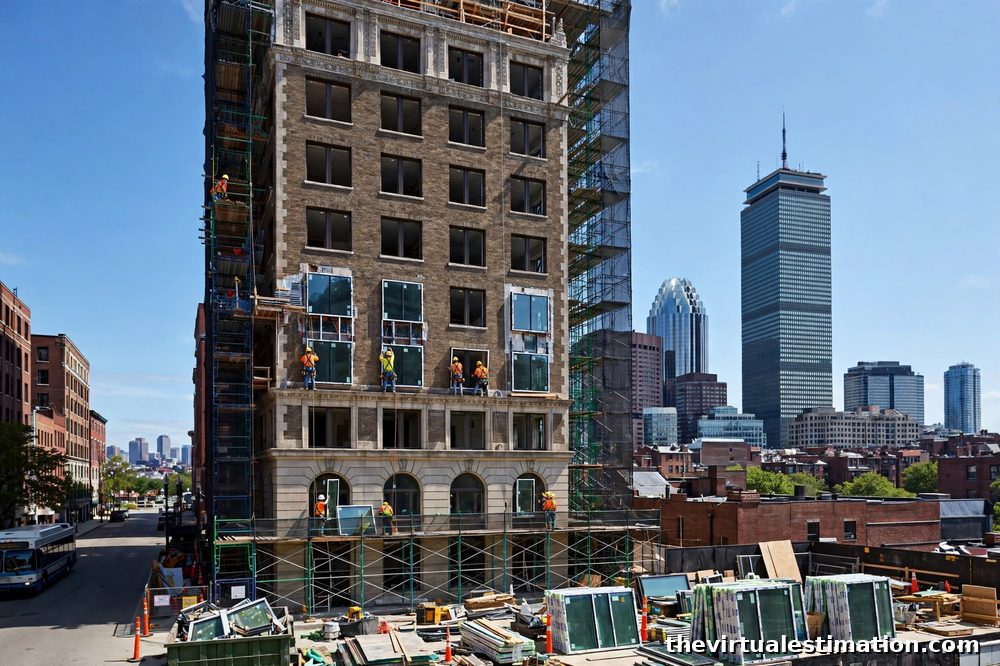
A conversion takeoff is not a new-build takeoff with a different title. Existing structure, egress, plumbing stacks, fire and life safety upgrades, floor-plate depth and light, and unit-layout constraints drive the cost, and the PILOT is negotiated per project, not a flat discount you apply to every downtown building. Price the physical scope, show the incentive as reported and time-limited, and keep the negotiated PILOT in the pro forma where it belongs, not in your construction estimate.
Squares + Streets: mapped place by place, not citywide
Boston's Squares + Streets districts allow mixed-use multifamily, commercial, and cultural space in neighbourhood squares, with districts ranging from transitional residential (up to 4 storeys, up to 14 units) to placemaker squares (up to 145 feet). The estimating point is that a parcel's mapped district, not a generic "Boston zoning" label, sets height, yard, ground-floor, and amenity rules. Mattapan Square was the first mapped area, and Roslindale Square followed in May 2026 as only the second. Districts proposed for Cleary Square in Hyde Park were still awaiting Zoning Commission approval in late 2025 reporting, and a district that is only proposed is not yet a basis for pricing.
Boston bid checklist: run this before the number goes out
Use this checklist on every Boston bid, in this order, and you will catch the errors that cost Boston estimators the most money:
- Name the exact municipality for the parcel, and confirm the permitting authority matches it.
- Classify the permit as long-form or short-form from the scope, then apply the matching fee. For long-form, use $50 plus $10 per $1,000 of estimated cost of work, due upfront.
- Cite the 10th Edition of 780 CMR, and confirm whether the project falls under the Specialized opt-in stretch energy code.
- Price IZ as a mix: unit count, AMI average, and the 3 percent voucher set-aside on large rental projects, using current-year AMI limits.
- Check the BCDC trigger at 200,000 square feet separately from Article 80 review, and note any special significance risk.
- Attach the BERDO cohort year to any retrofit scope on a covered existing building.
- Carry Article 85 review time on any demolition or gut scope involving a building 50 years or older, or in Downtown or Harborpark.
- On a conversion, show the PILOT as a negotiated, time-limited incentive with the December 31, 2026 application deadline and the December 31, 2027 construction start deadline, never as a flat discount.
- Confirm the Squares + Streets district is adopted and mapped before pricing height or unit count from it.
Boston rewards estimators who read the city's own rules before they read the drawings. The fee schedule, the code edition, the affordability mix, the review threshold, and the retrofit ordinance each move the number, and each one is published and checkable.
If you are bidding in Boston and want the permit, code, IZ, and review items above priced into your takeoff before submission, The Virtual Estimation can help. Send your drawings and project details to info@thevirtualestimation.com, and ask for a construction estimating service quote for your Boston project. You get a detailed, trade-by-trade estimate built around the rules that actually govern the parcel, so your bid goes in accurate, complete, and on time.