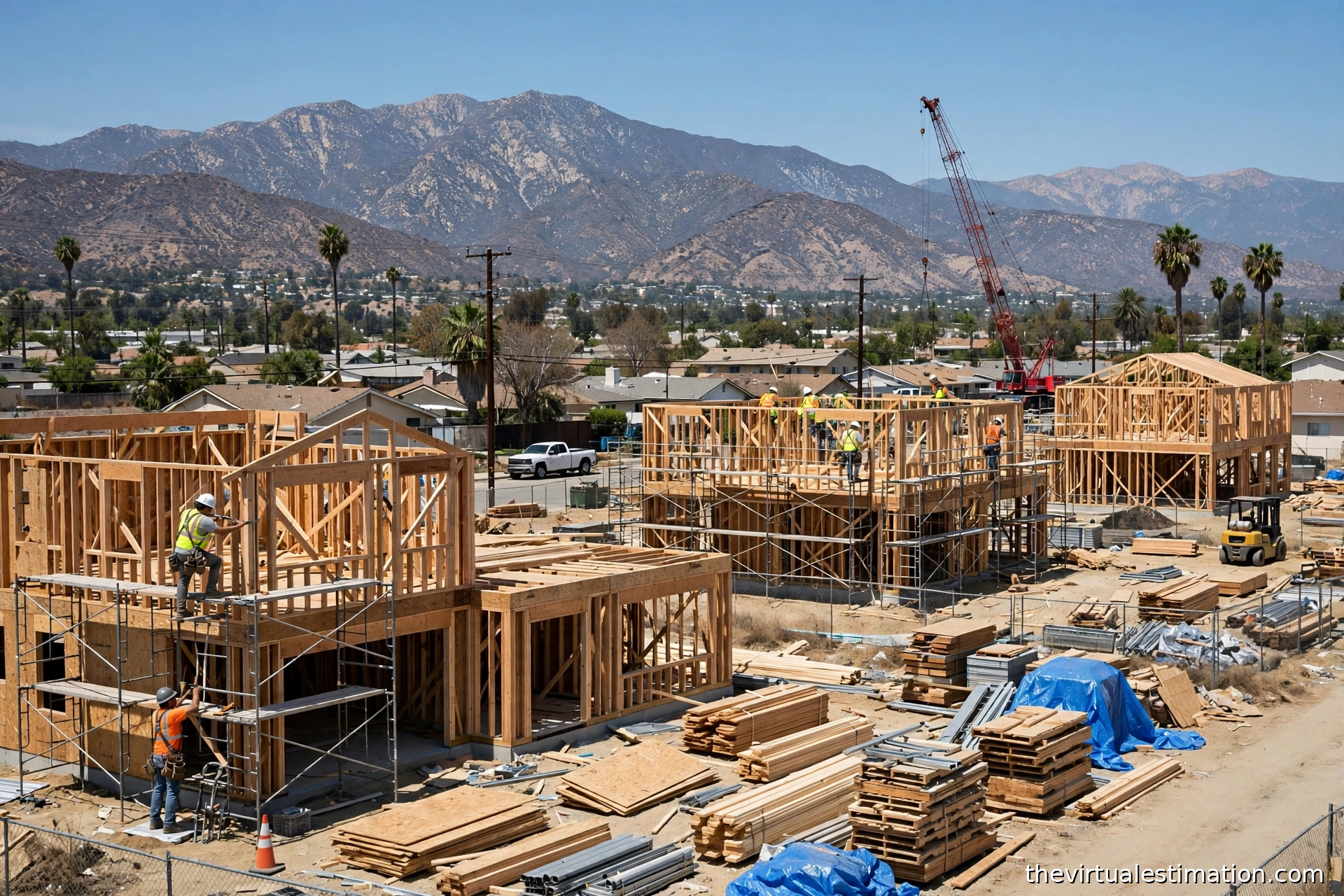
If you bid construction work in Los Angeles this year, you are not bidding in a normal market. You are bidding in a rebuild economy. The January 2025 Eaton and Pacific Palisades wildfires destroyed more than 12,300 structures, and the rebuild that followed is now the single biggest driver of construction pricing in Southern California. An early 2026 survey of more than 500 LA County homeowners found that 76% have begun rebuilding, with costs and financing (43%), insurance issues (34%), and labor shortages (29%) cited as the top hurdles. LA County estimates rebuilding will require 141,000 to 209,000 job-years of labor over the coming years, with roughly two-thirds of that demand concentrated around the Palisades area. The county added 2,300 construction jobs between April and May 2026 alone, and job postings are up 45% year over year.
Here is the part that should shape every estimate you write: 88% of rebuild permit applicants experienced permitting delays, and only 4% had their permits approved in under a month. That means your bid does not just need accurate quantities. It needs a permit schedule, a realistic escalation allowance, and line items most out-of-market estimators never think to include. This guide walks through what construction estimating services in Los Angeles actually have to account for in 2026: real permit economics, the codes that change your pricing, labor and per-square-foot reality, and a worked rebuild estimate you can sanity-check your own numbers against.
Los Angeles Permit Costs: How LADBS Fees Actually Work
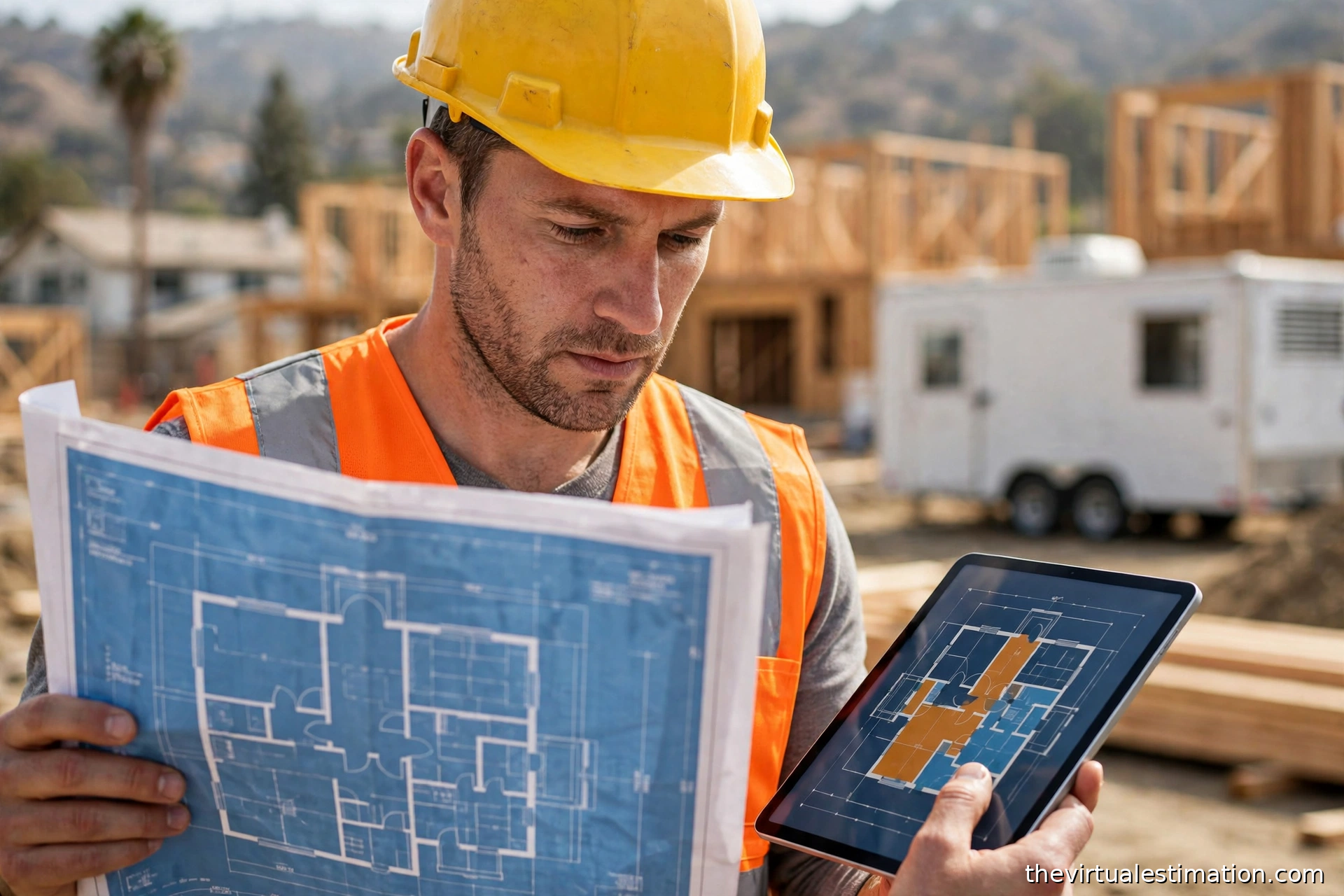
The Los Angeles Department of Building and Safety (LADBS) prices building permits on a valuation formula, not a flat schedule. It assigns a construction value per square foot by occupancy type, multiplies by the project area, and sets fees as a percentage of that valuation. You pay plan check when you submit, and plan check typically runs 50 to 85% of the base permit fee. The formula means two projects with the same square footage can carry very different fees depending on occupancy and valuation tables, so never quote a flat permit number without knowing the occupancy classification.
The ranges below are what you should budget in 2026. They come from current LADBS fee mechanics and published city data, and they are the numbers a competent residential estimating service will build into an LA bid.
| Permit or fee | Typical 2026 cost range |
|---|---|
| Custom home building permit | $2,000 to $15,000+, valuation-based |
| Electrical trade permit | $200 to $2,500 |
| Plumbing trade permit | $200 to $2,000 |
| Mechanical (HVAC) trade permit | $200 to $1,500 |
| Grading permit | $500 to $10,000+, by cubic yards |
| School district fee (new residential) | $4.79 per sq ft |
| Expedited processing surcharge | 40% on top of applicable fees |
Benchmark data puts this in context. Angi's 2026 city data shows the average LA building permit landing between $640 and $4,080, while kukun's 2026 data puts the average around $1,400 per permit, with room additions averaging about $2,800 and average processing running 21 days. As a working rule, budget permit fees at 3 to 8% of total project cost in LA.
The base permit is only the start. Supplemental reviews stack up fast on LA parcels: CALGreen review, fire department review, geology and soils report review in hillside and liquefaction zones, coastal development review, historic overlay review, and Title 24 energy compliance review. Hillside areas, methane zones, coastal zones, liquefaction zones, and historic preservation overlay zones (HPOZ) each change the estimate, sometimes by tens of thousands of dollars. Check the parcel on ZIMAS and the LADBS portal before you commit to a permit line item. One bright spot: the city's Standard Plan Pilot Program offers pre-approved, code-compliant home designs that can shorten review timelines, and 66% of surveyed homeowners are optimistic about it. If your client is rebuilding, ask whether a standard plan fits before you price a custom design cycle.
The 2026 Codes That Change Your Los Angeles Estimate
Several code cycles that took effect recently now have to be priced as standard scope in LA, not as alternates or allowances.
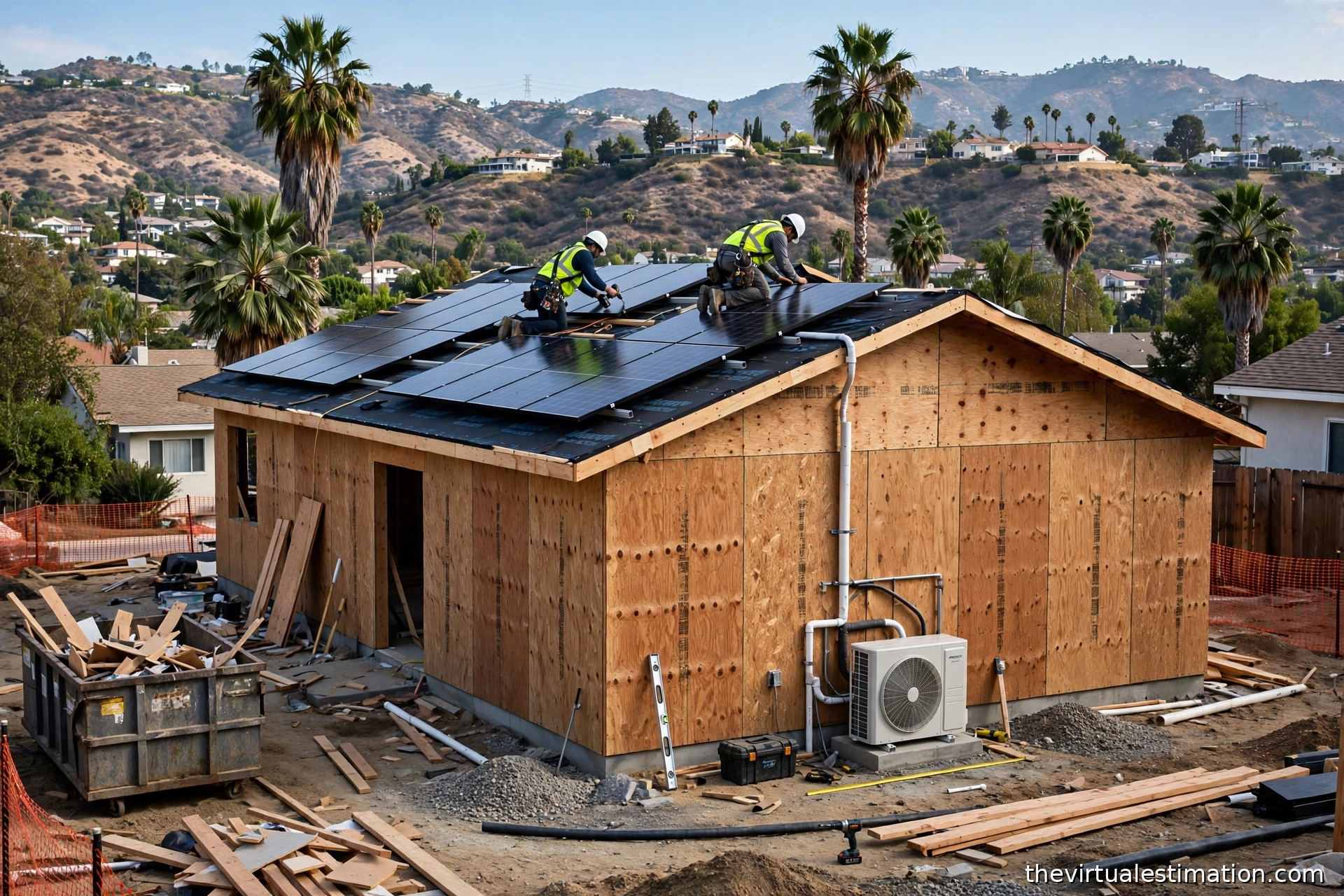
Title 24, Part 6, the 2025 California Energy Code, took effect January 1, 2026. It requires solar PV on all new single-family homes, and the 2025 edition extended solar requirements to new commercial and multifamily construction. Battery storage or battery-ready design is required, and the code pushes toward all-electric heat pump space and water heating, with the baseline moving to dual heat pumps. New electric-ready requirements cover EV charging, and envelope insulation minimums now run R-38 to R-49 in ceilings and R-19 to R-30 in floors depending on climate zone. On a new home, you should be carrying explicit line items for the solar array, the battery or battery-ready infrastructure, the heat pump package, and the Title 24 compliance report itself. Contractors who treated these as design development extras in 2024 are now getting surprised at plan check.
CALGreen (Part 11) layers on mandatory water-efficient fixtures, low-emitting materials, and construction waste diversion, and many jurisdictions in the region add local reach codes above the state baseline. Seismic design is a separate cost driver: ASCE 7 Seismic Design Category D applies broadly across Los Angeles, and the city's soft-story retrofit ordinances mean a pre-1978 retrofit typically runs $60,000 to $150,000 per building. Then there is the Wildland-Urban Interface: CBC Chapter 7A requires fire-hardened materials and construction methods in high fire-hazard severity zones, and after the 2025 fires you should expect stricter enforcement across Altadena, Pacific Palisades, and Malibu. A rebuild estimate in any of those zones without a fire-hardening line item is incomplete.
Los Angeles Construction Costs and Labor Rates in 2026
New single-family construction in Los Angeles is running $400 to $475 per square foot, which puts a typical 2,000 square foot home at $800,000 to $950,000 before land. Field labor runs $35 to $50 per hour, and labor accounts for roughly $150 per square foot of the total. By finish level, using North LA and foothill market data, hard costs break down as follows.
| Finish level | Hard cost per sq ft (2026) |
|---|---|
| Builder-grade | $400 to $500 |
| Mid-range custom | $500 to $650 |
| Higher-end custom | $650 to $750 |
| Luxury or hillside | $750 and up |
| Remodels | $200 to $600 |
| Room addition | $300 to $500 |
| Second-story addition | $350 to $600 |
These are hard costs only. Land, design, and permits sit outside them. Los Angeles runs 20 to 40% above the national average for construction, with a labor premium of 15 to 25% over other US metros. Materials are under sustained upward pressure, so a fixed annual inflation factor will mislead you. Quote a date-reviewed number and carry 10 to 15% contingency on top of quoted figures to cover permit delays, material price movement, and labor tightness.
How to Bid Los Angeles Work Without Getting Burned
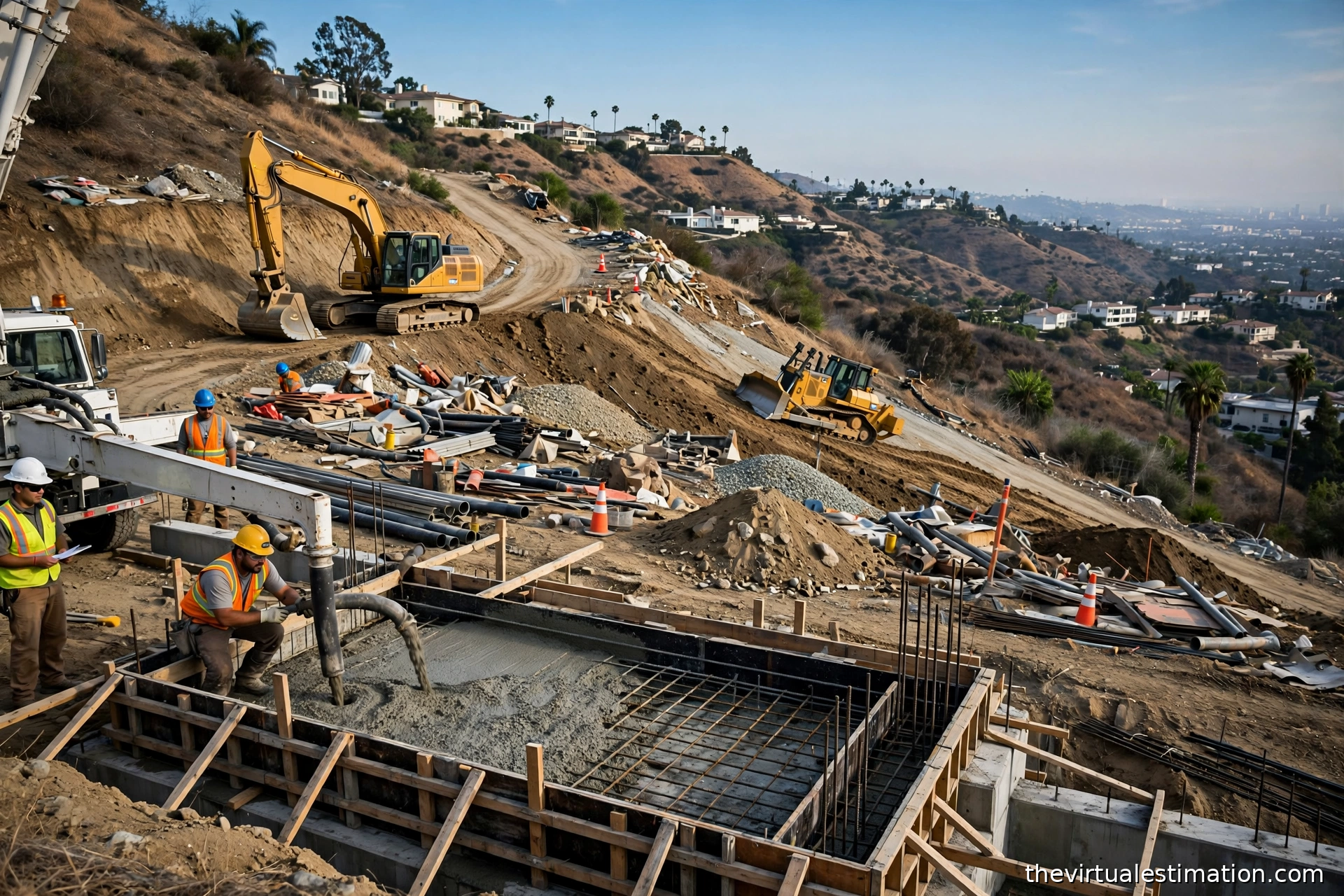
The delay data should change how you write bids. With 88% of rebuild permit applicants hitting delays and only 4% cleared in under a month, a bid that assumes a clean 30-day permit is a bid built on hope. Build a permit schedule contingency into the bid, and say so explicitly so the owner understands it. Labor competition is concentrated: rebuild zones are pulling crews toward Altadena, Pacific Palisades, and Malibu at the same time, which means your labor rates need a market adjustment if you are bidding in or near those corridors.
Price escalation with a clause, not a guess. Because materials face sustained upward pressure, a bid held open for 60 or 90 days in this market can lose its margin before the permit is even issued. Include an escalation allowance tied to a published index, or a defined bid validity window with repricing language. And verify your own numbers against what it costs to produce the estimate in the first place; if you have not priced your estimating workflow recently, our 2026 guide to what construction estimating services cost lays out the pricing models. The cheapest way to lose money in LA is to win a job at a number that assumed permits would move fast.
Worked Example: 2,000 Sq Ft Rebuild in the Palisades
Here is how these numbers assemble on a real project: a 2,000 square foot single-family rebuild in the Palisades area, priced at mid-range custom. Use it as a cross-check against your own takeoff.
| Budget line | Calculation | Amount |
|---|---|---|
| Hard construction | 2,000 sq ft x $550/sq ft | $1,100,000 |
| Design and engineering (plans, Title 24 report, structural) | 8 to 12% of hard cost | $88,000 to $132,000 |
| Permits and fees | 3 to 8% of project; school fee 2,000 x $4.79 = $9,580 | $45,000 to $95,000 |
| Contingency (permit delays, labor tightness) | 10 to 15% of subtotal | $125,000 to $190,000 |
| Project total before alternates | $1,358,000 to $1,517,000 |
Price three items as separate alternates: hillside foundation upgrades (grading and deepened footings can swing six figures on a steep lot), the WUI fire-hardening package (ember-resistant vents, noncombustible siding zones, tempered glazing), and the solar plus battery sizing, which depends on the final Title 24 model. The three items estimators most often miss on LA rebuilds: the 40% expedited processing surcharge if the owner demands a fast-tracked permit, the geology and soils report review on hillside parcels, and the owner's temporary housing costs during construction, which frequently become a negotiation point on insurance-funded rebuilds.
Los Angeles Estimating FAQs
How much does a building permit cost in Los Angeles?
Custom home building permits run $2,000 to $15,000 or more on LADBS's valuation formula, with trade permits from $200 to $2,500 depending on the trade. Budget permit fees at 3 to 8% of total project cost, and remember plan check alone typically costs 50 to 85% of the base permit fee.
How long do Los Angeles building permits take?
Simple permits average about 21 days, but rebuild permits are a different story: 88% of rebuild applicants experienced delays and only 4% were approved in under a month. Price permit-schedule contingency into every bid until the backlog clears.
What does Title 24 2026 add to my estimate?
The 2025 California Energy Code, effective January 1, 2026, requires solar PV on new homes, battery storage or battery-ready design, a shift to all-electric heat pump systems, EV-charging readiness, and higher insulation minimums. Carry these as priced line items, not allowances.
Why are Los Angeles construction costs higher than the national average?
LA runs 20 to 40% above the national average, driven by a 15 to 25% labor premium, Seismic Design Category D requirements, WUI fire-hardening rules, valuation-based permit fees, and current rebuild-zone demand pulling crews and pushing material prices.
Estimating in Los Angeles is a local discipline. The valuation-based LADBS fee structure, Title 24 energy requirements, seismic and wildfire codes, and a rebuild market moving hundreds of thousands of job-years through a permitting bottleneck all change the numbers in ways a generic national template will miss. If you are bidding LA work and want an estimate built on this market's actual costs, The Virtual Estimation prepares detailed construction estimates for contractors across the US. Send your plans to info@thevirtualestimation.com and review our full construction estimating services to see how we structure every bid.