You can nail every trade takeoff on a bid and still lose money on the job. I have watched it happen to good general contractors plenty of times. The steel takeoff is right, the concrete is right, the MEP numbers check out, and the project still bleeds. When we tear the job cost report apart at the end, the culprit is almost always the same section: general conditions.
General conditions are the Division 01 costs that keep the jobsite running but never appear on a single drawing. Supervision, trailers, temporary power, dumpsters, toilets, testing, bonds, cleanup. No vendor sends you a quote for them and no takeoff software draws them on a plan, so estimators price them from habit or a percentage pulled from thin air. On most commercial work these costs run 5 to 15 percent of total project cost, with the typical band landing between 5 and 10 percent. On a $2.5 million job, that is $125,000 to $375,000 of your bid sitting in lines you priced by feel.
What General Conditions Actually Cover
In CSI MasterFormat, general conditions live in Division 01, General Requirements. They are the indirect field costs you can charge to one specific project but not to one specific item of work. A column footing is direct cost. The superintendent who watches it get poured is general conditions. The concrete pump is direct cost. The trailer the superintendent works out of is general conditions.
Three distinctions keep estimators out of trouble. First, general conditions are not company overhead. Overhead runs your business whether or not you win this job. General conditions exist only because this project exists. Second, they are not contingency. Every line here should be a known cost you can defend with a rate and a duration. Third, on a GC bid these costs are mostly yours alone, which is why a proper construction estimate breaks them out as their own section instead of burying them in markup. Subcontractors price their own supervision inside their quotes. You carry the sitewide items: the trailer, the toilets, the temp power, the fencing, the bonds, the cleanup. Miss a line here and there is no sub to absorb it.
The Benchmark: 5 to 15 Percent
Small projects skew higher because fixed costs do not shrink: the trailer, the permit, and the superintendent's truck cost the same whether the job is $400,000 or $4 million. Large projects skew lower because direct costs dominate and dilute the indirects.
Use the percentage as a sanity check, never as your pricing method. Price every line from rates and durations, add it up, then divide by your direct costs. If your line-by-line total lands at 4 percent on a $600,000 retail fit-out, you probably missed something.
The 10 Cost Buckets, Priced Line by Line
1. Site Supervision
Supervision is where roughly half of your general conditions live, so price it first and price it honestly: project manager (full or partial time), site superintendent (full time on most commercial jobs), a project or field engineer on larger work. The method is simple: burdened monthly rate times project months. The part estimators get wrong is the burdened rate. A superintendent earning $4,800 a month in base salary costs roughly $6,200 to $6,500 once you load payroll taxes, workers comp, benefits, and vehicle allowance. In high-cost markets like New York or Los Angeles, where superintendent salaries run well above the national average near $58,000 a year, the burdened number climbs toward $8,000 or $9,000 a month.
The classic miss is partial allocation. Your PM is "only half time" on this job, but she is also the one answering the phone at 6 a.m. when the concrete sub no-shows. Budget supervision for the schedule you have, not the one you hope for. If the bid schedule says 8 months and your last three similar jobs ran 10, price 10. This bucket is where dedicated GC estimating support pays for itself, because supervision is the first number an owner questions.

2. Field Office and Trailers
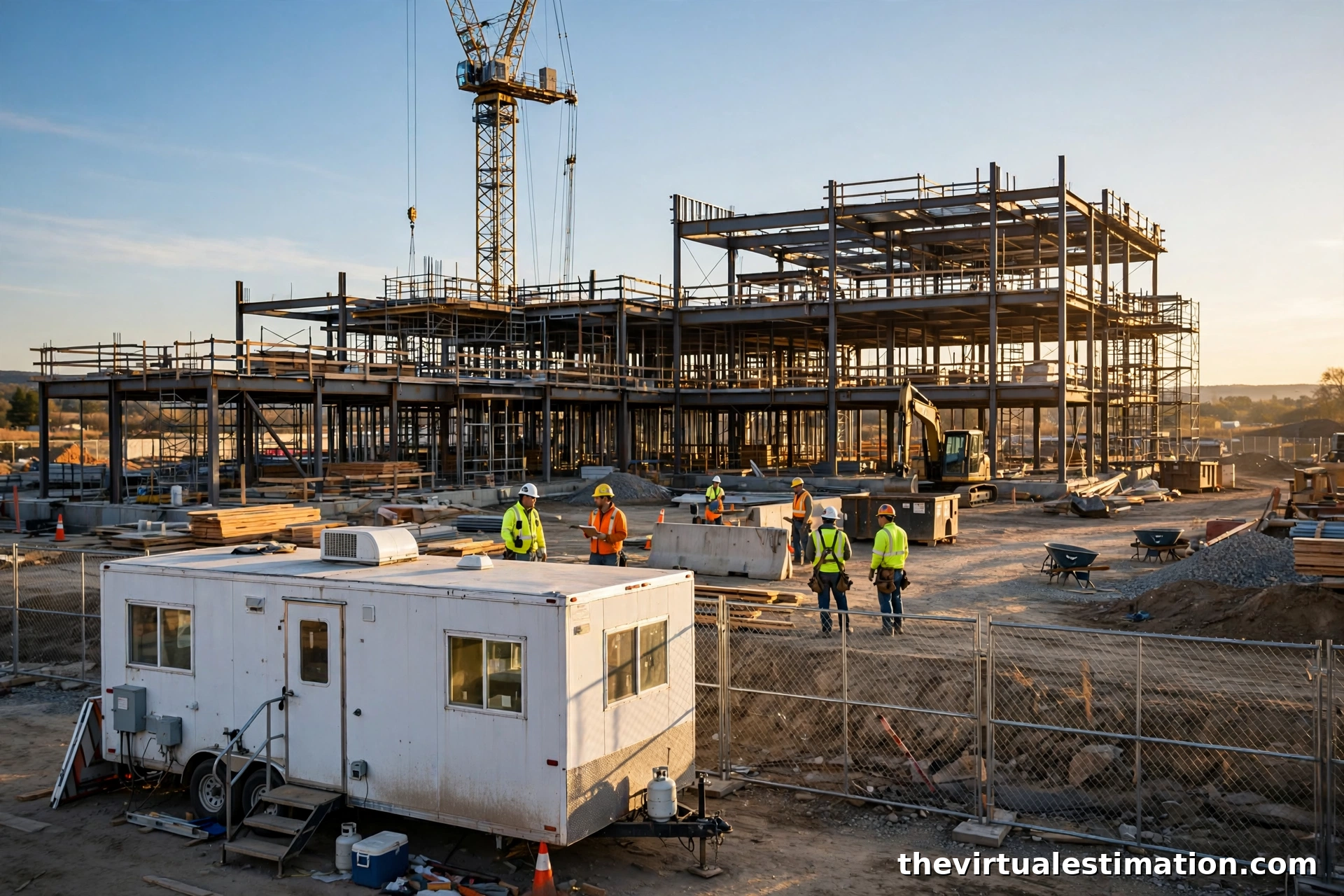
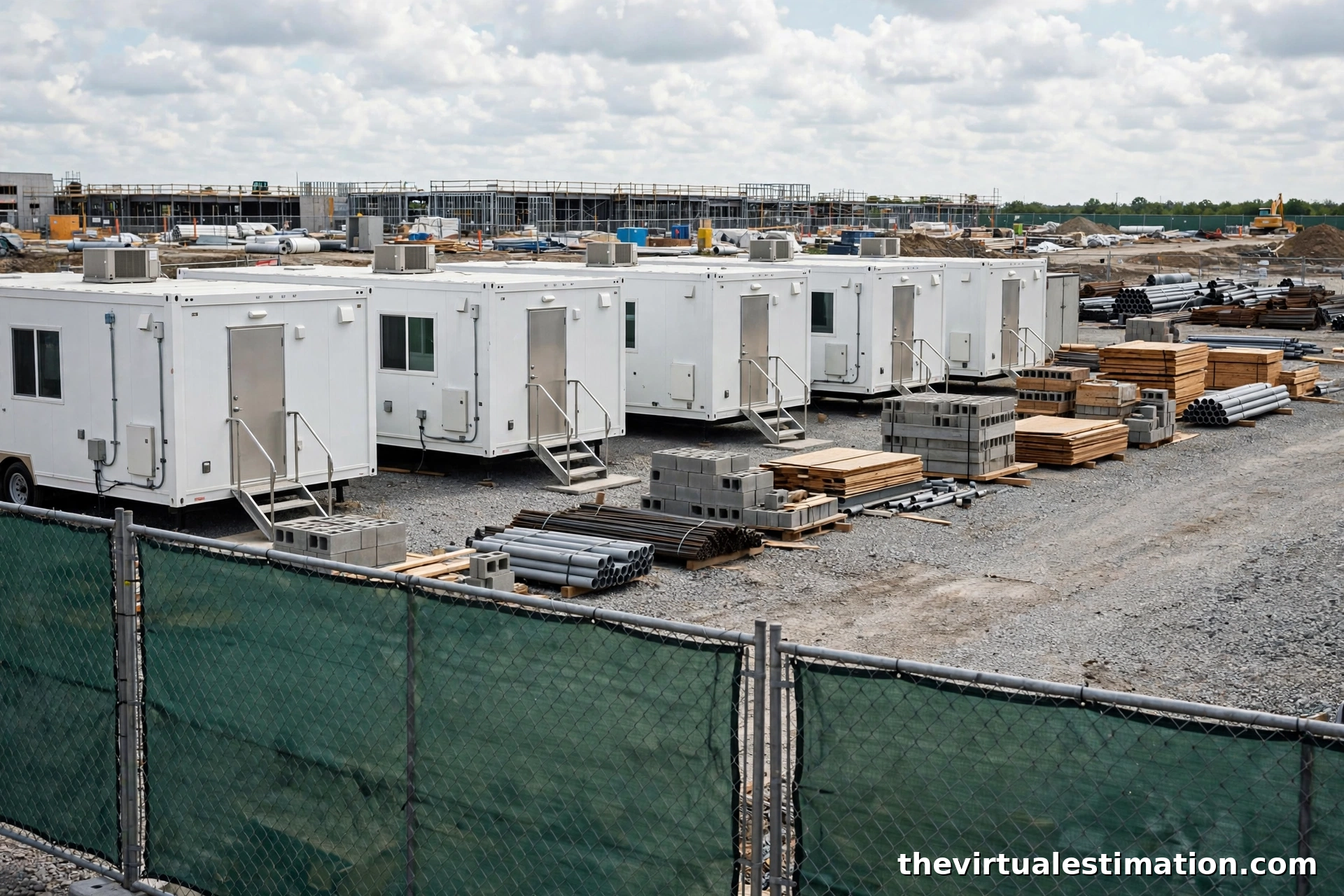
In 2026, a standard job trailer rents for $200 to $800 a month depending on size. The monthly rent is only part of the line. Delivery, blocking and leveling, steps, skirting, and permits routinely add $500 to $3,000 up front, and on a short rental the setup can exceed a year of rent. Then add internet and phones ($150 to $300 a month), electric and water, furniture, and supplies. Price it as: monthly rent plus running costs, times project months, plus one-time setup. On projects over a year, get a buy-versus-rent quote. A used trailer in decent shape often costs less than 18 months of rental.
3. Temporary Utilities
Somebody pays for power, water, and heat before the permanent systems exist, and the specs decide who, so read Division 01 before you assume. Price the hookup (utility fees, temp panel, distribution), the monthly consumption, and the early-phase gap when the building has no permanent power, which usually means a towable diesel generator. Fuel is the line estimators underestimate most. In cold climates, add temporary heat: fuel-fired heaters, fuel delivery, and the labor to move them as work progresses.
4. Sanitation
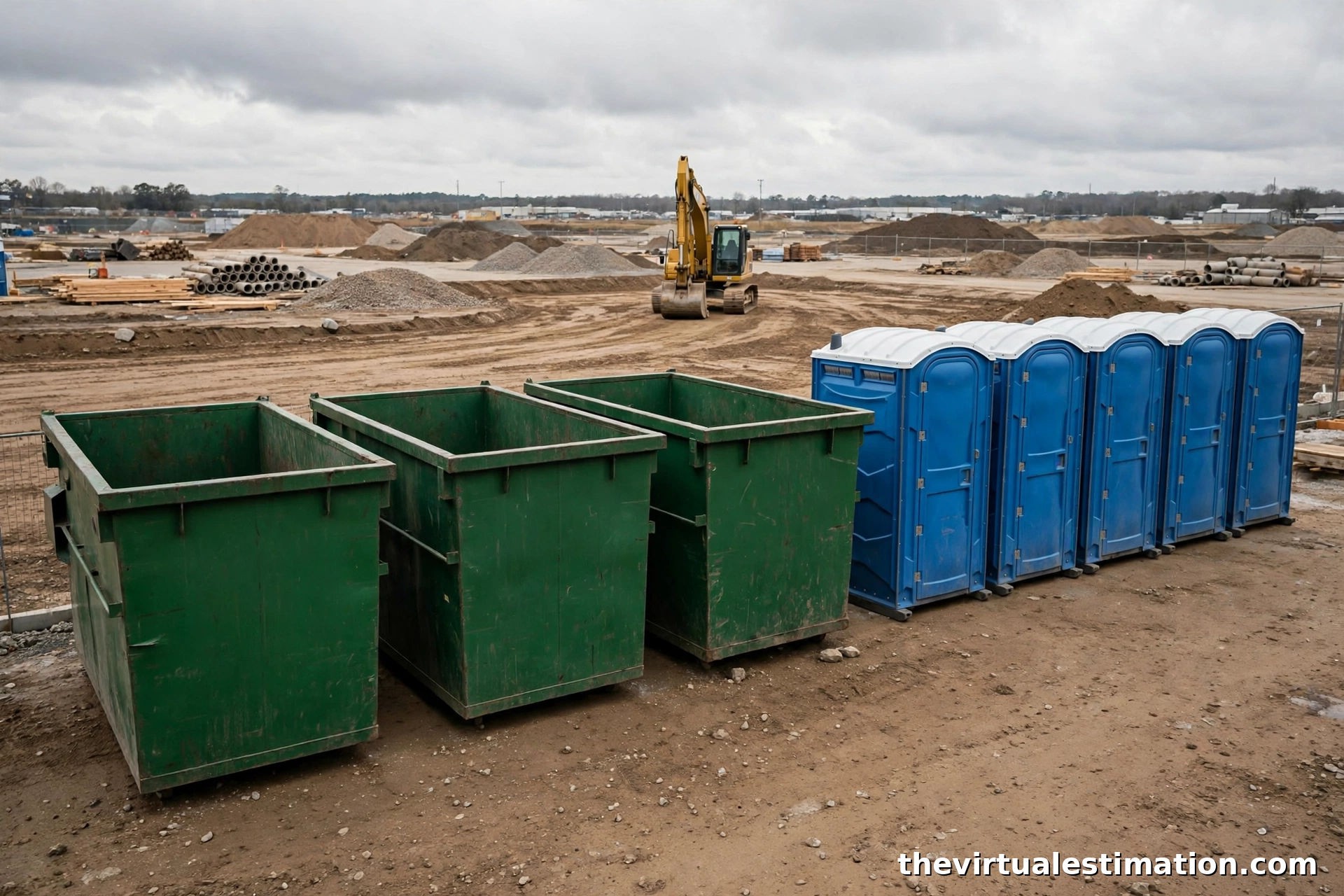
Plan on one serviced portable toilet per 20 workers, the long-standing OSHA rule of thumb, plus a handwash station per cluster of units. In 2026, a standard serviced unit typically runs $125 to $375 a month. The estimate is unit count times monthly rate times project months, plus delivery and pickup. Two mistakes show up constantly. First, estimators price the peak crew and forget the units sit there at near-peak count for the full duration. Second, nobody prices the extra weekly service when the crew doubles during finishes. Lock the service schedule in the vendor quote, not after the first complaint.
5. Waste and Dumpsters
Debris leaves the site in roll-off containers, and you pay per pull plus monthly rental. A 40-yard roll-off currently runs $550 to $900 per container in major markets, with per-pull disposal fees on top that vary by weight and landfill rates. Estimate debris volume by phase (demo, framing, drywall, finishes), divide by container size, and you get your pull count. The miss is underestimating pulls during drywall and finishes, when packaging and cutoffs fill containers fast. Ask your hauler for the weight allowance and overage rate before bid day, because overweight pulls are where the surprise invoices come from.
6. Temporary Fencing, Signage, and Security
Temp chain-link fence rents by the linear foot per month, plus gates and installation. A mid-size site can carry several thousand dollars a month in fence rental alone. Add project signage (the owner usually requires it), barricades, and lighting for after-hours security. On urban or high-theft sites, add a guard or camera system. One theft incident costs more than a month of cameras. Get the linear footage from the site plan, not from a guess.
7. Safety
Price PPE for your own crew, first aid supplies, fire extinguishers per code spacing, safety orientations for every new worker on site, and drug testing if the owner or your policy requires it. On larger jobs, a safety officer belongs in the supervision bucket instead. The number is small relative to the bid, usually a few thousand dollars on a mid-size job, which is exactly why estimators skip it and eat the cost later. Put the line in. It also reads well in a bid interview when the owner asks how you run a safe site.
8. Survey, Layout, Testing, and Inspections
Price a licensed surveyor for initial control and as-builts, your own layout labor, and third-party testing: concrete cylinders and breaks, soil compaction, structural steel inspection, firestopping inspection. Testing labs quote per test or per visit, so get the quote against the spec section, not against your memory of the last job. Special inspections required by the building code are the owner's responsibility in some jurisdictions and the GC's in others. Confirm it in Division 01 before you carry or exclude the cost, and if you exclude it, say so in your scope letter.
9. Permits, Bonds, and Insurance
Building permits and plan-check fees come from the authority having jurisdiction; many cities publish fee calculators, so run the valuation instead of guessing. Performance and payment bonds typically cost 1 to 3 percent of the contract value. On a $2.5 million job that is $25,000 to $75,000 before you have moved any dirt. Builder's risk insurance covers the structure during construction and is usually quoted as a rate against completed value. Get the bond quote from your agent before bid day. Guessing at 2 percent when your actual rate is 2.8 percent is a $20,000 error on a $2.5 million bid.
10. Cleanup, Vehicles, Small Tools, and Communications
Final cleaning (detailed clean before turnover, often by a specialty crew at a per-square-foot rate), progressive cleanup labor, project vehicles and fuel, small tools and consumables, radios or phones, and printing. Price vehicles at a monthly cost per truck plus fuel. Price small tools as a monthly allowance tied to crew size. Price final cleaning per square foot from a cleaning contractor's quote. The discipline that saves you: every one of these lines gets a rate and a duration, even if the rate is an allowance. Allowances you wrote down beat costs you forgot.
Putting It Together: A Sample Budget
Here is what the buckets look like assembled for an illustrative $2.5 million ground-up commercial building on an 8-month schedule. Working ranges drawn from the 2026 figures above, not a quote.
| Bucket | Basis | Budget |
|---|---|---|
| Site superintendent | 8 months at $7,000 burdened | $56,000 |
| Project manager (half time) | 8 months at $4,500 | $36,000 |
| Field office trailer and setup | 8 months at $600 plus $2,000 setup | $6,800 |
| Temporary power and heat | Hookup, generator period, fuel | $9,500 |
| Sanitation, 4 units serviced | 8 months at $225 per unit | $7,200 |
| Roll-off dumpsters | 10 pulls at $750 | $7,500 |
| Temp fencing and signage | Rental, gates, install | $4,200 |
| Safety | PPE, training, first aid, extinguishers | $3,800 |
| Survey, layout, testing | Control, layout labor, lab work | $11,000 |
| Bonds and builder's risk | About 1.7 percent of contract value | $42,000 |
| Permits and fees | AHJ fee schedule allowance | $18,000 |
| Final cleaning and punch support | Per-square-foot quote plus labor | $8,500 |
| Vehicles, fuel, small tools, phones | Monthly allowances | $9,500 |
| Total general conditions | 8.8 percent of $2.5M | $220,000 |
The total lands at 8.8 percent, inside the 5 to 10 percent band. Build the number from the ground up, then check it against the range. If your own budget for a similar job lands at 5 percent, go find the missing $90,000 before bid day finds it for you.
Five Mistakes That Wreck GC Budgets
1. Pricing by percentage instead of by line. Carrying a flat percent for generals without building the lines underneath is how you discover in month six that you have no supervision budget left. Build the lines, then check the percentage.
2. Pricing the bid schedule instead of the real schedule. If the bid documents say 8 months and your history says 10, every monthly line is 25 percent light. Duration is the multiplier on nearly every general conditions cost.
3. Forgetting the burden on labor. A $5,000-a-month salary is a $6,500-a-month cost. Apply a fully loaded rate to every person in the supervision bucket or you underprice your biggest bucket by 25 to 35 percent.
4. Mixing setup costs with monthly costs. Trailer delivery, temp power hookup, and fence installation happen once. Fold them into a monthly rate and you either double count them or forget them entirely.
5. Letting the small buckets go unpriced. Safety, signage, small tools, and communications feel too small to matter, until five forgotten $3,000 lines equal the profit on the job. Put the line in with an allowance and move on.
Frequently Asked Questions
What percentage of a bid should general conditions be?
Most commercial and residential projects land between 5 and 10 percent of total project cost, with the full typical range running 5 to 15 percent. Small projects skew higher because fixed costs do not scale down. Use the range as a sanity check on a line-by-line build, not as the pricing method itself.
Are general conditions the same as overhead and profit?
No. General conditions are project-specific indirect costs that end when the job ends. Company overhead keeps the business running regardless of this job, and overhead and profit are applied as markups after direct costs plus general conditions are totaled.
Who pays for general conditions on a subcontracted job?
The general contractor carries the sitewide items: supervision, trailer, toilets, temp power, fencing, testing, bonds, and cleanup. Subcontractors price their own crew-level supervision inside their quotes. If you are a sub bidding to a GC, do not carry sitewide general conditions unless the bid documents explicitly require it.
Get Your General Conditions Priced Right
If your team is buried in bid deadlines and the Division 01 section keeps getting priced from memory, The Virtual Estimation can build the full general conditions budget as part of your bid. Send your plans and specs to info@thevirtualestimation.com and get a line-by-line estimate with every bucket priced and ready to defend. See our GC estimating services for what is included on every commercial bid.