Commercial fencing may look like a straightforward linear-foot estimating exercise, but experienced estimators know that the fence itself is only one part of the scope.
A complete fencing estimate can include chain link fabric, ornamental steel panels, posts, rails, braces, concrete footings, gates, gate operators, security toppings, bollards, hardware, demolition, temporary fencing, and site-specific installation labor.
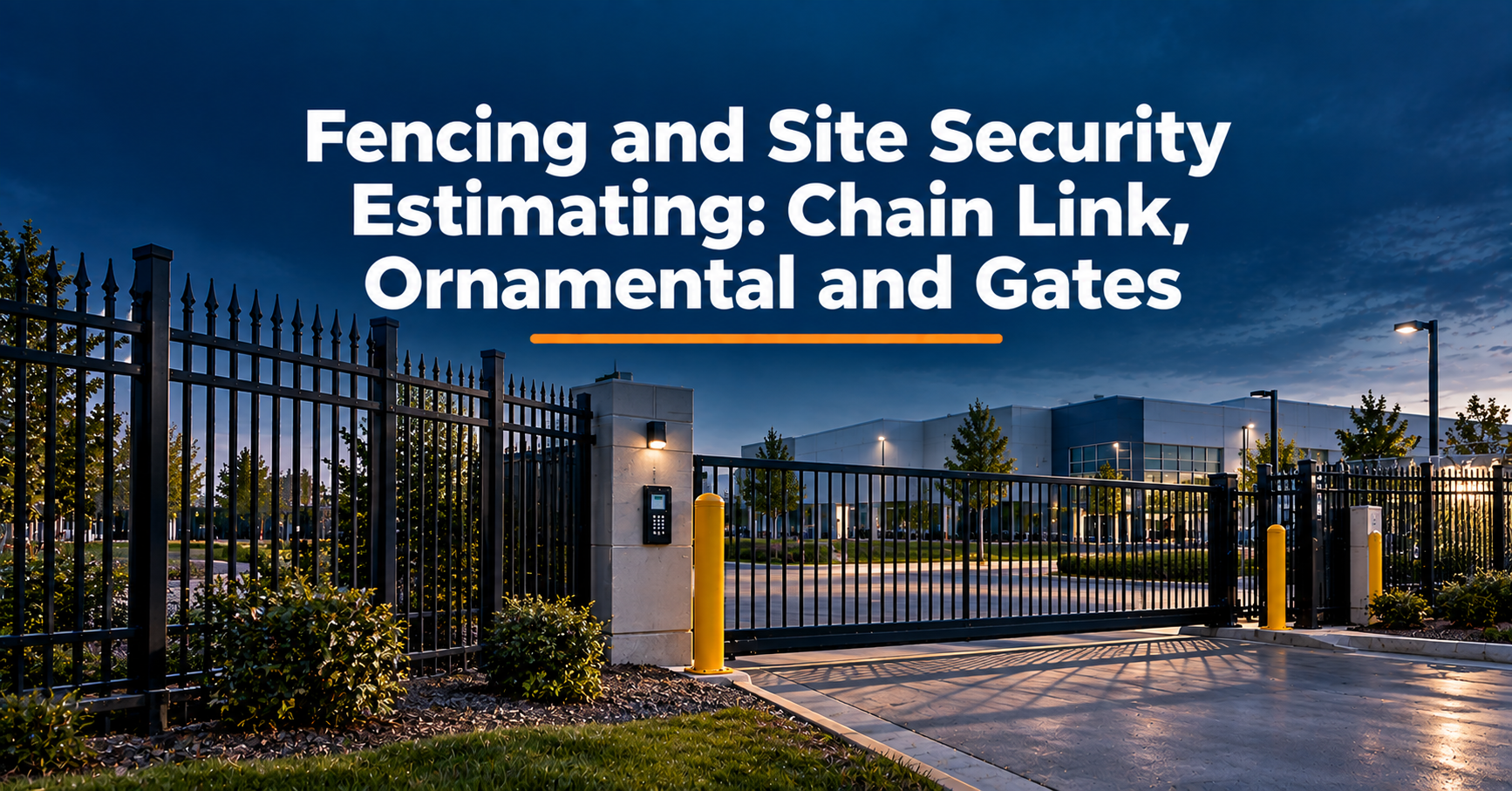
The complexity increases when a project has multiple fence types around the same property. A commercial warehouse might have chain link along the back property line, ornamental steel at the main entrance, an automated sliding gate for trucks, pedestrian gates for employees, and protective bollards around mechanical equipment.
For contractors bidding these projects, the objective is to create a takeoff that captures every component and assigns realistic material and labor costs before bid submission.
What Is Fencing and Site Security Estimating?
Fencing estimating is the process of measuring and pricing the materials, labor, equipment, and accessories required to install a fence or perimeter security system.
Depending on the project, the estimate may include:
Chain link fencing
Ornamental steel or iron fencing
Wood privacy fencing
Vinyl fencing
Security fencing
Temporary construction fencing
Pedestrian gates
Vehicle gates
Sliding gates
Swing gates
Automated gates
Bollards
Guardrails and barriers
Barbed wire
Razor ribbon
Privacy slats
Fence posts and rails
Concrete footings
Gate hardware
Gate operators
Access-control components
The important distinction is that a fence estimate is not simply a linear-foot price.
Fence height, material, post spacing, terrain, foundations, gate configuration, security requirements, and installation conditions can all change the final cost.
Why Commercial Fence Estimating Requires Detailed Takeoffs
A commercial property can contain several different fencing systems.
For example, the drawings may specify:
6-foot chain link fencing around one portion of the site
8-foot security fencing around equipment
Ornamental steel fencing along the public frontage
A motorized sliding gate at the main entrance
Pedestrian gates at employee entrances
Bollards around loading areas
Barbed wire above selected fence sections
Each system has different materials and labor requirements.
This is why professional estimators separate the scope by fence type, height, location, and installation method rather than applying one cost-per-foot allowance to the entire project.
Start With the Complete Site Plan
The site plan is normally the starting point for a fencing takeoff.
The estimator should review:
Civil site plans
Architectural site plans
Landscape plans
Grading plans
Utility plans
Fence details
Gate schedules
Security details
Specifications
Enlarged site plans
Existing-condition drawings
The fence route should be measured directly from the drawings.
Special attention should be given to corners, changes in direction, property boundaries, access roads, retaining walls, existing structures, and areas where the fence transitions from one system to another.
For projects with significant earthwork or excavation, fencing quantities should also be coordinated with the broader construction quantity takeoff services to avoid duplicated or missing sitework scope.
Chain Link Fence Estimating
Chain link is widely used for commercial, industrial, institutional, and utility applications.
A complete chain link takeoff should identify more than just the fabric.
Typical quantities include:
Fence fabric
Fence height
Mesh size
Wire gauge
Coating or finish
Line posts
Terminal posts
Corner posts
End posts
Gate posts
Top rails
Bottom rails where specified
Brace assemblies
Tension wire
Tension bands
Tension bars
Post caps
Ties
Fittings
Concrete
Gates
Security toppings
The estimator should separate different fence heights and specifications rather than combining everything into one linear-foot quantity.
Chain Link Post Takeoff
Posts are an important part of both material and labor calculations.
The takeoff should distinguish between:
Line Posts: Used along straight fence runs.
Terminal Posts: Used at ends, corners, and changes in direction.
Gate Posts: Typically require different sizes and foundations depending on the gate configuration.
Brace Posts: Required where additional structural support is specified.
Post spacing should follow the project details and specifications.
The estimator should also determine the required concrete volume for post foundations instead of assuming that all posts have identical footing requirements.
Chain Link Fabric and Security Toppings
Fence fabric should be measured according to its actual height and length.
The estimate should identify:
Linear footage
Fence height
Mesh opening
Wire gauge
Finish
Privacy requirements
Security additions should be quantified separately.
These may include:
Barbed wire
Razor ribbon
Privacy slats
Anti-climb features
Security arms
Specialized fittings
A security fence with additional topping can require significantly more material and installation labor than a standard chain link fence.
Ornamental Steel and Iron Fence Estimating
Ornamental fencing is usually more detail-intensive than standard chain link.
Depending on the design, the estimator may need to quantify:
Fence panels
Steel posts
Rails
Pickets
Decorative elements
Finials
Base plates
Anchors
Fasteners
Concrete footings
Special sections
Ornamental gates
Finish or coating
Architectural elevations and fence details are particularly important because ornamental fencing can contain custom panel dimensions and decorative features.
The estimator should avoid assuming that every panel is identical if the drawings show different configurations.
Wood Privacy Fence Estimating
Wood privacy fencing is common around residential developments, multifamily communities, schools, recreational facilities, and private commercial properties.
The takeoff can include:
Posts
Rails
Pickets
Cap boards
Trim
Gates
Hinges
Latches
Fasteners
Concrete
Stain or coating
Fence height and board arrangement can significantly affect material quantities.
For example, a solid privacy fence requires a different material calculation than a spaced-board fence, even when the total linear footage is identical.
Vinyl Fence Estimating
Vinyl fencing is typically estimated by panels, posts, rails, gates, and accessories.
The estimator should identify:
Panel dimensions
Post quantity
End posts
Corner posts
Gate posts
Rails
Caps
Gates
Hardware
Concrete
Specialty sections
Because vinyl systems can be manufacturer-specific, the estimate should follow the specified product or approved equivalent whenever that information is available.
Security Fence Estimating
High-security applications require additional estimating detail.
Security fencing may include:
Heavy-duty chain link
Smaller mesh
Taller fence
Reinforced posts
Barbed wire
Razor ribbon
Anti-climb features
Security gates
Tamper-resistant hardware
Specialized foundations
Vehicle barriers
The estimator should identify each security component individually.
A fence with security topping, for example, requires more than additional wire. It can also require special arms, brackets, fittings, posts, and installation labor.
Gate Estimating
Gates are one of the most commonly underestimated portions of a fencing project.
Every gate should be counted separately and identified by type.
Typical commercial gate categories include:
Single pedestrian gates
Double pedestrian gates
Single swing gates
Double swing gates
Sliding gates
Cantilever gates
Rolling gates
Automated vehicle gates
Emergency access gates
Security gates
The estimate should identify gate width, height, frame construction, finish, hardware, foundation, and operator requirements.
A large vehicle gate should never be treated as simply another section of fence.
Automatic Gate Estimating
Automated gates require coordination between fencing, electrical, and security scopes.
Depending on the design, the estimate may include:
Gate leaf
Gate frame
Gate posts
Operator
Motor
Track
Rollers
Hinges
Safety devices
Photo eyes
Vehicle loops
Keypads
Card readers
Intercoms
Control equipment
Conduit
Electrical connections
Concrete foundations
The bid documents should determine which trade is responsible for each component.
This is especially important when the project includes access control or security technology.
Sliding Gate vs. Swing Gate
Sliding and swing gates have very different installation requirements.
A sliding gate can require:
Track
Rollers
Guide assemblies
Gate stops
Operator
Concrete track foundation
Safety equipment
A swing gate can require:
Heavy-duty hinges
Operator arms
Gate stops
Reinforced posts
Safety devices
Concrete foundations
Labor should therefore be developed according to the actual gate type rather than using one generic gate installation allowance.
Bollard Estimating
Bollards are frequently used to protect buildings, storefronts, loading areas, utility equipment, pedestrian zones, and parking facilities.
A bollard takeoff should identify:
Fixed bollards
Removable bollards
Decorative bollards
Steel protective bollards
Retractable bollards
Crash-rated bollards
Diameter
Height
Finish
Mounting method
Concrete foundation
Surface-mounted and embedded bollards have different material and labor requirements.
Large protective bollards may also require reinforced foundations or specialized installation methods.
Perimeter Security Barriers
Some facilities require more than conventional fencing.
Site-security systems can include:
Vehicle barriers
Guardrails
Crash barriers
Steel barriers
Anti-ram systems
Access-control barriers
Protective posts
These items should be measured separately from standard fencing because their material, foundation, and labor requirements can be substantially different.
Fence Foundations and Concrete
Fence posts frequently require concrete foundations, making foundation quantities an important part of the estimate.
The estimator should review:
Footing diameter
Footing depth
Concrete requirements
Reinforcement
Post embedment
Soil conditions
Frost-depth requirements
Special gate foundations
Gate foundations are particularly important.
A large sliding or swing gate can require much larger foundations than standard line posts.
When concrete work is included in the fencing contractor's scope, it should be quantified rather than hidden inside a general installation allowance.
Fence Installation Labor Estimating
Fence labor is affected by much more than linear footage.
Important productivity factors include:
Fence type
Fence height
Post spacing
Ground conditions
Excavation requirements
Rock
Slopes
Existing concrete
Asphalt
Underground utilities
Gate complexity
Security hardware
Site access
Existing fence removal
A straight chain link fence installed on open, level ground will have a different labor requirement from ornamental steel fencing installed around an occupied commercial property.
For this reason, labor should be developed around actual installation conditions.
Fence Demolition and Removal
Replacement projects often include removal of existing fencing.
The estimator should identify:
Existing fence length
Fence type
Existing posts
Existing gates
Concrete footing removal
Loading and hauling
Disposal
Surface restoration
Temporary security
Removing a fence post embedded in concrete can require substantially more labor than removing fence fabric alone.
If the existing perimeter must remain secure during construction, temporary fencing may also be required.
Temporary Construction Fencing
Temporary fencing is common on commercial construction sites.
The estimate may include:
Temporary fence panels
Posts
Ballast
Gates
Privacy screening
Security gates
Delivery access
Relocation
Rental duration
Removal
The estimator should determine whether the contractor will purchase or rent the temporary system.
For rental fencing, project duration becomes an important pricing factor.
Site Conditions That Affect Fence Cost
Site conditions can significantly change the final fence estimate.
Before pricing, check for:
Slopes
Rock
Existing concrete
Asphalt
Underground utilities
Drainage systems
Landscaping
Trees
Retaining walls
Limited equipment access
Existing structures
Active facilities
Property-line restrictions
A fence crossing an existing parking lot may require concrete or asphalt cutting and restoration.
A fence installed near existing utilities may require additional coordination and hand excavation.
These conditions should be identified during the estimating phase rather than discovered after the project starts.
A Practical Fencing Estimating Workflow
Step 1: Review the Complete Site Package
Study civil, architectural, landscape, grading, utility, security, and fence drawings.
Step 2: Identify Every Fence Type
Separate chain link, ornamental, wood, vinyl, security, temporary, and specialty fencing.
Step 3: Measure Linear Footage
Measure each fence system independently.
Step 4: Count Posts and Structural Components
Calculate line posts, terminal posts, corners, gate posts, rails, braces, and other structural components.
Step 5: Count Gates
Separate pedestrian, swing, sliding, cantilever, emergency, and automated gates.
Step 6: Quantify Foundations
Calculate concrete footings and special foundations for gates, bollards, and barriers.
Step 7: Identify Security Components
Measure barbed wire, razor ribbon, privacy slats, anti-climb systems, and other security features.
Step 8: Review Related Trades
Determine responsibilities for electrical connections, access control, concrete, excavation, and site restoration.
Step 9: Develop Labor
Apply productivity based on fence type, terrain, access, height, and installation method.
Step 10: Price Materials
Use project specifications and current supplier pricing.
Step 11: Perform Quality Control
Cross-check the takeoff against details, schedules, specifications, and addenda.
Step 12: Prepare the Bid
Organize material, labor, equipment, subcontractor costs, overhead, and markup into a clear bid summary.
What Should a Professional Fence Takeoff Include?
A professional fencing takeoff should give the contractor enough detail to understand exactly what has been measured.
Fence Quantities
Linear footage by fence type, height, mesh, gauge, material, and finish.
Posts and Rails
Line posts, terminal posts, corners, gate posts, top rails, bottom rails, braces, and tension components.
Hardware
Clamps, ties, brackets, hinges, latches, bolts, fasteners, connectors, and specialty fittings.
Gates
Gate type, dimensions, hardware, posts, foundations, operators, and accessories.
Security Components
Barbed wire, razor ribbon, privacy slats, anti-climb systems, and protective barriers.
Foundations
Concrete footings, reinforcing steel, anchors, and specialty foundations.
Labor
Installation labor by fence system and site condition.
Assumptions and Exclusions
Excavation, concrete, electrical, access control, demolition, disposal, restoration, and temporary fencing responsibilities should be clearly documented.
Common Fencing Estimating Mistakes
Measuring Only the Property Perimeter
The property perimeter does not identify different fence systems, gates, corners, transitions, or specialty sections.
Using One Cost Per Linear Foot
A standard chain link fence and an automated ornamental security gate have completely different material and labor requirements.
Missing Gate Foundations
Large gates can require substantial concrete foundations that are easy to overlook.
Forgetting Gate Hardware
Hinges, latches, rollers, stops, locks, operators, and accessories need their own quantities.
Missing Security Toppings
Barbed wire and razor ribbon should be measured separately whenever specified.
Ignoring Existing Conditions
Concrete, asphalt, utilities, slopes, landscaping, and difficult soil can change installation productivity.
Missing Bollards
Bollards may appear on architectural, civil, or enlarged site plans rather than the primary fence detail.
Not Coordinating Automated Gates
Automated gates can involve electrical and access-control work. The estimator needs to identify exactly which trade supplies each component.
Forgetting Temporary Fencing
Construction projects may require temporary perimeter security before permanent fencing is completed.
How to Improve Fence Estimate Accuracy
The most effective approach is to separate the project into individual systems instead of creating one large fence allowance.
A commercial takeoff can be organized into:
Chain link fencing
Ornamental fencing
Wood fencing
Vinyl fencing
Security fencing
Gates
Automated gates
Bollards
Security barriers
Temporary fencing
Demolition
Foundations
Site restoration
This makes the estimate easier to audit and reduces the chance of hiding missing scope inside a single unit rate.
The estimator should also document:
Fence height
Material
Finish
Mesh or panel specification
Post spacing
Footing dimensions
Gate dimensions
Hardware
Operator requirements
Excavation responsibility
Concrete responsibility
Electrical responsibility
Access-control responsibility
Disposal requirements
When Should Contractors Outsource Fencing Estimating?
Fencing contractors may consider outsourced estimating when multiple bids are due simultaneously, projects contain several fence systems, or internal estimating staff are handling too many active opportunities.
Outsourcing can also help general contractors and developers who need detailed fencing quantities as part of a larger site-development estimate.
A dedicated estimating team can review the drawings, measure fence systems, count gates and accessories, develop labor quantities, and organize the estimate for bid review.
For contractors preparing a complete construction bid, professional bid estimating services can also help organize fencing within the broader project scope.
How The Virtual Estimation Supports Fencing Bids
The Virtual Estimation provides construction estimating and quantity takeoff support for contractors working on commercial and other construction projects.
For fencing scopes, the estimating process can be structured around fence types, linear footage, posts, rails, gates, hardware, foundations, bollards, security components, demolition, and labor.
Fencing can also be coordinated with related construction scopes so that excavation, concrete, utilities, and other site requirements are properly identified.
For larger commercial projects, construction estimating services can incorporate specialty scopes into a broader bid package.
Final Takeaway
Accurate fencing and site security estimating requires much more than measuring the property perimeter.
A complete commercial fence estimate should account for fence types, heights, posts, rails, fabric or panels, gates, hardware, operators, bollards, security toppings, foundations, demolition, temporary fencing, labor, and site conditions.
The biggest problems usually occur when specialty components are hidden inside a generic linear-foot allowance.
By separating each system, measuring actual site conditions, coordinating related trades, and documenting assumptions, contractors can develop a more transparent and defensible bid.
For commercial fencing contractors, general contractors, and developers, a detailed takeoff provides a clear understanding of the actual scope before bid day—and helps reduce the risk of discovering missing quantities after award.
Frequently Asked Questions
How do you estimate chain link fencing?
Measure the actual linear footage by fence height and specification, then quantify fabric, line posts, terminal posts, rails, braces, fittings, concrete, gates, security toppings, and labor.
How do you estimate commercial fencing?
Start with the civil and architectural site plans, identify every fence type, measure each run, count posts and gates, quantify foundations and accessories, review site conditions, and develop labor according to the installation requirements.
What is included in a fence material takeoff?
A fence material takeoff can include fabric or panels, posts, rails, braces, fittings, hardware, gates, concrete, bollards, security toppings, operators, and specialty components.
How are commercial gates estimated?
Each gate should be estimated separately based on type, width, height, frame, posts, hinges, latches, rollers, operators, foundations, and installation requirements.
What affects fence installation labor?
Fence type, height, terrain, soil conditions, excavation, existing pavement, utilities, access, gate complexity, security hardware, and demolition can all affect labor.
Are bollards included in fencing estimates?
Bollards can be included when they form part of the perimeter or site-security scope. They should be measured separately according to type, dimensions, mounting method, and foundation requirements.
Should automatic gate operators be included?
If automated gates are included in the fencing contractor's scope, operators, controls, safety devices, tracks or hinges, foundations, and related components should be identified. Electrical and access-control responsibilities should be verified from the bid documents.
How do you estimate ornamental steel fencing?
Measure each fence section and identify panels, posts, rails, pickets, decorative components, finishes, anchors, foundations, gates, hardware, and installation labor.
Do site conditions affect fence pricing?
Yes. Slopes, rock, excavation, existing concrete, utilities, landscaping, retaining walls, limited access, and existing structures can all change the material and labor requirements.
Can fencing be included in a complete construction estimate?
Yes. Fencing can be incorporated into a broader estimate alongside excavation, earthwork, concrete, utilities, paving, landscaping, security systems, and other site-development scopes.