Flatwork is where most concrete contractors lose money. Not on structural work, not on foundations on slabs, sidewalks, and parking lots. The jobs look simple from the outside, so owners push the price down and contractors agree. Then the forming takes twice as long because the site prep was not right, the concrete shows up thirty minutes late and starts to set, and the crew ends up rushing the finish. The estimate had no room for any of that.
Good flatwork estimating is not complicated. Measure the area, figure out the concrete volume, add your subbase and reinforcing, calculate your forming and finishing labor, and you have a bid. The problem is that most estimators skip steps or undercount materials on the items that look small. This guide covers the complete process for estimating concrete flatwork on residential and commercial projects.
For professional concrete flatwork takeoffs with 98% accuracy and 24 to 48 hour turnaround, contact The Virtual Estimation at info@thevirtualestimation.com or visit our construction estimating services page.
Measuring Flatwork Area From the Drawings
Start with the civil or architectural drawings and measure each flatwork area separately. Do not combine different slab types into one total area because the thickness, reinforcing, and finish requirements differ between a pedestrian sidewalk, a light-duty driveway, and a heavy-duty warehouse floor.
For simple rectangular areas, the calculation is straightforward. For irregular shapes, break the area into rectangles and right triangles, calculate each piece, and add them together.
Measure the actual poured area, not the visible finished surface. A sidewalk with a 6 inch wide curb header on each side is 12 inches wider than it looks on a top-down plan view if the curb headers are formed as part of the pour.
Account for existing obstructions the crew will work around. A parking lot with 15 light pole bases, 8 tree wells, and a detention vault adds significant forming and finishing time compared to a clean open slab. That extra time needs to be in the estimate.
Concrete Volume: The Calculation Everyone Thinks They Know
Volume in cubic yards equals area in square feet times thickness in feet divided by 27.
A 10,000 square foot parking lot at 5 inch thickness: 10,000 times 0.417 divided by 27 equals 154.4 cubic yards.
That is the theory. Here is where estimators go wrong.
Thicknesses vary across the same slab. The general parking area might be 4 inches. The heavy truck entrance and the loading dock apron might be 6 or 8 inches. The concrete pad under the dumpster enclosure might be 8 inches. Each zone needs its own calculation.
Thickened edges add volume. Most slabs thicken at the perimeter from 4 inches to 8 or 12 inches over a 12 to 24 inch width. For a 500 linear foot perimeter slab with a 6 inch thickened edge 18 inches wide, the additional concrete is 500 times 1.5 times (0.5 minus 0.33) divided by 27 equals approximately 4.7 cubic yards. Not huge, but not zero either.
Add 5 to 8 percent waste on flat rectangular slabs. Add 10 to 12 percent on irregular slabs with cuts and around obstacles. The waste comes from truck wash-out, spillage, over-excavation at low spots, and the practical reality that you order by the cubic yard and cannot return a partial load.
Subbase and Base Course
Most flatwork specifications require compacted subbase under the concrete. This is almost always overlooked or underestimated in residential flatwork bids and frequently underestimated in commercial bids.
Calculate the subbase volume the same way as the concrete. Area times thickness divided by 27. A 10,000 square foot slab with 6 inch compacted aggregate base requires 10,000 times 0.5 divided by 27 equals 185.2 cubic yards of aggregate base. Convert to tons by multiplying by the aggregate density, typically 1.4 tons per cubic yard, giving 259 tons.
Add 10 percent for compaction loss and delivery tolerance. Order 285 tons.
If the subgrade needs to be stabilized with geotextile fabric before the aggregate, measure the fabric area at the same square footage as the slab plus 10 percent overlap at seams.
Forming
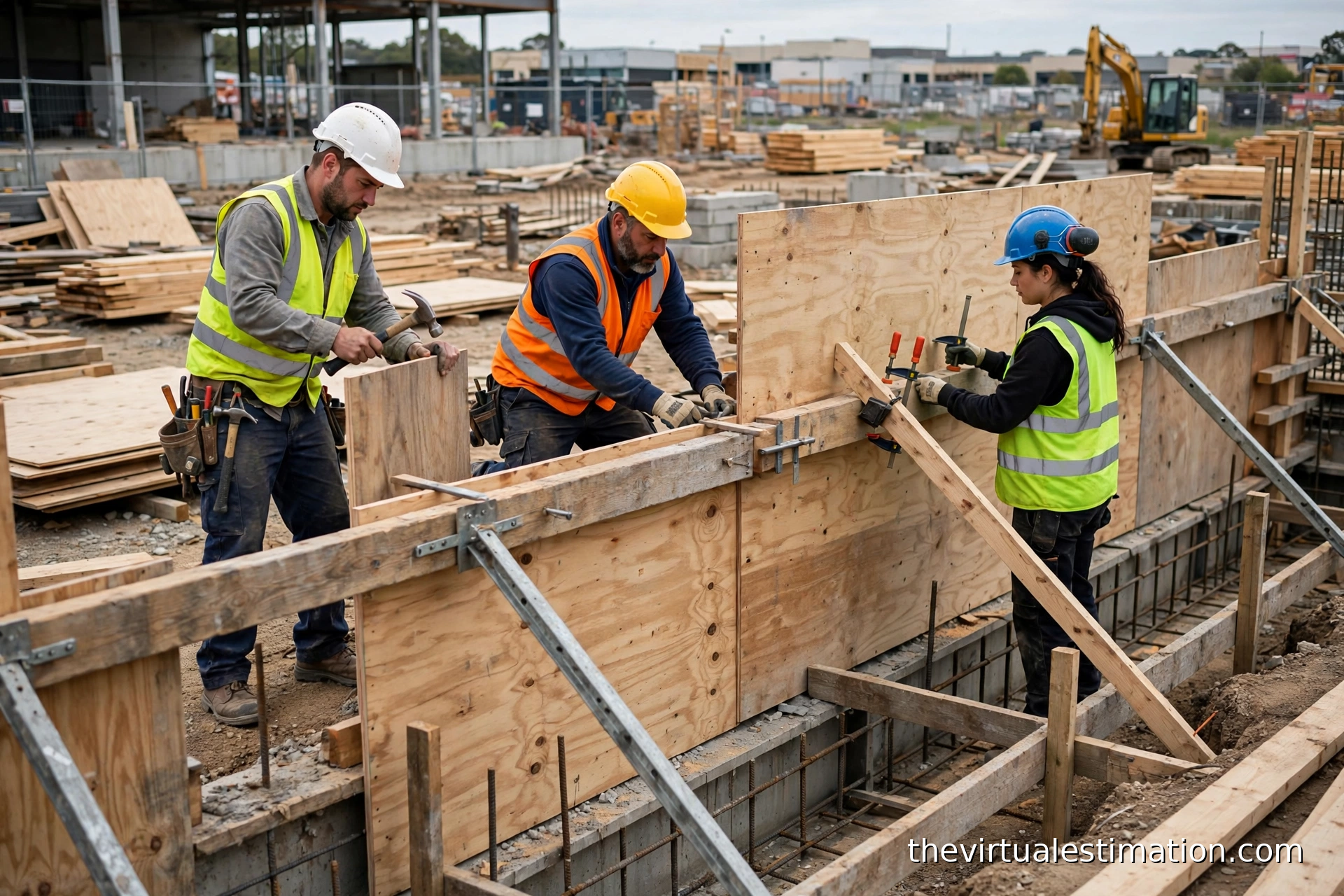
Forming is priced by the linear foot of edge form. Measure the complete perimeter of the slab including interior cuts around structures, openings, and columns. On a parking lot with a simple rectangular perimeter the forming is just the outer edge. On a complex site with islands, drain basins, and utility cutouts, the interior forming adds significantly to the linear footage.
Edge form height matches the slab thickness plus any grade variation the crew needs to accommodate. A 4 inch slab poured on a site with 2 inches of grade variation from one end to the other requires forms set slightly below grade at the high end to avoid a reveal at the edge. These adjustments take time and need to be accounted for in the labor rate.
Radius forming for curvilinear driveways, roundabouts, and landscaped islands takes two to three times longer to set than straight forming. If the project has significant curved edges, estimate the radius forming separately at a higher labor rate per linear foot.
Reinforcing Steel and Wire Mesh
The structural drawings or specification defines the reinforcing requirement for each slab type.
Residential driveways and sidewalks typically use 6x6 W1.4xW1.4 welded wire fabric. Measure the slab area and order sheets with 10 percent overlap allowance. Wire fabric is sold in 5 foot by 10 foot sheets or in rolls. For large areas, rolls are more economical and install faster.
Commercial slabs typically use rebar at 18 inch centers each way or heavier depending on the loading. Calculate the rebar quantity using the same approach in the rebar estimating guide. Bar spacing, laps, and edge bars add 15 to 20 percent to the theoretical grid quantity on most flatwork applications.
Heavy industrial slabs, airport aprons, and slabs designed for forklift traffic often use fiber reinforced concrete, post-tensioning, or both. Each of these changes the material scope significantly. Fiber is a concrete admixture priced per cubic yard of concrete. Post-tensioning adds tendons, dead end anchors, live end anchors, and a stressing operation after the concrete reaches specified strength.
Joints
Joints are the most commonly underestimated scope item in flatwork. Every slab needs them and every type has a different cost.
Contraction joints prevent random cracking by creating planned weak points where the slab will crack in a straight line. On residential driveways, they are typically cut with a saw or tooled with a jointing tool during finishing. On commercial parking lots and warehouse floors, they are saw-cut after the concrete has hardened enough to cut cleanly without raveling, typically 4 to 24 hours after placement depending on the mix and the ambient temperature.
Saw cutting is priced by the linear foot. Measure the total joint spacing grid. A 10,000 square foot parking lot with joints at 15 foot spacing has 10,000 divided by 15, which equals 667 linear feet of joint in each direction, or approximately 1,333 linear feet total. At $1.50 to $2.50 per linear foot for saw cutting, this adds $2,000 to $3,300 to the job. That does not come out of nowhere.
Isolation joints separate the slab from fixed structures such as building foundations, columns, walls, and curbs. They prevent the slab from cracking the building when it moves from thermal expansion and contraction. Measure the linear footage of every fixed structure the slab pours against and price fiber expansion joint material at that footage.
Construction joints occur where pours end and new pours begin. On large parking lots poured in multiple sections, every construction joint needs to be priced including the keyway form, the dowel bars if specified, and any load transfer plate assemblies.
Curing and Surface Sealer
Concrete loses moisture quickly in hot or windy conditions. Loss of moisture before the concrete reaches design strength causes surface dusting, cracking, and reduced wear resistance.
Curing compound is the standard method for commercial flatwork. Measure the slab area and apply the product coverage rate from the data sheet, typically 200 to 300 square feet per gallon. Add the application labor curing compound is applied immediately after finishing by pump sprayer at a rate of 3,000 to 5,000 square feet per hour per worker.
On flatwork specified to receive traffic coating, penetrating sealer, or decorative overlay, the curing compound must be compatible with the subsequent coating. Some coating systems require a curing and sealing compound applied as one product. Confirm the specification before pricing the curing system.
Concrete Finishing: Where Most Labor Estimates Fail
The finish specification determines labor cost more than any other single factor in flatwork estimating.
Broom finish is the standard exterior finish for sidewalks and driveways. After strike-off and floating, the finisher drags a broom across the surface while the concrete is still plastic. A skilled crew finishes 800 to 1,200 square feet per person per hour for standard broom finish on a flat, unobstructed slab.
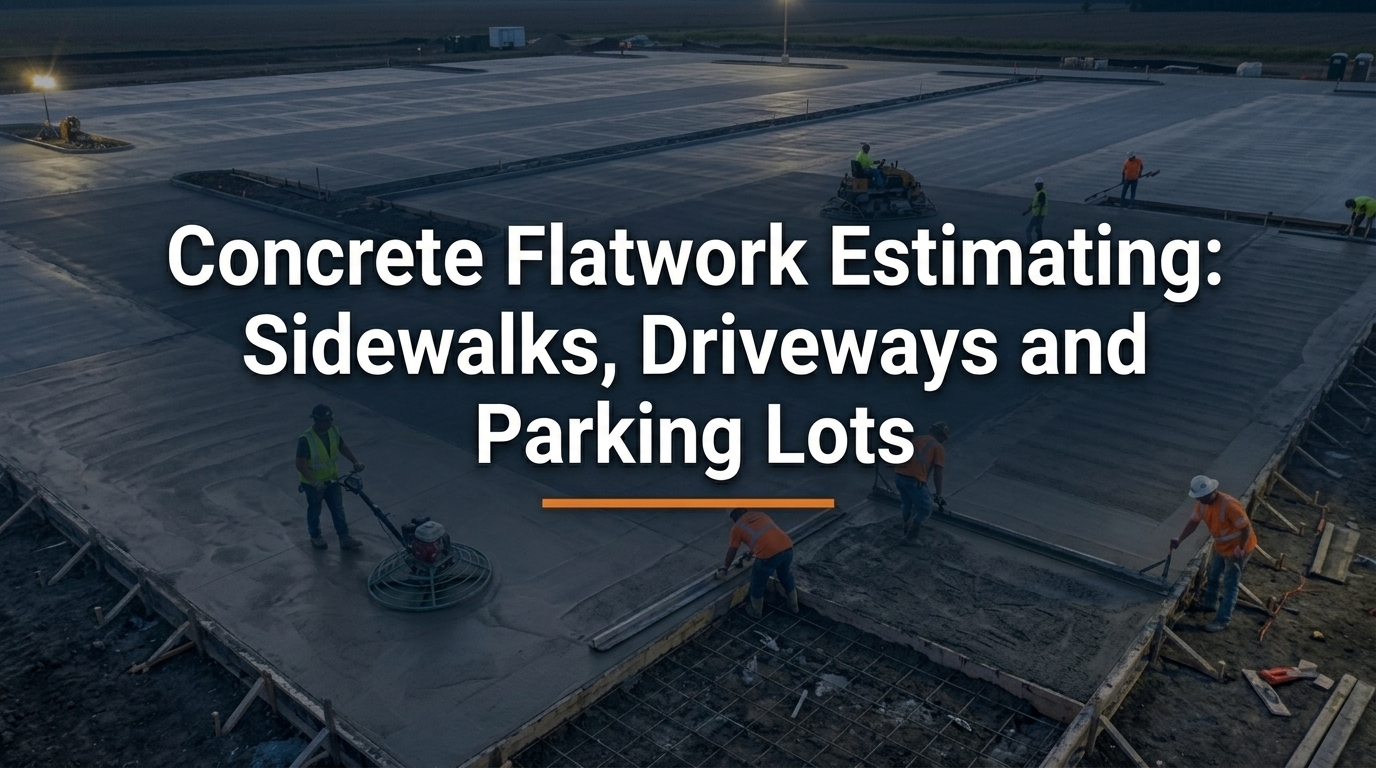
Power trowel finish is required for warehouse floors, commercial slabs, and any interior slab receiving a floor covering or coating. It requires multiple passes with a ride-on or walk-behind trowel after the bleed water evaporates. First pass is a float pass to consolidate the surface. Subsequent passes tighten and harden the surface. Total troweling time runs 45 to 90 minutes per 1,000 square feet depending on the mix design, the ambient conditions, and the specified flatness and levelness tolerances.
Exposed aggregate finish, stamped concrete, or colored concrete each add labor beyond the base finishing operation. Exposed aggregate requires a retarder applied before placement, pressure washing after the surface sets, and protective sealer after washing. Stamped concrete requires pattern tools, release agent, and a sealer coat. Color requires integral color in the mix and sometimes a hardener on the surface. Price each decorative process as a separate scope item.
F-number specifications on warehouse floors represent the most demanding finish work in flatwork. An FF35 floor flatness specification requires careful screed setup, immediate grinding of any high spots, and final survey and certification by a licensed professional. The tighter the specification, the more passes the finishing crew makes and the more quality control stops are built into the work. A warehouse floor specified at FF25 finishes 25 to 30 percent faster than the same floor specified at FF50.
Concrete Pumping
If the concrete cannot be placed directly from the truck chute, include a pump. This is the item most often forgotten in concrete estimates until the day of the pour.
Line pump: suitable for most slabs, fits on a trailer, lower mobilization cost, maximum horizontal reach approximately 1,000 feet. Mobilization runs $400 to $800. Pumping runs $125 to $200 per hour.
Boom pump: required for elevated slabs, for pours over obstacles, or where the line pump cannot reach. Mobilization runs $800 to $1,500. Pumping runs $175 to $350 per hour.
Calculate pump time from the pour volume divided by the pump output rate, typically 40 to 80 cubic yards per hour for a line pump. Add 30 minutes for setup, 15 minutes for washout, and 15 minutes for breakdown.
Labor Summary for Concrete Flatwork
Most estimators apply a total labor rate per square foot and call it done. That works for projects very similar to past work. It fails on projects with unusual conditions. Here is how to build the labor from the ground up:
Subgrade preparation and fine grading: 600 to 1,000 square feet per person per hour depending on equipment availability and site conditions.
Form setting: 100 to 200 linear feet per person per hour for straight forms. 40 to 80 linear feet per hour for radius forming.
Reinforcing placement: 200 to 400 square feet per hour for wire fabric. 150 to 300 square feet per hour for rebar grid.
Concrete placing and strike-off: 400 to 700 square feet per person per hour with pump placement. Less with direct chute placement on large open pours.
Floating and finishing: 800 to 1,200 square feet per person per hour for broom finish. 400 to 700 square feet per person per hour for power trowel finish.
Curing compound application: 3,000 to 5,000 square feet per person per hour.
Joint sealing after cure: 200 to 400 linear feet per person per hour including joint cleaning and sealant application.
Internal Links to Related Guides
Understanding how flatwork connects to adjacent scopes prevents gaps in your bid. The concrete estimating guide covers structural concrete quantities and mix design requirements that also apply to flatwork specifications. The foundation estimating guide covers the subgrade preparation and compaction that precedes most flatwork pours. The sitework estimating guide covers the site grading and aggregate base that the flatwork crew depends on being complete before their work starts.
For flatwork contractors across Texas, California, Florida, and every other state, visit our service areas page.
Frequently Asked Questions
How thick should a commercial parking lot slab be?
Standard commercial parking lots carrying passenger vehicles are designed at 4 to 5 inches with 6x6 wire mesh or rebar at 18 inches each way. Lots with regular truck traffic go to 6 inches. Heavy-duty truck courts and loading docks typically go to 8 inches with heavier rebar. Check the geotechnical report for subgrade bearing capacity before accepting the structural engineer's slab thickness recommendation.
What is the best way to estimate a residential driveway?
Measure the square footage. Figure the thickness from the specification or use 4 inches if no specification exists. Calculate cubic yards with 8 percent waste. Add your subgrade prep time, forming, reinforcing, placement, and finish labor. Price the concrete at the current local ready mix rate. The concrete material will be 40 to 55 percent of the total installed cost on most residential driveways.
How do you account for weather delays in a flatwork estimate?
Most contractors build weather contingency into their overhead and profit rather than as a separate line item. On large pours that cannot be delayed once concrete is in the truck, confirm the weather forecast within 48 hours and have a plan for hot weather or cold weather concrete that may affect the mix design and the finishing window. Some specifications require a hot weather or cold weather concrete plan to be submitted before work begins.
When does flatwork require a special inspection?
Concrete flatwork in commercial construction typically requires special inspection under the International Building Code for slabs on grade when the design compressive strength exceeds 5,000 psi or when structural slabs are involved. The special inspection cost is normally carried by the owner, but the contractor needs to allow access and schedule coordination time. Confirm inspection requirements from the project specifications before bid.