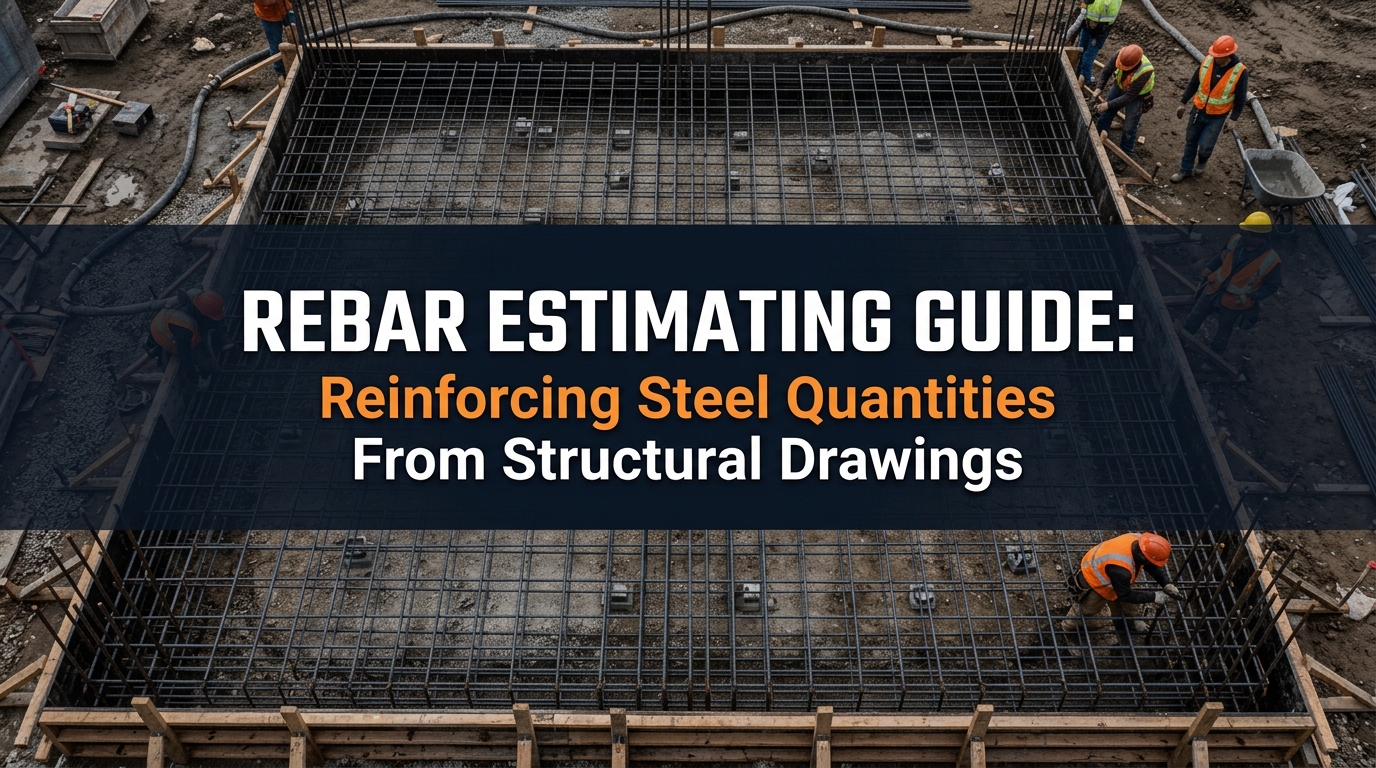
Reinforcing steel is one of the most calculation-intensive items in any concrete estimate. Unlike concrete, which you measure in cubic yards, or formwork, which you measure in square feet, rebar requires the estimator to work through dozens of individual bar types, sizes, spacings, and lengths before arriving at a final weight in tons. That final number is what gets priced, and getting it right requires a systematic approach to reading structural drawings.
Many contractors who do their own estimating undercount rebar because they focus on the main bars and overlook the ties, stirrups, hairpins, dowels, and temperature and shrinkage steel that add significantly to the total weight. On a large commercial project, missed rebar can represent tens of thousands of dollars in cost overrun that the contractor absorbs after the bid is awarded.
This guide covers the complete process of reading structural drawings for rebar, calculating bar quantities by element type, accounting for lap splices and development lengths, and converting linear footage to weight for pricing.
How Structural Drawings Communicate Rebar Requirements
Before measuring anything, a rebar estimator needs to understand how structural engineers communicate reinforcing requirements on drawings. The information is spread across multiple sheets and details, and missing any of it leads to an incomplete takeoff.
The general notes on the structural drawings are the starting point. These notes specify the default rebar coverage requirements, the standard lap splice lengths for each bar size, the development length requirements, the bar grade (typically Grade 60 in most US commercial construction), and any project-specific requirements that override the standard details.
The foundation plan shows the layout of footings, grade beams, pile caps, and mat slabs with the reinforcing callouts for each element. A typical callout reads something like 8 number 6 bars each way, which tells the estimator the bar count and size in each direction.
The reinforcing schedules, when provided, list every beam, column, and wall element by mark number with the complete reinforcing description for each. Not every project has a reinforcing schedule but when one is provided it significantly streamlines the takeoff.
The section details and elevation details show the reinforcing in cross-section views, which is where the estimator finds the stirrup spacing, tie configurations, bar placement within the element, and special conditions like increased spacing at ends versus midspan.
Rebar Bar Sizes and Their Weights
Every rebar estimator needs to know the standard bar sizes and their weights by heart because the weight conversion is done constantly throughout the takeoff. Rebar in the United States is designated by number, where the number approximates the bar diameter in eighths of an inch.
Number 3 bar is 0.375 inches in diameter and weighs 0.376 pounds per linear foot. Number 4 bar is 0.500 inches in diameter and weighs 0.668 pounds per linear foot. Number 5 bar is 0.625 inches in diameter and weighs 1.043 pounds per linear foot. Number 6 bar is 0.750 inches in diameter and weighs 1.502 pounds per linear foot. Number 7 bar is 0.875 inches in diameter and weighs 2.044 pounds per linear foot. Number 8 bar is 1.000 inches in diameter and weighs 2.670 pounds per linear foot. Number 9 bar is 1.128 inches in diameter and weighs 3.400 pounds per linear foot. Number 10 bar is 1.270 inches in diameter and weighs 4.303 pounds per linear foot. Number 11 bar is 1.410 inches in diameter and weighs 5.313 pounds per linear foot.
The estimator calculates the total linear footage of each bar size from the drawings, then multiplies by the weight per linear foot to get pounds, then divides by 2,000 to convert to tons. Rebar is purchased and priced by the ton, so this conversion is the final step in every rebar quantity calculation.
Calculating Slab Rebar: Top and Bottom Mats
Slabs are typically the largest rebar quantity item on most projects and the most straightforward to calculate. A reinforced concrete slab has a bottom mat of bars in two directions and often a top mat as well, plus additional bars at edges, openings, and reentrant corners.
The bottom mat calculation starts with the slab dimensions from the structural plan. For a slab that is 100 feet by 80 feet with number 5 bars at 12 inches on center each way in the bottom mat, the estimator calculates the bar count in each direction and the length of each bar.
In the long direction, bars run 80 feet. With 12 inch spacing across the 100 foot width, the bar count is 100 feet divided by 1 foot spacing plus 1, which gives 101 bars. Total length for the long bars is 101 bars times 80 feet, which equals 8,080 linear feet of number 5 bar.
In the short direction, bars run 100 feet. With 12 inch spacing across the 80 foot dimension, the bar count is 80 plus 1, which gives 81 bars. Total length for the short bars is 81 bars times 100 feet, which equals 8,100 linear feet of number 5 bar.
The top mat, if specified, is calculated the same way using the top mat bar size and spacing from the drawings. Top mat bars are often a smaller bar size than the bottom mat on residential slabs but may be the same size on commercial elevated slabs with high live load requirements.
Edge bars run around the perimeter of the slab and are measured by the total perimeter length. Additional bars at openings and reentrant corners are measured from the detail drawings showing their specific dimensions and placement.
Calculating Footing Rebar: Bottom Bars and Ties
Spread footings contain longitudinal bottom bars in two directions and sometimes ties or hairpin bars at the edges. The estimator uses the footing schedule to find the bar size and count for each footing type, then multiplies by the number of footings of that type from the foundation plan.
A typical footing schedule entry might read F3, 8 feet by 8 feet by 24 inches deep, 6 number 6 bars each way bottom. For that footing type the estimator calculates 6 bars each way times the bar length, which for an 8 foot square footing with 3 inch cover on each side is 8 feet minus 6 inches of cover, giving 7.5 feet per bar.
Six bars times 7.5 feet gives 45 linear feet per direction. Two directions gives 90 linear feet of number 6 bar per footing. If there are 24 footings of type F3 on the project, the total is 24 times 90, which equals 2,160 linear feet of number 6 bar just for the F3 footings.
The same calculation is repeated for every footing type. All linear footage totals for each bar size are accumulated across all footing types before converting to weight.
Continuous footings under walls use a different approach. The bars run longitudinally along the length of the footing and are measured by the total linear footage of the footing run. The number of bars comes from the detail drawing, which shows the cross section of the footing with bars at the bottom and sometimes at the top.
Calculating Wall Rebar: Vertical and Horizontal Bars
Foundation walls, shear walls, and retaining walls contain both vertical bars and horizontal bars, calculated separately.
Vertical bars are spaced at a specified interval across the length of the wall. To count them, the estimator divides the wall length by the bar spacing and adds one. For a 120 foot long wall with number 5 vertical bars at 12 inches on center, the bar count is 120 divided by 1 foot plus 1, giving 121 bars. Each vertical bar runs from near the bottom of the footing to near the top of the wall. For a wall that is 10 feet tall with 3 inch cover top and bottom, each bar is 9.5 feet long. Total vertical bar length is 121 bars times 9.5 feet, giving 1,149.5 linear feet of number 5 bar.
Horizontal bars are spaced at a specified interval up the height of the wall. The bar count is the wall height divided by the spacing plus one. For a 10 foot tall wall with number 4 horizontal bars at 18 inches on center, the bar count is 10 feet divided by 1.5 feet plus 1, giving approximately 8 bars. Each horizontal bar runs the full length of the wall, so 8 bars times 120 feet gives 960 linear feet of number 4 bar.
Walls with openings require the estimator to subtract bars that would fall within the opening and add the additional bars that frame around the opening. The detail drawings show the additional bars required at opening edges, corners, and lintels.
Lap Splices and Development Lengths: Why They Add More Bar Than You Think
One of the most significant sources of underestimation in rebar takeoffs is the failure to account for lap splices and development lengths. These requirements add bar length beyond the theoretical dimension of the element.
A lap splice occurs wherever two bars overlap to transfer force from one to the other. In practice, rebar is manufactured in standard lengths of 20 and 40 feet, so any element longer than the available bar length requires a splice. The splice length depends on the bar size, the concrete strength, the bar location in the element, and whether the splice is a tension or compression splice.
For Grade 60 number 5 bars in normal weight concrete with 4,000 psi compressive strength, a Class B tension lap splice is approximately 36 bar diameters. A number 5 bar has a diameter of 0.625 inches, so 36 times 0.625 gives a splice length of 22.5 inches, which rounds to 2 feet of additional bar per splice.
For a 120 foot long wall using 20 foot bars, there are 6 bars end to end with 5 splices per horizontal bar layer. Five splices times 2 feet per splice equals 10 additional feet of bar per horizontal layer, which adds roughly 5 to 8 percent to the theoretical quantity for horizontal wall bars alone.
Development lengths add bar at the ends of elements where bars must extend a minimum distance past the point where they are no longer theoretically needed. At the base of a wall where vertical bars dowel into the footing, the bars extend down into the footing by the development length and up the wall by the splice length to connect with the wall bars above. Both extensions add bar beyond what the nominal dimensions suggest.
Column Rebar: Longitudinal Bars, Ties and Spirals
Columns contain two types of reinforcing that must be estimated separately. Longitudinal bars run the full height of the column and carry the primary axial and flexural loads. Ties or spirals wrap around the longitudinal bars at regular intervals to provide confinement and shear resistance.
Longitudinal bar quantities come directly from the column schedule, which lists the number and size of bars for each column mark. The length of each bar is the column height plus the splice length at the top where bars connect to the floor above.
Ties are closed rectangular hoops made from smaller bar, typically number 3 or number 4. The tie size and spacing comes from the column schedule or the general reinforcing details. The estimator calculates the perimeter of the tie from the column dimensions minus cover on each side, then adds a standard hook extension of approximately 12 bar diameters on each end where the tie closes.
For a 16 inch square column with 1.5 inch cover on each side, the tie perimeter is 4 times 13 inches, which gives 52 inches plus two hook extensions. If the hooks are 4 inches each, the total tie length is 60 inches or 5 linear feet per tie. With ties at 6 inch spacing in a 10 foot column, the tie count is 10 feet times 12 inches per foot divided by 6 inch spacing, giving 20 ties per column. Twenty ties times 5 linear feet each gives 100 linear feet of number 3 bar per column.
Beam Rebar: Bottom Bars, Top Bars, Stirrups and Torsion Bars
Beams require the most complex rebar calculation of any element because they contain multiple bar types with different spacing patterns along the length of the beam.
Bottom bars carry tension at midspan. Top bars carry tension at supports. Both run longitudinally and are measured by the beam length plus development extensions at each end. The beam schedule or the framing plan notes specify the bar size and count at midspan and at the supports.
Stirrups run perpendicular to the beam axis and provide shear reinforcement. Their spacing typically varies along the length of the beam, with closer spacing near the supports where shear is highest and wider spacing near midspan. The structural drawings show this variation with a callout that might read number 4 stirrups at 4 inches for the first 2 feet from each support, then at 8 inches for the remaining span.
The estimator calculates the stirrup count in each zone separately, then calculates the perimeter of each stirrup based on the beam dimensions minus cover. Hook extensions are added for the closed stirrup configuration. Total stirrup length per beam is added up and converted to weight.
Waste and Cutting Loss: The Final Adjustment
After calculating all theoretical bar quantities, the estimator adds a waste factor to account for cutting loss, field adjustments, and the practical reality that bars are ordered in standard lengths and cut to size on site.
Waste factors for rebar typically run 3 to 7 percent depending on the complexity of the element and the variety of bar lengths required. A simple slab with long uniform bars might need only 3 percent waste. A complex structural frame with many different bar lengths and a high proportion of short bars might need 7 to 10 percent to account for cutting waste from standard length stock.
The waste factor is applied to the total linear footage before the weight conversion so that the final tonnage already includes the additional material needed for waste.
Converting Linear Footage to Tons for Pricing
Once all bar quantities are calculated by size and the waste factor is applied, the estimator converts each bar size from linear feet to pounds using the weight per foot values listed earlier, then divides by 2,000 to get tons.
The total weight in tons for each bar size is listed separately in the estimate because rebar is often priced differently by size, with smaller bars sometimes carrying a premium over the base price for larger stock bars. The estimator gets current pricing from local rebar suppliers or fabricators and applies the appropriate rate per ton for each bar size.
Fabricated rebar, which is cut and bent to specific shapes at a fabricating shop, costs more per ton than straight bar cut in the field. If the specifications or the project complexity require shop-fabricated cages or bent bars, the estimator needs to account for the fabrication premium in the pricing.
Frequently Asked Questions
What is the most common mistake in rebar estimating? Forgetting lap splices and development lengths is the most common and costly mistake. Estimators who measure bar lengths based purely on element dimensions without adding splice and development extensions consistently undercount rebar quantities by 8 to 15 percent on complex structural frames.
Should ties and stirrups be estimated in the same unit as main bars? Yes. All rebar, regardless of type, is ultimately converted to weight in tons for pricing. Ties and stirrups are calculated in linear feet of the appropriate bar size, converted to pounds, and added to the main bar quantities of the same size before totaling.
How do I handle rebar when the structural drawings show alternate bar sizes? Alternate bar sizes are common where the engineer provides two acceptable options such as number 6 bars at 9 inches or number 5 bars at 6 inches. The estimator should price the option that is more economical for the project conditions, which usually means less labor intensive installation rather than simply the lighter bar.
Is rebar typically included in the concrete subcontract or bid separately? On most commercial projects, the reinforcing steel is a separate trade contract from the concrete placement. The rebar contractor furnishes and installs the steel while the concrete contractor places and finishes the concrete. On smaller residential projects the concrete contractor often handles both. The estimator needs to confirm the division of responsibility before assigning rebar to a trade in the estimate.