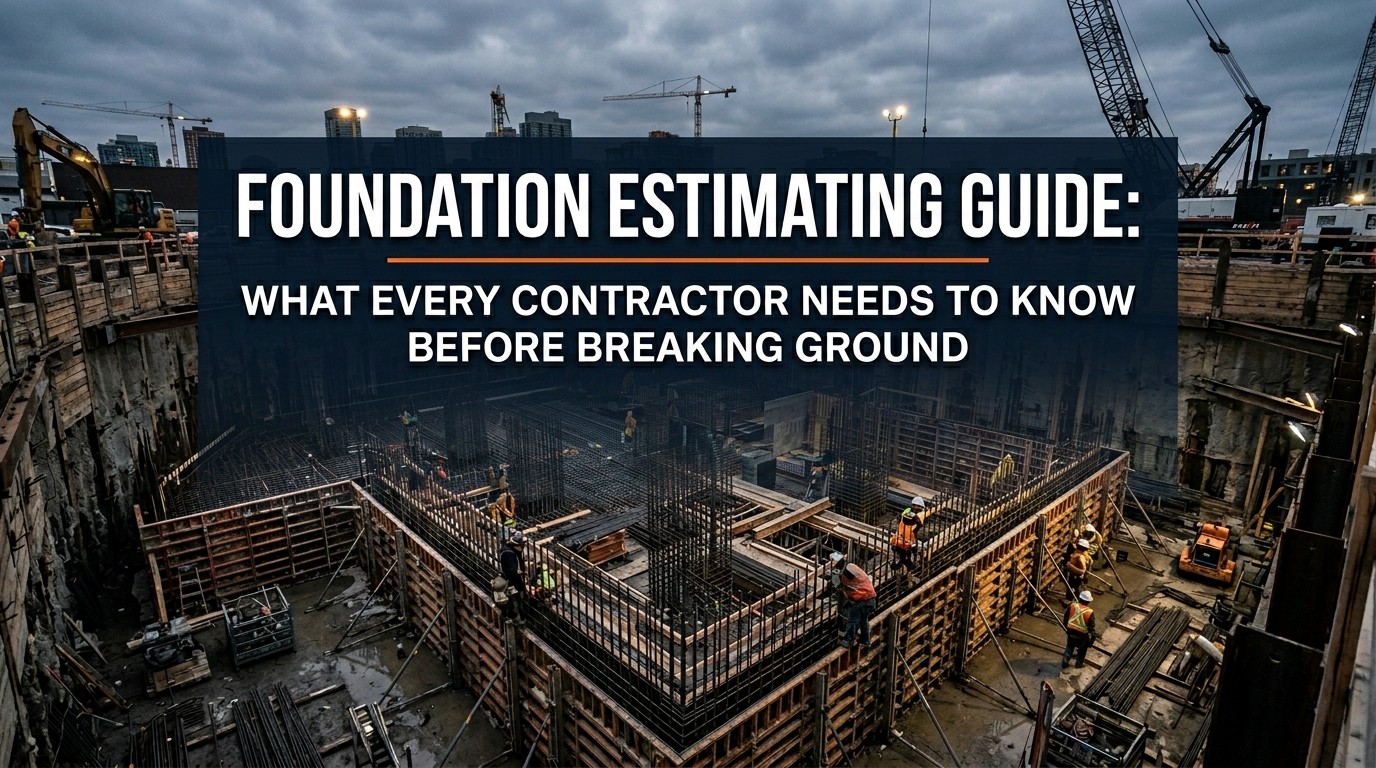
The foundation is the first major cost commitment on any construction project and one of the most consequential items in any estimate. Get it right and the project starts on solid financial footing. Miss key scope items and the contractor absorbs cost overruns before a single wall goes up.
Foundation estimating is challenging not because the math is complicated but because the scope is broad. A complete foundation estimate touches multiple trades and disciplines simultaneously. It includes earthwork, concrete, reinforcing steel, formwork, drainage, waterproofing, and sometimes deep foundation systems like piles or piers. Every one of those items has its own measurement method, its own pricing variables, and its own potential for error.
This guide covers how professional estimators approach foundation takeoffs from the ground up, what drawings and information they rely on, and how each component of a foundation system gets measured and priced for an accurate bid.
Understanding Foundation Types and What Each Requires in an Estimate
Before measuring anything, a foundation estimator identifies what type of foundation system the project uses. The foundation type determines which components need to be estimated and in what quantity.
Shallow foundations include spread footings, continuous wall footings, mat slabs, and slab on grade. These are the most common foundation types for residential and light commercial construction and involve excavation to a relatively shallow depth, concrete placement, and backfill.
Deep foundations include driven piles, drilled piers, caissons, and helical piers. These systems transfer building loads past weak upper soils to more competent material deeper in the ground. Deep foundations are more expensive and involve specialized subcontractors and equipment not found on shallow foundation projects.
Basement foundations add the complexity of below grade walls, waterproofing systems, drainage, and often temporary shoring or bracing during construction. A basement estimate has considerably more line items than a simple spread footing estimate.
The foundation type is determined by the structural engineer based on soil conditions from the geotechnical investigation report. That report is critical reading for any foundation estimator because it describes the soil bearing capacity, groundwater level, and any special requirements that affect cost.
Excavation: The First and Most Variable Line Item
Excavation is almost always the first line item in a foundation estimate and one of the most difficult to price with precision from drawings alone. The drawings tell you how deep and wide the excavation needs to be. The geotechnical report tells you what you will find when you start digging.
The basic excavation volume calculation is straightforward. For a spread footing, the estimator measures the footing plan dimensions and adds working space around the form on each side, typically 18 to 24 inches. The depth comes from the bottom of footing elevation shown on the foundation plan. Length times Width times Depth gives the cubic feet of excavation, divided by 27 for cubic yards.
For a basement or below grade wall, the excavation includes the full footprint of the basement plus working space for forming the outside of the foundation walls, typically 3 to 4 feet outside the wall face. The estimator also accounts for the slope or shoring of the excavation walls, which affects the total volume considerably.
Soil type drives the equipment selection and productivity rate that determines labor cost. Loose sandy soil excavates quickly. Dense clay, weathered rock, or cobbles slow production significantly and may require specialized breaking equipment or blasting, both of which add substantial cost.
The geotechnical report is the estimator's best tool for anticipating soil conditions. If the report identifies rock at 8 feet below grade and the footings are 6 feet deep, rock excavation may not be an issue. But if the footings go to 10 feet, rock removal becomes a line item that can easily double or triple the excavation cost.
Dewatering is another excavation related cost that appears when groundwater is present above the bottom of excavation level. The geotechnical report shows the groundwater depth. If construction requires working below that level, the estimate needs to include well points, sump pumps, or other dewatering measures.
Spread Footings and Continuous Footings: Measurement and Pricing
Spread footings support individual columns and are measured from the foundation plan and footing schedule together. The plan shows where each footing is located and what footing mark it carries. The schedule shows the dimensions of each footing mark.
The estimator counts each footing type from the plan and calculates the concrete volume for each type using the schedule dimensions. All footing concrete volumes are added together and adjusted for waste, typically 5 to 8 percent for footings.
Continuous footings support walls and are measured by linear foot from the foundation plan. The cross-section dimensions come from the footing detail or foundation section. Length times Width times Depth gives the volume per linear foot, multiplied by total linear footage and converted to cubic yards.
Both spread and continuous footings require the estimator to also calculate the reinforcing steel separately. The reinforcing schedule or general notes on the structural drawings specify the bar size and spacing. The estimator calculates the total weight of reinforcing steel in tons, which is how rebar is priced from suppliers and subcontractors.
Forming spread footings in open excavation is often done with compacted earth forms rather than wood or steel forms, which eliminates the formwork cost for many footing situations. But when soil conditions do not allow earth forming, or when the footing is above grade, the estimator adds the formwork cost at the appropriate rate per square foot of contact area.
Foundation Walls: Forming, Reinforcing and Concrete
Foundation walls require the estimator to coordinate information from the foundation plan, the wall sections, the wall schedule if one exists, and the reinforcing details.
The plan view shows the layout of the walls. The sections show the wall thickness and height at each location. The estimator measures the total linear footage of each wall type and calculates the concrete volume using the height and thickness from the sections.
Forming foundation walls is a significant cost item. Both faces of the wall require forming, so the total form contact area is twice the wall face area. An 8 inch thick wall that is 8 feet tall and 100 feet long has 1,600 square feet of total form contact area. The estimator prices this based on whether ganged forms or hand-set panel forms are most appropriate for the project conditions.
Form ties hold the two faces of the wall forms together. The count is calculated based on the wall area and the standard tie spacing, typically 2 feet on center each way. Snap ties and through ties are priced differently and the specification may call for a specific tie type if waterproofing is required.
Reinforcing steel in foundation walls is calculated from the vertical and horizontal bar schedules shown on the structural drawings. Vertical bars are counted by spacing and wall length. Horizontal bars are counted by spacing and wall height. Both dimensions and bar sizes come from the drawings and the estimator converts the total bar length for each size to weight in tons for pricing.
Basement Waterproofing and Drainage Systems
Any foundation element that is below grade in contact with soil requires waterproofing or at minimum a dampproofing treatment. The type and extent of waterproofing is specified in the project specifications and affects the estimate significantly.
Dampproofing is the most basic treatment, typically a spray or roll applied asphalt emulsion applied to the exterior face of the foundation wall. It costs relatively little and is measured in square feet of wall area.
Positive side waterproofing is a fully waterproof membrane system applied to the exterior of the foundation wall before backfill. Options include self-adhered sheet membranes, bentonite panels, crystalline coatings, and torch-applied membranes. Each system has a different cost per square foot and a different installation labor requirement.
Drainage board or protection board is installed over the waterproofing membrane to protect it during backfill and to provide a drainage plane for groundwater to reach the perimeter drain. It is measured in square feet of wall area.
Perimeter foundation drains are measured in linear feet around the building perimeter. The drain tile or perforated pipe is laid at the base of the footing and covered with drainage aggregate. The estimator measures the perimeter from the plan and prices the drain pipe, aggregate, filter fabric wrap, and the cleanout access points.
Interior drainage systems for basement construction add another layer of scope including interior french drains, sump pits, and sump pumps. These are common on residential basement projects and must be estimated separately from the exterior system.
Slab on Grade: Connection to Foundation
In most residential and commercial projects, the slab on grade is either part of the foundation estimate or closely related to it. The slab sits on the prepared subgrade inside the foundation walls and must be estimated in coordination with the foundation scope.
Key items in the slab estimate include the subgrade preparation including compaction and testing, the granular fill or crushed stone base course, the vapor barrier, the concrete volume, the reinforcing steel or fiber, the concrete finishing, and the curing.
The slab thickness comes from the structural drawings. On residential projects it is typically 4 inches. On commercial and industrial projects it ranges from 5 to 8 inches depending on the loading requirements. Equipment pads and thickened edges add to the concrete volume and must be measured separately.
The estimator coordinates the slab scope carefully with the foundation scope to avoid double-counting or missing items at the interface. The top of the foundation wall, the slab edge treatment, and any embedded items like anchor bolts and conduit sleeves are often the source of scope gaps between the foundation contractor and the slab contractor.
Pier and Beam Foundations: Residential Post and Beam Estimating
Pier and beam foundations are common in residential construction in certain regions of the United States, particularly in Texas, the Gulf Coast, and other areas with expansive clay soils. The foundation consists of concrete piers drilled into the ground to a stable bearing stratum, supporting grade beams that carry the floor framing above.
Estimating a pier and beam foundation requires the estimator to count the piers from the foundation plan and calculate the volume of each pier based on its diameter and depth. Piers are typically drilled by a specialty subcontractor using an auger rig, so the cost is often obtained as a subcontractor lump sum or unit price per pier rather than calculated from raw material costs.
Grade beams connecting the piers are measured by linear foot. The cross section dimensions come from the structural details. Grade beams are typically formed with wood or metal beam forms and contain significant reinforcing steel.
The crawl space within a pier and beam foundation requires ventilation and often a ground cover moisture barrier. These items are measured and priced as part of the foundation scope.
Deep Foundation Systems: Piles and Drilled Piers
When soil conditions near the surface cannot support the building loads, deep foundation systems carry the loads to more competent material at greater depth. Deep foundations are almost always installed by specialty subcontractors with specialized equipment, so the foundation estimator typically prices these as subcontract line items obtained through competitive bidding.
The estimator still needs to understand the scope to write an accurate scope letter and evaluate subcontractor bids. Driven pile estimates require knowing the pile type, the design load per pile, the pile length, the pile count from the foundation plan, and the pile cap configuration for each column.
Drilled pier or caisson estimates require the pier diameter, the pier depth to bearing stratum, the reinforcing cage configuration, and whether the pier will be poured dry or using temporary casing in groundwater conditions.
The estimator also includes the cost of pile load testing if the specifications require it, which is common on larger commercial projects with deep foundation systems. Testing costs are separate from the installation cost and can be significant.
Backfill and Compaction: The Final Foundation Line Item
After the foundation walls are formed, poured, stripped, and waterproofed, the excavation is backfilled. Backfill estimating is frequently underestimated because it involves both material and compaction labor.
The backfill volume is calculated as the excavation volume minus the volume occupied by the foundation walls and footing concrete. The remaining void is filled with either the excavated native material if it is suitable or with imported granular material if the native soil is not suitable for backfill per the specifications.
Compaction is performed in lifts, typically 8 to 12 inches of loose material per lift, with compaction equipment making multiple passes. The number of lifts and the equipment type depend on the depth of backfill and the soil type. The estimator calculates the total number of lifts and the equipment hours required to complete the compaction.
Compaction testing by a special inspector is often required by the specifications and by the local building code. The cost of this testing is usually carried by the owner or general contractor but the foundation contractor needs to allow for cooperation with the inspector and potential rework if test failures occur.
Frequently Asked Questions
What is the most commonly missed item in foundation estimates? Dewatering is the most frequently missed or underestimated item. Contractors who do not read the geotechnical report carefully often discover groundwater during excavation with no allowance in the estimate for pumping equipment and the slower production that comes with wet conditions.
How do soil conditions affect foundation cost? Soil conditions affect both the excavation cost and the foundation system selection. Rock excavation can cost 5 to 10 times more than earth excavation. Expansive clay soils require deeper footings or special foundation types. Loose fills require removal and replacement before footings can be placed. None of these conditions are visible from drawings alone, which is why reading the geotechnical report is essential.
Should foundation waterproofing be in the foundation estimate or a separate scope? On most projects the foundation contractor includes the waterproofing and drainage as part of their scope. On larger commercial projects a specialty waterproofing subcontractor may handle it separately. The estimator needs to confirm the division of scope clearly in the bid documents to avoid gaps or overlaps.
How accurate can a foundation estimate be before soil conditions are confirmed? With a geotechnical report and complete foundation drawings, a professional estimator can achieve 90 to 95 percent accuracy. Without a geotechnical report the accuracy drops significantly because soil conditions are the largest variable in foundation cost.