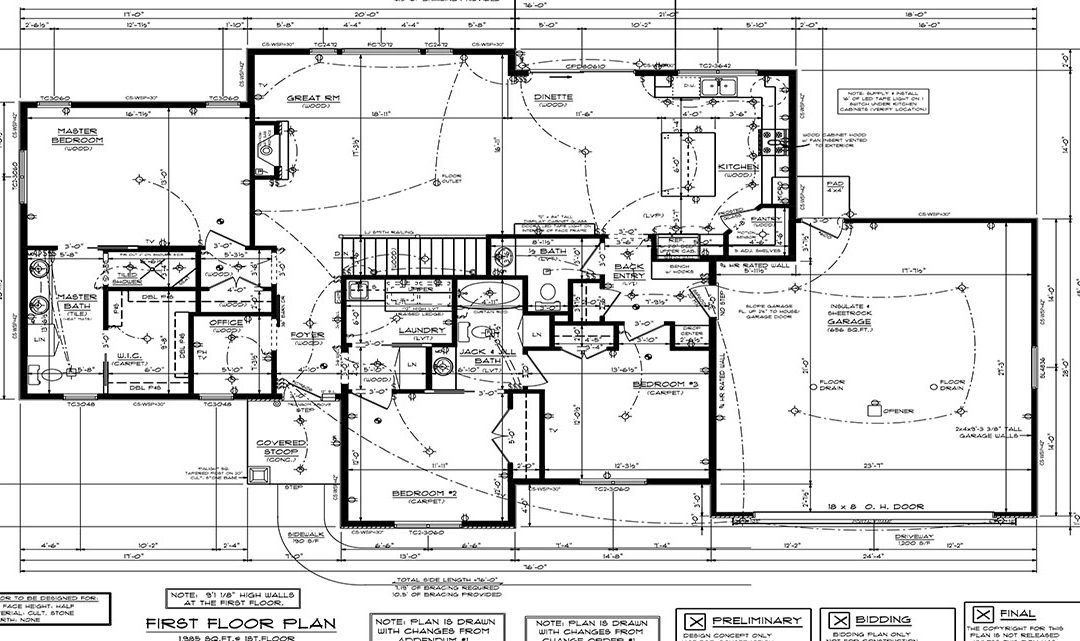
The Contractor’s Masterclass: A Comprehensive Guide to Construction Cost Estimation, Overhead, and Profitability
Admin
November 27, 2025

In the United States construction industry, there is a grim statistic that haunts the sector: nearly 60% of construction businesses fail within their first five years.
Why does this happen? Is it because they don't know how to frame a wall, pour concrete, or wire a panel? Rarely. Most contractors start their businesses because they are exceptional tradespeople. They fail because the business side of construction—specifically the math of construction cost estimation—is unforgiving.
If you bid too high, you starve for lack of work. If you bid too low, you starve while working yourself to death. The "sweet spot" in the middle isn't luck; it's a science.
At The Virtual Estimation, we believe that financial literacy is just as important as blueprint literacy. This comprehensive guide is designed to be your roadmap. We are going to dismantle the estimation process, expose the hidden costs that eat your profit, and provide the strategies you need to bid with absolute confidence.
Part 1: The Anatomy of a Perfect Estimate
A construction estimate is not a guess. It is a calculated prediction of the probable cost of a project. To create a winning bid, you must understand the three distinct layers of costs that make up your final number.
1. Direct Costs (The "Hard" Costs)
These are the costs that are directly attributed to the physical construction of the project. If the project didn't exist, these costs wouldn't exist.
- Materials: This includes everything from the lumber and steel to the screws and glue. It must include waste factors (which we will discuss later).
- Labor: This is the most volatile cost. It includes the hourly wages of the crew actively working on the site.
- Equipment: The cost to rent machinery (cranes, excavators) or the allocated depreciation and operating cost of equipment you own.
- Subcontractors: The firm fixed prices provided by your trade partners (electrical, plumbing, HVAC).
2. Indirect Costs (Job Site Overhead)
These are costs required to run the specific project but aren't part of the physical building. Contractors often forget these, leading to profit bleed.
- Site Supervision: The salary of your superintendent or project manager.
- Temporary Utilities: Power, water, and internet for the job site trailer.
- Safety & Security: Fencing, cameras, PPE, and signage.
- Permits & Inspections: Local municipality fees.
- Cleanup: Dumpster rentals and haul-away fees.
3. General Overhead (Office Overhead)
This is the silent killer. These are the costs of running your business regardless of whether you land a job today or not.
- Office rent and utilities.
- Executive salaries and administrative staff.
- Marketing and advertising.
- Insurance (General Liability, Workers' Comp).
- Software subscriptions (Estimating, Accounting, Project Management).
- Legal and CPA fees.
Key Takeaway: If your estimate only covers Direct Costs, you are paying for the privilege of building someone else's house. You must recover your Indirect Costs and General Overhead in every single bid.
Part 2: Methods of Estimation – Why "Stick Estimating" Wins
There are several ways to arrive at a number. However, as professional estimators, we strongly advocate for one specific method for accurate bidding.
1. The Square Foot Method (The Dangerous Shortcut)
This involves taking the total square footage of a project and multiplying it by a historical cost factor (e.g., "$200 per sq. ft.").
- Pros: Fast. Good for a Rough Order of Magnitude (ROM) or a ballpark number during an initial client meeting.
- Cons: Extremely inaccurate for a final bid. It ignores site conditions, finish levels, and structural complexities. A 2,000 sq. ft. house with marble floors and complex rooflines costs vastly more than a 2,000 sq. ft. box with vinyl flooring, yet the "square foot method" treats them similarly.
2. The Unit Cost Method
This breaks the project down into assemblies (e.g., "linear feet of wall"). The estimator applies a unit price that includes materials and labor for that assembly.
- Pros: Faster than detailed itemization.
- Cons: Can hide details. If the unit price database isn't updated monthly, you might be using 2023 labor rates in a 2025 market.
3. The Stick Estimating Method (The Gold Standard)
This is the method The Virtual Estimation utilizes for our clients. It involves counting every single piece of material (every "stick" of wood, every brick, every wire nut) and calculating the exact labor hours required to install them.
- The Process: We analyze the blueprints line by line. We count the studs, headers, and plates. We calculate the cubic yards of concrete. We determine the exact number of drywall sheets.
- Why it Wins: It is the only way to get a "Class 1" Estimate (accuracy within +/- 5%). It allows you to shop for specific material prices and apply your crew's specific productivity rates. It minimizes risk because nothing is assumed; everything is counted.
Part 3: The Mathematics of Profit – Markup vs. Margin
If you take only one thing away from this article, let it be this section. Misunderstanding the difference between Markup and Margin is the #1 reason contractors hit their revenue goals but still have no cash in the bank.
These terms are not interchangeable.
The Scenario
Let’s say your Total Cost (Direct + Indirect + Overhead) to build a deck is $10,000.
You want to make a 20% profit.
The Mistake (Using Markup incorrectly)
You calculate 10,000 x 12,000 Bid Price
You think you have a 20% margin. You are wrong.
Let's check the math:
- Price: $12,000
- Cost: $10,000
- Profit: $2,000
Margin Calculation: Profit ( 2 , 000 ) ÷ P r i c e ( 2,000)÷Price( 12,000) = 16.6% Margin
You thought you were making 20%, but you’re actually making 16.6%. Over a year of 1Minrevenue, thatmatherrorcostsyou 34,000 in pure profit.
The Correct Way (Calculating Margin)
If you want a 20% Margin, you must divide by the inverse
- Formula: Cost ÷ (1 - Desired Margin Percentage)
- Calculation: $10,000 ÷ (1 - 0.20)
- Calculation:10,000÷0.80 = 12,500 Bid Price
Now check the math:
- Price: $12,500
- Cost: $10,000
- Profit: $2,500
- Margin Calculation: $2,500 ÷ $12,500 = 20% Margin.
The Bottom Line: Always bid based on Margin, not Markup, if you want to hit your financial targets.
Part 4: Calculating Your Overhead Burden
How do you know how much to charge for overhead? You cannot just guess "10%." You need to calculate your specific Overhead Burden Rate.
Step 1: Calculate Annual Overhead
Add up every expense your company has that isn't tied to a specific job (Rent, Insurance, CEO Salary, Truck payments, Marketing). Let's say this totals $200,000 per year.
Step 2: Calculate Annual Revenue or Direct Costs
Let's say you plan to do $2,000,000 in sales this year.
Step 3: Determine the Percentage
$200,000 (Overhead) ÷ $2,000,000 (Sales) = 10%.
This means 10 cents of every single dollar you collect goes just to keeping the lights on. If you price a job with a 10% margin, you are making zero profit. You are breaking even.
To make a real 10% Net Profit, you would need to charge:
- Job Cost + 10% (Overhead Recovery) + 10% (Net Profit) = 20% Gross Margin.
At The Virtual Estimation, when we prepare bids for General Contractors, we break these numbers down clearly so you can see exactly where your break-even point lies.
Part 5: Bidding Strategies for 2025 and Beyond
Having the numbers right is half the battle. The strategic application of those numbers is how you win the contract.
1. The Bid-Hit Ratio
Do you know your win rate? If you bid 10 jobs and win 1, your Bid-Hit ratio is 10:1.
- If your ratio is too high (e.g., 20:1): You are likely bidding on the wrong projects, or your estimating process is flawed/too slow.
- If your ratio is too low (e.g., 2:1): You are likely leaving money on the table. You are too cheap.
A healthy ratio for a General Contractor is typically between 4:1 and 6:1.
2. Bid Selection (The Power of "No")
The most profitable action a contractor can take is declining to bid on a bad project. Avoid projects where:
- The client is litigious or difficult.
- The timeline is unrealistic.
- The plans are incomplete (this leads to scope gaps).
- The project type is outside your core competency.
3. Bid Leveling
When you receive quotes from subcontractors (e.g., three plumbers), you cannot just pick the lowest number. You must "level" the bids.
- Did Plumber A include fixtures?
- Did Plumber B exclude excavation?
- Did Plumber C miss the second-floor bathroom?
You must align the scopes to compare apples to apples. The Virtual Estimation assists with this by providing a master scope document that highlights exactly what should be included in every trade line.
Part 6: The Role of Material Waste Factors
One of the most common places estimates fall short is in waste factors.
- Concrete: You might calculate exactly 100 cubic yards for a slab. But what about the spillage? What about the uneven subgrade? We always recommend adding 5-10%.
- Drywall: You cannot order exactly the square footage of the walls. You have to account for off-cuts. A standard 4x8 sheet covers 32 sq. ft., but effectively, due to cutting, you might only get 28 sq. ft. of coverage.
- Lumber: Lumber is twisted, bowed, or split. Framing requires blocking and bracing that isn't always drawn on the plans.
Underestimating waste is essentially paying for materials out of your own pocket. Our takeoffs include industry-standard waste percentages for every material class to protect your budget.
Part 7: Why Outsourcing Estimation is the Modern Solution
We have covered a massive amount of technical ground. Stick estimating, overhead calculation, margin analysis, bid leveling—it is a full-time job.
And that is the problem. You already have a full-time job running your construction company.
This is why the industry is shifting toward outsourced construction estimating.
The Economics of Outsourcing
- The Cost of In-House: Hiring a qualified Senior Estimator costs 90k– 120k/year + benefits + taxes.
- The Cost of DIY: You doing it yourself costs you your evenings, your weekends, and your sanity. Plus, you are likely not as accurate as a specialist.
- The Outsourced Advantage: With The Virtual Estimation, you pay per project.
- Need a bid for a $500k commercial renovation? We do it.
- No bids next month? You pay $0.
- Need a specialized electrical takeoff? We have an electrical expert handle it.
Conclusion: Build Your Business on Data, Not Hope
Construction is a risky business, but it doesn't have to be a gamble. The difference between a contractor who struggles to make payroll and a contractor who buys a new fleet of trucks is often simply control over the numbers.
By mastering the concepts in this guide—moving from square-foot guesses to detailed stick estimates, understanding your true overhead, and pricing for margin rather than markup—you build a moat around your profitability.
Do not let your hard work be devalued by poor math.
Are you ready to take your estimation process to the professional level?
At The Virtual Estimation, we are more than just number crunchers; we are your strategic partners in profitability. Whether you are a custom home builder, a commercial GC, or a specialized tradesperson, we have the tools and talent to help you win more work at the right price.
Contact us today to discuss your next project. Let’s build a bid that wins.
About the Author
Our team of construction estimation experts brings years of industry experience to provide accurate, reliable, and insightful content for contractors, builders, and construction professionals.