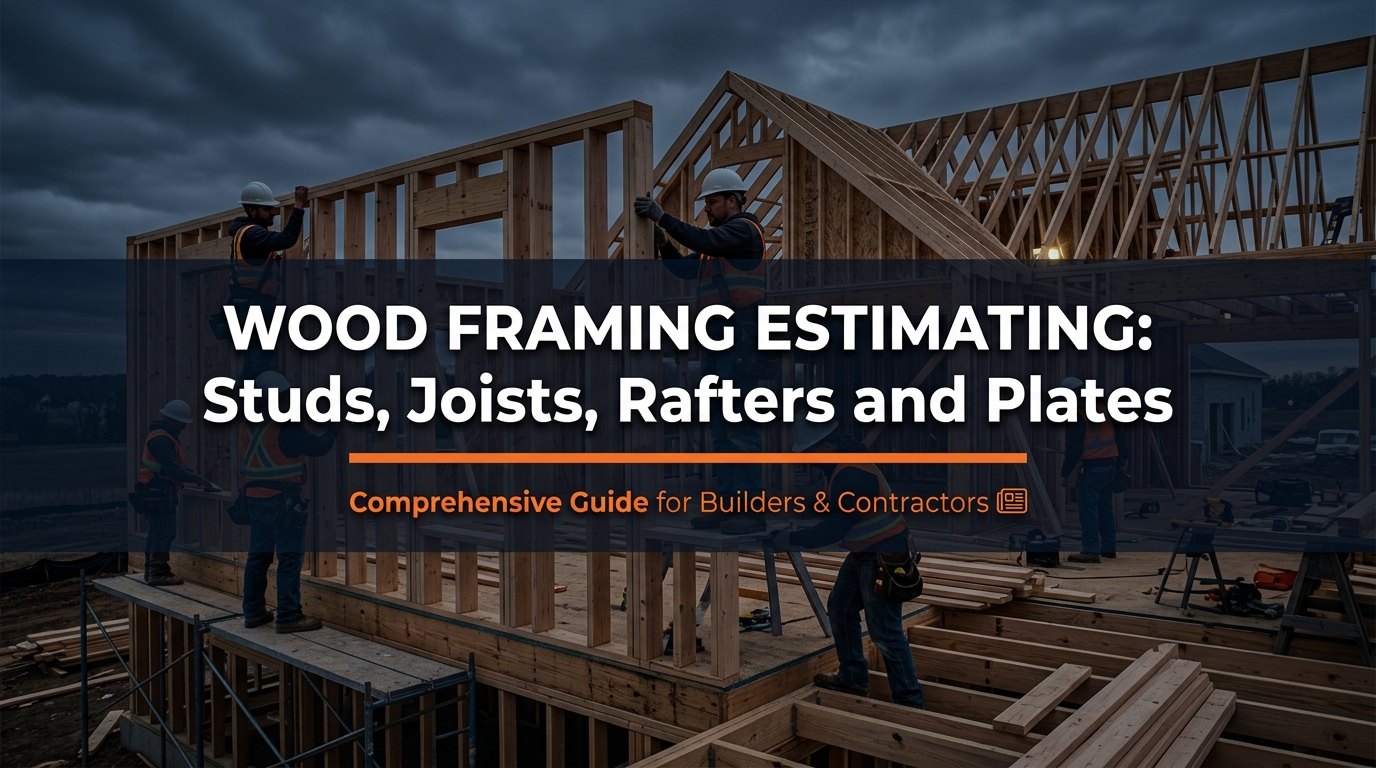
Wood framing is the skeleton of most residential and light commercial buildings in the United States. It is also one of the most detail-intensive scopes to estimate accurately because the quantity of individual pieces, from wall studs to roof rafters to rim joists and blocking, adds up quickly and varies significantly with the complexity of the design.
A contractor who estimates wood framing by applying a simple cost-per-square-foot rule from a previous job will win bids they will regret and lose bids they should have won. The only way to produce a reliable framing estimate is to work through the drawings systematically, counting every piece or calculating every lineal foot of material that goes into the frame.
This guide walks through the complete wood framing estimating process, covering wall framing, floor systems, roof framing, sheathing, and the smaller items that are frequently overlooked but add real cost to any framing scope.
What Drawings and Information You Need Before Starting
A framing estimate requires the architectural floor plans, the exterior elevations, the wall sections, the roof plan, the framing plans if provided by the structural engineer, and the window and door schedule.
The floor plans give the estimator the wall lengths and locations. The elevations show the wall heights at each face of the building. The wall sections show the framing details including stud size, spacing, and any special conditions like double stud walls or tall walls requiring deeper members. The roof plan shows the shape and extent of the roof surface, the ridge locations, and the slopes.
The window and door schedule is essential for framing because every opening requires a header, doubled studs on each side, a rough sill, cripple studs above and below, and king studs at the outer edges of the opening. None of those extra pieces are visible from a simple wall length measurement.
The structural framing plan, when provided by the engineer, shows the floor and roof framing with member sizes and spacings called out for each zone of the structure. On engineered light commercial framing, this plan is the primary document. On conventional residential framing, the estimator often works from the architectural plans and applies standard framing practices for member selection.
Wall Framing: Studs, Plates and Headers
Wall framing is the starting point for most residential framing estimates because the walls define the floor plan and establish the basic material quantity for the project.
Counting Studs
The industry standard method for estimating studs in conventional residential walls is to use one stud per linear foot of wall regardless of the actual spacing. This accounts for the studs at the spacing plus extra studs at corners, intersections, and openings without requiring the estimator to measure every individual piece. For a 2,400 square foot house with 400 linear feet of exterior walls and 600 linear feet of interior walls, this method gives 1,000 studs as a starting estimate.
A more precise method counts studs by spacing for the field, then adds extras for each corner, each intersection with another wall, each side of each door and window opening, and each partition end. This method is more accurate but takes longer and is more commonly used on commercial projects or complex residential designs where the simplified method would produce significant error.
Stud height comes from the wall height on the plans. Standard residential walls use pre-cut studs that are 92.625 inches long, designed to produce a finished wall height of 8 feet when combined with a double top plate and single bottom plate. Taller walls require custom length studs or full length lumber cut on site.
Calculating Plates
Every stud wall has a bottom plate and a double top plate, making three plates per wall run. The total plate material is three times the total linear footage of all walls.
For the 1,000 linear feet of walls in the previous example, the plate calculation is 1,000 feet times 3 plates, giving 3,000 linear feet of plate material. Plates are typically priced by the piece in 8, 10, 12, 14, or 16 foot lengths, so the estimator converts linear footage to a piece count based on the most efficient length for the project conditions.
Double top plates overlap at corners and wall intersections, which means the outside walls add extra plate length at every connection point. The estimator either adds a percentage for this or counts the overlaps separately depending on the level of precision required.
Headers Over Openings
Headers carry the loads above window and door openings across the gap created by removing the studs. The size of the header depends on the span and the load above, specified on the structural drawings or determined by the prescriptive tables in the building code for residential construction.
The estimator lists every opening from the window and door schedule, notes the rough opening width, and calculates the header length as the rough opening width plus the bearing on each side, typically 1.5 inches per side for a total of 3 inches added to the rough opening width.
For a project with 12 windows at an average rough opening width of 3 feet and 8 doors at an average rough opening of 3.5 feet, the total header length is 12 times 3.25 feet plus 8 times 3.75 feet, giving 39 feet plus 30 feet, totaling 69 linear feet of header material. Headers are typically made from doubled lumber with a 0.5 inch spacer to match the wall thickness, so the linear footage of header lumber is twice the header length.
Cripple Studs, King Studs and Trimmers
Every window and door opening requires additional framing pieces beyond the header. King studs run the full height of the wall on each side of the opening. Trimmers are full-height studs that support the header ends and run from the bottom plate to the underside of the header. Cripple studs fill the space above the header between the header and the top plate, and below the window sill between the sill and the bottom plate.
The estimator counts these pieces for each opening or applies standard factors. A common approach adds 8 extra studs per window opening (2 kings, 2 trimmers, 2 upper cripples, 2 lower cripples) and 6 extra studs per door opening (2 kings, 2 trimmers, 2 upper cripples only).
Floor Framing: Joists, Rim Boards, Blocking and Beams
Floor framing supports the loads from the floors above and must be estimated carefully because the quantities depend heavily on joist spacing and span, both of which vary across a floor plan.
Calculating Floor Joists
The joist count for a floor bay is the span dimension divided by the joist spacing plus one. For a floor area that is 30 feet deep with joists spanning in that direction and spaced at 16 inches on center across a 40 foot width, the joist count is 40 feet times 12 inches per foot divided by 16 inch spacing plus 1, giving 31 joists.
Each joist is as long as the span it covers. If the joists span 30 feet, each joist is 30 feet long unless they are supported by a beam at midspan, in which case each joist half is 15 feet long. Engineered lumber joists like I-joists or LVL beams are measured the same way but priced differently from dimensional lumber.
The estimator repeats this calculation for each floor bay, noting where joist direction or spacing changes. On complex floor plans with multiple framing zones, the work can be substantial but the accuracy it produces is essential for a competitive bid.
Rim Boards and Band Joists
Rim boards or band joists run along the perimeter of the floor frame at the same depth as the floor joists. They are measured by the total perimeter of the floor at each level. For a simple rectangular house that is 40 by 30 feet, the perimeter is 140 linear feet of rim board per floor level.
Blocking and Bridging
Blocking between joists is required at bearing walls above, at mid-span on longer joist runs, at floor penetrations, and at locations where shear transfer between floors must be provided. The estimator measures the total lineal footage of blocking needed at each location. Blocking pieces are typically 14.5 inches long for 16 inch on center framing, cut from the same dimensional lumber as the joists.
Beams and Posts
Beams carrying floor loads are measured by linear foot and priced by the member size. Posts supporting beams are counted from the framing plan and priced by length and size. Both beams and posts are often engineered LVL or PSL members on residential projects where spans exceed what dimensional lumber can handle.
Roof Framing: Rafters, Ridges, Hips, Valleys and Ceiling Joists
Roof framing is the most geometrically complex part of a residential framing estimate. Simple gable roofs are straightforward to calculate, but hip roofs, intersecting gables, dormers, and cathedral ceiling conditions all add complexity and additional pieces.
Gable Roof Rafters
The rafter length on a gable roof is calculated using the Pythagorean theorem applied to the roof geometry. The horizontal run of the rafter is half the building width for a simple gable. The vertical rise is the run multiplied by the roof pitch expressed as a fraction of 12. The rafter length is the square root of the run squared plus the rise squared, plus the overhang length at the eave.
For a building that is 30 feet wide with a 6 in 12 pitch roof and a 2 foot overhang, the run is 15 feet, the rise is 15 times 6 divided by 12, which equals 7.5 feet, and the rafter length is the square root of 15 squared plus 7.5 squared plus 2 feet of overhang. That gives approximately 18.8 feet per rafter.
The rafter count is the ridge length divided by the rafter spacing plus one, doubled for both sides of the roof. For a 40 foot building with rafters at 24 inches on center, the count on each side is 40 divided by 2 plus 1, giving 21 rafters per side and 42 rafters total.
Hip Roofs and Valley Rafters
Hip roofs add hip rafters at each corner and jack rafters filling in between the hip and the common rafters. Valley rafters appear where roof planes intersect. Both hip and valley rafters are longer than common rafters and cut at compound angles.
The estimator calculates hip and valley rafter lengths using the diagonal run of the hip or valley, which is the square root of twice the common rafter run squared for a 45 degree hip, multiplied by the same slope factor used for common rafters. Jack rafters diminish in length by a constant increment related to the spacing and slope, and are easiest estimated using a factor-based approach rather than calculating each jack individually.
Ceiling Joists
Ceiling joists span across the building at the top plate line to tie the rafters together and support the ceiling below. They are calculated the same way as floor joists, using the building width, the spacing from the drawings, and adding waste for cutting.
Wall and Roof Sheathing
Sheathing is measured in squares, where one square equals 100 square feet, or converted to panel counts where each 4 by 8 panel covers 32 square feet.
Wall sheathing area is the total exterior wall area including gable ends, minus the opening areas for windows and doors. On most residential projects, estimators apply a 5 to 8 percent waste factor for cutting around openings rather than measuring each opening individually.
Roof sheathing covers the actual roof surface area, not the plan area. The roof surface area is the plan area multiplied by a slope factor. For a 6 in 12 pitch, the slope factor is 1.118, meaning a 1,200 square foot plan area produces 1,342 square feet of actual roof surface to sheath.
Hardware, Connectors and Fasteners
Metal connectors, hangers, anchors, straps, and hold-downs add real cost to a framing estimate and are frequently underestimated or lumped into a general allowance that proves inadequate.
Hurricane ties or rafter ties connect each rafter or truss to the top plate and are counted at every rafter location, which on a 40 foot building at 24 inch spacing means 21 connectors per side, or 42 per roof perimeter.
Joist hangers are used wherever joists frame into a beam rather than sitting on top of it. The estimator counts the hanger locations from the framing plan and lists the size required for each joist size.
Hold-downs and shear anchors are specified on the structural shear wall schedule and must be counted from the plans. These are easy to miss on a residential estimate but can add several thousand dollars to the framing scope on a project with significant lateral load requirements.
Nails and screws are typically estimated as a percentage of the lumber cost, ranging from 3 to 5 percent depending on the project requirements and whether pneumatic nailing or hand nailing is assumed.
Frequently Asked Questions
What is the most accurate method for estimating wall studs? Counting studs by spacing for the full wall length and adding separate counts for corners, intersections, and opening framing produces the most accurate result. The one stud per lineal foot rule is an acceptable approximation for simple rectangular buildings but can produce significant errors on complex floor plans with many intersections and openings.
Should engineered lumber be estimated differently from dimensional lumber? Yes. Engineered lumber including LVL beams, I-joists, and PSL posts is measured and counted the same way as dimensional lumber but must be priced from manufacturer catalogs or distributor quotes because the cost per linear foot varies significantly by member depth and span rating.
How do I estimate framing for a complex hip roof with dormers? Complex roofs are most accurately estimated by developing a roof framing plan that shows every rafter type and location before starting the quantity calculation. Working from an undeveloped architectural roof plan without this intermediate step leads to missed pieces and inaccurate lengths on compound cut members.
Is blocking included in lumber takeoffs or priced separately? Blocking is usually included in the lumber estimate as part of the overall framing scope. The pieces are cut from the same dimensional lumber as the joists and studs, so they add to the material quantity but are often priced at the same rate as the primary framing lumber.