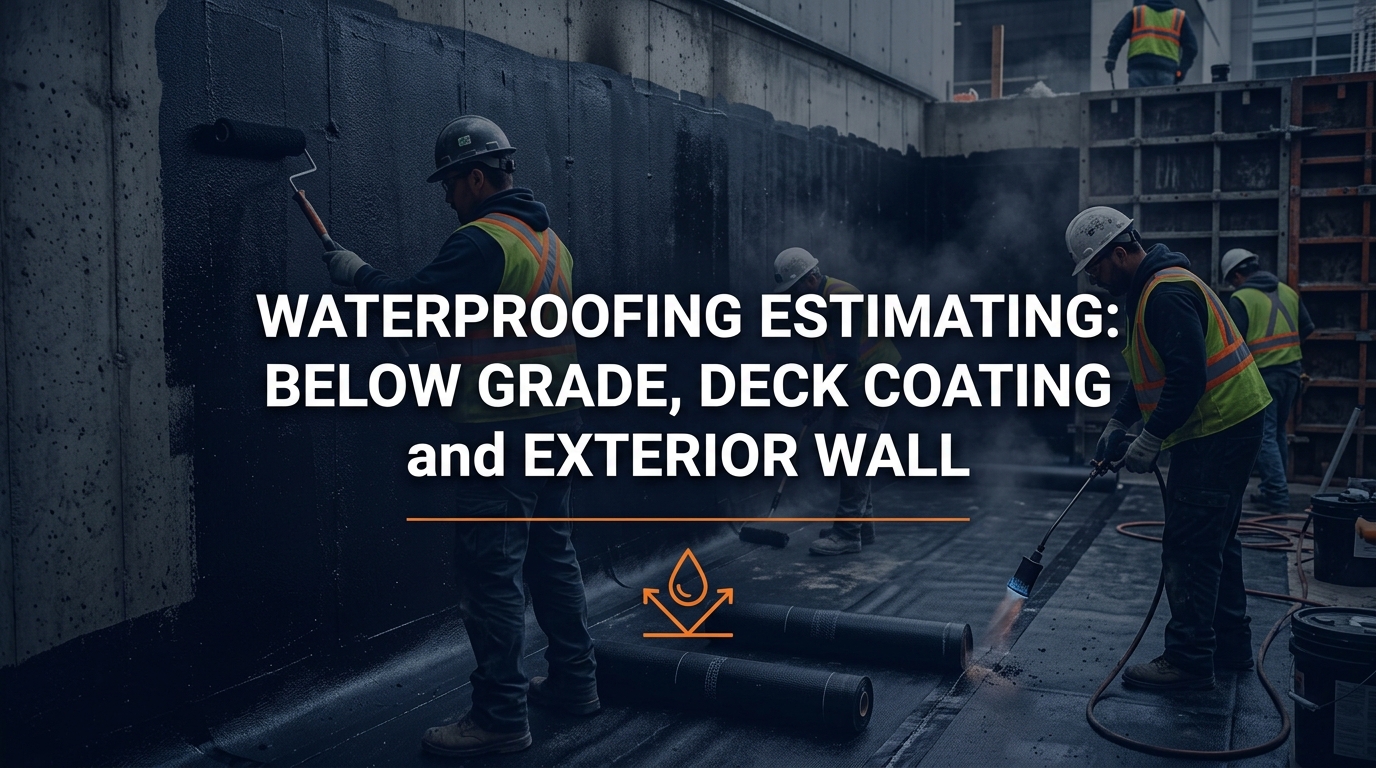
Waterproofing Estimating Guide: Below Grade, Deck Coating and Exterior Wall Systems
Water finds the cheapest path into a building every time. A waterproofing estimate that misses a transition detail or underestimates membrane overlap turns into a callback list two years after closeout.
This guide walks through how to estimate waterproofing across the four systems contractors deal with most: below grade walls, plaza and deck coatings, exterior wall barriers and drainage layers.
Why Waterproofing Estimates Need Extra Care
Waterproofing scope rarely gets its own clean drawing set. It hides inside structural details, civil drawings and architectural wall sections all at once.
Three things cause the most estimating mistakes on this trade.
- Pricing square footage without checking for double layer or reinforced detail areas
- Skipping drainage board, protection board or insulation that sits alongside the membrane
- Missing transition details at footings, pipe penetrations and expansion joints, where most leaks actually start
A waterproofing scope built detail by detail, not just square footage by square footage, gives contractors a far more accurate number.
Step 1: Identify the System Type First
Waterproofing is not one product. Pricing changes completely depending on the system.
| System Type | Common Application |
|---|---|
| Below grade sheet membrane | Foundation walls, retaining walls |
| Below grade liquid applied | Foundation walls, complex geometry |
| Plaza and deck coating | Parking decks, roof plazas, balconies |
| Exterior wall air and water barrier | Above grade wall assemblies |
| Drainage composite | Below grade walls and plaza systems |
Confirm the system type from the specification section, usually division 7, before pulling any quantities from the drawings.
Step 2: Take Off Below Grade Wall Areas
Below grade waterproofing covers foundation walls from the footing up to grade. Measure the wall area, then check for these add ons.
| Item | Why It Matters |
|---|---|
| Wall height below grade | Sets the base square footage |
| Footing detail wrap | Extra membrane at the wall to footing transition |
| Inside and outside corners | Needs extra membrane width for proper lap |
| Pipe and conduit penetrations | Needs boot or sealant detail at every penetration |
| Construction joints | Needs reinforced strip membrane |
A typical foundation wall waterproofing scope runs these material costs per square foot.
| Material Type | Cost Per Square Foot |
|---|---|
| Self adhered sheet membrane | 1.50 to 3.00 dollars |
| Hot applied rubberized asphalt | 2.50 to 4.50 dollars |
| Liquid applied polyurethane | 3.00 to 5.50 dollars |
| Bentonite panel system | 2.00 to 3.75 dollars |
Add 10 to 15 percent waste on sheet membrane for overlap and seam allowance. Liquid applied systems carry a lower waste factor, usually 5 to 8 percent, since there is no seam overlap to account for.
Step 3: Estimate Drainage Board and Protection Board
Drainage board sits between the membrane and the backfill on most below grade walls. Protection board does a similar job on plaza and deck systems.
| Component | Cost Per Square Foot | Purpose |
|---|---|---|
| Drainage composite board | 0.75 to 1.50 dollars | Relieves hydrostatic pressure |
| Protection board | 0.50 to 1.00 dollar | Shields membrane during backfill or traffic |
| Insulation board over membrane | 1.00 to 2.50 dollars | Adds thermal value on inverted roof systems |
Skipping drainage board on a clay heavy soil site is one of the fastest ways to see a foundation leak inside the first wet season.
Step 4: Estimate Plaza and Deck Coating Systems
Plaza decks and parking structures need traffic rated waterproofing, which costs more than standard below grade membrane because it carries vehicle or pedestrian load.
| System | Cost Per Square Foot | Typical Use |
|---|---|---|
| Fluid applied traffic coating | 6.00 to 12.00 dollars | Parking decks |
| Sheet membrane under pavers | 4.00 to 7.00 dollars | Roof plazas |
| Cementitious topping with integral coating | 5.00 to 9.00 dollars | Balconies, walkways |
Plaza systems also need slope to drain checked before pricing. A flat plaza with no positive slope often needs a tapered insulation or topping layer added to the scope, and that line item gets missed often in early estimates.
Step 5: Estimate Exterior Wall Air and Water Barriers
Above grade walls use a fluid applied or sheet applied air and water barrier instead of a true waterproofing membrane. Pricing follows wall area minus openings.
| Material Type | Cost Per Square Foot |
|---|---|
| Fluid applied air barrier | 1.25 to 2.50 dollars |
| Self adhered sheet air barrier | 1.50 to 2.75 dollars |
| Mechanically fastened sheet barrier | 1.00 to 2.00 dollars |
Add flashing detail costs separately at window heads, sills and jambs. These details run 3 to 6 dollars per linear foot depending on complexity and material type.
Step 6: Apply Realistic Labor Rates
Labor productivity on waterproofing depends heavily on substrate condition and detail complexity.
| Task | Labor Rate |
|---|---|
| Sheet membrane install, flat wall | 80 to 120 square feet per hour |
| Sheet membrane install, detailed corners and penetrations | 40 to 60 square feet per hour |
| Liquid applied membrane, roller or spray | 100 to 150 square feet per hour |
| Drainage board install | 150 to 200 square feet per hour |
| Plaza coating, multi coat system | 60 to 90 square feet per hour |
Detail heavy areas, like penetrations and corners, take two to three times longer than flat wall runs. Always price those zones separately rather than averaging them into the overall square footage rate.
Step 7: Build in Testing and Quality Control Costs
Many waterproofing specs now call for flood testing or electronic leak detection before backfill or topping installation. Budget these costs separately.
- Flood testing on plaza decks, typically 0.50 to 1.00 dollar per square foot
- Electronic leak detection survey, typically 1.00 to 2.00 dollars per square foot
- Mock up panel and pull test, usually a fixed cost between 500 and 1500 dollars per project
Skipping this line item in the estimate creates a budget gap later when the architect requires testing as a condition of substrate acceptance.
Common Estimating Mistakes on Waterproofing
- Pricing wall area without adding footing wrap and corner detail
- Leaving out drainage board on poor draining soil sites
- Missing slope correction needed on flat plaza decks
- Forgetting flashing detail costs at window and door openings
- Skipping testing and quality control line items
When to Outsource the Waterproofing Takeoff
Waterproofing scope crosses between structural, civil and architectural drawings, which makes it one of the easier trades to underestimate in house. A detail missed on one sheet often shows up nowhere else.
The Virtual Estimation builds waterproofing takeoffs detail by detail, cross checking structural sections against architectural wall types so nothing gets missed between drawing sets. Turnaround runs 24 to 48 hours with accuracy near 98 percent, which gives contractors a number they can bid with confidence.
For foundation heavy projects, pairing the waterproofing scope with a concrete estimating package keeps the foundation, footing and waterproofing numbers consistent from the same set of drawings.
Final Thoughts
Waterproofing is a small line item on most budgets but one of the most expensive trades to get wrong after the building closes in. Treat every system, detail and transition as its own scope item, not a flat square footage rate, and the bid holds up from preconstruction through warranty.
If your next project needs a detailed waterproofing takeoff, send the drawings to info@thevirtualestimation.com and get a free quote today. More trade specific guides are available on the blog, and you can check service areas to confirm coverage across the US, Canada, Australia and the UK.