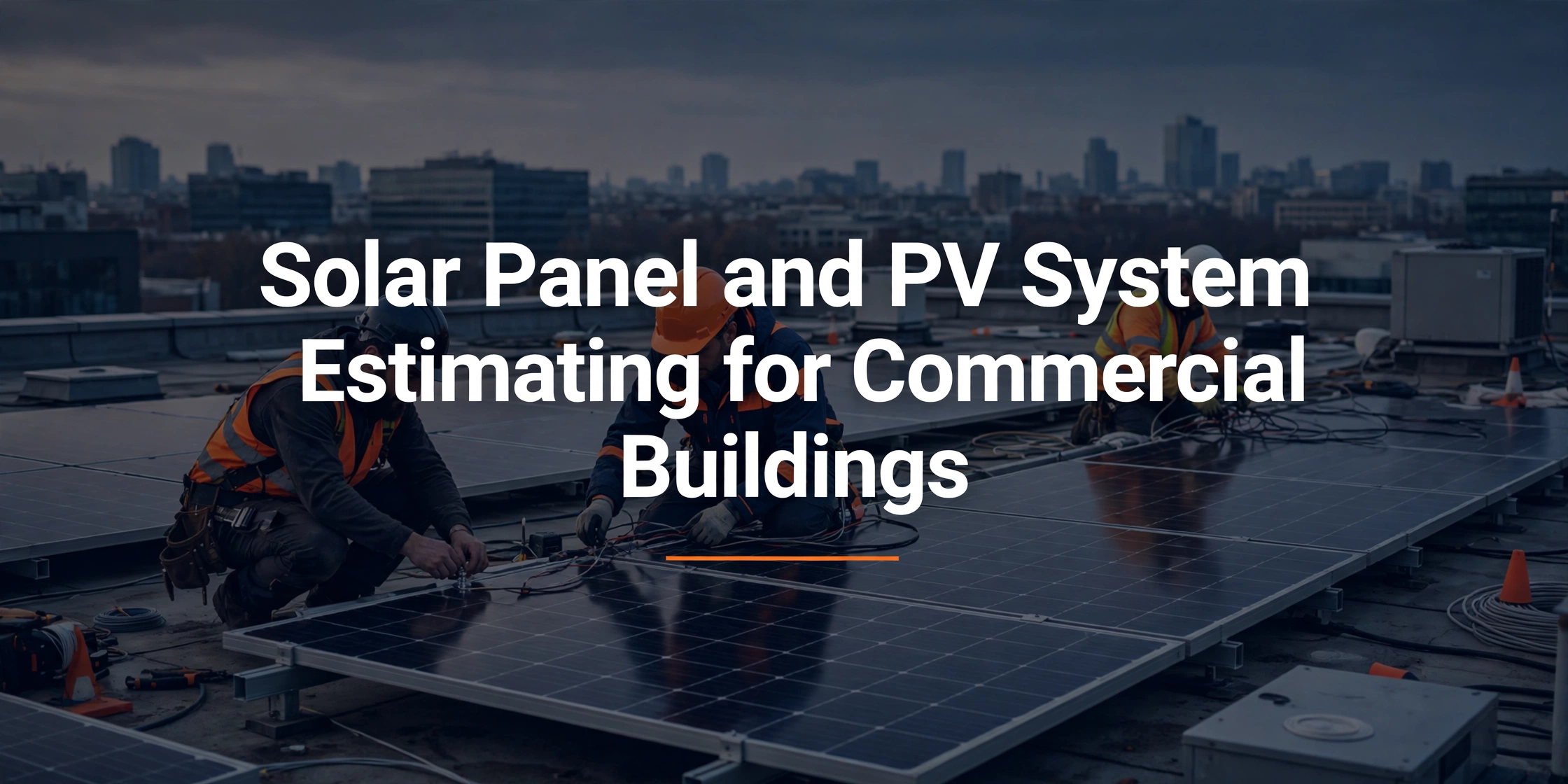
A reliable solar estimate must account for the complete PV system, including modules, racking, inverters, DC and AC wiring, disconnects, grounding, monitoring, equipment, labor, interconnection requirements, and—when included—battery energy storage.
For contractors, electrical contractors, EPCs, developers, and renewable-energy installers, small estimating errors can quickly affect the overall project budget. Missing a significant amount of racking, underestimating cable runs, overlooking rooftop conditions, or failing to account for electrical interconnection equipment can create gaps in the bid.
Commercial solar estimating starts with understanding the design and converting it into measurable quantities and realistic installation costs.
This guide explains how contractors can approach photovoltaic estimating for commercial buildings, from panel counts and mounting systems to inverters, wiring, labor, and battery storage.
What Is Solar PV Estimating?
Solar estimating is the process of determining the quantities, labor, equipment, materials, and costs required to install a photovoltaic energy system.
A commercial PV estimate may include:
Solar modules
Module-level equipment
Racking and mounting systems
Rails and attachments
Inverters
DC wiring
AC wiring
Conduit
Combiner or junction equipment
Disconnects
Grounding and bonding
Electrical distribution equipment
Monitoring equipment
Rapid shutdown equipment where applicable
Interconnection equipment
Battery energy storage
Roof penetrations and waterproofing
Equipment pads and supports
Installation labor
Testing and commissioning
The exact scope depends on the project design, building type, utility requirements, and contract responsibilities.
Start With the Solar Drawing Package
The first step in a commercial solar estimate is reviewing the complete project documentation.
The estimator should examine the electrical plans, PV layout, single-line diagram, equipment schedules, structural drawings, roof plans, specifications, utility requirements, and available site information.
The PV layout helps establish the number and arrangement of modules.
The electrical drawings provide information about inverter configuration, circuiting, disconnects, conductors, equipment, and interconnection.
Structural information becomes especially important for rooftop systems because the mounting approach and attachment requirements can affect both material quantities and labor.
A solar estimate should never rely on the panel count alone.
How to Calculate Solar Panel Count
The solar panel count is one of the first quantities established during a PV takeoff.
The estimator should identify the module type and wattage specified by the design.
A basic system capacity calculation is:
System DC Capacity = Number of Modules × Module Wattage
For example, if a design uses 500 modules rated at 450 watts each:
500 × 450 W = 225,000 W
The resulting system capacity is 225 kW DC.
However, the estimator should use the actual module schedule and approved design documents rather than assuming a standard panel size.
Panel count can also be affected by roof geometry, setbacks, equipment clearances, obstructions, fire-access requirements, structural limitations, and available installation areas.
Rooftop Conditions and Solar Layout
Commercial rooftops can create significant estimating challenges.
A large roof does not necessarily mean that the entire area is available for PV modules.
The estimator should identify:
HVAC equipment
Roof drains
Skylights
Parapets
Mechanical penthouses
Access paths
Roof hatches
Existing equipment
Required setbacks
Shading conditions
Structural limitations
Maintenance access
These conditions influence the number of modules that can actually be installed.
The solar takeoff should therefore be based on the designed layout rather than simply dividing total roof area by the area of one module.
Solar Racking and Mounting Estimate
The mounting system is another major component of the PV material takeoff.
Depending on the commercial installation, the system may use ballasted, mechanically attached, rail-based, rail-less, or other engineered mounting configurations.
The estimator may need to quantify:
Rails
Clamps
Module attachments
Roof attachments
Ballast
Mounting brackets
Splices
End clamps
Mid clamps
Structural supports
Flashing
Waterproofing components
The exact quantities depend on module dimensions, array configuration, roof construction, wind requirements, structural design, and manufacturer specifications.
Estimating Roof Attachments
Roof attachments can have a surprisingly large impact on the estimate.
The number and type of attachments depend on the engineered mounting design.
The estimator should review the racking layout and structural details rather than applying a generic attachment ratio.
Attachment work may also require additional labor for layout, drilling, flashing, sealing, waterproofing, and coordination with roofing requirements.
For existing commercial buildings, protecting the roof warranty can be particularly important.
Solar Inverter Estimating
Inverters convert the DC electricity generated by the PV modules into AC electricity used by the building or delivered to the electrical system.
The estimate should identify the inverter type, quantity, capacity, and installation location.
Depending on the design, a commercial project may use string inverters, central inverters, or other system configurations.
The estimator should review:
Inverter quantity
Inverter capacity
Mounting requirements
Disconnects
AC connections
DC inputs
Monitoring equipment
Communications
Manufacturer-specific accessories
The inverter schedule and single-line diagram should be used to confirm the equipment quantities.
DC Wiring and Solar Cable Takeoff
A complete solar wiring estimate should account for the DC conductors connecting PV modules and strings to the inverter or associated equipment.
The estimator should consider:
Module interconnections
String wiring
Home-run conductors
Positive and negative conductors
Conductor sizes
Cable management
Connectors
Junction boxes
Transition points
Routing distances
Cable quantities should be based on the actual array configuration and routing.
Simply multiplying the number of modules by a generic cable allowance can produce inaccurate results, especially on large commercial roofs.
AC Wiring and Conduit Estimating
After the inverter, the estimate must account for the AC side of the system.
Depending on the design, this can include conductors and raceways between the inverter, disconnects, distribution equipment, switchgear, transformers, and point of interconnection.
The estimator should quantify:
Conduit
Conductors
Cable
Fittings
Supports
Disconnects
Junction boxes
Pull boxes
Terminations
Long rooftop runs can create substantial material and labor costs.
Conduit routing should therefore be measured from the actual drawings whenever possible.
Solar Electrical Equipment
Commercial PV systems may require additional electrical equipment beyond the modules and inverters.
The estimate may include:
Disconnect switches
Combiner equipment
Distribution panels
Switchboards
Switchgear
Transformers
Fuses
Circuit breakers
Surge protection
Metering
Monitoring equipment
Communication equipment
The exact scope depends on the system design and interconnection configuration.
The single-line diagram is particularly useful for identifying these components.
Grounding and Bonding
Grounding and bonding should be included as a distinct part of the PV takeoff.
The estimator may need to quantify grounding conductors, bonding components, grounding connections, equipment grounding conductors, and other required hardware.
Racking and module bonding requirements should be reviewed according to the selected mounting system and project design.
Missing grounding components can create both material and labor gaps in the final bid.
Solar Interconnection Estimating
Commercial PV projects frequently require coordination with the building's electrical distribution system and utility interconnection requirements.
The estimator should identify the point of interconnection and determine what equipment is necessary between the PV system and the building electrical system.
Depending on the project, this may involve:
Service equipment
Switchgear
Distribution panels
Breakers
Disconnects
Transformers
Metering
Protection equipment
Conductors
Conduit
Utility-required equipment
The estimator should clearly identify which interconnection components are included in the contractor's scope and which are supplied by the utility or another party.
Battery Energy Storage Estimating
Battery storage can significantly expand the scope of a commercial solar project.
A battery storage estimate should identify the required energy capacity, power rating, equipment configuration, and installation requirements shown in the project documents.
Potential components include:
Battery cabinets
Battery modules
Energy storage system equipment
Power conversion equipment
Inverters
Disconnects
Distribution equipment
Wiring
Conduit
Communications
Monitoring
Fire protection interfaces
Equipment pads
Enclosures
HVAC or thermal-management equipment where required
Storage systems can also introduce additional site, structural, electrical, and safety considerations.
The estimator should therefore treat battery storage as a separate scope rather than simply adding a percentage to the PV cost.
Estimating Solar Installation Labor
Solar labor depends heavily on system size, mounting method, roof conditions, equipment configuration, accessibility, and installation sequence.
Labor may include:
Material handling
Roof staging
Module installation
Racking installation
Roof attachments
Wiring
Conduit installation
Inverter installation
Equipment installation
Grounding
Terminations
Testing
Commissioning
For rooftop commercial systems, material movement can become a significant productivity factor.
If modules, racking, and electrical equipment must be transported long distances across a roof or lifted from ground level, the labor estimate should reflect those conditions.
Equipment and Material Handling
Commercial solar projects can require cranes, lifts, forklifts, hoists, carts, or other material-handling equipment.
The estimator should review how equipment and materials will reach the installation area.
Potential equipment costs include:
Crane rental
Forklift
Telehandler
Boom lift
Scissor lift
Material hoist
Delivery equipment
Specialized installation tools
The estimate should distinguish between equipment that is included in installation labor and equipment that requires separate rental or mobilization.
Solar Material Pricing
Material pricing can represent a large percentage of a PV project.
Major cost categories include modules, inverters, racking, electrical equipment, conductors, conduit, connectors, and storage equipment.
The estimator should use project-specific supplier pricing when available.
Solar material pricing can also vary based on equipment availability, manufacturer, system size, shipping requirements, and project schedule.
Using outdated material pricing can make an otherwise accurate takeoff commercially unreliable.
Commercial Solar Cost Estimate Workflow
A practical commercial solar estimating workflow can be organized as follows:
Step 1: Review Project Documents
Study the PV layout, electrical drawings, single-line diagram, structural documents, specifications, and available site information.
Step 2: Establish System Capacity
Confirm the number and wattage of modules and calculate the designed DC capacity.
Step 3: Perform the Module Takeoff
Count modules and verify their arrangement by array.
Step 4: Measure Racking
Quantify rails, clamps, attachments, ballast, supports, and related mounting components according to the design.
Step 5: Take Off Electrical Components
Measure DC and AC wiring, conduit, disconnects, junction boxes, grounding components, inverters, and distribution equipment.
Step 6: Review Interconnection
Identify the equipment and installation work required to connect the PV system to the building electrical system.
Step 7: Add Battery Storage
If applicable, create a separate storage takeoff covering batteries, power conversion equipment, wiring, controls, and installation requirements.
Step 8: Calculate Labor
Assign labor hours based on realistic installation productivity and project conditions.
Step 9: Add Equipment and Material Handling
Include cranes, lifts, forklifts, mobilization, staging, and other equipment where required.
Step 10: Review the Complete Bid
Check quantities, exclusions, clarifications, subcontractor scopes, equipment pricing, labor assumptions, and project requirements before finalizing the bid.
Common Solar Estimating Mistakes
One common mistake is estimating the project from the number of modules alone.
Modules represent only one part of the system.
Another problem is using generic racking assumptions without reviewing the actual mounting design.
Electrical quantities can also be underestimated when the estimator does not measure actual conduit and conductor routes.
Interconnection equipment is another area that deserves careful attention. A PV system may require significant electrical infrastructure between the inverter and the point of interconnection.
Battery storage should also be estimated independently when included in the project scope.
Finally, labor assumptions should reflect actual rooftop conditions rather than applying a generic installation rate to every commercial project.
Digital Takeoff for Solar Projects
Digital takeoff tools can improve the organization and speed of commercial PV estimating.
Estimators can use digital plans to measure array layouts, conduit routes, equipment locations, roof areas, and other components while organizing quantities by drawing sheet and system.
Digital takeoff also makes revisions easier to manage when the design changes.
For larger projects, maintaining a clear connection between drawings, quantities, material pricing, labor assumptions, and final costs can make the estimate easier to review and update.
What Should a Professional Solar Estimate Include?
A professional PV system estimate should provide enough detail for a contractor to understand how the total project cost was developed.
Typical deliverables may include:
Solar module quantity
Module specifications
System capacity
Racking quantities
Mounting components
Inverter quantities
DC wiring
AC wiring
Conduit
Disconnects
Grounding and bonding
Electrical equipment
Interconnection equipment
Battery storage quantities
Labor hours
Equipment costs
Material costs
Installation costs
Clarifications
Exclusions
Alternates where applicable
The exact format should match the contractor's bidding and procurement workflow.
When Should Contractors Outsource Solar Estimating?
Commercial PV estimates can become complex when multiple buildings, large arrays, storage systems, or complicated electrical interconnections are involved.
Outsourcing can help contractors increase estimating capacity without immediately expanding their internal estimating staff.
A specialized estimating team can support quantity takeoffs, material lists, labor calculations, electrical scope review, and bid preparation while the contractor maintains control over final pricing and project strategy.
This can be especially useful when several renewable-energy bids need to be prepared simultaneously.
The Virtual Estimation for Solar Bids
The Virtual Estimation provides professional construction estimating and quantity takeoff support for contractors, subcontractors, general contractors, builders, developers, and construction professionals.
For commercial renewable-energy projects, an organized estimating process can help break the PV scope into measurable components, including modules, racking, inverters, wiring, electrical equipment, interconnection, labor, and battery storage when applicable.
The objective is to give contractors a clear cost structure they can review before submitting a bid.
Final Takeaway
Accurate commercial solar estimating requires much more than counting photovoltaic panels.
A complete estimate should connect the PV layout, module quantities, racking, inverters, DC and AC wiring, electrical equipment, grounding, interconnection, labor, equipment, and battery storage into one coordinated cost model.
The more accurately the estimator understands the design and actual installation conditions, the more useful the final bid becomes.
For commercial solar contractors and electrical contractors, a detailed takeoff provides the foundation for better procurement decisions, more controlled labor assumptions, and more competitive project bids.
Frequently Asked Questions
How do you estimate a commercial solar PV system?
Start by reviewing the PV layout, electrical drawings, single-line diagram, structural information, and specifications. Count modules, measure racking and wiring, identify inverters and electrical equipment, review interconnection requirements, calculate labor and equipment, and add battery storage if included.
How do you calculate the number of solar panels?
The number of panels is determined from the project design and required system capacity. The estimator should verify the specified module wattage, array layout, roof constraints, equipment clearances, and other design requirements rather than relying only on roof area.
What is included in a solar material takeoff?
A solar material takeoff may include modules, racking, clamps, attachments, inverters, conductors, conduit, connectors, disconnects, grounding components, electrical equipment, monitoring equipment, and battery storage components when applicable.
How do you estimate solar installation labor?
Solar labor should be based on installation quantities and realistic productivity rates while considering roof access, material handling, mounting type, conduit routing, equipment installation, wiring, testing, and site conditions.
How is battery storage included in a solar estimate?
Battery storage should generally be estimated as a separate system scope covering batteries, power conversion equipment, wiring, disconnects, controls, monitoring, equipment supports, and other project-specific installation requirements.
Why is commercial solar estimating difficult?
Commercial solar projects can involve large quantities, complex electrical systems, rooftop constraints, structural considerations, utility interconnection requirements, and significant material and labor coordination. These factors make detailed takeoff and scope review important.