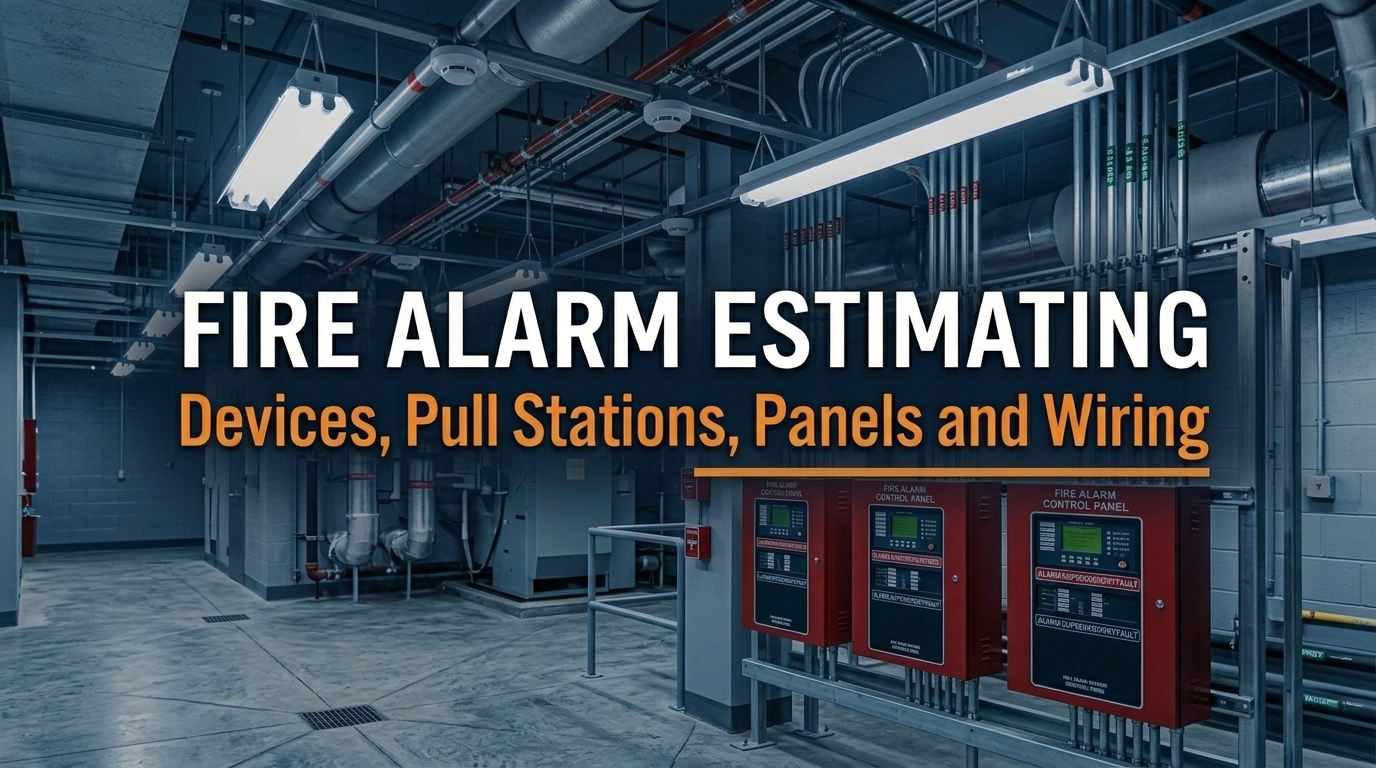
Fire alarm estimating combines device counting, wiring calculation, panel sizing, and programming scope into one system that most electrical estimators price incorrectly the first time they encounter it. The reason is straightforward: fire alarm is not simply electrical work. It operates under NFPA 72, the National Fire Alarm and Signaling Code, which specifies where devices must be placed, how circuits must be wired, what redundancy the system requires, and what the authority having jurisdiction must approve before occupancy.
An estimator who counts devices from the plan without reading the specifications misses addressable module costs, misses programming scope, misses the inspector test and commissioning time, and potentially misses an entire notification appliance circuit zone. Each gap individually is manageable. Together they produce a bid that loses significant money.
This guide covers exactly how professional fire alarm estimators read fire alarm drawings, count detection and notification devices, measure wiring, size panels, and calculate labor for accurate commercial bids in 2026.
For professional fire alarm takeoffs with 98% accuracy and 24 to 48 hour turnaround, The Virtual Estimation serves fire alarm contractors across all 50 states. Contact us at info@thevirtualestimation.com or visit our construction estimating services page.
What Fire Alarm Estimating Requires Before Measuring Begins
Professional fire alarm estimators gather five documents before starting any takeoff: the fire alarm floor plans, the fire alarm riser diagram, the device schedule or legend, the panel specifications, and the project specifications including the basis of design narrative.
The floor plans show every device location, every wiring path, and every conduit run on each floor. The riser diagram shows how all floors connect back to the fire alarm control panel, the battery backup, and the monitoring connection. The device legend defines every symbol used on the plan and cross-references it to the specified product. The panel specifications define whether the system is addressable or conventional, the panel manufacturer, the number of initiating device circuits and notification appliance circuits required, and the monitoring interface requirements.
The basis of design narrative explains the design intent for the system including the occupancy type, the detection coverage strategy, and any special requirements such as voice evacuation, mass notification integration, or elevator recall. This document is where the estimator confirms the full scope before counting a single device.
Addressable vs Conventional Fire Alarm Systems
The first determination in any fire alarm estimate is whether the system is addressable or conventional. This single factor affects nearly every line item in the estimate.
Conventional systems wire initiating devices such as smoke detectors and pull stations in zones on dedicated initiating device circuits. When a device activates, the panel identifies which zone activated but not which specific device. Each zone requires a separate pair of wires back to the panel. Conventional systems are less expensive in materials and programming but more expensive in wiring because each zone requires a dedicated circuit home run.
Addressable systems assign a unique address to every device on the system. All devices on a floor or zone share a single signaling line circuit that loops through each device in sequence. When a device activates, the panel identifies the exact device by address. Addressable systems cost more in device hardware because each device contains an addressable module, but less in wiring because a single loop circuit serves many devices.
| Factor | Conventional | Addressable |
|---|---|---|
| Device cost | Lower | 20 to 50% higher per device |
| Wiring cost | Higher (dedicated home runs) | Lower (loop wiring) |
| Programming cost | Minimal | Significant |
| Panel cost | Lower | Higher |
| Best for | Small buildings under 5 zones | Any building, required on most commercial |
| NFPA 72 requirement | Acceptable | Required by many AHJs on new construction |
Most commercial new construction projects above 5,000 square feet use addressable systems because local fire marshals and AHJs increasingly require them. Estimators must confirm the system type from the specifications before pricing any material.
Detection Device Count and Classification
Detection devices initiate an alarm when they sense a fire condition. Estimators count every detection device from the floor plan by type and cross-reference the count against the code-required coverage area to verify completeness.
Smoke Detector Coverage and Spacing
NFPA 72 requires smoke detectors to be spaced at a maximum of 900 square feet per detector on smooth ceilings with a maximum spacing of 30 feet between detectors. On sloped ceilings, irregular spaces, and areas with HVAC distribution, spacing reduces. The estimator counts every detector symbol from the plan and verifies the count against the floor area divided by the applicable coverage area.
| Detector Type | Coverage per Unit | Relative Cost |
|---|---|---|
| Photoelectric smoke, conventional | 900 sq ft max | Base |
| Ionization smoke, conventional | 900 sq ft max | Similar to base |
| Photoelectric smoke, addressable | 900 sq ft max | 2 to 3 times higher |
| Combination smoke and heat, addressable | 900 sq ft max | 2.5 to 3.5 times higher |
| Duct smoke detector | Per HVAC unit | 4 to 7 times higher |
| Beam smoke detector | Long open spaces | 10 to 20 times higher |
Duct smoke detectors mount in HVAC ductwork and monitor the air moving through the duct. Every air handling unit above a threshold CFM rating requires a duct smoke detector on the supply air side and often on the return air side. The estimator counts every air handling unit from the mechanical equipment schedule and prices a duct smoke detector assembly for each one. Duct detectors are significantly more expensive than area detectors because they include a remote test and reset station, an indicator lamp at an accessible location, and the duct sampling tube assembly.
Heat Detectors
Heat detectors activate at a fixed temperature or at a specified rate of temperature rise. They are used in kitchens, mechanical rooms, attics, and other areas where smoke detectors produce nuisance alarms due to heat, steam, or particulates.
Fixed temperature heat detectors are the most common type, rated at 135 degrees Fahrenheit for standard applications and at higher temperatures for boiler rooms and high-heat spaces. Rate-of-rise heat detectors activate when temperature increases more than 15 degrees Fahrenheit per minute, which detects fast-developing fires before the fixed temperature threshold is reached. Combination units respond to either condition and are increasingly standard on commercial projects.
Carbon Monoxide Detectors
NFPA 72 and building codes increasingly require carbon monoxide detection in buildings with fuel-burning appliances, attached parking structures, and sleeping rooms in hotel and residential occupancies. CO detectors are separate line items from smoke detectors and are priced individually by type.
Combination smoke and CO detectors are available in both conventional and addressable configurations. The estimator identifies every CO detector location from the plan and prices the correct unit. Using a smoke-only unit price for combination units significantly underestimates material cost.
Manual Pull Station Count
Pull stations mount at every required exit location and at specific intervals along egress paths per NFPA 72. Standard single-action pull stations are the most common type. Dual-action pull stations, which require a two-step operation to activate, are specified in schools and other occupancies where accidental activation is a concern.
The estimator counts every pull station symbol from the plan. Pull stations mount at 42 to 48 inches above the finished floor at every exit door and at intervals not exceeding 200 feet along egress paths on each floor. A building with 8 exit doors and two long corridors might require 14 to 18 pull stations per floor depending on the corridor lengths and the AHJ requirements.
| Pull Station Type | Relative Cost |
|---|---|
| Single action, surface mount | Base |
| Single action, flush mount | 20 to 30% higher |
| Dual action, surface mount | 40 to 80% higher |
| Weatherproof, outdoor | 50 to 100% higher |
| With key reset | 30 to 50% higher |
Notification Appliance Count and Circuit Design
Notification appliances alert building occupants when the alarm activates. They include horns, strobes, horn-strobe combination units, and speakers for voice evacuation systems. Each device type has specific placement requirements under NFPA 72 and the Americans with Disabilities Act.
Strobe Requirements Under ADA and NFPA 72
The ADA requires visual notification appliances in all common use areas of commercial buildings occupied by the public. Visual appliances — strobes — must be spaced according to candela output requirements that depend on the room size and the ceiling height. Larger rooms require higher candela strobes or multiple strobe units to achieve the required coverage.
| Room Size | Minimum Strobe Candela |
|---|---|
| Up to 20 x 20 ft | 15 candela |
| Up to 28 x 28 ft | 30 candela |
| Up to 40 x 40 ft | 75 candela |
| Up to 45 x 45 ft | 95 candela |
| Up to 50 x 50 ft | 110 candela |
| Corridor | 15 candela at maximum 50 ft intervals |
The estimator counts every notification appliance from the plan by type and candela rating. Standard horn-strobe units at 15 candela for open office areas cost less than 110 candela units for large conference rooms and assembly spaces. Using the wrong candela rating in the material pricing creates a cost variance that the contractor absorbs after award.
Notification Appliance Circuit Loading
Each notification appliance circuit can serve a limited number of devices based on the current draw of the devices and the maximum current capacity of the panel output circuit, typically 2.0 to 3.0 amps per NAC. The estimator totals the current draw of all devices on each proposed circuit and confirms the circuit loading is within the panel capacity. Overloaded circuits require either a power booster or an additional circuit back to the panel, both of which add material cost.
Fire Alarm Control Panel Sizing and Pricing
The fire alarm control panel is the central processor of the entire system. Every initiating device and notification appliance connects to or communicates with the panel. Panel selection and pricing depends on the number of addressable points, the number of NAC circuits required, and the special features required by the specifications.
Panel Point Count
Addressable panels are sized by the number of addressable points they support. Every addressable detector, every addressable module, every pull station module, and every relay output occupies one or more points on the panel. The estimator counts the total number of addressable points from the device schedule and selects a panel with sufficient capacity, typically with 20 to 25 percent spare capacity for future expansion.
| Panel Size | Addressable Point Capacity | Typical Application |
|---|---|---|
| Small loop controller | 50 to 100 points | Small commercial, single floor |
| Mid-size panel | 200 to 500 points | Multi-floor commercial |
| Large panel | 1,000 to 2,000 points | High-rise, campus systems |
| Network node | Unlimited (networked) | Large campus, multiple buildings |
Special Panel Features
Voice evacuation panels include an amplifier, a microphone for manual announcements, pre-recorded message capability, and speaker circuit outputs in addition to standard fire alarm functions. Voice evacuation adds 40 to 100 percent to the base panel cost. The estimator confirms from the specifications whether voice evacuation is required before pricing the panel.
Mass notification integration, elevator recall control, stairwell pressurization control, and smoke control system interface are additional features that add both panel hardware cost and programming scope. Each interface requires input and output modules, relay connections, and additional programming time.
Low Voltage Wiring Estimation
Fire alarm wiring is low voltage, typically 24 volt DC on initiating and signaling line circuits and 24 volt DC on notification appliance circuits. All wiring must meet the NFPA 72 requirements for the circuit type and survivability classification.
Wire Types and Circuit Classification
NFPA 72 classifies circuits by their survivability requirements. Class A circuits provide redundant pathways so that a single open or ground fault does not disable the circuit. Class B circuits provide a single pathway that can be disabled by a single fault.
| Circuit Type | NFPA 72 Class | Wire Gauge | Conduit Required |
|---|---|---|---|
| Initiating device circuit | Class B typical | 18 AWG minimum | Per local AHJ |
| Signaling line circuit (addressable) | Class A or B | 18 AWG minimum | Per local AHJ |
| Notification appliance circuit | Class B typical | 16 AWG minimum | Per local AHJ |
| Speaker circuit (voice evac) | Class A typical | 16 AWG minimum | Usually required |
Calculating Wiring Quantities
Fire alarm wiring is measured by the linear foot for each wire gauge and circuit type. The estimator traces each circuit from the panel to the first device, device to device along the circuit path, and back to the panel on Class A return circuits.
For a floor with 30 addressable smoke detectors on a single signaling line circuit, the estimator traces the loop from the panel riser connection through each detector location in sequence and back to the panel. Each detector connects to the loop with a short tap connection. The total circuit length equals the path length through all 30 detector locations plus the rise from the panel to the floor level plus a 10 percent slack and termination allowance.
Low voltage wiring is sold in 500 and 1,000 foot spools. The estimator calculates total footage for each wire gauge and converts to spool counts, always rounding up to whole spools.
Conduit Requirements
Many AHJs require fire alarm wiring in conduit throughout the building. Others allow plenum-rated cable in plenum spaces without conduit. The local fire code and the project specifications define the conduit requirement. Where conduit is required, the estimator adds conduit quantities to the fire alarm estimate using the same conduit measurement method described in the electrical estimating guide.
Fire Alarm Programming and Commissioning
Programming is the scope item most commonly missed in fire alarm estimates. Every addressable fire alarm system requires programming before it can be tested or accepted. Programming includes assigning addresses to every device, defining zones and their relationships, configuring the panel response to each alarm and supervisory condition, setting up elevator recall sequences, and entering all text descriptors for the panel display.
Programming time varies with system size and complexity. A 200-point addressable system in a standard commercial building requires 8 to 16 hours of programming time. A 1,000-point system with voice evacuation, elevator recall, and smoke control interface requires 40 to 80 hours of programming. Programming is performed by a factory-trained technician and is always a separate line item from installation labor.
Commissioning and testing under NFPA 72 requires 100 percent device testing of every initiating device and every notification appliance before the AHJ inspection. A building with 400 devices requires testing every device individually, which at 3 to 5 minutes per device takes 20 to 33 hours of technician time for testing alone. Add the documentation time for the commissioning record and the inspection coordination, and commissioning for a large system represents a significant labor cost.
Fire Alarm Labor Hours by Task
Device Installation Labor
Device installation runs 6 to 12 devices per hour for standard smoke detectors and pull stations on completed conduit and wiring. Duct smoke detectors take longer at 1.5 to 3 hours each because of the duct penetration, sampling tube installation, and remote indicator mounting.
Notification appliances run 8 to 15 units per hour for standard horn-strobe units on completed wiring. Speaker installation for voice evacuation runs 4 to 8 units per hour because of the grille alignment and tap setting requirements.
Panel Installation and Termination Labor
Panel mounting and rough-in runs 3 to 8 hours for a standard commercial panel. Wiring termination at the panel runs 5 to 15 minutes per circuit connection depending on the terminal type and the conductor size. A 200-circuit panel requires 20 to 50 hours of termination labor on the panel side alone.
Wiring Installation Labor
Fire alarm wiring in conduit runs at the same productivity rate as standard electrical branch circuit wiring. Plenum-rated cable in open ceiling spaces without conduit runs 30 to 50 percent faster because conduit installation is eliminated.
How Fire Alarm Estimating Connects to Related Trades
Fire alarm estimating connects directly to several other trade scopes on every commercial project.
The fire suppression estimating guide covers the flow switches and tamper switches on the fire suppression system that connect to the fire alarm panel as supervisory points. The fire alarm contractor provides the monitoring connection. The fire suppression contractor provides the switches. Confirming this scope boundary prevents gaps in the estimate.
The electrical estimating guide covers the 120-volt power circuit to the fire alarm panel and the battery charger. The electrical contractor provides and installs the dedicated circuit. The fire alarm contractor connects the panel to that circuit.
The HVAC estimating guide relates to fire alarm through the duct smoke detectors and the smoke damper control relays. The fire alarm contractor provides the detectors and relays. The HVAC contractor provides and installs the smoke dampers. Coordination between both trades is required to confirm the interface wiring scope.
For fire alarm contractors working across Texas, California, Florida, and all major US construction markets, visit our service areas page for regional estimating support.
The Virtual Estimation delivers complete fire alarm takeoffs within 24 to 48 hours at flat-rate pricing. Email info@thevirtualestimation.com to submit your drawings and receive a quote within one hour.
Frequently Asked Questions About Fire Alarm Estimating
What is the difference between an initiating device circuit and a notification appliance circuit? An initiating device circuit connects detection devices such as smoke detectors and pull stations to the fire alarm panel. When a device on this circuit activates, it signals the panel to go into alarm. A notification appliance circuit connects output devices such as horns and strobes to the panel. When the panel goes into alarm, it activates the notification appliance circuits to alert building occupants. Both circuit types are present on every fire alarm system and both must be estimated separately.
How do I estimate fire alarm for a building with an existing system? Existing system expansions require a review of the current panel capacity, the current loop loading, and the current NAC circuit loading before adding new devices. If the existing panel has insufficient spare capacity, a new panel or an expansion chassis may be required, which significantly increases the scope. Always request the current system configuration report from the building owner before estimating an addition to an existing fire alarm system.
Should I include the fire alarm monitoring connection in my estimate? The connection between the fire alarm panel and the central monitoring station is typically a separate contract between the building owner and a monitoring service provider. The fire alarm contractor usually provides and installs the communication module on the panel but does not provide the monitoring service itself. Confirm the scope boundary with the general contractor. Some projects include the first year of monitoring as part of the fire alarm contract.
How does voice evacuation affect the estimate? Voice evacuation adds speakers throughout the building, an amplifier, a microphone station, a digital message storage unit, and a voice evacuation controller integrated with the fire alarm panel. Speaker circuits require higher-gauge wire than standard NAC circuits. Programming time increases substantially because each message zone must be programmed and tested. A voice evacuation system typically adds 35 to 60 percent to the total fire alarm system cost compared to a standard horn-strobe system of equivalent size.
What file formats work best for fire alarm takeoffs? PDF drawings exported at the correct scale work with all digital takeoff tools. For best results, submit the fire alarm floor plans, the riser diagram, the device legend, and the panel specifications together at submission. Email files to info@thevirtualestimation.com to start your fire alarm estimate.