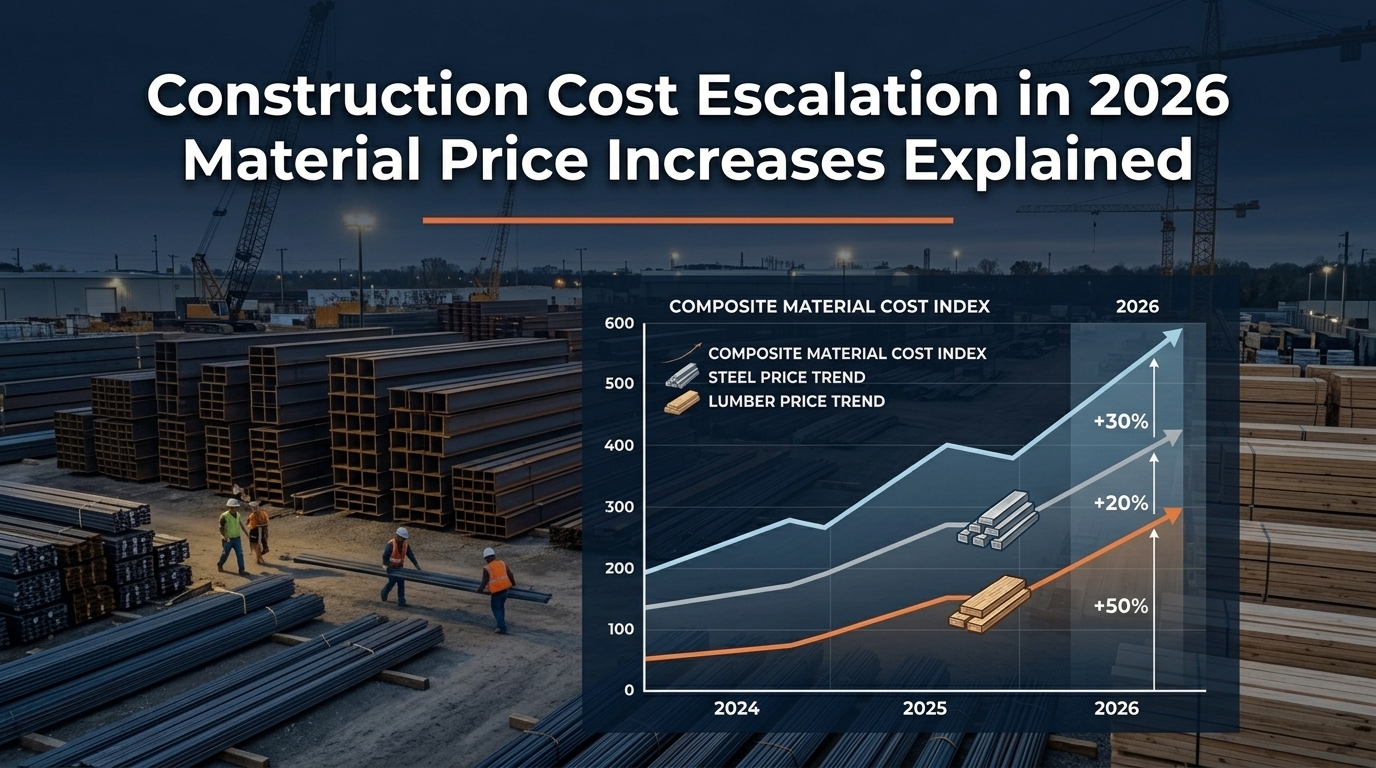
Construction estimating in 2026 is harder than it has been at any point since the supply chain chaos of 2021 and 2022. Input prices for nonresidential construction surged at a 12.6 percent annualized rate during the first two months of 2026, the fastest pace since the supply chain disruptions of early 2022. That number is not a quarterly average. That is what happened in sixty days. Outrank's Blog
The contractors getting hurt are not the ones who missed the headlines. They are the ones who submitted fixed-price bids in late 2025 and early 2026 based on pricing that evaporated before their projects broke ground. If you are bidding work today for construction starting in three to six months, you need current numbers, not year-old assumptions.
This guide covers what is actually driving cost escalation in 2026, what it means for each major material category, how to apply escalation factors to your estimates, and what contract terms protect you when prices move after bid day.
For professional construction estimates that use current regional pricing updated monthly, The Virtual Estimation serves contractors across all 50 states with 24 to 48 hour delivery. Contact us at info@thevirtualestimation.com or visit our construction estimating services page.
What Is Driving Cost Escalation in 2026
Three forces are running simultaneously and they are not canceling each other out.
Tariffs. Steel, aluminum, and copper items made entirely or mostly from those metals now carry a 50 percent tariff. Derivatives containing those metals carry 25 percent. Industrial and electrical equipment that incorporates those materials including transformers, panel boards, and conduit systems faces a 15 percent tariff. Softwood lumber carries a 10 percent tariff with derivative products at 25 percent. These rates were confirmed by the Associated General Contractors of America in April 2026 and affect every commercial project with significant structural or MEP scope.
Labor shortages. The industry needs to attract approximately 349,000 net new workers in 2026, beyond normal hiring levels, just to maintain rough equilibrium between supply and demand. That figure climbs to 456,000 in 2027. The shortage is structural, not cyclical. Labor cost escalation is no longer a contingency line item. It must be built into every bid from the start. RSMeans
Energy and geopolitical pressure. The escalating conflict in the Middle East has thrown global energy and shipping markets into chaos. Shipping container disruptions have pushed freight costs to levels not seen since the height of the pandemic. Diesel prices have been wildly unpredictable, and since heavy machinery and logistics are diesel-dependent, price swings at the pump translate directly to earthwork and sitework costs within days.
Material Category Breakdown What Is Up and By How Much
Steel
Steel is the most tariff-affected material in commercial construction. The federal government's use of Section 232 tariffs on imported steel expanded significantly in 2025 and into 2026, with rates reaching as high as 50 percent on many products.
For structural steel estimating, this means fabricated steel prices today bear no resemblance to 2024 pricing. In 2026, construction material costs are rising 5 to 50 percent across key categories with steel leading the surge. A structural steel estimate based on pricing from six months ago can understate the current cost by 20 to 30 percent on tariff-exposed tonnage.
What this means in practice: get a current mill or fabricator quote dated within 30 days before finalizing any structural steel estimate. Do not rely on RSMeans or historical data alone on steel-heavy projects. See our structural steel estimating guide for how to calculate tonnage and confirm the scope before requesting quotes.
Copper
Copper wire and cable prices rose 27.1 percent year-over-year as of February 2026, driven by booming demand from data centers and electrical grid expansion. The 50 percent tariff on copper derivatives compounds a supply imbalance that was already pushing prices higher before tariffs took effect. Tax Credit Advisor
Copper affects every electrical and plumbing estimate on your project. Copper and nickel face the strongest upward pressure in 2026 among major material categories. For electrical subcontractors, copper wire is a line item that can swing a bid from profitable to breakeven based on the date the quote was received. Tmgroupdc
The practical response is simple but must be enforced: every electrical or plumbing bid should include a copper escalation clause that allows adjustment if copper prices move more than a specified percentage between bid date and material purchase date. Most electrical contractors already do this. If you do not, start now.
Our electrical estimating guide and plumbing estimating guide cover how to calculate wire and pipe quantities accurately the starting point before any escalation adjustment.
Lumber
Lumber has been the least volatile major category in 2026 but it is not stable. As of early 2026, the national average for framing lumber sits around $872 per thousand board feet. While there was a small seasonal dip, year-over-year lumber costs are up nearly 13 percent.
Lumber prices have been relatively stable compared to metals, but that stability is not guaranteed. Softwood tariffs remain a risk factor that can push prices higher quickly. Tmgroupdc
For residential framing and commercial wood frame construction, the current year-over-year increase of 13 percent means a framing estimate from early 2025 understates current lumber cost by a meaningful amount. Any project with significant wood frame scope should use current distributor pricing rather than historical data.
Our wood framing estimating guide covers how to calculate stud counts, plate quantities, and sheathing areas accurately. Accurate quantities times current pricing is the only reliable approach in this environment.
Concrete
Imported cement prices are expected to increase by $5 to $10 per ton in 2026, with proposed 25 percent tariffs on cement from Canada and Mexico potentially triggering regional shortages in markets that depend on imported cement. Tax Credit Advisor
Ready mix prices are driven by cement cost, aggregate cost, and diesel fuel for delivery. All three are elevated in 2026. Regional price variation is significant. A concrete estimate using Houston pricing applied to a Chicago project will be materially wrong in either direction.
For concrete estimating, confirm the current ready mix price from your local supplier for each mix design specified on the project before finalizing any concrete bid. A phone call takes ten minutes and protects the estimate from regional pricing assumptions that may not hold.
Our concrete estimating guide covers volume calculations, waste factors, and mix design cost differences that apply regardless of current pricing levels.
Aluminum
Aluminum prices climbed roughly 40 percent in the United States following tariff increases, reflecting both duties and tighter inventories. Percepture
Aluminum affects glazing, curtain wall, storefront, window systems, exterior cladding, and roofing trim on commercial projects. A glazing estimate that used 2024 aluminum pricing is now significantly understated. For any project with aluminum-intensive scope, current quotes from glazing subcontractors and curtain wall manufacturers are essential before bid day.
HVAC and Mechanical Equipment
Electrical materials including copper and nickel continue to face strong demand driven by electrical work, infrastructure projects, and energy-related construction. In some cases there is limited availability of related equipment such as transformers and electrical components. Tmgroupdc
Equipment lead times have extended significantly. Transformers, switchgear, and air handling units that previously delivered in 8 to 12 weeks now carry lead times of 20 to 52 weeks on some models. An HVAC estimate based on current equipment pricing but without confirming lead time can win a bid and then delay a project by 6 months waiting for equipment that was not ordered early enough.
The HVAC estimating guide covers equipment counting and scope confirmation. On any project starting in late 2026 or 2027, equipment lead time review should happen before bid submission, not after award.
How to Apply Escalation Factors to Your Estimates
Baseline construction cost escalation in 2026 is expected to range between 4 percent and 6 percent overall, with potential for higher increases in tariff-sensitive or labor-intensive trades. RSMeans
Applying a single blanket escalation percentage to the full estimate is the lazy approach and it will be wrong in both directions simultaneously. The right method escalates each material category based on its own trend.
| Material | Recommended Escalation Factor |
|---|---|
| Structural steel | 15 to 30 percent above 2024 baseline |
| Copper wire and conduit | 20 to 30 percent above 2024 baseline |
| Aluminum systems and glazing | 25 to 40 percent above 2024 baseline |
| Lumber and framing | 10 to 15 percent above 2024 baseline |
| Ready mix concrete | 5 to 10 percent above 2024 baseline |
| HVAC equipment | 8 to 18 percent above 2024 baseline |
| General labor | 5 to 10 percent above 2024 baseline |
| Diesel and equipment fuel | 10 to 20 percent above 2024 baseline |
These are starting points. For any project with a construction start more than 90 days out, add a forward escalation factor of 0.5 to 1 percent per month from the estimate date to the expected material purchase date.
The Escalation Calculation
For a project with $500,000 of structural steel starting 6 months from bid date:
Current steel price with tariff adjustment applied: $500,000
Forward escalation at 1 percent per month for 6 months: $500,000 times 0.06 equals $30,000
Adjusted steel cost in the estimate: $530,000
Do this calculation for every tariff-sensitive material in the estimate. The total escalation allowance on a steel and MEP-heavy commercial project can easily reach $100,000 to $300,000 on a $5 million job. That is not a rounding error. It is the difference between a profitable project and one that drains your company's reserves.
Construction Contingency Must Increase in 2026
A 20 percent material cost increase can wipe out 50 to 70 percent of your profit margin. On a $2 million project, that translates to $100,000 to $150,000 in unexpected losses.
Standard contingency of 3 to 5 percent on commercial work is no longer sufficient when individual material categories are moving 20 to 40 percent in a single year. Many experienced contractors have increased their contingency to 8 to 12 percent on projects with significant tariff-exposed scope.
The contingency increase needs to be communicated to the owner during the estimate presentation, not discovered post-award. Owners who understand the current cost environment are generally willing to accept higher contingencies when the reasoning is documented clearly.
Protecting Yourself With the Right Contract Terms
In 2026, the lump sum contract is becoming a relic of the past. We are seeing a massive shift toward index-linked escalation clauses.
If you must submit a lump sum bid, these three provisions protect you against significant mid-project cost swings.
Material price validity period. State clearly in your bid that quoted material prices are valid for 30 days from bid date. After 30 days, material prices are subject to revision based on then-current supplier pricing. This is standard practice for electrical and mechanical contractors and is increasingly common in all trades.
Escalation clause. A written provision in the contract that allows price adjustment if a specified material's market price increases more than a defined threshold, typically 5 to 10 percent, between contract execution and material purchase. Tie the clause to a published index such as the producer price index for the specific material category so adjustments are objective and documented.
Owner approval for early procurement. On projects with long lead equipment, include a provision allowing you to order critical equipment immediately after contract execution and bill the owner for the deposit to lock in current pricing. This protects both parties from equipment price increases and delivery delays.
What This Means for Your Estimating Process
Construction bid accuracy depends on up-to-date material pricing. When costs are volatile, it becomes harder to estimate construction costs with confidence.
Three changes to your estimating process make a measurable difference in 2026.
First, get current supplier quotes for every tariff-sensitive material on every significant bid. Do not estimate steel, copper, or aluminum from historical data. Call your supplier, get a written quote with a validity date, and use that number.
Second, confirm equipment lead times before you submit. A competitive bid that cannot deliver the project on schedule because of a 40-week transformer lead time is not a good bid regardless of the price.
Third, consider whether your current estimating approach gives you the accuracy you need when material prices are moving this fast. The Virtual Estimation updates our regional pricing database monthly using RSMeans data and current supplier quotes. Our estimates reflect what materials and labor actually cost in your market today. For complex bids on tariff-exposed projects, working with a professional estimating service that maintains current pricing data reduces the risk of submitting a bid based on numbers that are already outdated. Visit our service areas page or email info@thevirtualestimation.com to get started.
Frequently Asked Questions
How much has construction cost escalation been in 2026?
Construction material costs rose 3.1 percent year-over-year as of February 2026, but the annualized rate during January and February alone was 12.6 percent. The overall year-over-year number understates the current pace of increase because it averages in the more stable second half of 2025. Specific categories like copper, aluminum, and steel have risen far more than the headline number suggests. Outrank's Blog
Which construction trades are most affected by 2026 cost escalation?
Cost escalation is expected to remain uneven with some trades experiencing stability while others continue to fluctuate significantly. Electrical, mechanical, and structural trades are most affected because they use the highest volumes of copper, aluminum, and steel. Civil and earthwork trades are affected through diesel and equipment fuel costs. Wood frame residential is affected through lumber tariffs but at a lower rate than metals. RSMeans
Should I add escalation to all my estimates or just future projects?
Add escalation to any project where the construction start date is more than 60 days from your bid submission date. For projects starting within 60 days, use current supplier quotes and standard contingency. For projects starting 6 to 12 months out, apply the escalation factors in this guide and include an escalation clause in your contract.
How do tariffs affect my electrical estimates specifically?
Electrical estimates are heavily impacted through copper wire and cable pricing, aluminum conduit pricing, and equipment costs for panels, transformers, and switchgear. The 50 percent tariff on copper derivatives and the 15 percent tariff on electrical equipment have pushed electrical material costs significantly above 2024 levels. Any electrical bid prepared from 2024 pricing data needs a full reprice before submission.
What is the best way to handle escalation on a public works project where lump sum bidding is required?
Public works projects typically do not allow escalation clauses in the base contract. The best approach is to obtain current material quotes with the shortest possible validity period, build an escalation contingency into your bid price explicitly in your cost buildup, and submit the bid with a written note in the qualifications section documenting the material price basis date. If the project is delayed post-award, document the material price difference and submit a change order request supported by the documented price change.