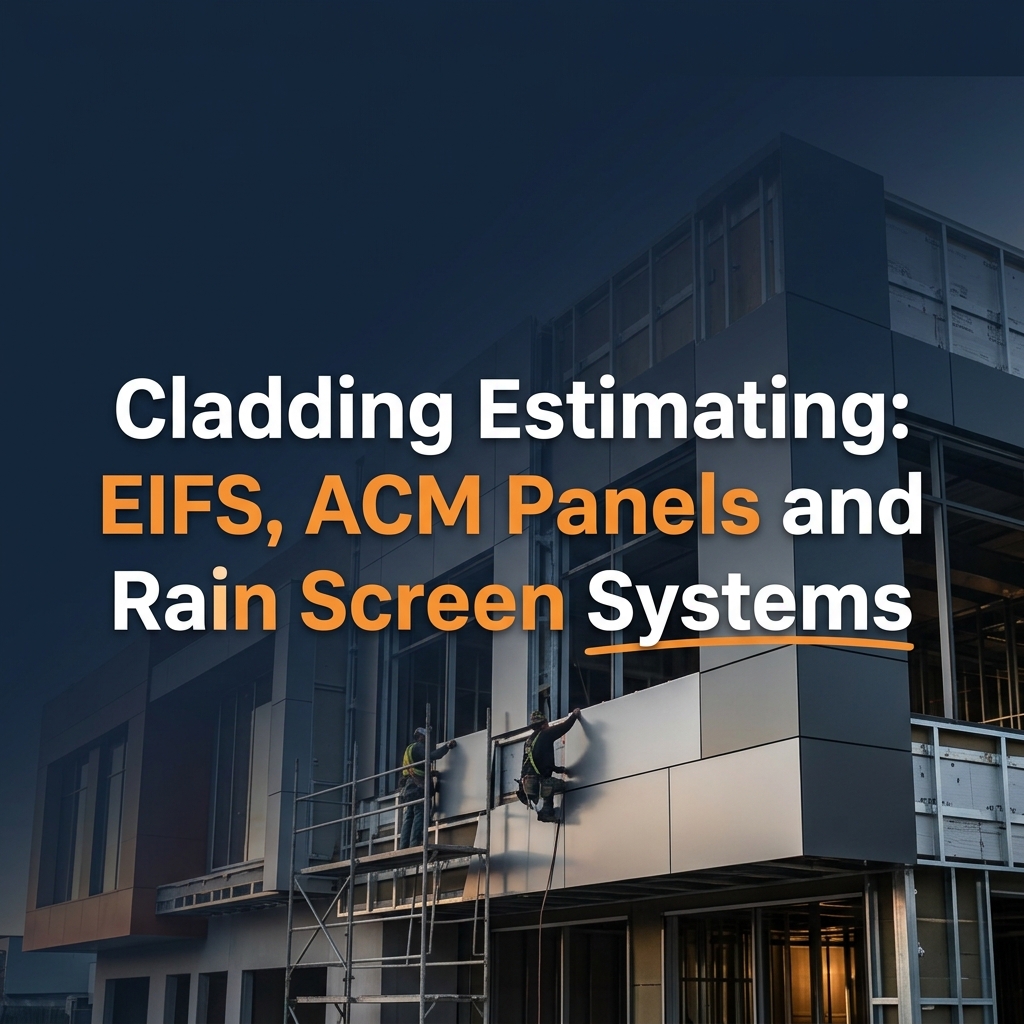
Cladding and Exterior Insulation Estimating: EIFS, ACM Panels and Rain Screen Systems
Exterior cladding sells the building before anyone steps inside it. It is also one of the trades where a small takeoff error turns into a major cost overrun, since panel layouts, attachment systems and insulation thickness all move the number in different directions.
This guide covers how to estimate the three cladding systems contractors run into most often: EIFS, aluminum composite panels and rain screen assemblies.
Why Cladding Estimates Go Off Track
Cladding pricing depends on more than wall area. Three factors cause most of the estimating mistakes on this trade.
- Pricing flat wall area without accounting for panel layout, joint patterns and waste from cuts
- Skipping the substrate, insulation and attachment system that sits behind the finish panel
- Missing trim, flashing and corner conditions that drive labor hours up fast
Breaking the system into layers, substrate, insulation, attachment and finish, gives a far more reliable number than pricing the wall as one flat rate.
Step 1: Confirm the System Type
Start by reading the wall section details and specifications, not just the elevation drawings. The wall section shows the full assembly from structure to finish.
| System Type | Common Application |
|---|---|
| EIFS, exterior insulation finish system | Commercial and residential exterior walls |
| ACM, aluminum composite panel | Mid rise and high rise commercial facades |
| Metal panel, insulated or non insulated | Industrial and commercial buildings |
| Rain screen, ventilated cavity wall | High performance commercial facades |
Each system carries a different cost structure, different waste factor and a completely different labor rate.
Step 2: Take Off EIFS Quantities
EIFS pricing depends on insulation thickness, finish texture and the amount of trim and reveal detail in the design.
| Component | Cost Per Square Foot |
|---|---|
| EPS insulation board, 2 inch | 1.50 to 2.50 dollars |
| Base coat and mesh | 1.25 to 2.00 dollars |
| Finish coat, standard texture | 1.50 to 2.75 dollars |
| Finish coat, fine texture or color upgrade | 2.00 to 3.50 dollars |
Add 8 to 12 percent waste on insulation board for cutting around openings and corners. Add 5 to 8 percent waste on finish coat material for trowel loss and texture variation.
EIFS labor runs between 0.10 and 0.18 labor hours per square foot for standard wall areas, climbing to 0.25 hours per square foot or higher on detail heavy elevations with reveals, banding and multiple texture changes.
Step 3: Take Off ACM Panel Quantities
Aluminum composite panels get priced by panel area, then adjusted for layout efficiency and attachment system.
| Component | Cost Per Square Foot |
|---|---|
| ACM panel material, standard finish | 8.00 to 14.00 dollars |
| ACM panel material, metallic or custom finish | 12.00 to 20.00 dollars |
| Sub girt and attachment clips | 2.50 to 4.50 dollars |
| Sealant and gasket system | 0.75 to 1.50 dollars |
Panel waste runs higher than most cladding systems, typically 10 to 15 percent, since panels get fabricated to fixed sizes and field cuts rarely reuse efficiently.
| Task | Labor Rate |
|---|---|
| Sub girt install | 0.20 to 0.30 labor hours per square foot |
| Panel install, flat wall | 0.25 to 0.40 labor hours per square foot |
| Panel install, complex geometry or returns | 0.45 to 0.65 labor hours per square foot |
Confirm the attachment system early. Exposed fastener systems install faster but cost more in visible hardware, while concealed clip systems take longer to install but give a cleaner finish.
Step 4: Take Off Rain Screen Assemblies
Rain screen systems add an air gap and drainage cavity behind the finish material, which adds cost but improves long term wall performance.
| Component | Cost Per Square Foot |
|---|---|
| Air and water barrier | 1.25 to 2.50 dollars |
| Continuous insulation | 1.50 to 3.50 dollars |
| Drainage cavity and furring | 1.00 to 2.00 dollars |
| Finish panel, varies by material | 6.00 to 18.00 dollars |
The finish panel cost swings the widest depending on material choice. Fiber cement, metal panel and natural stone veneer all carry different price points even on the same rain screen assembly.
Labor on rain screen systems runs higher than standard cladding because of the extra furring and cavity work.
| Task | Labor Rate |
|---|---|
| Furring and cavity install | 0.20 to 0.35 labor hours per square foot |
| Finish panel install | 0.30 to 0.50 labor hours per square foot |
Step 5: Price Trim, Flashing and Corner Conditions
Trim and flashing details rarely get priced accurately on a square footage basis. Price them separately by linear foot.
| Detail | Cost Per Linear Foot |
|---|---|
| Window head and sill flashing | 4.00 to 8.00 dollars |
| Outside corner trim | 6.00 to 12.00 dollars |
| Expansion joint cover | 8.00 to 15.00 dollars |
| Parapet cap flashing | 10.00 to 18.00 dollars |
A building with a high window to wall ratio and multiple setbacks needs significantly more linear footage of trim than a simple box shaped building with the same total square footage.
Step 6: Build in Waste and Layout Efficiency
Panel layout efficiency depends on building geometry and panel module size.
- Simple rectangular buildings run 5 to 8 percent waste on most panel systems
- Buildings with multiple offsets, bays and curves run 12 to 18 percent waste
- Custom shaped or curved panels can push waste above 20 percent
Always confirm the panel module size against the building dimensions before finalizing waste percentage. A module that does not divide evenly into the wall length creates extra cut panels at every run.
Common Mistakes to Avoid
- Pricing wall area without separating substrate, insulation and finish layers
- Underestimating waste on ACM and metal panel systems
- Missing trim, flashing and corner detail costs
- Using one labor rate across flat walls and detail heavy elevations
- Skipping the attachment system cost on rain screen and ACM systems
When to Bring in a Professional Estimator
Cladding systems carry more layers than most exterior trades, and a missed substrate or attachment detail can throw off a bid significantly on a large facade.
The Virtual Estimation builds cladding takeoffs layer by layer, pricing substrate, insulation, attachment and finish separately so contractors see exactly where the cost comes from. Turnaround runs 24 to 48 hours, with accuracy near 98 percent on every package.
For projects with both structural and cladding scope, pairing the takeoff with a lumber and wood framing estimating package keeps the wall assembly numbers consistent from substrate to finish.
Final Thoughts
Cladding is one of the most visible parts of a building and one of the easiest trades to underprice if the takeoff stops at flat square footage. Break every system into its layers, price trim and flashing separately, and confirm waste against the actual panel module before locking in the bid.
If your next project needs a detailed cladding takeoff, send the drawings to info@thevirtualestimation.com and get a free quote today. Browse more trade guides on the blog, or check service areas to confirm coverage across the US, Canada, Australia and the UK.