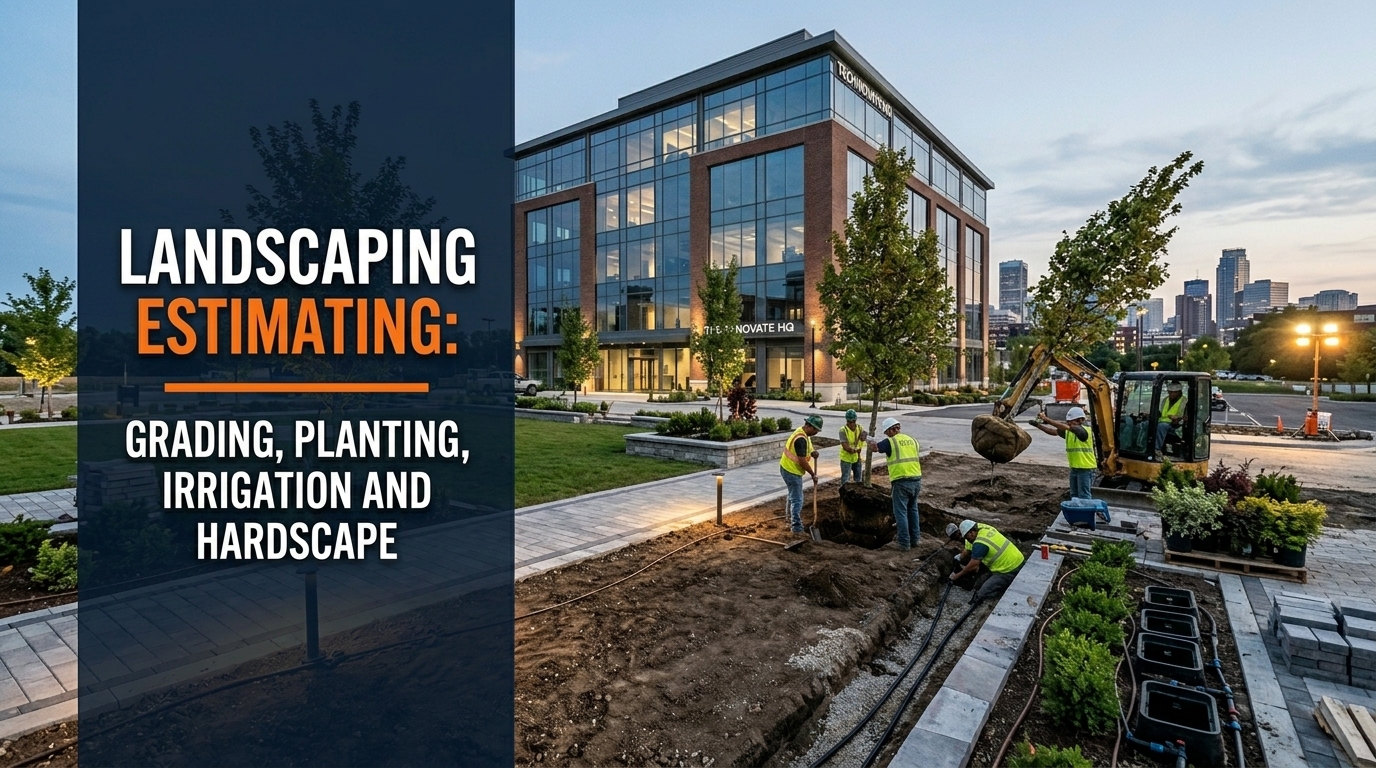
Landscaping Estimating Guide: How to Takeoff Grading, Planting, Irrigation and Hardscape
Landscaping looks like the easy scope on a job. It usually shows up last in the schedule and gets a quick rough number during early budgeting. That rough number rarely survives contact with the actual planting plan.
This guide breaks landscaping into its real cost drivers: finish grading, planting, irrigation and hardscape, with the rates contractors need to bid it accurately.
Why Landscaping Estimates Run Low
Landscaping scopes get underpriced more often than almost any other trade on a commercial site. Three reasons explain most of it.
- Pricing plant material without checking size, container type and installation labor separately
- Treating irrigation as a flat allowance instead of a zoned system takeoff
- Missing hardscape base preparation, which often costs more than the surface material itself
Breaking the scope into grading, soft scape, irrigation and hardscape gives a number that actually matches the landscape architect's planting plan.
Step 1: Take Off Finish Grading
Finish grading sets the foundation for everything that follows. It includes topsoil placement, fine grading and soil amendment before any planting begins.
| Item | Cost Range |
|---|---|
| Topsoil placement, 4 to 6 inch depth | 1.50 to 3.00 dollars per square foot |
| Soil amendment, compost or fertilizer blend | 0.50 to 1.25 dollars per square foot |
| Fine grading for planting beds | 0.40 to 0.80 dollars per square foot |
| Fine grading for sod areas | 0.30 to 0.60 dollars per square foot |
Confirm the depth of topsoil required in the specification. A jump from 4 inches to 8 inches roughly doubles the material cost on large planting areas.
Step 2: Estimate Sod and Seed Areas
Sod and seed pricing depends on grass type, area size and access conditions for delivery.
| Item | Cost Range |
|---|---|
| Sod, standard turf grass | 0.60 to 1.20 dollars per square foot |
| Sod, specialty or drought resistant variety | 1.00 to 1.80 dollars per square foot |
| Hydroseed application | 0.15 to 0.35 dollars per square foot |
| Seed and straw, standard method | 0.08 to 0.18 dollars per square foot |
Sod labor runs 0.02 to 0.04 labor hours per square foot on accessible flat areas, climbing higher on slopes or areas with limited equipment access.
Step 3: Estimate Plant Material and Installation
Planting is where the biggest cost swings happen. Size and container type drive price more than species in most cases.
| Plant Type | Size | Material Cost | Install Labor |
|---|---|---|---|
| Shrub, gallon container | 1 to 3 gallon | 12 to 35 dollars | 0.15 to 0.25 hour |
| Shrub, larger container | 5 to 7 gallon | 35 to 75 dollars | 0.25 to 0.40 hour |
| Tree, balled and burlapped | 2 to 3 inch caliper | 250 to 600 dollars | 1.5 to 2.5 hours |
| Tree, balled and burlapped | 4 to 6 inch caliper | 600 to 1500 dollars | 2.5 to 4 hours |
| Groundcover, flat or plug | Per flat | 18 to 35 dollars | 0.10 to 0.20 hour per flat |
Tree installation labor jumps significantly once caliper size increases, since larger trees need equipment, staking and more soil preparation per unit.
Always confirm plant count against the planting plan legend, not the plan graphics. Symbols on a planting plan get drawn at a fixed scale and rarely reflect true spacing once counted manually.
Step 4: Estimate Irrigation Systems
Irrigation gets priced by zone, not by total area, since head spacing and pipe runs vary by zone type.
| Component | Cost Range |
|---|---|
| Spray zone, including heads and lateral pipe | 0.40 to 0.80 dollars per square foot |
| Drip zone, planting beds | 0.50 to 1.00 dollar per square foot |
| Controller and valve assembly, per zone | 150 to 350 dollars |
| Mainline pipe install | 4.00 to 8.00 dollars per linear foot |
| Backflow preventer and point of connection | 800 to 2000 dollars per system |
A typical commercial site with mixed turf and planting bed irrigation runs between 4 and 8 zones per acre, depending on plant density and turf area.
| Task | Labor Rate |
|---|---|
| Trenching for lateral lines | 80 to 120 linear feet per hour |
| Head install and adjustment | 8 to 12 heads per hour |
| Controller wiring and programming | 3 to 5 hours per system |
Step 5: Estimate Hardscape Paving and Walls
Hardscape elements often cost more than the planting scope on the same site, especially once base preparation gets factored in.
| Item | Cost Range |
|---|---|
| Concrete paver walkway, including base | 8.00 to 16.00 dollars per square foot |
| Permeable paver system | 12.00 to 22.00 dollars per square foot |
| Segmental retaining wall, under 4 feet | 25.00 to 45.00 dollars per square foot of face |
| Decorative gravel or mulch bed | 1.50 to 3.50 dollars per square foot |
Base preparation for pavers, including compacted aggregate base, typically runs 3 to 5 dollars per square foot before the paving material goes in. Skipping this line item is one of the most common landscaping estimating mistakes.
Step 6: Price Site Furnishings and Specialty Items
Site furnishings get specified individually and priced as fixed unit costs rather than square footage.
| Item | Cost Range |
|---|---|
| Site bench | 600 to 1800 dollars per unit |
| Bike rack | 300 to 800 dollars per unit |
| Trash and recycling receptacle | 500 to 1200 dollars per unit |
| Bollard, decorative | 200 to 500 dollars per unit |
| Tree grate | 400 to 1000 dollars per unit |
Confirm footing and anchoring requirements for each furnishing item, since some sit on a simple base while others need a concrete footing poured separately.
Step 7: Apply Waste and Replacement Allowances
Landscape material carries higher waste and replacement risk than most other trades because plant material is a living product.
- Add 5 to 8 percent on sod for trim loss around curves and edges
- Add 3 to 5 percent on plant material for transplant loss, higher in extreme heat or cold climates
- Add a 1 year warranty replacement allowance on trees and shrubs, often 5 to 10 percent of material cost
Skipping the warranty replacement allowance creates a budget gap when the landscape architect requires a one year establishment period with guaranteed replacement.
Common Mistakes to Avoid
- Pricing plant material by species without confirming size and container type
- Treating irrigation as a flat per square foot allowance instead of a zone based takeoff
- Missing base preparation costs under hardscape paving
- Skipping warranty and replacement allowances on plant material
- Counting plants from plan graphics instead of the planting legend
When to Bring in a Professional Estimator
Landscaping touches grading, planting, irrigation and hardscape all in one scope, and each piece needs its own takeoff method. A missed zone on the irrigation plan or a miscounted tree caliper size adds up fast across a large site.
The Virtual Estimation builds landscaping takeoffs by breaking the scope into grading, soft scape, irrigation and hardscape, so every component gets priced with the right method and labor rate. Turnaround runs 24 to 48 hours, with accuracy near 98 percent across every package.
For sites with significant grading and drainage work ahead of planting, pairing this takeoff with an earthwork estimating package keeps the cut, fill and finish grade numbers consistent from rough grade through final landscape.
Final Thoughts
Landscaping is not a flat allowance trade. Grading, planting, irrigation and hardscape each carry their own cost drivers, and skipping any one of them leaves a gap in the bid that shows up after the crew is already on site.
If your next project needs a complete landscaping takeoff, send the drawings to info@thevirtualestimation.com and get a free quote today. Browse more trade guides on the blog, or check service areas to confirm coverage across the US, Canada, Australia and the UK.